
Restaurant QR Menu & Table-Ordering System Development in Dubai (2026): Costs, VAT & the Commission-Free Dine-In Play
What a QR menu and table-ordering system costs to build in Dubai in 2026 — real AED ranges, VAT and service-charge handling, UAE payment gateways, and the labour and turnover ROI dine-in operators miss.
- PUBLISHED
- 12 SEPT 2026
- READ TIME
- 09 MIN
- AUTHOR
- AQUARIUS · DUBAI
- UNIT
- REV 2026.09
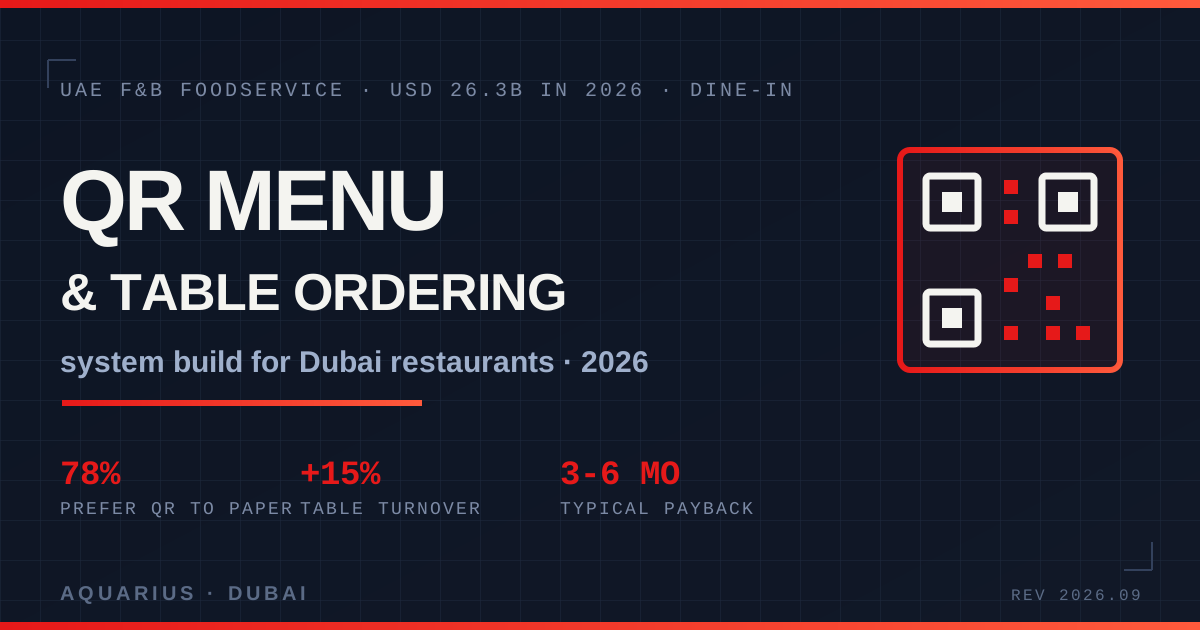
Short answer: A branded QR menu with pay-at-table for a single Dubai restaurant typically costs AED 8,000-25,000 to build in 2026; a multi-outlet system with a kitchen display, live menu management and POS sync runs AED 30,000-90,000; and a full ordering platform with loyalty, an app and analytics sits at AED 90,000-250,000+. It pays for itself two ways dine-in operators consistently underestimate: 15% higher table turnover and 15-22% lower ordering labour, on a UAE food-service market worth roughly USD 26.3 billion in 2026.
Key takeaways
- Huge, hungry market: the UAE foodservice market is around USD 26.3 billion in 2026 (up from USD 22.2B in 2025), and the UAE has 30,000+ food outlets with Dubai holding roughly 60% of them.
- Guests already want it: 78% of diners prefer QR menus to paper, and 57% of foodservice firms are raising QR investment in 2026.
- Real operating ROI: QR table-ordering lifts average check by 5-10% (8-14% with AI upsell prompts), table turnover by ~15%, and cuts ordering labour 15-22% — typical payback is 3-6 months.
- Get the bill maths right: UAE dine-in is 5% VAT, and a 10% service charge is only lawful on hotel-licensed premises per Dubai Municipality — your system must itemise these correctly on every receipt.
- Build to scope: a single-venue QR menu is AED 8-25K; a multi-outlet platform with KDS and POS sync is AED 30-90K. Scope the VAT, payment-gateway and Arabic/RTL line items before comparing quotes.
Why QR table-ordering is a 2026 opportunity in Dubai (TOFU)
The demand backdrop is exceptional. The UAE foodservice market is worth roughly USD 26.3 billion in 2026, up from about USD 22.2 billion in 2025 and growing at a high-teens CAGR. The country is home to more than 30,000 food outlets, and Dubai accounts for an estimated 60% of them — the highest restaurant density in the region, fed by a record 19.59 million international visitors in 2025 and 80.7% hotel occupancy (Dubai Department of Economy and Tourism). Dubai counted over 3,200 coffee shops and 2,600 cafeterias even back in 2022, a base still growing around 6-7% a year.
Guest behaviour has already shifted. Surveys now put 78% of diners as preferring QR menus over paper, and 57% of foodservice businesses are increasing their QR investment in 2026. What started as a COVID-era stopgap is now a standard expectation — especially among the young, phone-first, multinational crowd that fills Dubai's dining rooms. The venues still handing out laminated menus and chasing waiters for the bill are quietly losing checks and turns to the ones that let a guest scan, order, upsell themselves and pay in ninety seconds.
What a Dubai QR ordering system actually needs — features and AED ranges (MOFU)
A QR menu is not just a PDF behind a barcode. A real table-ordering system routes orders to the kitchen, itemises UAE taxes correctly, takes payment through a local gateway, and works in Arabic and English. Here is the realistic 2026 build scope and AED ranges.
| Build tier | What it includes | AED range (2026) |
|---|---|---|
| Single-venue QR menu + pay-at-table | Dynamic bilingual menu, cart, online payment, VAT receipt, waiter-call | AED 8,000-25,000 |
| Multi-outlet ordering system | Above, plus kitchen display (KDS), live menu/86-ing, table & zone mapping, POS sync, basic analytics | AED 30,000-90,000 |
| Full ordering + loyalty platform | Branded app, loyalty/CRM, AI upsell, multi-brand dashboard, deep POS/inventory integration, reporting | AED 90,000-250,000+ |
The UAE-specific line items — the ones that separate a working system from a template — are the ones operators forget to ask about:
- VAT and service-charge maths, done right. UAE dine-in carries 5% VAT. A 10% service charge is only lawful on hotel-licensed premises under Dubai Municipality rules, and where it applies, VAT is calculated on the meal plus the service charge. Your system must itemise each line and issue an FTA-compliant tax invoice with your TRN — get this wrong and you have a compliance and trust problem on every receipt. See our UAE tax-invoice and e-invoicing guide for the exact fields.
- Local payment gateways. Integrate UAE-ready rails — Network International (N-Genius), Telr, PayTabs, Tap, plus wallet options like Mamo or Apple Pay — for instant pay-at-table. Card-present tips, split bills and Apple/Google Pay all lift completion rates.
- Kitchen display + POS sync. Orders should hit a KDS or your existing POS (Foodics, Omega, Micros) directly, not a WhatsApp thread a runner retypes. This is where the 15-22% labour saving actually comes from.
- True bilingual EN/AR + RTL. A proper right-to-left Arabic menu with correct typography and currency formatting, not a translation plugin — see our Arabic/RTL best practices.
- PDPL-safe guest data. Loyalty and marketing capture personal data, so consent, retention and breach handling must follow UAE law — our PDPL compliance checklist covers the build side.
The ROI maths, running costs, and how Aquarius builds it (BOFU)
Run the numbers and the build justifies itself fast. Take a mid-size Dubai restaurant doing AED 400,000/month in dine-in sales. A conservative 7% lift in average check from self-serve upselling adds AED 28,000/month — about AED 336,000 a year. Layer on the ~15% table-turnover gain during peak service and the 15-22% cut in ordering labour (a Dubai waiter costs roughly AED 2,550/month in basic pay before service charge, and F&B operators named staff and rent costs their biggest 2025 squeeze), and a single-venue system paying for itself in 3-6 months is entirely realistic.
Budget honestly for running costs too. Plan on 15-20% of the build cost per year for maintenance, updates, security and support — the same ratio that applies across website and app maintenance in Dubai — plus hosting, per-transaction gateway fees, and any SaaS menu/KDS licences. Off-the-shelf SaaS (per-table or per-order fees) can look cheaper on day one but bleeds margin at Dubai volumes and rarely bends to your brand, your loyalty logic or your POS — which is exactly the build-versus-buy trade-off worth scoping before you commit.
That's how we approach it at Aquarius: the UAE layer — correct VAT and service-charge itemisation, the right local payment gateway, KDS/POS sync and a real Arabic/RTL experience — is designed in from sprint one, not bolted on after launch when retrofitting costs several times more. We start most operators on a single-venue QR-menu MVP to prove the check-size and turnover lift, then extend to multi-outlet, loyalty and an app as the numbers land. See our development services and pricing, or tell us your outlet count and average cover and we'll model the payback for your restaurant.
Frequently asked questions
How much does a QR menu ordering system cost in Dubai in 2026?
A branded single-venue QR menu with pay-at-table and VAT receipts typically costs AED 8,000-25,000. A multi-outlet system with a kitchen display, live menu management and POS sync runs AED 30,000-90,000, and a full ordering-plus-loyalty platform with an app and analytics sits at AED 90,000-250,000+.
Should I build custom or use an off-the-shelf QR ordering app?
Start SaaS if you want to test the concept in one venue this week; build custom once you run multiple outlets, want your own branding and loyalty logic, or need deep POS and inventory integration. At Dubai dine-in volumes, per-order SaaS fees often exceed the annual cost of a custom system within a year or two, and you never own the guest data.
How does the system handle VAT and the service charge on a Dubai bill?
UAE dine-in carries 5% VAT, and a 10% service charge is only lawful on hotel-licensed premises under Dubai Municipality rules. Where the service charge applies, VAT is calculated on the meal plus the service charge. A compliant system itemises each line and issues an FTA tax invoice showing your TRN and the 5% VAT amount.
Which payment gateway works for pay-at-table in the UAE?
Use a UAE-licensed gateway — Network International (N-Genius), Telr, PayTabs or Tap — with Apple Pay and Google Pay enabled for fast checkout, plus split-bill and tipping. Shopify Payments still isn't available in the UAE, so avoid stacks that depend on it.
Does QR ordering really increase revenue, or just cut costs?
Both. Self-serve ordering lifts average check 5-10% (8-14% with AI upsell prompts) because guests browse without waiting, and roughly 15% more table turns during peak service means more covers per shift. Combined with a 15-22% reduction in ordering labour, most venues report payback within three to six months.
The bottom line: with a USD 26.3 billion foodservice market, 30,000+ outlets and 78% of diners already preferring to scan, a QR menu and table-ordering system is one of the clearest ROI plays a Dubai restaurant can make in 2026. Scope it to the tier you actually need, insist that VAT/service-charge itemisation, the right local gateway and Arabic/RTL are built in from day one, and you turn slow service and manual ordering into margin you keep.