
Restaurant Reservation & Table Management System Development in Dubai (2026): SevenRooms vs Eat App vs OpenTable vs Custom
Deposits cut Dubai no-shows from 2.47% to 0.80%. Compare SevenRooms, Eat App, OpenTable, Resy and a custom reservation build with 2026 AED costs and payback maths.
- PUBLISHED
- 11 NOV 2026
- READ TIME
- 11 MIN
- AUTHOR
- AQUARIUS · DUBAI
- UNIT
- REV 2026.09
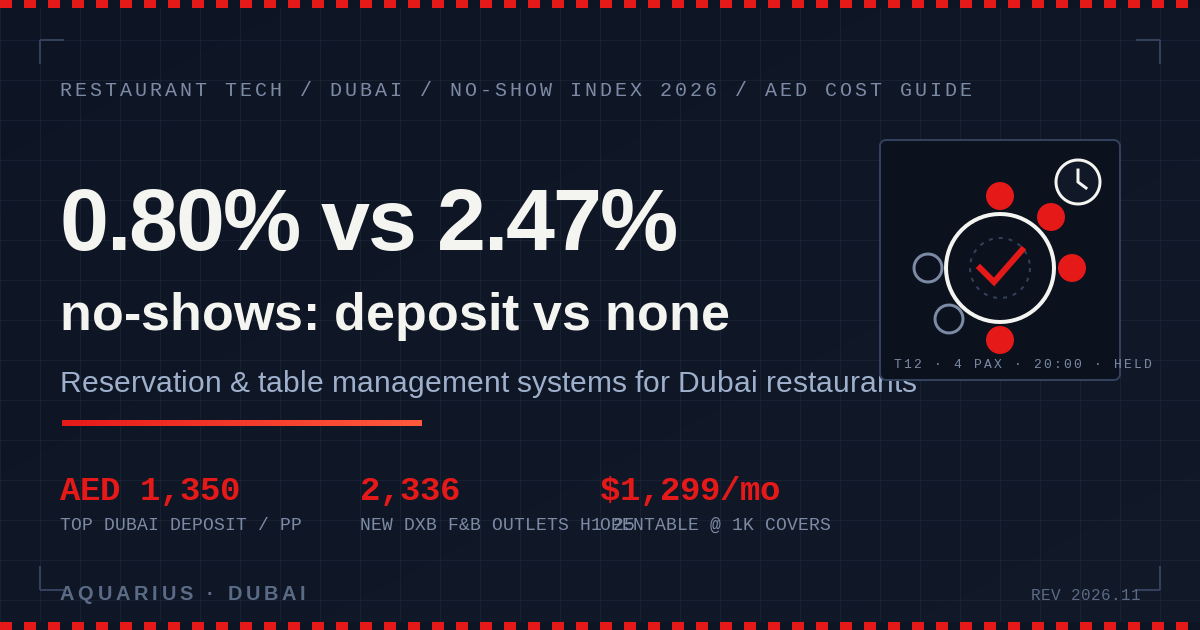
Short answer: a Dubai restaurant doing 1,000 covers a month through OpenTable’s network pays roughly $1,299 (about AED 4,770) in that month, while Resy charges a flat $249 and Dubai-born Eat App tops out at $389 for its Pro plan with no per-cover fee. A custom reservation and table-management build costs AED 70,000–160,000 once and removes the per-cover tax entirely, which pays back inside 18–30 months for venues above roughly 2,500 covers a month. The bigger win is not the licence fee: venues that take a deposit or card hold saw a 0.80% no-show rate in 2026 against 2.47% for venues that did not.
That last number is the one to pin above the host stand. On a 120-cover Friday night at an AED 350 average spend, the gap between 2.47% and 0.80% is two tables and roughly AED 2,300 in revenue, every single Friday.
Why Dubai restaurants are rebuilding the front door in 2026
Dubai has never had more tables competing for the same diner. Dubai Municipality recorded 2,336 new food establishments opening in the first half of 2025 alone, backed by 34,700 food-safety inspection visits in the same six months. Mordor Intelligence sizes the UAE full-service restaurant market at USD 11.26 billion in 2026, heading to USD 25.97 billion by 2031 at an 18.19% compound rate, and notes UAE residents dined out an average of 2.5 times a week in 2024.
Demand is there. Dubai welcomed 19.59 million international visitors in 2025, with hotel occupancy at 80.7%, and the Michelin Guide Dubai 2026 edition, unveiled in October 2026 at Atlantis The Royal, now lists 122 restaurants across 38 cuisines with 20 starred venues, including two three-star kitchens in Trèsind Studio and FZN.
The problem is friction between that demand and the table. Resos’ No-Show Index 2026, built on 3.77 million reservations across 2,417 restaurants between August 2025 and July 2026, puts the average no-show rate at 2.33% and finds that 56% of the 566,049 cancellations it tracked arrived inside 24 hours of the booking or after it had already started. Bloom Intelligence’s US data since January 2025 is uglier: 3.7% no-shows plus 15% cancellations. For a Dubai fine-dining room at AED 600–1,000 a head, each empty seat is a loss the kitchen has already paid for in prep and labour, which typically runs 25–30% of revenue.
What a reservation and table-management system actually does
“Booking widget” undersells it. A 2026 system for a Dubai venue has six moving parts, and the gaps between them are where no-shows and double-bookings live.
1. Booking channels
Your own website, Google’s Reserve with Google button, Instagram profile link, WhatsApp, and marketplace channels. Deliveroo UAE launched in-app Deliveroo Reservations in Dubai on 4 June 2026, powered by SevenRooms, so a third delivery and discovery app now pushes bookings into the same floor plan as Zomato UAE and Google. Every channel must write to one availability engine or the host gets two parties for table 12 at eight o’clock.
2. Floor plan and pacing
Live table map, turn times per party size, kitchen pacing caps (so the pass never gets 14 tables in a 10-minute window), and shift templates for brunch versus dinner. This is the layer that turns a booking list into covers you can actually serve.
3. Deposits, card holds and cancellation policy
Dubai’s top rooms already enforce this hard. Trèsind Studio takes AED 1,350 per person in advance, fully refundable up to 48 hours before dinner and non-refundable after that. Row on 45 holds AED 500 per person with free amendment or cancellation at 48 hours or more. Stay by Yannick Alléno has quoted AED 500 per head and L’Olivo at Al Mahara AED 250. Mid-market Dubai venues have charged no-show fees for years: Zuma’s long-standing policy was AED 300 per person for no-shows and AED 120 for late cancellation on parties of seven or more, while LPM held AED 200 per person on tables of four and up.
4. Guest CRM
Visit history, allergies, spend, tags like “VIP” or “Emaar corporate”, birthdays, and the no-show count that decides whether this guest gets a card hold next time. Under the UAE Personal Data Protection Law (Federal Decree-Law 45 of 2021) this is personal data, so consent, retention and access-request handling need to be designed in, not bolted on. Our UAE PDPL checklist for websites and apps covers the specifics.
5. Reminders and waitlist
WhatsApp is the only channel that reliably reaches a Dubai diner; roughly 85.8% of UAE social media users are on it. Resos found venues sending an SMS reminder saw a 16% lower no-show rate than those that did not, and WhatsApp open rates run higher than SMS in the Gulf. Waitlist with a “your table is ready” ping turns the dropped 2.47% into a served walk-in.
6. Reporting and integrations
POS sync so spend lands on the guest profile, payments for deposits and prepaid menus, accounting export for the 5% VAT on no-show fees, and a data warehouse feed for multi-venue groups.
SevenRooms vs Eat App vs OpenTable vs Resy vs custom: 2026 cost comparison
Prices below are 2026 list prices in USD as published or widely quoted, converted at the pegged 3.6725 AED. SevenRooms does not publish pricing; the range is what single-venue Dubai operators report being quoted.
| Platform | Monthly fee | Per-cover fees | Dubai relevance | Approx. AED / month at 1,000 covers |
|---|---|---|---|---|
| Eat App (Dubai HQ) | Free / $99 Lite / $199 Core / $389 Pro (annual: $69 / $159 / $299) | None | Founded in Dubai 2015; 50+ Emaar Hospitality venues; $10m Series B extension Jan 2026; WhatsApp credits bundled | AED 0–1,430 |
| SevenRooms | Quote only; ~$499 entry, $500–2,000+ typical per venue | None; WhatsApp add-on ~$100 | Powers Deliveroo Reservations and Zomato UAE sync; used by Zuma, LPM, CE LA VI, At.mosphere | AED 1,830–7,350+ |
| OpenTable | $149 Basic / $299 Core / $499 Pro | $1.50 Basic or $1.00 Core/Pro per network cover; $0.25 per web cover on Basic; 2% on deposits | Strong with tourists booking from the US and UK before arrival | AED 4,770 (Core) to AED 5,500 (Pro) |
| Resy | From $249 flat | None | Amex-owned; smaller UAE venue footprint | AED 915 |
| Custom build (Aquarius) | AED 2,500–8,000 run cost (hosting, WhatsApp, support) | None, ever | Owns guest data, Reserve with Google + WhatsApp + POS native; one-off AED 70k–160k | AED 2,500–8,000 |
Two things jump out. First, the per-cover model is the trap: OpenTable Core at 1,000 network covers is $1,299 a month, more than five times Resy, and the fee scales with your success. Second, the Dubai market has a credible local SaaS in Eat App, which is why “build versus buy” here is really “build versus Eat App or SevenRooms”, not versus a US-centric tool.
When SaaS wins
- Single venue under roughly 2,000 covers a month. Eat App Core at $199 covers you and the payback maths on a custom build never closes.
- You need the discovery traffic. Deliveroo Reservations, Zomato and OpenTable’s tourist audience only flow through their partnered engines.
- You have no technical owner in the business. SaaS uptime and support is someone else’s 2 a.m. problem.
When custom wins
- Multi-venue groups. Three Dubai venues on SevenRooms at $800 each is AED 105,000 a year; a shared platform with one guest database costs that once.
- Deposit-heavy models. Tasting menus, brunch packages and events where you want prepaid menus, split payments, gift cards and loyalty in one flow without a 2% deposit fee.
- Data ownership. Guest spend, visit frequency and no-show history are the most valuable asset a restaurant group owns. On rented SaaS it leaves when you do.
- Hybrid operations. If you already run a QR menu and table-ordering system or your own direct ordering app, reservations belong in the same guest record, not a fourth dashboard.
How Dubai no-show economics actually work
Resos’ 2026 dataset gives the clearest picture of where tables are lost, and the patterns transfer directly to Dubai’s dinner-heavy, tourist-heavy trade:
| Factor | No-show rate | What it means for a Dubai venue |
|---|---|---|
| Deposit or card hold taken | 0.80% | Single biggest lever; mirrors what Trèsind Studio and Row on 45 already do |
| No deposit | 2.47% | Three times the loss rate |
| Dinner vs lunch | 2.63% vs 1.84% | Apply holds to dinner first; leave lunch frictionless |
| Party of 1–2 vs 10+ | 2.63% vs 1.15% | Big groups show up; small parties ghost. Do not only hold cards for 6+ |
| Booked 2–6 days ahead | 2.67% (worst) | Reminder at 48h and 3h, both via WhatsApp |
| Monday vs Wednesday | 2.69% vs 2.09% | Monday needs tighter pacing, not more tables |
| SMS reminder sent | 16% lower rate | Cheapest fix available; automate it |
Deposits carry a tax wrinkle in the UAE. A no-show or late-cancellation fee is generally treated as consideration for making the table available, so it attracts 5% VAT and must be reported in the period the no-show occurs, not when the booking was taken. Your system should raise a tax invoice for retained deposits automatically. Check the treatment with your tax adviser; the Federal Tax Authority has not issued a restaurant-specific public clarification.
Take payments through a UAE-licensed gateway with card-hold (pre-authorisation) support. We compared the three Dubai mainstays in Tap vs PayTabs vs Stripe for UAE payments; for deposits specifically, look at pre-auth hold duration and the fee charged on a released hold.
What a custom reservation system costs in Dubai in 2026
These are Aquarius quote ranges from Dubai restaurant and hospitality builds. Treat them as planning bands, not fixed prices; a discovery call narrows them.
| Scope | What you get | One-off (AED) | Timeline |
|---|---|---|---|
| Booking widget + deposits | Website and Instagram booking flow, Reserve with Google, card hold or deposit via Tap/PayTabs, WhatsApp confirmations and reminders, admin calendar | 25,000–60,000 | 4–6 weeks |
| Full reservation + table management + guest CRM | Everything above plus live floor plan, pacing rules, waitlist, guest profiles with spend and no-show history, POS integration, VAT invoicing on retained fees, PDPL consent and access-request tooling | 70,000–160,000 | 10–16 weeks |
| Multi-venue group platform | Shared guest database across venues, group-level reporting, loyalty and gift cards, prepaid tasting menus and brunch packages, marketplace channel sync, role-based access for GMs and head office | 150,000–320,000 | 16–26 weeks |
| Run cost (any tier) | UAE-region hosting, WhatsApp Business API conversation fees, payment gateway fees, monitoring, support SLA | 2,500–8,000 / month | Ongoing |
Payback example
A three-venue Dubai group seating 2,500 covers a month per venue at an AED 320 average spend. On SevenRooms at a mid-range $900 per venue the group pays about AED 119,000 a year in licences. A AED 180,000 group platform with AED 5,000 a month run cost recovers its build in roughly 30 months on licence savings alone. Add the no-show effect: moving from 2.47% to 0.80% on 7,500 covers at AED 320 recovers about AED 40,000 a month in previously empty seats. Counting both, payback lands inside the first year.
How Aquarius builds it
We are a Dubai software studio, so the stack starts from what works here rather than what works in Manhattan.
- WhatsApp first. Confirmations, reminders, waitlist pings and deposit links go out over the WhatsApp Business API, with SMS as fallback. See how we wire it in our WhatsApp Business API integration guide for Dubai.
- Reserve with Google and marketplace sync. Google’s booking button on your Business Profile feeds the same availability engine as your site. Where a marketplace exposes an API, we sync; where it does not, we build a host-side import so you never run two books.
- Deposits done properly. Pre-auth holds that release automatically on arrival, tiered deposit rules by party size and daypart, automatic 5% VAT invoices on retained fees, and a 48-hour free-cancellation default modelled on Dubai’s top rooms.
- PDPL by design. Consent capture at booking, retention schedules, one-click export and erasure for guest data requests.
- Your data, your cloud. UAE-region hosting, nightly exports you own, and a clean API so your next POS, loyalty or BI tool plugs in without a migration project.
Risk reversal: we start every reservation project with a fixed-price two-week discovery sprint that delivers the floor-plan model, deposit rules, integration map and a line-item quote. If you decide to stay on SaaS afterwards, you keep the documents and we part as friends. Current bands are on our pricing page; the full hospitality service list is under services.
Most Dubai restaurants treat the reservation tool as a line item. The ones growing in 2026 treat it as the guest database their whole group runs on.
FAQ: restaurant reservation systems in Dubai
Can a Dubai restaurant legally charge a no-show fee?
Yes. Dubai venues from LPM and Zuma to Trèsind Studio have enforced published no-show and late-cancellation charges for years. The policy must be clearly disclosed before the card hold or deposit is taken, the fee should be proportionate to the booking, and retained fees are subject to 5% VAT. Keep the consent record attached to the booking.
How much deposit do Dubai restaurants take per person?
It scales with the ticket. Published 2025–2026 figures range from AED 250 per person at L’Olivo at Al Mahara and AED 500 at Row on 45 and Stay by Yannick Alléno, up to AED 1,350 per person at Trèsind Studio. Casual and mid-market venues more commonly use a card hold with a AED 100–300 per-person no-show charge rather than an upfront payment.
Is Eat App or SevenRooms better for a Dubai restaurant?
Eat App is cheaper, Dubai-based and bundles WhatsApp messaging, so it suits independents and small groups at $99–389 a month. SevenRooms costs several times more but powers Deliveroo Reservations and the Zomato UAE channel and is the incumbent at Dubai’s big-name rooms. Above three venues, or if you want to own guest data outright, a custom platform usually beats both on five-year cost.
How long does a custom reservation system take to build in Dubai?
A booking widget with deposits ships in 4–6 weeks. A full reservation, floor-plan and guest-CRM platform takes 10–16 weeks. Multi-venue group platforms with loyalty and prepaid menus run 16–26 weeks. Launch before Dubai’s October–April peak needs a kick-off by June.
Do deposits really reduce no-shows?
The 2026 Resos index of 3.77 million bookings shows venues taking a deposit or card hold at a 0.80% no-show rate versus 2.47% without. The data is descriptive rather than a controlled experiment, so part of the gap reflects the type of venue that asks for a hold, but the direction is consistent with every operator survey, and an automated reminder alone cut no-shows by 16%.
Figures cited are from Dubai Municipality, Mordor Intelligence, the Resos No-Show Index 2026, Bloom Intelligence, Michelin Guide, published venue reservation policies and vendor pricing pages as of November 2026. SaaS prices are USD list prices converted at AED 3.6725 and may change. Aquarius cost bands are indicative quote ranges, not fixed offers.