
Robo-Advisory Platform Development in Dubai (2027): Licence Routes, Algorithm Rules and Real AED Costs
Sarwa crossed USD 1bn in client assets in May 2026 and the CMA has run federal robo-advisory rules on the mainland since January. The real licence routes, algorithm duties and AED build costs in Dubai.
- PUBLISHED
- 25 NOV 2026
- READ TIME
- 13 MIN
- AUTHOR
- AQUARIUS · DUBAI
- UNIT
- REV 2026.09
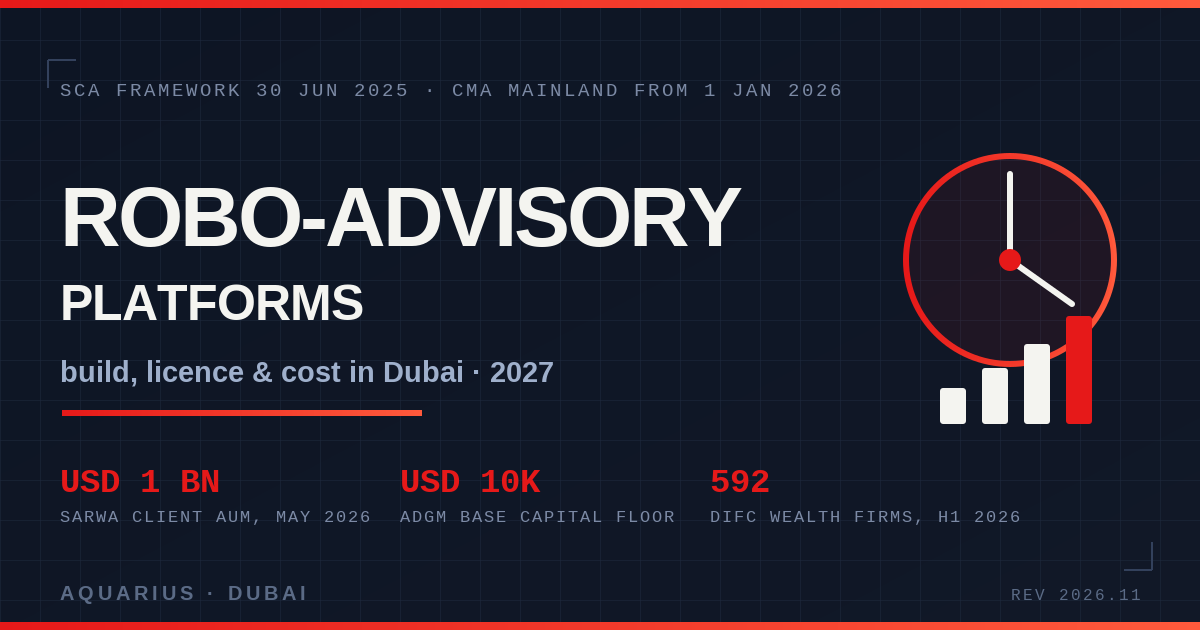
Short answer: a robo-advisory platform can now be offered to mainland UAE clients, but only on top of a portfolio management licence — the Securities and Commodities Authority approved the federal framework on 30 June 2025 and the Capital Market Authority has applied it on the mainland since 1 January 2026. In DIFC and ADGM the route is older and cheaper: ADGM sets base capital at USD 10,000 if you stick to passive products, rebalancing only and no client assets, versus USD 250,000 for a normal discretionary manager. The software itself costs roughly AED 90,000–180,000 for a compliant onboarding and model-portfolio front end, AED 180,000–400,000 once a discretionary rebalancing engine and custodian integration are in, and AED 400,000–900,000 for a full platform with KYC/AML, reporting and an auditable algorithm trail.
Most firms in Dubai get the order wrong. They build the app, then discover the licence they hold does not permit discretionary management, or that their rebalancing logic cannot be explained to a regulator line by line. The licence shapes the software. Read this before you write a sprint plan.
Why the window opened in Dubai now (awareness)
Three numbers explain the rush. First, a homegrown platform proved the unit economics: Sarwa crossed USD 1 billion in client assets in May 2026, the first UAE-built fintech to do it, up from USD 879.7 million at the end of Q4 2025 — growth of roughly 14% in two quarters on an ADGM licence, not a bank balance sheet.
Second, the money is already here and still arriving. DIFC passed 10,018 active registered companies in H1 2026, organic growth of 30% in twelve months, including 592 wealth and asset management firms and an Innovation Hub that reached 1,933 AI, FinTech and innovation businesses, up 39% year on year. Henley & Partners scored the UAE 85.3 out of 100 on its 2026 wealth mobility framework and recorded a 41% increase in enquiries from UAE-based individuals between Q4 2025 and Q1 2026.
Third, the clients want an algorithm. BridgeWise surveyed 2,100 investors across 19 countries for its State of AI for Wealth in 2026 report: 78.3% already use AI in investment decisions, 65.1% expect to replace traditional research within a year, and the UAE ranked second overall and first globally on momentum — the strongest stated intent anywhere to switch. Frequent use runs at 57.8% among investors aged 18–35 against 26.9% among the over-50s.
Most Dubai firms get this wrong: they treat robo-advisory as a cheaper distribution channel for the same advisory licence they already hold. It is a different regulated activity with its own algorithm governance obligations, and the regulator will ask to see the model, not the marketing.
What the regulator actually requires (consideration)
There are three separate regimes in one country, and a Dubai business can legitimately sit in any of them. The choice drives capital, client eligibility and roughly a third of the build cost.
Mainland: the CMA route
The SCA framework approved on 30 June 2025 restricts robo-advisory to firms already licensed for portfolio management, whether discretionary or non-discretionary, and attaches governance conditions: independent IT audits, cybersecurity controls, regular reviews of the investment algorithm, and transparent disclosure of fees and risks. Since 1 January 2026 the Capital Market Authority has administered it — Federal Decree-Law No. 32 of 2025 replaced the SCA with the CMA, and No. 33 of 2025 codified the financial activities licensing regime. Note the perimeter is widening, not narrowing: former SCA Resolution No. 10 of 2025 pulled finfluencers and social-media financial content into licensing scope too.
DIFC: the DFSA route
Advising on financial products in DIFC needs a Category 4 licence and a Financial Services Permission, plus a retail endorsement if you intend to serve retail clients rather than professional ones only. This is the most common route for a Dubai-domiciled consumer product: StashAway Management (DIFC) Limited operates under DFSA licence F006312.
ADGM: the cheapest honest entry
ADGM published dedicated Supplementary Guidance for digital investment management on 22 July 2019 and it is still the most build-friendly regime in the country. Base capital is USD 250,000 for a Category 3C investment manager, but drops to USD 10,000 if three conditions all hold: the product menu is limited to passive, liquid instruments; investment management is restricted to portfolio rebalancing; and you do not hold client assets. The guidance also sets the algorithm bar that every regime now echoes — human oversight of the design, performance and security of the model, protection against behavioural bias, safeguards on model integrity, and outcomes that are explainable, traceable and repeatable.
That last phrase is the single most expensive sentence in UAE robo-advisory. It means every allocation your engine produced must be reconstructable months later from the inputs that existed at the time — which is an engineering requirement, not a compliance document.
What the incumbents charge
Your pricing has to survive next to these. All figures are published annual management fees, exclusive of the underlying ETF expense ratio.
| Platform | Regulator | Annual management fee | Entry point |
|---|---|---|---|
| StashAway | DFSA (DIFC), licence F006312 | 0.8% on the first USD 25,000, tiering down to 0.2% above USD 1m | No minimum; 0.29% AED conversion fee |
| Sarwa Invest | FSRA (ADGM), Category 3C | 0.4%–0.85%, minimum USD 7 per month | USD 500 on the Trade account |
| Derayah Smart (regional benchmark) | Saudi CMA | 0.65% | Regional comparator, not UAE-licensed |
Read the tiering carefully. On an AED 5,000,000 portfolio, 0.85% is AED 42,500 a year and 0.20% is AED 10,000 — a AED 32,500 annual gap on one client. If your platform cannot tier, you are competing on a promise you cannot keep.
What you are actually building
A robo-advisory platform is eight systems that happen to share a login. Scoping it as one app is why projects in Dubai overrun.
- Risk profiling and suitability. The questionnaire is a regulated artefact, versioned, with the scoring logic and every answer retained for the audit trail.
- Onboarding, KYC and AML screening. Emirates ID and passport capture, UAE Pass where available, sanctions and PEP screening, source-of-funds capture.
- Model portfolio engine. Target allocations per risk band, with a halal-screened variant — non-negotiable in this market.
- Rebalancing and order generation. Drift thresholds, cash buffers, fractional handling, and a decision log per run.
- Broker and custodian integration. Execution venue, independent custody, reconciliation. If you hold nothing, ADGM capital stays at USD 10,000.
- Fee calculation and billing. Tiered basis points, minimum monthly fees, 5% VAT treatment, AED conversion disclosure.
- Reporting. Client statements, performance, and the regulatory reporting your licence specifies.
- Algorithm governance tooling. Model version registry, change approvals, replay of any past allocation, and the review cadence the framework demands.
Numbers nine and ten are not software: the independent IT audit and the data obligations. Personal financial data puts you squarely inside UAE data protection duties — see our UAE PDPL compliance checklist for websites and apps before you choose a hosting region.
What it costs in AED, and when it pays back (decision)
These are our build ranges for a UAE-facing platform, excluding licence, capital and ongoing audit fees.
| Scope | AED range | What you get |
|---|---|---|
| Non-discretionary advisory front end | 90,000–180,000 | Risk profiling, suitability logic, model portfolios, disclosures, client dashboard |
| Discretionary platform | 180,000–400,000 | The above plus rebalancing engine, order generation, broker and custodian integration, fee billing |
| Full regulated platform | 400,000–900,000 | Plus KYC/AML orchestration, reporting suite, algorithm version registry and replayable audit trail, admin back office |
| Annual run and compliance support | 60,000–160,000 | Hosting, monitoring, algorithm review support, independent IT audit remediation |
Now the arithmetic that decides whether to start. At a blended 0.60% management fee, a platform needs AED 75 million of assets under management to generate AED 450,000 of annual revenue — one year of fees covering the mid-case full build. Cross AED 167 million and the same fee produces AED 1 million a year. Sarwa reached USD 1 billion, roughly AED 3.67 billion, in under a decade; at 0.4%–0.85% that book is worth something in the order of USD 4–8.5 million of annual fee revenue. The cost of inaction is not the build price. It is the AED 32,500 per large client per year that a tiering competitor can undercut you by while you still quote a flat fee.
How Aquarius builds it
We build the audit trail first and the app second, because that is the order a regulator reads it in. Practically: a versioned suitability model and decision log on day one, every allocation replayable from stored inputs, the rebalancing engine isolated behind a tested interface so a model change never silently rewrites history, and the disclosure screens drafted against your actual licence wording rather than a template. We have built regulated financial products in this market before — see our work on fintech app development under DIFC and ADGM regulation and stock trading app development under the CMA licence. If your clients are families rather than retail, the family office software route is often the better build.
Fixed scope, fixed AED price, published pricing, and a phase-one that is deliberately small enough to put in front of your compliance officer before the expensive half starts. Full capability list on our services page.
FAQ
Can I launch a robo-advisor in the UAE without a portfolio management licence?
No. The federal framework approved on 30 June 2025 limits robo-advisory to firms already licensed for portfolio management, and since 1 January 2026 the CMA applies it on the mainland. Generating tailored portfolio recommendations is regulated investment advice whether or not a human is involved, and unlicensed advice exposes the firm to administrative penalties, cessation orders and potential criminal liability.
Is DIFC, ADGM or mainland cheapest to start in?
On capital, ADGM: base capital is USD 10,000 if you offer only passive liquid products, limit management to rebalancing, and never hold client assets — against USD 250,000 for a standard Category 3C manager. DIFC requires a Category 4 licence with a retail endorsement to serve retail clients. Mainland reaches the largest onshore client base but presumes you already hold the portfolio management licence.
What does the algorithm governance requirement mean in code?
Human oversight of model design, performance and security; protection against behavioural bias; safeguards on model integrity; and outcomes that are explainable, traceable and repeatable. In engineering terms: version every model, store the inputs alongside the output, and be able to replay any historical allocation exactly. Retrofitting this is usually the single largest unplanned cost in a UAE robo build.
Do I need a halal portfolio option?
Commercially, yes. Every significant UAE and GCC platform ships a Shariah-screened variant, and treating it as a later phase means rebuilding the model engine rather than adding a configuration.
How long does a first version take?
A non-discretionary advisory front end is typically 8–12 weeks. A discretionary platform with rebalancing, custodian integration and a replayable audit trail is 4–7 months, and the independent IT audit plus licence interaction normally runs in parallel rather than after.
If you are weighing this up, the useful first step is small. Tell us which regime you hold or are applying for and the asset classes you intend to offer, and we will send back the regime comparison, the audit-trail requirements your build has to satisfy, and a fixed AED price for phase one. Talk to Aquarius and ask for the robo-advisory checklist with it.