
Stock Trading App Development in Dubai 2026: CMA Licence, Cost and Compliance
SCA became the CMA on 1 January 2026. What a UAE-facing stock trading app now costs to build in AED, which licence route fits, and the AED 250m penalty for getting it wrong.
- PUBLISHED
- 29 SEPT 2026
- READ TIME
- 12 MIN
- AUTHOR
- AQUARIUS · DUBAI
- UNIT
- REV 2026.09
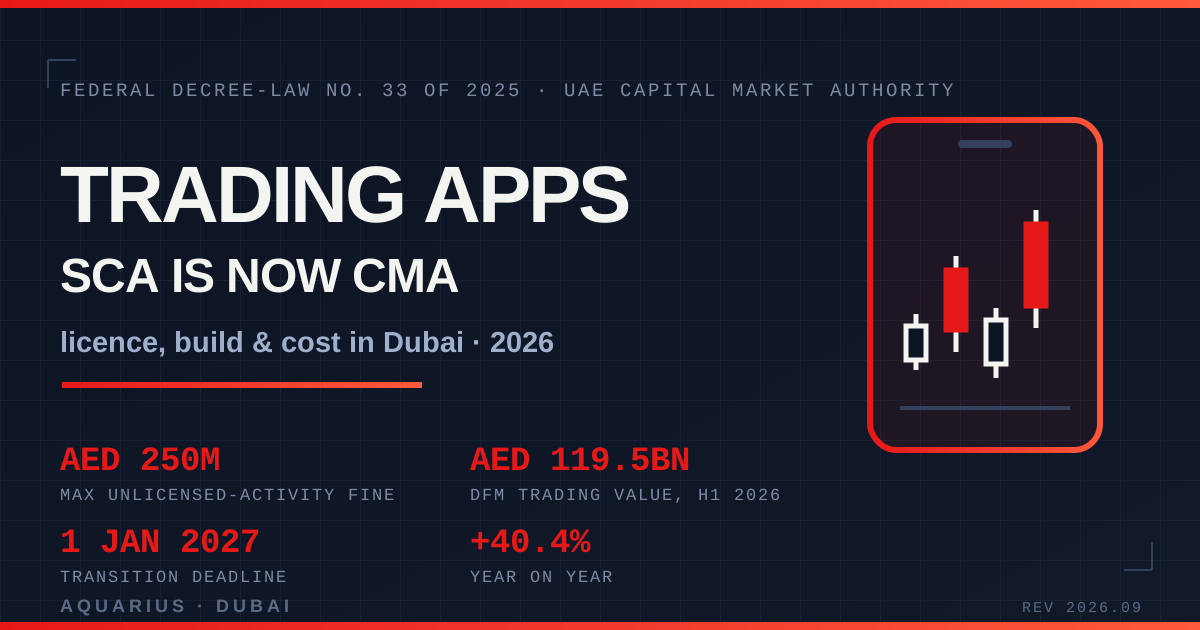
Short answer: building a stock trading app in Dubai in 2026 is roughly AED 260,000 to AED 900,000 of software — and a far bigger regulatory bill on top. The regulator most founders still Google no longer exists: on 1 January 2026 the Securities and Commodities Authority was reconstituted as the Capital Market Authority (CMA) under Federal Decree-Law No. 32 of 2025, with the substantive regime in Federal Decree-Law No. 33 of 2025 and a one-year transition ending 1 January 2027. Offering securities to UAE residents without a CMA licence now carries fines of up to AED 250 million and imprisonment of not less than one year — and the CMA has already blocked websites to enforce it.
Key takeaways
- The regulator changed, not just the logo. SCA became the CMA on 1 January 2026. Existing market participants have until 1 January 2027 to comply with the new framework.
- Being offshore does not help. Article 2(1)(d) of Federal Decree-Law No. 33 of 2025 catches any person targeting clients within the UAE, even if their activity is conducted outside the UAE. Your app store listing is the targeting.
- Enforcement is real and it is aimed at your product. The CMA has fined firms AED 5.5 million for unlicensed financial activity, closed their offices and blocked their websites.
- The market is why everyone is building. DFM traded AED 119.5 billion in H1 2026, up 40.4% year on year, and added 42,864 investors, 71.4% of them international.
- Most Dubai trading apps get the sequencing wrong. They build the app first and discover the licence second. The licence dictates the architecture, not the reverse.
Why 2026 is the year Dubai trading apps got serious
The demand side is no longer speculative. The Dubai Financial Market recorded AED 119.5 billion in trading value in H1 2026, a 40.4% jump year on year, and registered 42,864 new investors in the same period — 71.4% of them international. Abu Dhabi Securities Exchange closed H1 2026 with a market capitalisation of AED 2.8 trillion and AED 171 billion of trading value, adding more than 30,000 investors, 77% of them foreign.
Retail is the engine. Retail trading value on ADX reached AED 167 billion in 2025 against AED 136 billion in 2024, a 22.9% increase, while the number of trades rose from 4.6 million to 5.6 million. Those trades arrive through phones, not trading floors. Add the demographic pressure — roughly 30% of Gen Z investors globally start before the age of 21, about three times the Generation X rate, and the UAE is one of the fastest-growing hubs for exactly that cohort — and the product opportunity is obvious.
So is the competition for compliance talent. Every serious entrant is now re-papering against a regulator that came into existence nine months ago.
SCA is now CMA: what actually changed
Two laws came into force on 1 January 2026. Federal Decree-Law No. 32 of 2025 reconstitutes the Securities and Commodities Authority as the Capital Market Authority, which inherits all of the SCA rights, obligations and contracts as legal successor. Federal Decree-Law No. 33 of 2025 replaces the substantive regime that ran under Federal Law No. 4 of 2000, with a one-year transition period: compliance is required by 1 January 2027.
Three changes matter to anyone shipping a product:
- Extraterritorial reach. Article 2(1)(d) applies the law to any person targeting clients inside the UAE even where the activity happens abroad. A Cyprus or Seychelles entity running Arabic-language ads at Dubai residents is inside the perimeter.
- Virtual assets are in scope. The regulatory perimeter now expressly reaches virtual assets alongside conventional securities, narrowing the gap that a lot of hybrid crypto-and-equities apps were built into. Our Dubai crypto exchange and VARA licensing guide covers that side.
- Enforcement with product-level teeth. Article 71 sets fines of up to AED 250 million and imprisonment of not less than one year for unlicensed financial activity. The CMA has already levied AED 5.5 million in fines on firms for unlicensed activity, alongside closing premises and blocking websites.
Website blocking is the sanction product teams underestimate. A frozen domain takes your onboarding funnel, your app store support URL and your brand search results down at the same moment.
Which licence route fits your app
There are four realistic routes to a UAE-facing trading app, and they lead to very different builds. Published capital thresholds vary by adviser and are being reconsolidated under the CMA rulebook, so treat the ranges below as planning figures and confirm the current requirement before you commit.
| Route | Regulator | Indicative capital / fees | What you can build |
|---|---|---|---|
| Full brokerage and dealing (onshore) | CMA (ex-SCA) | Published ranges of AED 10m to AED 30m paid-up capital | Direct DFM and ADX execution, client money, own order book |
| Marketing, introducing and arranging | CMA Category 5 style | Published ranges of AED 500,000 to AED 4m | App that introduces clients to a licensed broker, no client cash held |
| DIFC financial services | DFSA | Application USD 15,000 to USD 70,000; annual USD 15,000 to USD 50,000+; fintech capital around AED 550,000 | Common-law jurisdiction, strong institutional credibility |
| ADGM financial services | FSRA | Category 3A broker setup around AED 350,000 to AED 800,000 plus USD 500,000+ paid-up capital; RegLab fees from about USD 2,000 | Cheapest supervised path for an early-stage fintech to test |
The pattern we see working for Dubai startups: launch as an introducing or white-label front end against an already-licensed broker, prove retention, then raise into a full licence. It moves the capital requirement out of your seed round and keeps the engineering identical — you are building the same order ticket, the same portfolio view and the same statements either way.
What a compliant trading app has to contain
Feature lists are not the hard part. The regulated plumbing is. Every UAE-facing trading app needs, at minimum:
- eKYC and identity. UAE Pass is a CBUAE-recognised verification pathway that authenticates a customer against the federal identity database with no manual document upload, which removes days from onboarding for low-to-medium risk clients. See our UAE Pass integration guide for the developer detail. Note that the April 2026 KYC clarification requires verification across the customer lifecycle, not only at account opening — so build re-verification triggers, not a one-time gate.
- AML monitoring and goAML. Registration on the goAML platform is mandatory for brokers, asset managers and investment firms even where no suspicious transaction has ever occurred, and suspicious transaction reports have no minimum value threshold. Your transaction monitoring has to produce a filable report, not a dashboard alert. Our AML and goAML compliance software guide goes deeper.
- Suitability and risk profiling captured, versioned and replayable, because the question after a complaint is what the client was shown on the day.
- Market data. DFM and ADX data reaches you through authorised vendors such as the ICE Consolidated Feed or the LSEG real-time platform, with Level 1, 2 and 3 depth. DFM does not publish its connectivity specifications, so licensing and latency terms are a commercial negotiation to budget for rather than an API key you sign up for.
- Immutable audit trail, client money segregation reporting, and an Arabic-first UI including proper RTL number and date handling.
- PDPL alignment for the personal and financial data you now hold, including retention and data-subject request handling.
A useful rule: if a feature would appear in a regulator inspection request, it is not a phase-two item.
What it costs to build, in AED
Software pricing for a UAE-facing trading app, excluding licence capital, exchange and data fees:
| Scope | What you get | Indicative AED | Timeline |
|---|---|---|---|
| Introducing-broker MVP | iOS, Android and web front end on a partner broker API, UAE Pass onboarding, watchlists, portfolio, statements | 260,000 - 420,000 | 14 - 20 weeks |
| Full retail trading platform | Order management, live market data, AML and suitability engine, admin and compliance back office, goAML export | 450,000 - 900,000 | 7 - 11 months |
| Regulated extras | Audit trail hardening, penetration test, disaster recovery, UAE-resident hosting | 70,000 - 180,000 | Parallel |
| Run rate | Maintenance, data vendor integration support, compliance change requests | 12,000 - 40,000 / month | Ongoing |
Add 5% VAT, and make sure your supplier TRN is on the invoice so you can reclaim it. Set that against the downside: the maximum penalty for unlicensed activity is AED 250 million, roughly 278 times the top of a full-platform build. The cheapest line item in this entire project is getting the licence question answered before the first sprint.
How Aquarius builds trading and investment apps
We start with the perimeter question, not the wireframe: who holds client money, which regulator supervises it, and which of the four routes above the product is actually on. That answer decides the architecture, and it is free to get right in week one and brutally expensive to discover in month eight.
From there we build what survives an inspection — UAE Pass onboarding with lifecycle re-verification, an audit trail you can export rather than screenshot, goAML-shaped reporting, Arabic-first RTL screens, and UAE-resident hosting where data residency is part of the review. We work to your compliance officer requirements list, in writing, and we hand over the repository, the cloud account and the domain at the end. Nothing about your platform stays hostage with us. See our pricing and what each service includes.
If you are earlier than a licence, we will say so and scope the introducing-broker version instead of selling you the expensive one. Send us your brief and we will come back with a route recommendation, a module list and an AED number.
FAQ
Do I need a licence to launch a trading app in Dubai?
Yes, if it serves UAE clients. Carrying on financial activity in the UAE without a CMA licence, approval, registration or accreditation is an offence under Article 71 of Federal Decree-Law No. 33 of 2025, punishable by fines up to AED 250 million and imprisonment of not less than one year. DIFC and ADGM sit outside the CMA onshore remit and are supervised by the DFSA and FSRA respectively.
Is the SCA still the regulator in 2026?
No. The Securities and Commodities Authority was reconstituted as the Capital Market Authority (CMA) on 1 January 2026 under Federal Decree-Law No. 32 of 2025, and the CMA inherits all of the SCA rights, obligations and contracts. Existing participants have until 1 January 2027 to comply with the new framework under Federal Decree-Law No. 33 of 2025.
Can I run a UAE trading app from an offshore company?
Not safely. Article 2(1)(d) of Federal Decree-Law No. 33 of 2025 extends the law to any person targeting clients within the UAE even if the activity is conducted outside it. The CMA has responded to unlicensed activity by fining firms, closing premises and blocking websites, and it had issued AED 5.5 million in such fines by 2026.
How much does a stock trading app cost to build in Dubai?
Expect AED 260,000 to AED 420,000 for an introducing-broker MVP on a partner API and AED 450,000 to AED 900,000 for a full retail platform with order management, live market data and a compliance back office, plus AED 12,000 to AED 40,000 a month to run it. Licence capital, exchange fees and market data are separate and usually larger.
What is the cheapest compliant way to start?
An introducing or white-label front end against an already-licensed broker, or the ADGM RegLab, where sandbox application fees start from around USD 2,000. Both let you validate retention with real users before committing to full-brokerage capital, and neither changes the app you eventually ship.
Does UAE PDPL apply to a trading app?
Yes. You are processing identity documents, financial position and transaction history, which makes retention limits, data-subject request handling and breach response product requirements rather than policy documents. Our UAE PDPL compliance checklist has the implementation detail.