
Software End of Life 2027: The Runtime, OS and Database Wall Hitting Dubai Web Stacks
Ubuntu 22.04, Node 22, PHP 8.2, Redis 8.0 and .NET 8 all lose support by mid-2027. We scanned 624 .ae domains: 44% of disclosed PHP versions are already dead or dying. Dates and AED costs.
- PUBLISHED
- 22 NOV 2026
- READ TIME
- 11 MIN
- AUTHOR
- AQUARIUS · DUBAI
- UNIT
- REV 2026.09
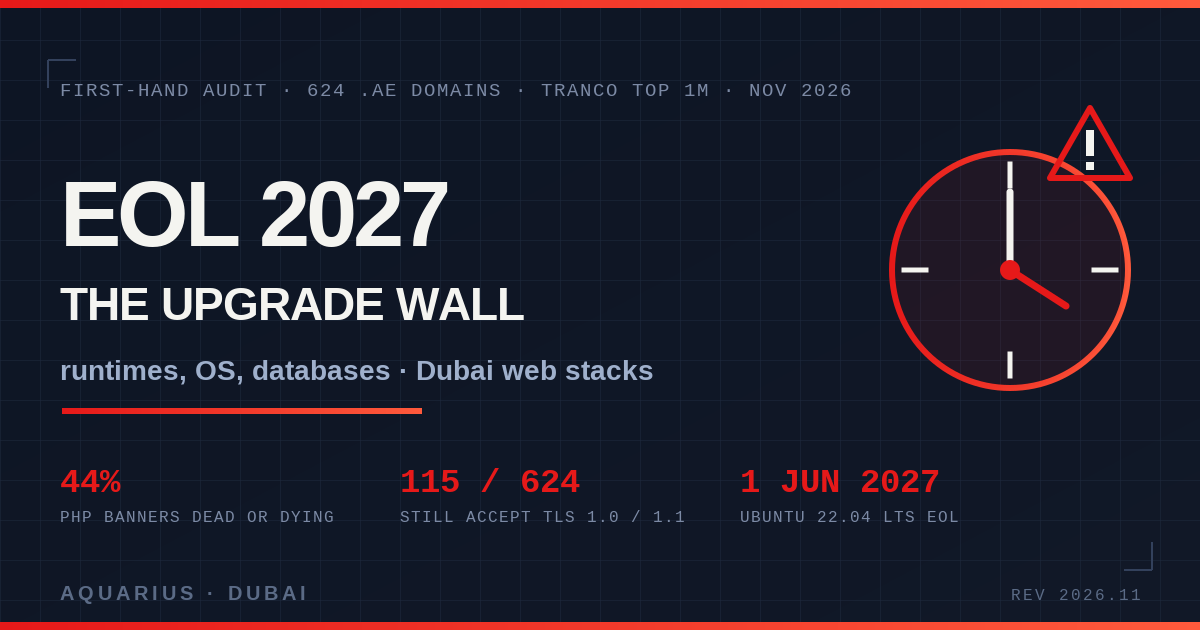
Short answer: between November 2026 and mid-2027 almost every layer of a typical Dubai web stack runs out of free security support — Ubuntu 22.04 LTS on 1 June 2027, Node.js 22 on 30 April 2027, PHP 8.2 on 31 December 2026, Redis 8.0 on 1 December 2026, and .NET 8 and PostgreSQL 14 already stopped getting patches this month. Nothing breaks on the day. What breaks is your ability to patch, pass an audit or get a breach claim paid afterwards.
Most UAE businesses read “end of life” as “it stops working.” That is the expensive misreading. EOL software keeps serving traffic flawlessly — it just stops receiving fixes, so every new vulnerability found after that date stays open on your server permanently.
The scale of the 2027 wall
The NVD published 105,084 CVE records between 1 January and 21 November 2026 — we pulled that figure directly from the NIST API in three date windows, and it is already more than any full year on record. Every one of those that lands in a component you can no longer patch is permanent.
The UAE is a loud target. Dr Mohamed Al Kuwaiti, head of the UAE Cyber Security Council, has put the national blocking rate at roughly 600,000 cyberattacks a day — about seven every second — with one 24-hour period peaking near 640,000. And IBM’s Cost of a Data Breach 2026 puts the Middle East average breach at USD 8 million (about AED 29.4 million), second only to the United States, rising to USD 10.67m in finance and technology.
Against that, the cost of a runtime upgrade is a rounding error. Which makes the real question not “should we upgrade” but “which clock expires first.”
What we found scanning 624 .ae websites
We took the Tranco top-one-million domain list, filtered it to every .ae domain in it — 624 of them — and in November 2026 probed each one for the server banner it advertises and the TLS versions it still accepts. No exploitation, just the headers a browser already sees. Results:
| Probe (624 .ae domains, Tranco top 1M, Nov 2026) | Hosts |
|---|---|
| Answered an HTTPS request | 493 |
Returned a Server or X-Powered-By banner | 412 |
| Leaked an exact version number | 95 |
| Disclosed a PHP version | 54 |
| … of those, already past PHP end of life (5.6 – 8.1) | 16 |
| … of those, on PHP 8.2 — dead 31 Dec 2026 | 8 |
| Completed a TLS 1.0 or TLS 1.1 handshake | 115 (18%) |
Read the PHP row again: of the 54 UAE sites that tell you their PHP version, 44% are running something already dead or dead within six weeks. Two still answer on PHP 5.6, which lost security support on 31 December 2018.
The Apache banners are even more revealing, because the distribution is baked into them. Apache/2.4.29 (Ubuntu) is Ubuntu 18.04. 2.4.41 is Ubuntu 20.04, whose free support ended 31 May 2025. Four sites advertise 2.4.52 — Ubuntu 22.04, the exact release that hits the wall on 1 June 2027. One UAE club site answers with Apache 2.4.6 on CentOS 7 plus OpenSSL 1.0.2k and PHP 7.4: three components whose support ended in 2019, 2024 and 2022 respectively, all on one box.
And 115 hosts still negotiating TLS 1.0 matters beyond hygiene — PCI DSS has forbidden TLS 1.0 for cardholder data since 2018.
Every date that matters between now and 2028
Here is the actual calendar, taken from each vendor’s own support policy. “Paid life support” means a commercial option exists to keep getting patches past the date.
| Component | Free security support ends | Paid life support after |
|---|---|---|
| MySQL 8.0 | 30 Apr 2026 (passed) | RDS Extended Support to 31 Jul 2029 |
| Amazon Linux 2 | 30 Jun 2026 (passed) | None — migrate to AL2023 |
| Python 3.10 | 1 Oct 2026 (passed) | None |
| .NET 8 and .NET 9 | 10 Nov 2026 (passed) | None — move to .NET 10 LTS |
| PostgreSQL 14 | 12 Nov 2026 (passed) | RDS Extended Support |
| Redis 8.0 | 1 Dec 2026 | None |
| PHP 8.2 | 31 Dec 2026 | Third-party only |
| Windows Server 2016 | 12 Jan 2027 | ESU, priced per core |
| Ruby 3.3 on AWS Lambda | 31 Mar 2027 | None |
| Node.js 22 (Active LTS since 2024) | 30 Apr 2027 | None |
AWS Lambda nodejs22.x runtime | 30 May 2027 | Create blocked 29 Jul 2027 |
| Ubuntu 22.04 LTS | 1 Jun 2027 | Ubuntu Pro ESM to 21 Apr 2032 |
Lambda python3.11, java17 (AL2) | 30 Jun 2027 | None |
| PostgreSQL 15 | 11 Nov 2027 | RDS Extended Support |
| Node.js 24 | 30 Apr 2028 | None |
The paid-life-support meter is the hidden line item
Staying put is not free, and the pricing is designed to make procrastination expensive:
- Ubuntu Pro — USD 500 per server per year (about AED 1,836) for Infra-only ESM, USD 1,775 (AED 6,518) with 24/7 support. Free for up to five machines, which covers a hobby project and no production estate.
- Amazon RDS Extended Support — billed per vCPU-hour, USD 0.100 in years one and two, doubling to USD 0.200 in year three. On an 8-vCPU instance that is roughly USD 7,000 (AED 25,700) per year per instance, then AED 51,400. For MySQL 8.0 the meter started 1 August 2026, so Dubai teams are already paying it — often without noticing the line item.
- Lambda managed runtimes — no paid tier at all. After the deprecation date your functions keep running but get no patches; after the block-create date you cannot even deploy a new one on that runtime.
One nuance that catches people: Ubuntu Pro ESM covers the Main repository fully, around 4,700 packages. The 36,000-package Universe set gets best-effort coverage. If your stack leans on Universe packages, “we bought Ubuntu Pro” is a weaker answer than it sounds.
Why your auditor cares more than your CTO
Since 31 March 2025, PCI DSS requirement 12.3.4 has been mandatory: any organisation in scope must review hardware and software technologies at least annually, flag anything that has reached or is approaching vendor end of support, and hold a remediation plan approved by senior management. An EOL runtime is no longer a technical debt note — it is a documented finding.
The UAE layer stacks on top. PDPL (Federal Decree-Law No. 45 of 2021) Article 20 obliges controllers and processors to apply appropriate technical and organisational measures to protect personal data; running a web server that cannot receive a patch is hard to defend as appropriate. Dubai government entities and their suppliers also sit under the DESC Information Security Regulation, whose 13 control domains assume a maintained, patchable estate.
What the upgrade actually costs in Dubai
Real AED ranges from our own UAE project work. The variance is almost entirely about test coverage: a stack with a working CI suite upgrades at the bottom of each band, one without lands at the top because the regression testing is manual.
| Work | Typical AED | Timeline |
|---|---|---|
| Stack EOL audit + dated remediation plan | 9,000 – 18,000 | 1 – 2 weeks |
| Runtime major upgrade per app (Node, PHP, Python, .NET) | 18,000 – 45,000 | 2 – 4 weeks |
| Managed database major version upgrade, rehearsed with rollback | 22,000 – 60,000 | 3 – 5 weeks |
| OS re-platform (22.04 → 26.04) rebuilt as infrastructure-as-code | 35,000 – 90,000 | 4 – 8 weeks |
| Version-watch and patch retainer | 3,500 – 9,000 / month | ongoing |
Compare that to the alternative. One year of RDS Extended Support on three mid-size instances is roughly AED 77,000 — more than the full database upgrade that would have made it unnecessary, and at the end of it you still own the old version. See our pricing page for how these scope, and our legacy software modernisation guide if the application itself — not just its runtime — is the problem.
How Aquarius runs an EOL upgrade
- Inventory from the outside in. Banners, TLS versions, package manifests, Lambda runtime identifiers, RDS engine versions — the same probing we ran across 624 .ae domains, pointed at your estate.
- Sort by date, not by noise. One table, every component, its real support date, and whether a paid extension exists. Anything inside twelve months is this quarter’s work.
- Upgrade the floor first. OS and database before application runtimes — a Node 24 build on Ubuntu 20.04 is still an unpatchable box.
- Rehearse on a clone. Every database major version jump is practised on a restored snapshot with a measured rollback window before anything touches production.
- Pin a watch. Support dates go into the deployment pipeline, so the next wall is a calendar entry, not a surprise.
Risk reversal: if our audit finds your stack is genuinely clear through 2028, we say so and bill the audit only. We would rather hand you a clean report than sell an upgrade you do not need. Data residency constraints are handled in the same pass — see hosting and data residency in Dubai.
FAQ
Does end-of-life software stop working?
No. That is why this gets ignored. EOL software runs normally and indefinitely — it simply receives no more security patches, so vulnerabilities disclosed after the date remain exploitable on your server forever. The 16 UAE sites in our scan still serving PHP 5.6 to 8.1 are all working fine today.
Is Ubuntu Pro enough to skip the 22.04 upgrade?
For a year or two, often yes — ESM extends 22.04 to 21 April 2032 at roughly AED 1,836 per server per year. But it fully covers only the ~4,700 Main packages; Universe is best-effort. Treat it as runway to plan a move to 26.04 LTS (supported to 29 May 2031), not as a substitute for one.
We are on AWS Lambda. What happens on the deprecation date?
Three dates, not one. For nodejs22.x: patches stop 30 May 2027, you can no longer create functions on it from 29 July 2027, and you cannot update existing ones from 31 August 2027. Existing functions keep invoking, which is precisely how teams end up with an unpatchable function they also cannot change.
Which single upgrade should a Dubai SME do first?
Whatever is internet-facing and version-disclosing. In our scan that was almost always PHP or the web server — publicly advertised, directly reachable, and the cheapest thing on the list to fix. Then the database, because it carries the longest rehearsal time.
Does PDPL actually require patching?
Not by name. Article 20 requires appropriate technical and organisational measures to secure personal data, and PCI DSS 4.0.1 requirement 12.3.4 makes the annual EOL review explicit for anyone handling card data. Between them, an unpatchable production server is very difficult to present as compliant.
The quiet version of this problem
Nobody schedules an outage for an EOL date. The stack keeps serving, the dashboards stay green, and the cost shows up two years later as a breach, a failed audit, or a cloud bill with a line item nobody approved. The teams that handle this well treat support dates as infrastructure — tracked, owned, budgeted.
If you want to know exactly which clocks are running on your stack, send us the domain. We will run the same audit we ran across 624 UAE sites and come back with a dated list.