
School Bus Tracking and Transport Software in Dubai (2026): RTA Rules, Real AED Costs and the Child-Check That Ends the Paper Register
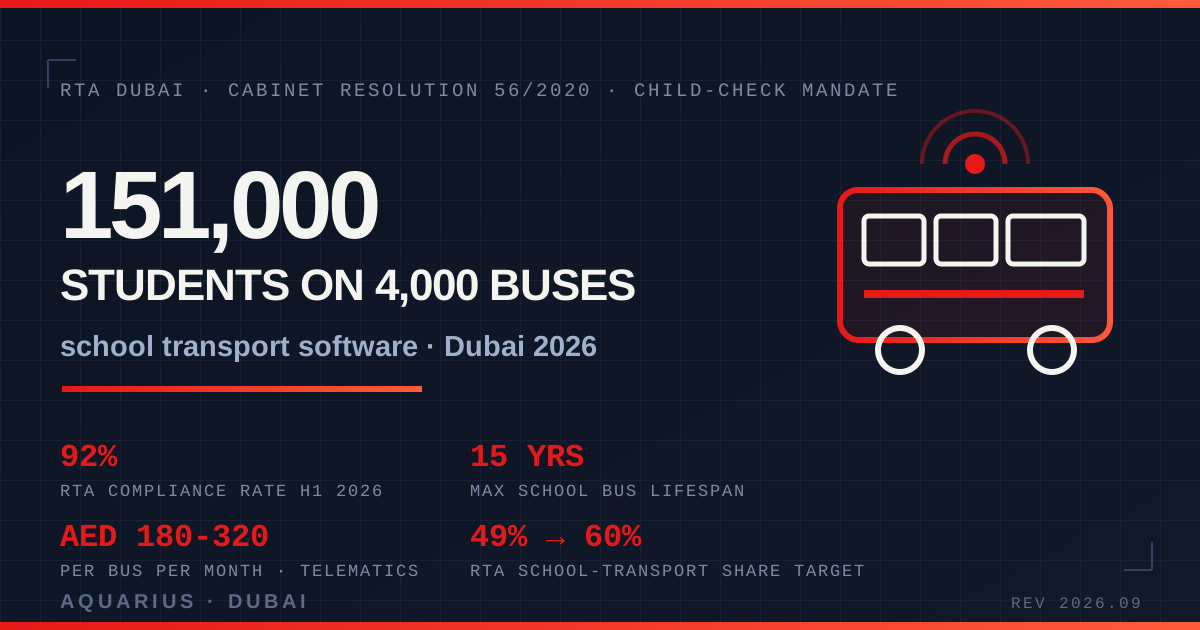
About 4,000 school buses move roughly 151,000 students across Dubai every day, and the RTA wants that share to rise from 49% to 60%. What the software really costs in AED.
- PUBLISHED
- 23 SEPT 2026
- READ TIME
- 12 MIN
- AUTHOR
- AQUARIUS · DUBAI
- UNIT
- REV 2026.09
Short answer: A parent-facing school bus tracking app in Dubai costs AED 60,000–130,000 to build, a full school transport management platform AED 160,000–380,000, and a multi-school operator system AED 450,000–950,000+. On top of software, UAE telematics vendors quote roughly AED 5,500–9,500 per bus for hardware and installation plus AED 180–320 per bus per month for connectivity and monitoring. The reason those numbers now sit on school board agendas is not parent convenience. It is that the end-of-route child check has become a regulated, evidence-producing event — and a clipboard cannot produce evidence.
Here is what most Dubai schools get wrong: they buy tracking to reassure parents. The RTA does not inspect your parent app. It inspects your permits, your driver and attendant records, your GPS feed, and your proof that every bus was swept before it parked. Tracking is the by-product. The audit trail is the product.
Key takeaways
- The fleet is enormous and growing. Around 4,000 school buses carry roughly 151,000 students in Dubai every school day, inside a private-school sector of 227 schools and 387,441 students from 185 nationalities, with 26 new private institutions and about 17,000 new seats arriving for 2026–27.
- The regulator is actively counting. The RTA has run more than 8,000 school transport inspections in two years. H1 2026 produced 654 violations, down 15% year on year, for a compliance rate near 92% — and a fresh 30-day inspection campaign opened the 2026–27 school year.
- Leaving a child on a bus is a federal design requirement, not a policy note. Cabinet Resolution No. 56 of 2020 requires cameras, motion sensors and a smart alert system so no student is left behind. Dubai’s own bylaw makes the bus conductor responsible for verifying the vehicle is empty after the final stop.
- Dubai wants more children on buses, not fewer. The RTA’s Q1 2026 school-pooling pilot with Yango Group and Urban Express Transport targets lifting school-transport share from 49% to 60%, cutting family transport cost by up to 15% and trimming some trips by 35–40% — a 40-minute run down to about 25 minutes.
The stakes: 151,000 children, 227 schools, and a 92% compliance rate you have to keep
Dubai’s private education sector is the anchor. KHDA regulates 227 private schools teaching 387,441 students across 17 curricula and 185 nationalities, and 26 new private education institutions open in 2026–27, adding close to 17,000 seats. Fees were frozen for 2026–27 under Dubai Executive Council directives, which matters more than it sounds: when tuition cannot rise, every operational cost line gets audited harder — and transport is one of the biggest.
Underneath that sits an operation most people never see. Roughly 4,000 school buses move about 151,000 Dubai students daily. Nationally the scale is larger: Emirates Transport opened 2026–27 with 10,200 school buses serving more than 285,000 students across 630 schools, including 547 vehicles adapted for over 4,100 students of determination, while STS Group runs 4,000+ buses for more than 120,000 students, each with a driver and a female attendant.
Compliance is measurably tight and tightening. The RTA has conducted over 8,000 school transport inspections in two years. In the first half of 2026 those inspections produced 654 violations — 15% fewer than the year before — putting the sector at roughly 92% compliance. A 92% pass rate is the interesting number for an operator: the remaining failures are concentrated, repeated, and documentation-shaped. They are exactly the kind of failure software removes.
What Dubai law actually requires of a school bus
Two layers apply. Dubai’s framework runs through Executive Council Resolution No. 2 of 2008 and its implementing bylaw, Administrative Resolution No. 196 of 2015. Federal safety specification comes from Cabinet Resolution No. 56 of 2020.
Vehicle and permit rules
A school bus in Dubai may not exceed 15 years from date of manufacture. Operating permits are valid one year, renewable, with renewal due within 30 days of expiry, and require comprehensive insurance covering all passengers, a technical test report, and — for buses over 50 passengers — a crash test report. Every bus carries a valid RTA Operation Card, which the RTA can suspend immediately, taking the vehicle out of service that day.
People rules
School bus drivers must be at least 25 years old, hold a valid UAE bus licence, pass RTA training and testing, and produce a certificate of good conduct plus medical fitness. Every trip needs a supervisor or conductor on board. Under the Dubai bylaw the female bus conductor must assist boarding and alighting, ensure students reach their guardians, and verify that no student remains on board after the final stop.
Technology rules
GPS is mandatory: a school bus must carry a Global Positioning System enabling its location to be tracked, and the 2026 standard expects that unit to come from an approved provider and transmit live to the RTA’s school transport monitoring portal. Installation without active portal registration is not compliance. Cabinet Resolution No. 56 of 2020 adds cameras, motion sensors and an AI-driven smart alert system to warn driver and supervisor if a student is left on board, plus a protected fuel tank. In practice the workflow is hardware-enforced: the driver must physically walk to a button at the rear of the bus to silence the end-of-route alarm, and failing to do so escalates to the operations centre.
On the road, Article 90 of the traffic regulations fines a school bus driver AED 500 and six black points for failing to deploy the stop sign; Article 91 fines a motorist who ignores it AED 1,000 and ten black points. Those are the visible penalties. The expensive one is an Operation Card suspension in week two of term.
The five modules that actually matter
1. Live tracking a parent and an inspector both trust
Sub-30-second position updates, ETA to the assigned stop, geofenced arrival alerts, and full route replay. Dual-network failover matters in Dubai because a single-carrier tracker goes dark in exactly the basement and podium pick-up zones schools use.
2. Attendance at the door, not on paper
RFID card, QR or facial check-in on boarding and alighting, tied to the student record, the stop and the guardian. This dataset answers “which bus is my child on right now” without a phone call — and it is the same dataset that proves a headcount was taken.
3. The end-of-route child check as a logged workflow
Sweep confirmation by the attendant, the rear-button deactivation event, a timestamped photo or sensor state, and automatic escalation if the check is not completed inside the grace window. Every trip, retained, queryable. This single module is the reason to build rather than bolt on a generic fleet tracker.
4. Routing and fleet operations
Stop clustering, route optimisation, driver and attendant rostering with permit-expiry alerts, vehicle inspection and insurance-renewal reminders, fuel and maintenance logs. Permit-expiry alerts alone eliminate the most common inspection finding there is.
5. Bilingual parent communication
Arabic and English parity, delay notifications, parent-side absence reporting (which removes the phantom pick-up), and a clean consent record. Dubai parents are not a monolingual audience, and a one-language app quietly halves adoption.
Real AED costs: hardware, subscription and custom build
Split the budget three ways. Hardware sits on the bus, subscription keeps it talking, and the platform is what your staff and parents actually use. UAE providers advertise basic vehicle GPS from around AED 500 per vehicle per year including device, installation and app — but school-grade compliance stacks (multi-camera, child-detection sensor, driver monitoring, tamper protection) are quoted nearer AED 5,500–9,500 per bus one-off with AED 180–320 per bus per month after that. For a 30-bus operator that is roughly AED 165,000–285,000 up front and AED 65,000–115,000 a year running.
| Option | AED cost | Timeline | Best for |
|---|---|---|---|
| Telematics hardware + install, per bus (GPS, cameras, child-detect sensor) | AED 5,500–9,500 one-off | 1–2 days per bus | Every bus — this is the regulated layer |
| Telematics subscription, per bus | AED 180–320 per month | Ongoing | Connectivity, storage, monitoring portal |
| Off-the-shelf school ERP transport module | AED 1–5 per student per month | 4–8 weeks | Single schools already on a school ERP |
| Custom parent tracking app + attendance (iOS, Android, admin console) | AED 60,000–130,000 | 6–9 weeks | One school, 10–40 buses, fast win |
| Full transport management platform (routing, rostering, child-check audit trail, bilingual parent app, ops dashboard) | AED 160,000–380,000 | 3–6 months | School groups and mid-size operators |
| Multi-school operator platform (multi-tenant, 1,000+ buses, RTA feed integration, BI layer) | AED 450,000–950,000+ | 7–12 months | National operators and pooling networks |
| Annual run cost (hosting, support, telematics integrations, rule upkeep) | 15–20% of build per year | Ongoing | Everyone — budget it or the integrations rot |
Now compare that to the revenue it protects. UAE parents pay AED 3,000–10,000 per child per year for school transport, with some Dubai routes quoted at AED 8,000–14,000. A 30-bus operation carrying 1,200 children is a transport book of roughly AED 3.6–12 million a year. Against that, a AED 250,000 platform is two to seven percent of a single year’s transport revenue — and it is the part that stops the book being suspended.
The margin case: fuel, routes and the 49% problem
Costs are rising underneath operators. Fuel jumped in August 2026 — Special 95 up 6.08% and diesel up 5.56% — and Emirates Transport publicly committed to absorbing it rather than passing it to parents, citing route optimisation and IoT monitoring as the mechanism. That is the entire software argument in one sentence: when you cannot raise the price, the only lever left is the route.
School-district benchmarks internationally put route optimisation at a 10–20% reduction in fuel consumption, 5–15% fewer miles driven, and 80–90% less manual planning time, with payback typically inside 12–18 months. Dubai adds a local multiplier: the RTA pooling pilot launched in Q1 2026 with Yango Group and Urban Express Transport runs shared buses across multiple schools inside defined zones, lowering family transport cost by up to 15% with extra discounts for two- and three-child families, and cutting average trip time 35–40% in some areas.
The strategic number is the share target. The RTA wants school-transport usage to move from 49% to 60% of students, because private-car drop-off is what jams the school zone. Earlier RTA school-area projects delivered a 20% improvement in peak-hour traffic flow around 37+ schools, and the 2026 mobility plan targets 15–30% reductions in congestion and journey times. For 2026–27 the RTA also raised frequency on 30+ bus routes serving Al Nahda, Muhaisnah, Al Barsha, Al Quoz, Dubai Silicon Oasis and Al Garhoud, added school-zone taxi supply, and formally recognised Careem School Rides, Uber Teens, BOLT School and Yango pooling as options — with the nol Student Card giving a 50% discount on Metro, tram and bus.
Read that as a market signal, not a news item. Every one of those services is a software product competing for the same child. A school still running a WhatsApp group and a laminated route sheet is competing against venture-funded mobility apps for its own transport revenue.
The data problem nobody budgets for
A school transport system processes children’s real-time location, boarding photos and interior CCTV. Under Federal Decree-Law No. 45 of 2021, the UAE Personal Data Protection Law, that is about as sensitive as processing gets. Three controls belong in the build, not the policy document: role-based access so a driver sees only today’s manifest, defined retention for camera footage (typically 30–90 days, longer only for incidents), and an access audit trail recording who viewed which child’s location and when. Add signed parent consent and a data processing agreement with every telematics vendor in the chain.
The failure mode is predictable and avoidable: a cheap tracker on a vendor-hosted portal, one admin login shared by six staff, footage retained indefinitely on an overseas server. It works perfectly until the day it is evidence. The underlying obligations are in our UAE PDPL compliance checklist for websites and apps.
How Aquarius builds school transport systems
We start at the child check, because it is the one event that is both a legal obligation and a parent’s actual fear. The sweep workflow, the rear-button deactivation event and the escalation timer are modelled as first-class records with immutable history — not a checkbox on a form. Attendance scanning comes next, then routing, then the parent app, because a beautiful parent app sitting on an unreliable manifest just broadcasts bad data faster.
Every build is Arabic and English from day one, UAE-hosted, integrated with whichever RTA-approved telematics units the fleet already carries rather than forcing a hardware rip-out, and handed over with full source code in your own cloud accounts. If you already run a school ERP we integrate to it rather than duplicating the student record — see our breakdown of school management ERP software in Dubai, and the fleet tracking and logistics software guide for the telematics side. Engagement models and bands sit on the pricing page; the wider build catalogue is on services.
FAQ
Is GPS tracking mandatory on Dubai school buses?
Yes. Dubai’s implementing bylaw requires every school bus to carry a GPS enabling its location to be tracked, and the current standard expects an approved unit transmitting live to the RTA’s school transport monitoring system. A tracker that is installed but not registered to the portal does not satisfy the requirement.
What is the child-detection requirement in the UAE?
Cabinet Resolution No. 56 of 2020 requires school buses to carry cameras, motion sensors and a smart alert system so that no student is left behind, alerting driver and supervisor. Dubai’s bylaw separately makes the bus conductor responsible for confirming no student remains after the final stop. Operationally this is a rear-button sweep at the end of every route — logged.
How much does school bus tracking software cost in Dubai?
Telematics hardware and installation run about AED 5,500–9,500 per bus one-off with AED 180–320 per bus per month after that. A custom parent-tracking app is AED 60,000–130,000; a full transport management platform AED 160,000–380,000; a multi-school operator platform AED 450,000–950,000+, plus 15–20% of build per year to run.
How old can a school bus be in Dubai?
The lifespan of a school bus may not exceed 15 years from the date of manufacture under Administrative Resolution No. 196 of 2015. Operating permits are annual, renewable within 30 days of expiry, and require comprehensive passenger insurance plus a technical test report.
Should a single school build or subscribe?
Below roughly 15 buses, a school ERP transport module at AED 1–5 per student per month is usually the right call. Build when you operate across multiple schools, need the child-check audit trail to survive an inspection on your own terms, or need Arabic parity and RTA portal integration that a vendor will not prioritise for one customer.
Does the RTA pooling pilot replace school buses?
No — it adds shared routes across schools inside defined zones, run with Yango Group and Urban Express Transport, aimed at lifting school-transport share from 49% to 60% and cutting family cost by up to 15%. For operators it means more routes coordinated across more schools, which is a scheduling and data problem before it is a bus problem.
The bottom line
Dubai moves 151,000 children on about 4,000 buses every school day, inside a sector of 227 private schools and 387,441 students, and the regulator has already inspected its way to a 92% compliance rate. The remaining risk is not mechanical. It is evidential: whether you can show, for every trip, that the right children boarded, the right guardian received them, and the bus was swept before it parked. A clipboard cannot produce that, and a generic fleet tracker will not either. Build the audit trail first and the parent app becomes the easy part. Talk to Aquarius and we will map your fleet, your permits and your 2026–27 inspection exposure to an architecture and an AED number in one session.