
We Probed 787 .ae Domains for a security.txt: Only 30 Have One, and Zero of 94 .gov.ae Sites Publish Any
We probed 787 UAE .ae domains on 27 Nov 2026. Only 30 of the 680 reachable hosts serve a valid security.txt, just 16 pass RFC 9116, and not one of the 94 .gov.ae hosts publishes one.
- PUBLISHED
- 27 NOV 2026
- READ TIME
- 13 MIN
- AUTHOR
- AQUARIUS · DUBAI
- UNIT
- REV 2026.09
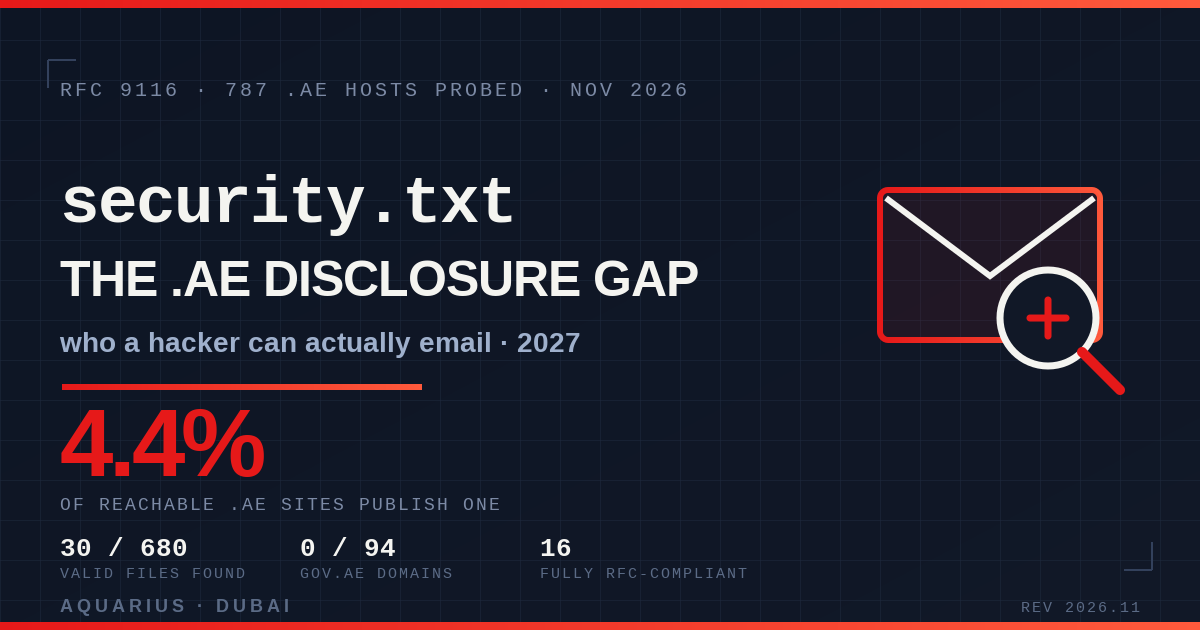
We asked a simple question of 787 UAE .ae domains on 27 November 2026: if a stranger found a vulnerability in your website tonight, is there a published address to send it to? For 650 of the 680 reachable sites, the answer is no. Exactly 30 served a valid security.txt file — 4.4% of reachable hosts — and only 16 of those 30 fully satisfy RFC 9116. Across the 94 .gov.ae hosts in the sample, the count of valid files is zero.
That matters because the alternative to a published channel is not silence. It is a researcher guessing at info@, giving up, posting the bug publicly, or selling it. This post is the raw measurement, the named failures, and what a working disclosure channel costs to set up in Dubai.
Why the UAE cannot afford a missing inbox
Dr Mohamed Hamad Al Kuwaiti, head of the UAE Cybersecurity Council, told Emirates 24/7 in August 2026 that UAE systems absorb roughly 600,000 cyberattacks every day. In February 2026 he gave Aletihad a sharper figure: 128 confirmed cyber threat incidents since the start of 2026, against 90,000–200,000 daily attempts. Of the 21 threat groups tracked, 15 — 71.4% — were state-sponsored. The incident mix was defacement 38.3%, data leaks 25.8%, data breaches 13.3%, initial access 10.2%, ransomware 7.8% and DDoS 4.7%.
The sectors in the firing line are the ones that run the economy: government administration 9.4% of incidents, financial services and banking 9.3%, real estate 5.5%.
Now the cost. IBM's Cost of a Data Breach 2026, published 3 August 2026, puts the Middle East average breach at USD 8 million — roughly AED 29.4 million — against a global average of USD 4.99 million. Financial and technology firms in the region tie at USD 10.67 million each. Lost business alone accounts for USD 3.57 million of the regional figure; post-breach response USD 2.17 million; detection and escalation USD 1.9 million; notification USD 0.36 million. IBM also found 26% of malicious breaches were AI-enabled, with another 11% unable to confirm either way.
A published disclosure address is the cheapest control on that list. It costs a text file.
What RFC 9116 actually requires
security.txt is a standard, not a convention. RFC 9116 states the file MUST be served from /.well-known/security.txt; a top-level /security.txt is tolerated only "for legacy compatibility", and where both exist the .well-known copy wins. The Contact field MUST be present and MUST be a valid URI under RFC 3986 — meaning mailto: or https:, not a bare email string. The Expires field MUST be present, must appear exactly once, and the spec recommends a value less than one year out. If a Canonical URI does not match the location the file was fetched from, the contents "SHOULD NOT be trusted". An OpenPGP cleartext signature is recommended.
For global context: the Web Almanac 2025 security chapter measured security.txt on 1.82% of desktop and 1.72% of mobile sites, up from about 1% a year earlier — and concluded that "at least 25% of security.txt files are not fully valid". The reachable .ae sample, at 4.4%, is actually ahead of the global web on raw presence. Read on for why that number is misleading.
The method, because status codes lie
We took a Tranco-derived list of 787 .ae hosts and requested, over HTTPS, three paths per host: /.well-known/security.txt, /security.txt, and a deliberately nonexistent control path under /.well-known/ containing a random token. Files were only counted as valid if the body was not HTML and contained a Contact: field.
That control probe earned its keep. 97 hosts returned HTTP 200 for a path that cannot exist, and 99 hosts returned a 200 for /.well-known/security.txt that was not a security.txt at all — 98 of them serving text/html, almost always a soft-404 landing page or a SPA shell. The two sets overlap by 96 hosts. Any scan that trusts status 200 would have reported roughly four times more adoption than exists.
The full response census for /.well-known/security.txt:
| Response | Hosts | What it means |
|---|---|---|
| 404 | 425 | Honest answer: no file |
| 200 | 126 | Only 27 were real security.txt files |
| Connection failed (0) | 111 | DNS, TLS or timeout failure |
| 403 | 97 | WAF or bot rule blocking .well-known |
| 500 | 13 | Server error on a static path |
| 410 | 2 | yalah.ae, federalerp.gov.ae |
Three of the 30 valid files were served only from the legacy root path, not .well-known: etisalat.ae, eand.ae and thomann.ae. Under RFC 9116 those are reachable by a human who guesses but invisible to any automated tool that follows the spec.
Only 16 of 30 files are actually compliant
Field coverage across the 30 valid files: Contact 30, Expires 21, Preferred-Languages 18, Policy 13, Canonical 12, Encryption 8, Hiring 8, Acknowledgments 5. Zero files carried an OpenPGP cleartext signature.
The Expires picture is worse than the count suggests. Of the 30 files, 10 carry a valid in-date value, 9 omit the field entirely despite it being a MUST, 6 set it more than a year out, 3 have already expired, and 2 are unparseable. Median remaining life among the parseable ones: 225 days. Globally the Almanac found 75% of implementers now set Expires; the .ae sample manages 70%, and far fewer set it correctly.
Three files have a Contact that is not a URI at all, which means a compliant parser discards it. Stray and misspelled fields appeared too: Acknowledgements (British spelling, not in the spec) three times, plus one each of OpenBugBounty and Signature.
Named failures, verified on apex and www
Every defect below was re-fetched on both the apex and www hostname, and on both paths, before being named.
- michaelpage.ae — the clear winner.
Contact: mailto:socREMOVETHIS@page.com: a placeholder shipped to production. The file expired 9 October 2024, 779 days ago. It also invents aSignature:field and writesPreferred Languages:with a space instead of a hyphen, so that line is unparseable too. - emiratesislamic.ae — expired 17 November 2026, ten days before our scan. The canonical line reads
Canonical: Canonical: https://..., and the URI it points to is onemiratesnbd.com, not the host serving the file. Per RFC 9116 section 2.5.2, that is a file a researcher "SHOULD NOT" trust. It also contains a PGP SIGNATURE block with no matching SIGNED MESSAGE header. - twinkl.ae —
Contact: @arbgae42g. Not an email, not a URL, not a usable handle. - expedia.ae —
Contact: RespDisc@expedia.comwith nomailto:scheme, and noExpiresfield. - etisalat.ae / eand.ae — 404 on the mandatory
.well-knownpath, noExpires, two conflictingCanonicallines, and the canonical URI they do publish returns a 404. - edcad.ae —
tel:andmailto:written with a trailing space, which makes both invalid URIs. - assignmenthelp.ae — a Gmail address as the security contact.
The finding that reframes the whole scan
Of the 30 valid files, 24 are served from a .ae host and 6 redirect off .ae entirely. More importantly, when we traced who owns the contact address, only about six organisations have a UAE-domiciled security contact: e&/etisalat, Ounass (Al Tayer), Emirates Islamic/Emirates NBD, edcad.ae, fanet.ae and solomia-home.ae. The other ~23 files are inherited from a foreign parent — a global brand's .ae storefront serving head office's file, routing a UAE bug report to a SOC in another timezone and another jurisdiction.
So the honest UAE-owned adoption rate is closer to 6 in 680, or under 1%. The 4.4% headline is mostly imported.
One more detail worth sitting with: bugbounty.ae — the UAE National Bug Bounty Programme itself — returns a 404 for /.well-known/security.txt, while its live CVD intake endpoint works fine. The country has built the receiving infrastructure. Almost nobody has published the pointer to it.
Server stack changes nothing
Adoption by fronting server, as reported in the Server header: Cloudflare 15 valid files of 327 hosts (4.6%), nginx 3 of 61, Apache 0 of 32, IIS 0 of 21, LiteSpeed 0 of 16, Vercel 0 of 9. There is no platform where this is handled for you. It is a publishing decision, not a hosting feature.
What it costs to fix in Dubai
A disclosure channel is not one deliverable, it is a ladder. Most UAE businesses should start on the first rung and stop there until something arrives.
| Level | What you get | Typical Dubai cost (AED) | Time |
|---|---|---|---|
| Published file | RFC 9116 security.txt at /.well-known/, monitored alias, Expires under 12 months, calendar reminder | 1,500 – 3,500 | 1 – 2 days |
| File plus policy | Above, plus a hosted disclosure policy page, safe-harbour wording, Arabic and English, Preferred-Languages set | 4,500 – 9,000 | 3 – 5 days |
| Managed intake | Above, plus triage SLA, PGP key, acknowledgements page, PDPL Article 9 breach-notification runbook | 12,000 – 28,000 | 2 – 3 weeks |
| Annual upkeep | Expires rotation, quarterly validation, inbox ownership review | 2,400 – 6,000 / yr | — |
Against an AED 29.4 million regional average breach cost, the first rung is a rounding error. And there is a hard reason to own the channel rather than wait: IBM's 2026 global data shows breaches disclosed by the attacker are the most expensive at USD 5.12 million and take 268 days to contain, versus 209 days when an internal team finds the problem first — and internal teams found only 38% of breaches. Two extra months of dwell time is what a missing inbox buys you. IBM does not publish a Middle East split by discovery method, so treat that gap as a global figure applied to a region whose average breach already costs 60% more.
The regulatory angle is real too. UAE PDPL, Federal Decree-Law No. 45 of 2021, Article 9 requires a controller to notify the UAE Data Office of a breach "without undue delay", notify affected individuals where the risk is high, and keep breach records. There is no fixed 72-hour clock in the law itself — the window is deferred to the Executive Regulations — but "without undue delay" is not a defence you want to argue after learning about your own breach from a journalist.
How Aquarius sets this up
We do it in the order that actually reduces risk. First we publish the file at the mandatory path and verify it from outside your network on both apex and www, because a WAF rule that 403s .well-known is the single most common failure in this dataset — 97 hosts in our scan. Then we point Contact at a shared, monitored alias rather than a named person who will change jobs. Then we set Expires to 11 months and book the rotation. Then, and only then, the policy page and PGP key.
If you also want the file wired into your wider security posture, our write-up on running a vulnerability disclosure programme and bug bounty in Dubai covers triage, safe harbour and reward structures. For the transport layer underneath it, see our scan of HSTS adoption across .ae homepages. Build and maintenance rates sit on our pricing page.
Risk reversal, plainly: if we publish your file and it does not validate clean against RFC 9116 on both hostnames, we fix it at no charge. There is nothing to fail at on a text file, which is exactly why 650 sites having no file at all is indefensible.
FAQ
Does a security.txt file invite attacks?
No. Attackers do not need an invitation and do not read your contact file. The population that uses security.txt is researchers who already found something and want to report it responsibly. Withholding the address does not hide the bug, it only removes the path that ends in a quiet fix.
Is security.txt required by UAE law?
Not directly. No UAE instrument names the file. But PDPL Article 9 obliges you to detect and report breaches without undue delay, and you cannot act on a report that had nowhere to land. Treat the file as the cheapest way to meet an obligation you already have.
Where exactly does the file go?
At https://yourdomain.ae/.well-known/security.txt, served as text/plain, over HTTPS, on both the apex and www. A file at /security.txt only is legacy-tolerated and will be missed by compliant tooling — which is the exact state etisalat.ae and eand.ae are in today.
What should the Contact field say?
A URI, not a bare address: Contact: mailto:security@yourdomain.ae or a link to a web form. Use a monitored group alias. Three files in our sample put a non-URI string there, and a compliant parser throws those away.
How often does it need updating?
At minimum whenever Expires approaches — RFC 9116 recommends under one year. In our sample 3 files are already expired and 9 have no expiry at all. An expired file tells a researcher the channel is abandoned, which is worse than no file, because it burns their goodwill before they even write to you.
If you want the file published and validated this week, tell us your domain and we will scan it first and show you exactly what a researcher sees today.
Method note: 787 .ae hosts probed over HTTPS on 27 November 2026 from a single vantage point, three paths per host including a random-token control path, 28 concurrent workers. Files counted only when the response body was non-HTML and contained a Contact: field. 680 hosts answered. Named hosts re-verified on apex and www. Hosts behind a 403 or connection failure may serve a file to a browser that our client could not see, so 4.4% is a floor, not a ceiling.