
We Read the HSTS Header on 787 .ae Homepages: 56% Never Lock the Browser to HTTPS
We probed 787 .ae homepages on 25 November 2026: 380 of 682 live sites send no Strict-Transport-Security header, 93 claim preload without being listed, and only 13 are in Chrome preload list.
- PUBLISHED
- 25 NOV 2026
- READ TIME
- 12 MIN
- AUTHOR
- AQUARIUS · DUBAI
- UNIT
- REV 2026.09
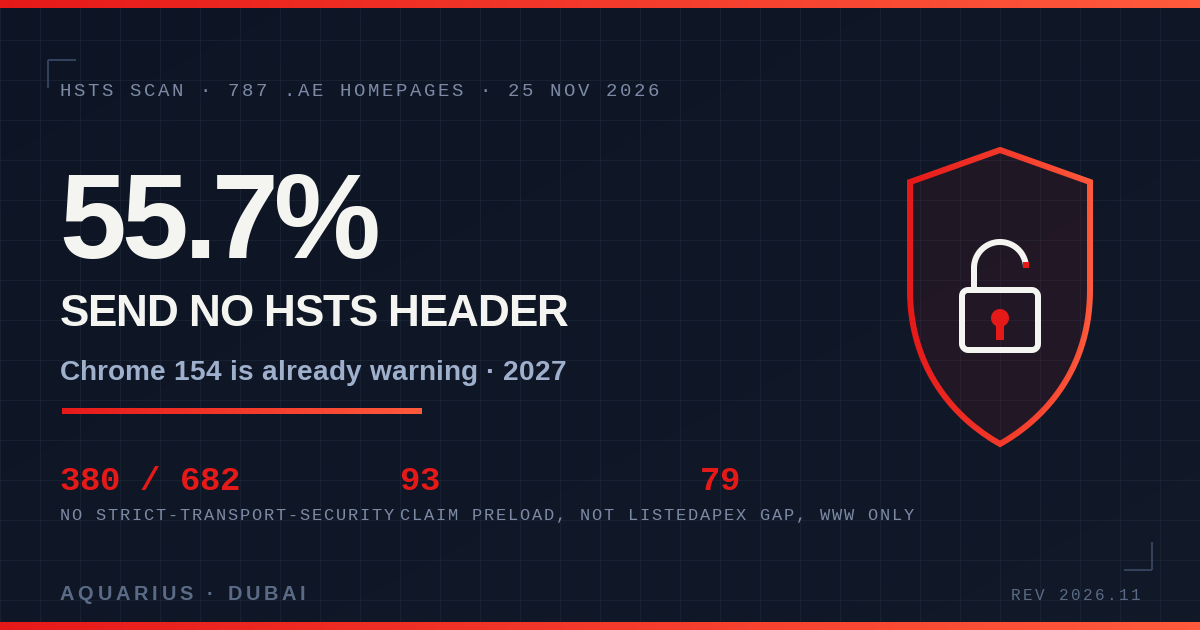
Short answer: we read the response headers of 787 of the most-visited .ae domains on 25 November 2026. Of the 682 that answered over HTTPS, 380 (55.7%) sent no Strict-Transport-Security header at all — and only 181 (26.5%) met the one-year minimum that Chrome’s preload list requires. Worse: 106 sites shout the preload directive, but just 13 of the 787 are actually in the Chromium preload list.
HSTS is one line of configuration. It is the difference between a browser that prefers HTTPS and a browser that refuses to speak plaintext to your domain ever again. Most Dubai sites have paid for the certificate and then skipped the line that makes it count.
Why this stopped being optional in 2026 (awareness)
Three numbers set the stakes:
- Chrome 154, October 2026: Google turned “Always Use Secure Connections” on by default for all users, after enabling it for the 1 bn+ Enhanced Safe Browsing cohort in Chrome 147 (April 2026). Chrome now attempts HTTPS first on public sites and interrupts the navigation when it has to fall back.
- Chrome is 76.98% of UAE browser share (StatCounter, UAE, October 2026), with Safari second at 12.05%. There is no “most of my users are on something lenient” escape hatch here.
- A Middle East data breach now averages USD 8m — up from USD 7.29m a year earlier and well above the USD 4.99m global average (IBM Cost of a Data Breach 2026). Finance and technology top the table at USD 10.67m each.
Google’s own telemetry says HTTPS already carries 98% of Windows navigations and over 99% on Android and Mac. The plaintext tail is small — which is exactly why browsers are now willing to treat it as an error instead of a default.
Most Dubai firms get this wrong: they think a green padlock means the site is HTTPS-only. It does not. Without HSTS, the first request a user makes after typing your domain can still leave the device over plaintext HTTP — and that first request is the one an attacker on hotel or mall Wi-Fi wants.
What we measured, and what came back (consideration)
Method: 787 .ae hostnames taken from a public popularity ranking, each fetched twice — once over HTTPS following redirects, once over HTTP with redirects disabled — recording every Strict-Transport-Security value in the chain, the redirect hops, and the server banner. We then diffed the preload claims against the actual Chromium transport_security_state_static.json list. Same approach as our TLS certificate scan of .ae homepages.
| Finding (787 .ae hosts, 25 Nov 2026) | Count | Share |
|---|---|---|
| Answered over HTTPS | 682 | 86.7% of 787 |
| No Strict-Transport-Security header | 380 | 55.7% of 682 |
| Meets the 1-year (31536000) preload minimum | 181 | 26.5% of 682 |
| HSTS present but max-age under 1 year | 120 | 17.6% of 682 |
| HSTS present but no includeSubDomains | 122 | 17.9% of 682 |
| Redirect http→https but no HSTS on arrival | 310 of 575 | 53.9% |
| Apex has no HSTS, www or final host does | 79 | — |
Sends the preload directive | 106 | — |
| Actually in the Chromium preload list | 13 | 1.7% of 787 |
| Serves HTTP 200 in cleartext on port 80 | 21 | — |
| Redirects http→another http URL | 21 | — |
The apex gap: 79 sites protect www and leave the bare domain open
This is the single most common real defect we found, and it is invisible to anyone testing with www. in the address bar. Nobody types www. any more. Yet 79 hosts send nothing on the apex and only pick up HSTS one hop later — among them a bank, a telco, a police portal and a municipality. One pattern repeats: the apex 301s to www, the www host sets a perfect header, and the redirect that got the user there carried no header at all. That first hop is permanently hijackable.
A second pattern: a national postal domain and one other host send max-age=0; includeSubDomains; preload. A max-age of zero does not mean “default” — it is the explicit instruction to delete any HSTS state the browser already holds for that domain. Two more sites run max-age=300: five minutes of protection, including one federal ministry.
The preload illusion
Of the 106 hosts advertising preload, 93 are not on the list — and 35 of those do not even satisfy the header criteria, so submission would be rejected today. The entire Chromium preload list contains only 78 .ae domains. The directive is a request to be considered; it does nothing until the domain is submitted at hstspreload.org and ships in a Chrome release. One government portal we checked sends max-age=16070400; includeSubDomains; preload — 186 days. That claim can never be honoured, because the bar is 365.
The flip side is a free win: 126 hosts already satisfy every header requirement and 113 of them have never submitted. Zero code, zero risk appetite required beyond the decision itself.
Your CDN is probably the reason
| Server / edge | Hosts | With HSTS | Rate |
|---|---|---|---|
| Vercel | 9 | 9 | 100% |
| Akamai | 8 | 7 | 87.5% |
| Microsoft IIS | 22 | 10 | 45.5% |
| Cloudflare | 334 | 139 | 41.6% |
| Apache | 32 | 13 | 40.6% |
| nginx | 60 | 14 | 23.3% |
| LiteSpeed | 18 | 3 | 16.7% |
195 Cloudflare-fronted .ae homepages send no HSTS — not because Cloudflare cannot, but because the toggle ships off. It is a single switch in the SSL/TLS panel. The platforms that enable it by default sit at or near 100%.
One honourable exception worth naming: a national identity domain serves HTTPS with no HSTS header but simply does not listen on port 80 at all. No listener, no downgrade. That is a defensible architecture — it just does not survive a user who has the domain in their history from an older plaintext era.
Government beats the private sector
Of 68 .gov.ae hosts that answered, 50 (73.5%) send HSTS — far ahead of the 44.3% overall rate, with a median max-age of one year. The embarrassment is elsewhere: two government sites answer port 80 with a live HTTP 200 and no redirect, while serving HSTS correctly over HTTPS. The header is unreachable for anyone who never gets upgraded.
What fixing it costs in AED (decision)
This is the cheapest security work available to a UAE business. Against a USD 8m average regional breach cost, the entire remediation sits in four figures.
| Scope | What happens | Typical AED | Timeline |
|---|---|---|---|
| Header switch-on | Enable HSTS at the edge or app, 6 months max-age, verify apex + www | AED 0 – 1,200 | Same day |
| Redirect-chain repair | Kill http→http hops, close or redirect port 80, header on every hop | AED 1,200 – 3,500 | 2 – 4 days |
| Subdomain inventory + includeSubDomains | Audit every host under the apex, fix HTTP-only internal tools, then ramp to 1 year | AED 3,500 – 9,000 | 1 – 3 weeks |
| Preload submission | Mixed-content sweep, 1-year header, hstspreload.org submission, monitoring | AED 4,500 – 12,000 | 2 – 6 weeks to ship in Chrome |
Why the staged ramp matters: includeSubDomains with a one-year max-age will break any subdomain that still serves plaintext — a legacy intranet, a mail portal, a staging box — and the browser will enforce it for a year with no way to reach the user and take it back. Preload is harder still: inclusion “cannot easily be undone” and removal “tends to be slow and painful,” in Google’s own words, because it takes months for a change to reach users through a Chrome release. Ramp 300s → 1 week → 6 months → 1 year, with a subdomain inventory before each step.
How Aquarius does it
We start with the scan, not the config. You get the per-host table — apex, www, every redirect hop, every header, every subdomain that would break — before anything is switched on. Then we ramp max-age on a schedule you approve, fix what breaks, and only submit to the preload list once a full crawl comes back clean.
It is the same discipline we apply in our script integrity and CSP scan: measure the real response, fix the root cause, never ship a header that a browser will enforce longer than you can support it. Header hardening is included in every build and maintenance plan on our pricing page, and as a standalone engagement under services. Risk reversal: if our scan finds your domain already correct on all 11 checks, the audit is free.
FAQ
What does Strict-Transport-Security actually do?
It tells the browser to convert every future request to that domain into HTTPS internally, before any packet leaves the device, for the duration of max-age. No redirect, no plaintext hop, and certificate warnings become non-bypassable. It only applies after the browser has seen the header once — which is why the preload list exists.
Is HSTS a Google ranking factor?
Not directly. HTTPS is a lightweight ranking signal; HSTS is not a separate one. The real SEO value is indirect: it removes a redirect hop from the critical path and eliminates the mixed-signal duplicate-URL problems that plaintext origins create.
What max-age should a Dubai business start with?
Start at max-age=300 for a day to confirm nothing breaks, move to max-age=15552000 (6 months) for a few weeks, then 31536000 (1 year) with includeSubDomains once your subdomain inventory is clean. One year is the floor for preload eligibility.
Our site is behind Cloudflare. Are we covered?
Probably not. 195 of the 334 Cloudflare-fronted .ae homepages in our scan sent no HSTS header at all — the feature exists but ships disabled. Check the SSL/TLS → Edge Certificates panel; it is one toggle plus the max-age and subdomain options.
Does PDPL require HSTS?
UAE PDPL requires appropriate technical measures to protect personal data in transit rather than naming specific headers. HSTS is the cheapest credible evidence you can show that transport security was enforced and not merely offered — which matters the day a regulator or an insurer asks.
Want your own domain checked against all 11 points, apex and www, with the exact config lines for your stack? Ask us for a free HSTS and HTTPS scan — we will send the per-host table, not a score out of 100.