
Share Deal vs Asset Deal: How Dubai Acquisitions Get Structured in 2026
A share sale keeps the licence, the TRN and the systems. An asset sale triggers 5% VAT unless TOGC applies, a new licence and gratuity on every employee. The 2026 Dubai structuring call, in AED.
- PUBLISHED
- 16 NOV 2026
- READ TIME
- 13 MIN
- AUTHOR
- AQUARIUS · DUBAI
- UNIT
- REV 2026.09
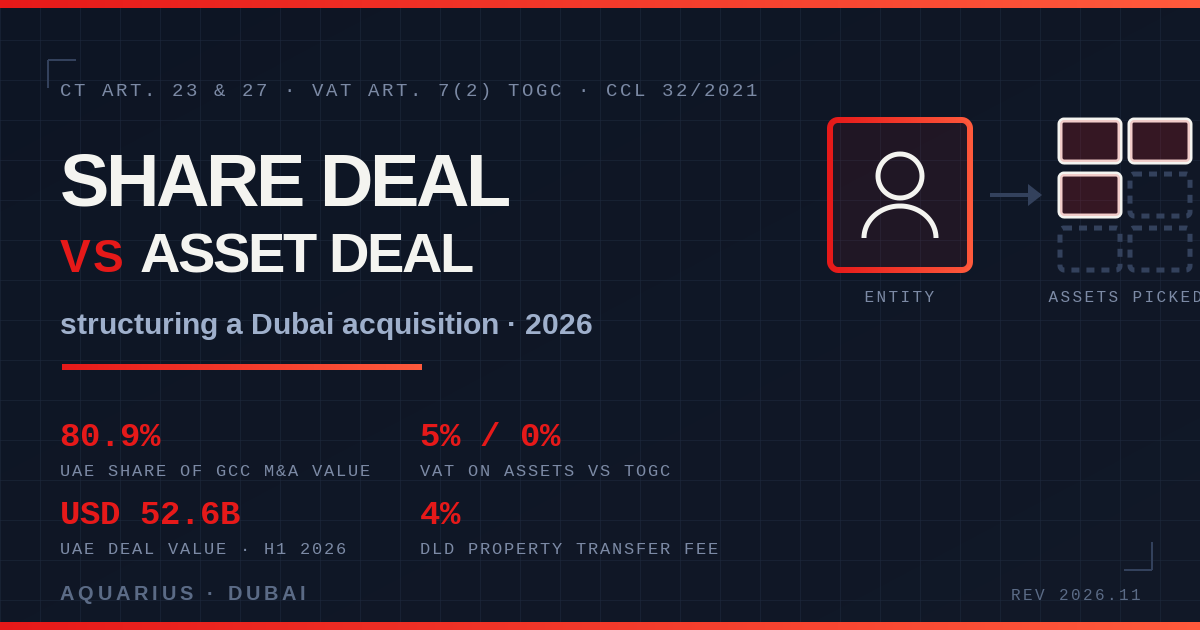
Short answer: in a share deal you buy the company, so the trade licence, the TRN, the staff visas, the bank mandate and every system stay exactly where they are — and so does every historic liability. In an asset deal you buy a chosen list of assets, which means 5% VAT unless the transfer qualifies as a going concern under Article 7(2) of the VAT Decree-Law, a new trade licence, end-of-service gratuity crystallising on every employee, and a rebuild of the operating stack behind the business. Dubai sellers almost always want the share deal; buyers with legacy-exposure worries want the asset deal. The tax and the systems bill decide who wins.
Most Dubai buyers argue structure for six weeks on tax grounds alone, sign, and then discover the part nobody modelled: an asset deal hands you a business whose payment gateway, VAT invoicing, SaaS tenancy and customer database all belong to a legal entity you did not buy.
The 2026 market: fewer deals, much bigger ones
This is not a niche question any more. Grant Thornton’s GCC and UAE M&A review put disclosed GCC deal value at USD 65.1 billion in H1 2026, up 12.1% on the USD 58 billion a year earlier — and the UAE alone accounted for USD 52.6 billion, or 80.9% of the region’s disclosed value. On volume the UAE took 131 of the region’s 192 transactions (68.2%), while total GCC volumes fell 17.9% from 234 deals in H1 2025. EY’s MENA M&A report counted 390 completed deals worth USD 46.7 billion across MENA in H1 2026.
Read those two numbers together: value up, volume down. Buyers are doing fewer, larger, more structured transactions — and acquisitions made up 64.1% of GCC deal volume, meaning control deals where the share-versus-asset fork is live rather than minority stakes where it is not.
The Dubai mid-market has quietly professionalised. Five years ago a AED 20 million business changed hands on a two-page agreement and a licence amendment. In 2026 the same deal carries a tax structuring memo, a data-protection annex and a systems separation plan — because the downside of getting any of the three wrong is now measurable.
What actually changes hands
Share deal
You buy the shares; the company carries on as the same legal and taxable person. It keeps its trade licence, its corporate tax registration, its TRN, its VAT filing history, its contracts, its employees and their accrued service, its bank accounts and its merchant IDs. You also inherit every liability sitting in it, disclosed or not — which is why warranty packages and indemnities do the heavy lifting on a share deal. On a mainland LLC you must also clear statutory pre-emption rights under Federal Decree-Law No. 32 of 2021: existing partners have a first right over the shares, and it cannot be waived in advance — the waiver has to be given at the time of the transaction. DIFC and ADGM companies sit under common-law regimes with no equivalent statutory pre-emption.
Asset deal
You buy a schedule: equipment, stock, IP, goodwill, specified contracts, maybe property. Everything not on the schedule stays with the seller, including unknown and contingent liabilities — the entire appeal. The cost is that nothing transfers automatically. Each material contract needs the counterparty’s consent or a novation. Employees have to be terminated and re-hired. The buyer needs its own licence and approvals for the activity. And the assets are a supply for VAT purposes unless the going-concern relief applies.
The tax fork, in both directions
For the seller, the gap is stark. A qualifying share disposal can land fully outside corporate tax under the participation exemption — broadly a 5% ownership interest or AED 4 million acquisition cost, held for an uninterrupted 12 months, where the target is subject to tax at a minimum 9% rate. An asset sale has no equivalent: gains are ordinary taxable income at 9% above the AED 375,000 threshold.
For VAT, the directions reverse. A share transfer is not a taxable supply, so no 5% is charged — but that also restricts input VAT recovery on deal costs, which on a mid-market Dubai transaction means the 5% on advisory fees is a real, non-recoverable cost. An asset transfer is a supply at 5% VAT unless it qualifies as a transfer of a business as a going concern. The FTA’s Public Clarification VATP015 (issued 20 August 2019) sets the conditions: there must be a transfer of the whole or an independent part of a business, the recipient must be a taxable person, and the recipient must intend to continue the business transferred. Sell the assets on their own, even as part of winding down, and it is not a TOGC — it is a 5% supply, and the transferor owes the VAT.
There is a third route people forget. Article 27 Business Restructuring Relief lets a taxable person transfer an entire business, or an independent part of it, in exchange for shares or other ownership interests, at net book value on a no-gain-no-loss basis. The conditions are tight: all parties must be UAE taxable persons that are not exempt and not Qualifying Free Zone Persons, must share the same financial year and accounting standards, and the transaction must have valid commercial reasons. The relief is elected in the corporate tax return — and there is a two-year clawback: dispose of the shares received, or of the transferor or transferee, outside the qualifying group within two years and the relief is unwound.
Buyers should also note the basis difference, because it is worth real money over five years. A share deal gives you no step-up — you inherit historic tax values and historic depreciation. An asset deal steps the basis up to what you actually paid, which is a deductible shield you can model. That shield is frequently the number that justifies absorbing the asset-deal friction.
The friction bill, priced
These are the transaction mechanics on a Dubai mainland deal, not the advisory fees.
| Item | Share deal | Asset deal |
|---|---|---|
| VAT on the transaction | Not a supply — nil | 5% unless TOGC conditions met |
| Seller corporate tax on gain | Potentially nil (participation exemption) | 9% above AED 375,000 |
| DET application fee | AED 1,000–2,000 | Included in new licence |
| Trade licence update | AED 2,000–3,500 | New licence AED 10,000–50,000+ |
| Notary on MoA amendment | 0.25% of the share transfer value | Not applicable |
| Notarisation and legal translation | AED 500–1,500 | Per-contract novation drafting |
| Dubai real property transfer | Nil — title does not move | 4% of property value (DLD) |
| Trademark / IP assignment | Nil | AED 500–2,000 per registration |
| Employees | Service continues; no gratuity triggered | Gratuity crystallises; visas AED 3,000–5,000 each |
| Typical DET processing | 7–10 working days | Licence, then 2–4 weeks per visa batch |
The gratuity line is the one that moves a price. End-of-service pay runs at 21 days’ basic salary per year for the first five years and 30 days thereafter, capped at two years’ total pay. On a 40-person services business with long-tenured staff, terminating and re-hiring in an asset deal can convert a soft balance-sheet provision into an immediate cash settlement — and someone has to fund it at completion.
If the combined annual UAE sales of the parties exceed AED 300 million, or combined market share exceeds 40% of the relevant UAE market, the deal is notifiable to the Ministry of Economy at least 90 days before completion either way — which is part of why the price mechanism and the signing-to-completion gap need deciding at the same time as the structure.
The part nobody prices: your systems
Tax memos stop at the balance sheet. The business runs on software, and software does not care what your SPA says.
A share deal does not dodge change-of-control clauses
The common assumption is that buying shares sidesteps consent requirements because no contract is being assigned. That is only half true. A share purchase does defeat a pure anti-assignment clause — but most enterprise software and SaaS agreements are drafted with a separate change-of-control trigger precisely to stop parties routing around assignment restrictions. An indirect change of ownership then requires notice, consent, or hands the vendor a termination right. Vendor consent takes days to several weeks, and is occasionally refused outright or priced as a re-negotiation. Map every material SaaS, hosting, ERP and licence agreement for change-of-control and competitor triggers during diligence, and treat each one as a completion condition. That mapping belongs in the same workstream as technical due diligence on the codebase itself.
An asset deal rebuilds the operating stack
Because the acquiring entity is new, the following do not come with the assets:
- The TRN. New entity, new VAT registration. Every tax invoice template, credit note, VAT return mapping and accounting integration has to be re-pointed. With UAE e-invoicing already running — voluntary adoption opened 1 July 2026, businesses with revenue of AED 50 million or more had to appoint an Accredited Service Provider by 30 October 2026 and go live 1 January 2027, and everyone below that threshold by 1 July 2027 — a mid-deal TRN change means redoing ASP onboarding and field mapping against a hard regulatory date, not a convenient one.
- The merchant account. A payment gateway is onboarded against a specific trade licence, UBO set and authorised signatory. An ownership or licence change triggers re-verification; a brand-new entity means full KYB from scratch — trade licence, incorporation and ownership documents, beneficial-owner ID, IBAN, website, refund and privacy policies, expected volumes. PayTabs runs a seven-stage onboarding; Network International asks for the same documentary set. Checkout downtime here is revenue, not admin.
- The customer data. Moving a customer database to a different legal entity means a new controller under the UAE Personal Data Protection Law (Federal Decree-Law No. 45 of 2021), so you need a lawful basis documented before the files move, plus the cross-border conditions if hosting changes jurisdiction. Note that the federal executive regulations were still unissued through late 2026, so there is no Cabinet-set federal fine schedule to plan against — the defensible position is a documented basis and a conservative transfer record, not a reliance on numbers that are not law yet.
- Everything named after the seller. Domains, DNS, email tenancy, app store developer accounts, code repositories, CI pipelines, analytics properties, ad accounts, SSL certificates and third-party API keys all sit in seller-owned identities. Each one is a migration task with an owner and a date, and the pattern is the same one that governs a carve-out and its transition services exit.
Our own ranges for that work, on Dubai mid-market deals: a share-deal systems handover — records and UBO updates across portals, identity and access transfer, admin re-keying, no migration — typically runs AED 15,000–45,000 over two to four weeks. An asset-deal separation — new tenants, data migration, gateway re-onboarding, invoicing and TRN rework, a tracked contract-consent register — runs AED 90,000–350,000 over two to five months depending on how many systems and how much customer data are in scope. See how we scope and price build work.
Which structure, when
Pick a share deal when the target’s licence, approvals or regulatory permissions are hard to re-obtain; when staff tenure is long and gratuity would crystallise expensively; when customer contracts are numerous and consent-gathering is impractical; when the seller needs the participation exemption to make the price work; or when the business is software-heavy and migration risk outweighs liability risk.
Pick an asset deal when the target entity carries unquantifiable legacy exposure — tax positions, litigation, employment claims; when you want only part of the business; when a stepped-up tax basis is worth more than the friction; or when the seller is retaining other operations and the deal is in substance a carve-out anyway.
And model the Article 27 route before you default to either, because a share-for-business exchange at net book value sometimes beats both — as long as you can live with the two-year holding requirement.
FAQ
Is a share sale or an asset sale better for tax in Dubai?
For the seller, usually a share sale: a qualifying disposal can be exempt from corporate tax under the participation exemption (5% ownership or AED 4 million acquisition cost, 12 months uninterrupted holding, target taxed at a minimum 9%), while asset-sale gains are taxable at 9% above AED 375,000. For the buyer, an asset deal is often better because it steps the tax basis up to the price paid, where a share deal inherits historic values with no step-up. The two preferences pull against each other, which is why the structure is priced, not assumed.
Do I pay 5% VAT when buying a business in the UAE?
On a share purchase, no — the transfer of shares is not a taxable supply. On an asset purchase, yes at 5% unless the deal meets the transfer-of-going-concern conditions in Article 7(2) of the VAT Decree-Law, as clarified in FTA Public Clarification VATP015: a transfer of the whole or an independent part of a business, to a taxable person, who intends to continue that business. Selling assets alone does not qualify, and the transferor is liable for the VAT if it does not.
Does the trade licence transfer with the business?
In a share deal the licence stays with the company — you file a change of ownership with the Dubai Department of Economy and Tourism, amend the MoA before a notary, and the licence reissues in the new ownership structure, typically in 7 to 10 working days, with DET fees around AED 1,000–2,000 plus a licence update of AED 2,000–3,500 and notary fees at 0.25% of the share transfer value. In an asset deal the licence does not move: the buying entity must hold its own licence and activity approvals before it can trade.
What happens to employees in a UAE asset deal?
Their employment with the seller ends, so end-of-service gratuity becomes payable — 21 days’ basic salary per year for the first five years, 30 days thereafter, capped at two years’ total pay — and the buyer re-hires under new contracts, with new visas at roughly AED 3,000–5,000 per employee and 2 to 4 weeks of processing per batch. In a share deal nothing happens: the employer is the same company, service is continuous, and no gratuity crystallises.
Will my SaaS and software contracts survive the deal?
Not automatically, in either structure. In an asset deal every licence and subscription needs assignment or novation, which means vendor consent. In a share deal pure anti-assignment clauses are not triggered, but separately drafted change-of-control clauses usually are — giving the vendor a notice, consent or termination right on an indirect ownership change. Build a consent register during diligence and treat the material ones as completion conditions, not post-closing housekeeping.
Where Aquarius fits
We are not your deal counsel or your tax advisors. We are the team that makes the structure survive contact with production: the systems inventory that tells you what an asset deal will actually cost, the consent register for change-of-control clauses, the migration of tenants, gateways, data and pipelines into the acquiring entity, and the invoicing and e-invoicing rework that a new TRN forces. On the deals that go wrong, the tax was fine and the checkout was down for nine days.
See what we build for Dubai acquirers, or tell us about the transaction and we will tell you which structure your technology stack can actually absorb.