
Software Company Licence in Dubai (2026): Free Zone vs Mainland, Real AED Costs and the Rule That Changed
A Dubai software licence runs AED 12,500-45,000 in a free zone and AED 40,000-80,000+ on the mainland. Real 2026 costs, the new mainland permit, and the 0% tax trap.
- PUBLISHED
- 25 SEPT 2026
- READ TIME
- 10 MIN
- AUTHOR
- AQUARIUS · DUBAI
- UNIT
- REV 2026.09
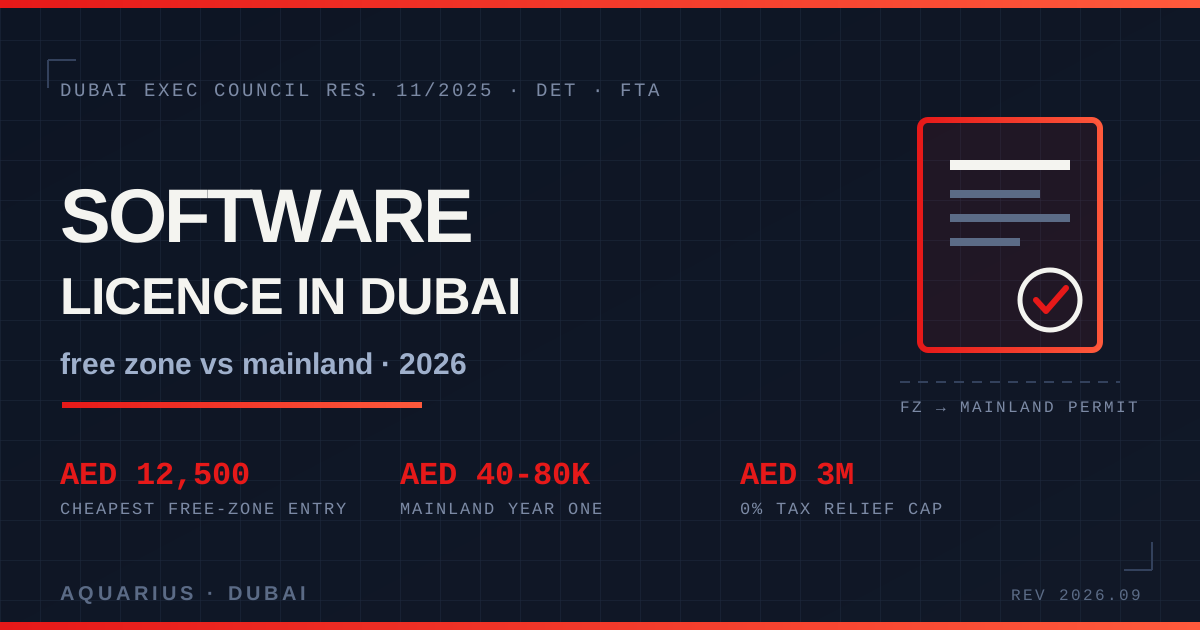
Short answer: A software or IT company licence in Dubai costs AED 12,500-15,000 a year at the cheapest free-zone entry point, AED 20,000-45,000 for a realistic first year in a tech free zone with a visa and a desk, and AED 40,000-80,000+ on the mainland with a DET licence, office and visas. The cheap number is rarely the cheap decision. Since Dubai Executive Council Resolution No. 11 of 2025 a Dubai free-zone company can finally sell on the mainland with a DET permit - but the moment it does, that mainland revenue is usually non-qualifying, and it can cost the company the 0% corporate tax rate the free zone existed to give it.
Key takeaways
- The old rule is dead: "a free-zone company cannot invoice mainland clients" stopped being true in Dubai on 3 March 2025, when Resolution No. 11 of 2025 was gazetted. Over 10,000 free-zone firms are eligible for a DET mainland permit.
- Cheapest legal entry: around AED 12,500-12,900 a year for a zero-visa free-zone package; each visa adds roughly AED 2,000-3,000 in licence terms plus medical, Emirates ID and establishment card costs.
- The tax cliff nobody quotes: a Qualifying Free Zone Person keeps 0% only while non-qualifying revenue stays under 5% of total revenue and AED 5,000,000. One large mainland enterprise contract can break it.
- The genuine 0% for small studios: Small Business Relief at revenue up to AED 3,000,000 now runs to tax periods ending on or before 31 December 2029 (Ministerial Decision No. 131) - but you have to elect it on the return.
- A build deadline, not just a tax one: under Ministerial Decisions 243 and 244 of 2025, businesses under AED 50m revenue must appoint an Accredited Service Provider by 31 March 2027 and be issuing structured e-invoices by 1 July 2027. Your invoicing system is now compliance software.
Dubai is licensing tech companies faster than it is building offices (TOFU)
Three numbers explain why this question gets asked ten times a day in Dubai. First, the Dubai Chamber of Digital Economy supported the establishment and expansion of 1,690 digital startups during 2025, a 39.7% increase on 2024, with AI companies about 15% of them and fintech 12%, while mobility tech, SaaS and e-commerce together made up another 20%. Second, 75% of the companies it supported were global businesses - founders relocating into Dubai rather than Dubai residents starting up. Third, the emirate issued nearly 19,000 new business licences in Q1 2025 alone, out of roughly 40,000 nationwide, and accounted for 59% of all registered commercial licences in the UAE by the end of March 2025.
Administration has moved with the volume. More than 900,000 Dubai Unified Licences (DUL) have been issued across mainland and free zones, and Dubai's government says the unified licence number has cut bank account opening time by about 90%. That matters more than it sounds: for a software company, the bank account - not the trade licence - is usually the thing that delays the first invoice.
What most founders get wrong: they shop for the lowest licence price, then discover the licence was 20% of the real first-year cost and the wrong 20% to optimise. The licence decides who you are legally allowed to sell to, what tax rate you pay, how many visas you can issue and whether you can bid for government work. Price it last.
The rule that changed: free-zone firms can now work the mainland
For twenty years the received wisdom was that a free-zone company could not serve mainland UAE clients without a local distributor, agent or a separate onshore entity. Dubai Executive Council Resolution No. 11 of 2025, published in the Official Gazette on 3 March 2025 with immediate effect, replaced that for Dubai. A qualifying free-zone establishment can now apply through the Department of Economy and Tourism (DET) for either a branch licence - valid for one year and renewable, operated either from a mainland address or from the free-zone premises - or a temporary permit for a specific activity of up to six months. Firms already doing mainland work informally were given one year from 3 March 2025 to regularise, with one possible extension.
Two caveats keep this from being a free lunch. It is a Dubai framework: for Abu Dhabi, Sharjah and the other emirates, the traditional branch, agency or dual-licence route still applies. And government contracts are still awarded almost exclusively to mainland entities - if public-sector or semi-government work is in your plan, that is the argument for a mainland licence on day one, not the tax rate.
What a software company licence really costs in 2026 (MOFU)
These are indicative 2026 figures for the routes a development, SaaS or AI company in Dubai actually uses. Licence fees are annual; setup and registration fees are one-off.
| Route | Indicative 2026 cost (AED) | Visas / notes |
|---|---|---|
| Budget free zone, zero-visa package (IFZA, Meydan) | from 12,500 - 12,900 a year | Each visa adds roughly 2,000 - 3,000 in licence terms |
| Dubai Silicon Oasis, flexi-desk package | 15,000 - 20,000 a year incl. registration | Quota of 2 visas per flexi desk, 3 per fixed desk |
| Dubai Silicon Oasis, commercial office | 12,000 licence + 6,900 one-off registration + 2,200 card + 10% of rent as deposit | Higher visa quota, real premises, Dtec ecosystem |
| Dubai Internet City | licence about 13,500; flexi-desk entity 15,000 - 25,000; private office 25,000 - 40,000+ | About 17% above the UAE free-zone licence average of 11,504 |
| DIFC Innovation Licence | about USD 1,500 a year (roughly AED 5,500) | Around 90% subsidised, up to 4 visas, DIFC Innovation Hub access |
| DIFC AI & Coding Licence | USD 12,500 a year plus USD 8,000 application | For funded, regulated-adjacent AI businesses |
| Mainland DET commercial / professional licence | licence issuance 10,000 - 15,000; first year all-in 40,000 - 80,000+ | Ejari office, unrestricted onshore trade, government tenders |
Rolled up, an IT or software licence in Dubai typically lands at AED 20,000-45,000 for the first year depending on structure. All-in first-year comparisons published by Dubai setup advisors put a free-zone software company at roughly AED 34,000-72,000 against AED 71,000-157,000+ on the mainland once office, visas and approvals are counted. Renewals typically run 70-85% of the year-one figure, because registration and documentation fees do not repeat but licence, desk, establishment card and visa costs do.
The DIFC Innovation Licence is the outlier worth a hard look: at about AED 5,500 a year with up to four visas, it is cheaper than most flexi-desk packages and carries far more signalling weight with investors and enterprise procurement teams. It is also the narrowest - it is aimed at technology, AI, Web3 and fintech startups, and DIFC vets what you actually do.
The tax maths that should actually pick your route
UAE corporate tax is 0% on taxable income up to AED 375,000 and 9% above it. Two reliefs sit on top, and they point in opposite directions.
Small Business Relief treats an eligible business with revenue of AED 3,000,000 or less as having no taxable income - an effective 0%, with simplified filing. It was due to expire at the end of 2026; Ministerial Decision No. 131 extended it to tax periods ending on or before 31 December 2029. Critically, you must elect it on your return; it is not automatic. For the majority of Dubai software studios - the two-to-eight-person team billing under AED 3m - this is the real 0%, and it applies on the mainland exactly as it does in a free zone.
Qualifying Free Zone Person (QFZP) status is the other 0%, and it is conditional. A QFZP pays 0% only on Qualifying Income, and it keeps that status only while non-qualifying revenue stays within the de minimis threshold: 5% of total revenue or AED 5,000,000, whichever is lower, per the FTA's free zone persons guide. Mainland B2B revenue is generally non-qualifying unless it falls inside a specific carve-out. Read that alongside Resolution No. 11 and the trap is obvious: the new mainland permit gives a free-zone dev shop access to the largest client pool in the emirate, and using it past the de minimis line puts all of its income into the 9% band, not just the mainland part. If mainland enterprise work is your growth plan, a mainland licence plus Small Business Relief is often cleaner than a free-zone licence you will spend the next three years defending.
Then the transaction taxes. VAT registration is mandatory once taxable supplies pass AED 375,000 in the previous 12 months or are expected to within 30 days, voluntary above AED 187,500, and late registration draws a AED 10,000 penalty. For a software company that mostly bills UAE clients, the TRN is not optional in practice either - enterprise procurement will ask for it before they raise a PO.
The 2026-27 compliance work that lands on your software, not your accountant
Under Ministerial Decisions Nos. 243 and 244 of 2025, the UAE is moving B2B and B2G invoicing onto structured e-invoices exchanged through Accredited Service Providers. The pilot and voluntary phase opened on 1 July 2026. Businesses with revenue of AED 50 million or more must appoint an ASP by 30 October 2026 (extended from 31 July 2026) and go live by 1 January 2027; businesses under AED 50 million must appoint an ASP by 31 March 2027 and go live by 1 July 2027.
That is a development project with a legal deadline. If you invoice from a custom app, a Zoho or Odoo instance, or a bespoke SaaS billing flow, something has to emit compliant structured invoices to an ASP and store the acknowledgements. We cover the field mapping and sequencing in our UAE e-invoicing and VAT invoicing guide. The same logic applies to data: a new licence means a new website and CRM collecting personal data on day one, which is PDPL territory from the first form submission.
Budget the first year properly, then build (BOFU)
A defensible first-year budget for a two-founder Dubai software company looks like this. Licence and structure: AED 15,000-25,000 in a free zone with a desk and one or two visas, or AED 40,000-60,000 on the mainland with a small Ejari office. Per-visa extras: establishment card, medical, Emirates ID and insurance - budget a few thousand dirhams per person beyond the licence quote. Commercial infrastructure: a site that closes enterprise buyers, a CRM that survives your first 200 leads, and invoicing that will pass the 2027 e-invoicing test. Working capital: plan for the bank account, not the licence, to set your start date - even with the DUL cutting account opening time by roughly 90%, corporate onboarding is still the long pole.
The cost of getting the route wrong is not the licence fee. It is a restructuring: a free-zone entity that wins a AED 6m mainland contract in year two can lose QFZP status on the whole year's income - a 9% swing on every dirham earned, not just on the new contract - and then pay again to open the onshore entity it should have opened first. That is an avoidable six-figure mistake made to save AED 30,000.
Aquarius does not sell trade licences, and that is exactly why we are useful at this stage: we build the commercial layer that has to exist the week the licence lands. A positioning-first website and landing pages that convert enterprise buyers, a CRM and quote flow wired to real pipeline reporting, VAT-correct and e-invoicing-ready invoicing, PDPL-compliant forms and consent, and Arabic where the audience needs it. If you are weighing routes, compare this with our numbers on the freelance permit path for Dubai developers - cheaper, faster, and enough to bill legally until you need a company - and with what a business setup consultancy's own website and CRM stack costs, if advising on setup is the business you are starting. Our published package prices are the budget baseline, and our services map to each stage of the build. Tell us your licence route and your target client type and we will scope the website, CRM and invoicing build against your licence timeline before you commit to either jurisdiction - no fee to get that plan.
Frequently asked questions
How much does a software company licence cost in Dubai in 2026?
Budget AED 12,500-12,900 a year for the cheapest zero-visa free-zone package, AED 15,000-25,000 for a free-zone entity with a flexi desk and one or two visas, and AED 40,000-80,000+ for a mainland DET licence with an office and visas. Typical all-in first-year figures for an IT or software company run AED 20,000-45,000 depending on structure, with renewals at about 70-85% of year one.
Can a Dubai free-zone software company invoice mainland clients?
In Dubai, yes - since Executive Council Resolution No. 11 of 2025, gazetted on 3 March 2025, a qualifying free-zone entity can obtain a DET branch licence (one year, renewable) or a temporary permit (up to six months) to carry out approved activities on the mainland. Other emirates still generally require a branch, agent or dual licence. Treat the tax side separately: mainland revenue is usually non-qualifying income for corporate tax purposes.
Will a free zone keep my tax at 0%?
Only conditionally. A Qualifying Free Zone Person pays 0% on Qualifying Income and keeps that status only while non-qualifying revenue stays within 5% of total revenue or AED 5,000,000, whichever is lower. Otherwise the 9% rate applies to income above AED 375,000. Separately, Small Business Relief gives an effective 0% to businesses with revenue up to AED 3,000,000 - mainland or free zone - for tax periods ending on or before 31 December 2029, if you elect it on your return.
Do I need a mainland licence for Dubai government software projects?
In practice, yes. Government and semi-government contracts in the UAE are awarded almost exclusively to mainland entities, and the new free-zone mainland permit does not change public procurement preferences. If tenders are in your plan, weigh a mainland DET licence from the start rather than restructuring later.
When does UAE e-invoicing affect my company?
The pilot and voluntary phase started on 1 July 2026 under Ministerial Decisions 243 and 244 of 2025. If your revenue is AED 50 million or more, appoint an Accredited Service Provider by 30 October 2026 and go live by 1 January 2027. Under AED 50 million, appoint by 31 March 2027 and go live by 1 July 2027. Whatever issues your invoices - custom app, ERP or SaaS - has to produce structured e-invoices through an ASP by then.
Dubai has made the licence the easy part: a few thousand dirhams, a few days, nearly 19,000 new licences in a single quarter. What it has not made easy is the sequence behind it - which clients you may bill, which 0% you are actually claiming, and which invoice format the FTA will accept in 2027. Pick the route that matches your buyer, elect the relief you qualify for, and build the commercial stack while the licence is still printing.