
Software Supply Chain Security in Dubai (2026): SBOMs, npm Worms and Real AED Costs
Supply chain compromise causes 16% of Middle East breaches at AED 31m each. SBOMs, npm worms and what it really costs to secure a Dubai codebase in 2026.
- PUBLISHED
- 23 OCT 2026
- READ TIME
- 12 MIN
- AUTHOR
- AQUARIUS · DUBAI
- UNIT
- REV 2026.09
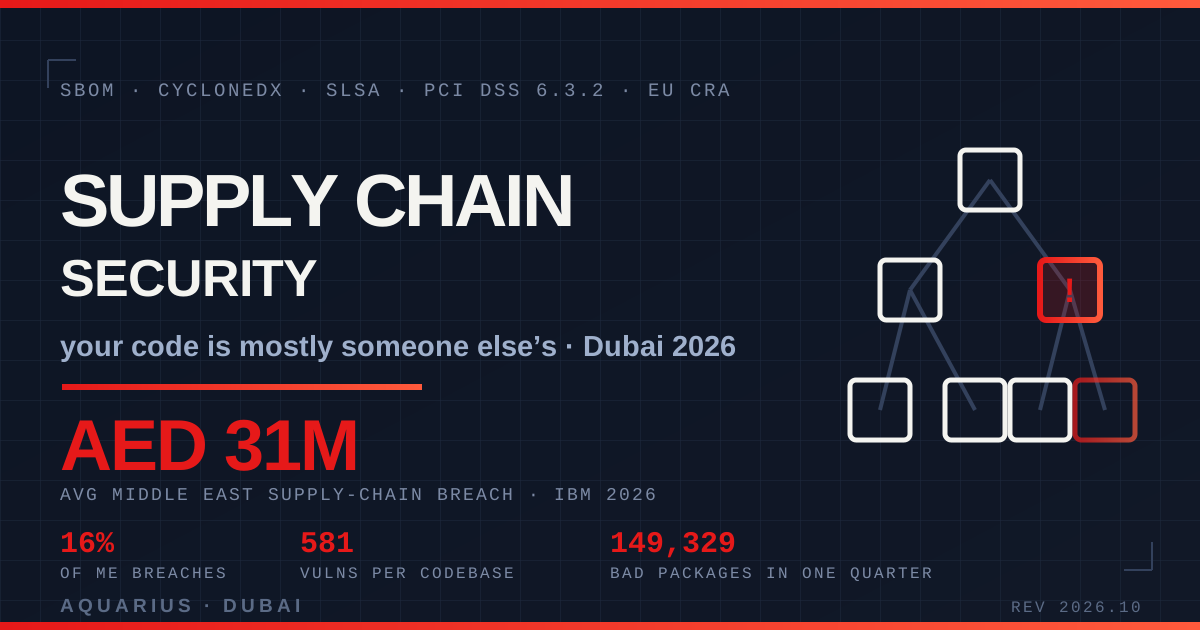
Short answer: supply chain compromise now causes 16% of all Middle East data breaches and costs an average of USD 8.45 million — about AED 31 million — per incident, which makes it the second most common way organisations in this region get breached, ahead of social engineering. The thing being compromised is rarely your own code. It is the 500-plus open-source packages your Dubai web app, mobile backend or AI product installs without anyone reading them. The fix is boring and cheap: an inventory of every component (an SBOM), a pipeline that cannot be published to with a stolen token, and someone whose job it is to read advisories. Budget AED 6,000–18,000 to get a first SBOM in place and AED 2,500–9,000 a month to keep it honest. Prices exclude 5% VAT.
The stakes: the most expensive code in your product is code you did not write
Three numbers set the scene, and all three are from 2026.
First, IBM’s Cost of a Data Breach 2026 puts the average breach in the Middle East at USD 8 million (roughly AED 29.4 million), broken down as USD 3.57 million in lost business, USD 2.17 million in post-breach response, USD 1.9 million in detection and escalation and USD 0.36 million in notification. Within that, supply chain compromise accounts for 16% of regional breaches at an average USD 8.45 million (about AED 31 million) — behind phishing (18%, USD 10.41 million) and level with social engineering (16%, USD 7.32 million). Globally the same report names supply chain compromise the single biggest cost amplifier, adding USD 227,250 (about AED 835,000) to a breach, with a 258-day average lifecycle.
Second, the dependency layer itself has got measurably worse. Black Duck’s 2026 Open Source Security and Risk Analysis report, based on audits of 947 commercial codebases across 17 industries and published on 25 February 2026, found the mean number of open-source vulnerabilities per codebase more than doubled, up 107% to 581. 87% of audited codebases contained at least one vulnerability, 78% contained a high-risk one and 44% contained a critical-risk one. Licence conflicts jumped from 56% to 68% of codebases — the largest single-year increase in the report’s history. The report attributes much of the jump to AI-assisted development pulling in dependencies faster than anyone reviews them.
Third, the attackers industrialised. Sonatype logged 149,329 malicious open-source packages in Q3 2026 alone, taking the cumulative count since 2017 to 1,960,846. The npm registry took 133,579 of them — 89.5% of the quarter. Of the 27,618 packages with overtly malicious behaviour, roughly three in four delivered a payload, stole secrets, or both. ReversingLabs’ 2026 report independently measured a 73% rise in malicious open-source packages.
Set that against the local threat volume. The UAE Cyber Security Council reports blocking around 600,000 cyberattacks a day — about 25,000 an hour — up from a 90,000–200,000 daily baseline earlier in 2026, with peaks above 800,000, and roughly 750,000 attempts against critical national infrastructure reported on 21 October 2026. Help AG has also found that 50% of vulnerabilities in UAE environments are more than five years old. That last figure is the real Dubai story: this is not an exotic-attack problem, it is a patch-hygiene problem.
Most Dubai businesses get this backwards. They pay AED 25,000 for an annual penetration test of code they wrote, and nothing at all to track the 581 known vulnerabilities sitting in code they installed.
What a real attack looks like now: Shai-Hulud, the self-spreading npm worm
On 24 November 2025 researchers detected the second wave of the Shai-Hulud npm campaign, named “The Second Coming” by its own operators. Within hours it had compromised more than 700 npm packages, created over 27,000 malicious GitHub repositories and exposed roughly 14,000 secrets across 487 organisations. Trojanised releases appeared under names any Dubai engineering team would recognise — Zapier, ENS Domains, AsyncAPI, PostHog and Postman packages — with a combined download volume near 132 million per month. Microsoft published defender guidance on 9 December 2025, and a later wave tracked as CHAINDROP hit 400-plus more packages.
Two mechanics matter for how you defend. Version one ran from the postinstall lifecycle hook; version two moved to preinstall, so the payload executes before installation completes — a failed npm install still infects the machine. And it did not just steal: it planted GitHub Actions backdoors for persistence and carried a destructive dead-man’s switch that triggered when it detected containment. A developer laptop in Business Bay running one bad install becomes a credential leak, a poisoned CI pipeline and a seeded public repository of your own secrets, in that order.
The registries have responded by killing long-lived credentials, and this changes your pipeline whether you publish packages or not. npm began revoking classic tokens on 9 December 2025. Granular tokens with write access now require 2FA and are capped at a 90-day lifetime; npm login issues a session token that expires in two hours; and granular tokens that bypass 2FA are barred from sensitive account actions, with a full prohibition from January 2027. The replacement is trusted publishing via OIDC, where your CI proves its identity to the registry and no token is stored anywhere. If your deploy still depends on an NPM_TOKEN secret that a former contractor may have copied, that is the first thing to retire — see our Dubai CI/CD setup cost guide for where this sits in a pipeline.
What an SBOM actually is, and the four controls that do the work
A Software Bill of Materials is a machine-readable list of every component in a build, its version, its licence and where it came from. Two formats dominate — CycloneDX (OWASP) and SPDX (Linux Foundation) — and almost every tool can emit either. An SBOM is not a security control by itself. It is the inventory that makes every other control possible: when the next Shai-Hulud lands, the only question that matters is “do we ship that package, in which product, at which version?” Teams with an SBOM answer in minutes. Teams without one spend the 258 days IBM measured.
| Control | What it actually stops | Effort to put in place |
|---|---|---|
| SBOM generation in CI (CycloneDX or SPDX) | Blind spots. Answers “are we affected?” in minutes, not weeks | 1–2 days per application |
Lockfile pinning + npm ci / --frozen-lockfile only | Silent version drift and a compromised patch release landing in production | Hours, plus a build-script policy |
Disabling install scripts (--ignore-scripts) with an allowlist | The exact preinstall execution Shai-Hulud V2 relies on | 1–3 days of regression testing |
| OIDC trusted publishing + short-lived CI credentials | Stolen tokens being used to publish or deploy on your behalf | 1–2 days per pipeline |
| Advisory triage with a patch SLA | The 50% of UAE vulnerabilities older than five years | Ongoing, 2–6 hours a week |
Tooling is the cheap part. GitHub’s dependency graph and Dependabot alerts are free; GitHub Code Security lists at USD 30 and Secret Protection at USD 19 per active committer per month (an active committer being anyone whose commit reached an enabled repository in the last 90 days, counted once across the enterprise). Snyk’s Team plan lists at USD 25 per developer per month billed annually, with bundled enterprise tiers quoted far higher. For a ten-developer Dubai product team, both GitHub products together come to roughly AED 1,800 a month. That is 0.006% of the average regional supply-chain breach.
The three rules that now reach Dubai companies
1. The UAE Secure Supply Chain Programme. Under the UAE National Cybersecurity Strategy 2025–2031, the Cyber Security Council’s Secure Supply Chain Programme moves the country towards requiring SBOM transparency in government procurement, alongside a third-party security policy that sets baseline requirements for suppliers. In parallel, the rollout of the National Cyber Accreditation Programme (NCAP) during 2026 begins restricting the use of unaccredited cybersecurity service providers for critical information infrastructure. If you sell software to a UAE federal or Dubai government entity, or to a bank, hospital, utility or telco, expect component-level questions in the next tender — and expect your own vendors to be asked the same.
2. PCI DSS v4.0.1 Requirement 6.3.2. Any Dubai business touching card data must maintain “an inventory of bespoke and custom software, and third-party software components incorporated into bespoke and custom software… to facilitate vulnerability and patch management”. This has been fully required since 31 March 2025. The standard never says “SBOM” and mandates no format, which is why so many Dubai merchants fail it on evidence rather than intent — a spreadsheet last updated at launch is not a maintained inventory. Our PCI DSS compliance cost guide for Dubai covers where this sits in an assessment.
3. The EU Cyber Resilience Act, if you sell into Europe. Article 14 reporting of actively exploited vulnerabilities and severe incidents through the ENISA single reporting platform applies from 11 September 2026, and Article 69(3) extends it to products already on the EU market. The Annex I SBOM obligation binds from 11 December 2027. Practically, the earlier date is the real deadline: you cannot report an exploited component inside 24 hours if you do not know which components you ship. Plenty of Dubai and Abu Dhabi product companies sell to EU customers and have not yet read this.
What it costs in Dubai, in AED
Below are the ranges we quote in 2026 for Dubai and wider UAE clients. Scope drives the number — repositories, languages, pipelines and how much of the build is someone else’s container image.
| Engagement | AED | Typical timeline |
|---|---|---|
| Dependency inventory + first SBOM, one application | 6,000–18,000 | 3–7 days |
| Pipeline hardening — OIDC publishing, lockfile and install-script policy, least-privilege CI, artifact provenance | 15,000–45,000 | 1–3 weeks |
| Programme across multiple repos — SBOM registry, policy gate in CI, vendor questionnaire pack, PCI 6.3.2 evidence | 55,000–160,000 | 4–10 weeks |
| Compromise response — token rotation, repository sweep, forensic dependency diff | 12,000–40,000 | 24–96 hours |
| Monthly watch — advisory triage, patch pull requests, quarterly SBOM refresh | 2,500–9,000 / month | ongoing |
| Scanner licences passed through at cost (10 developers) | ~900–1,800 / month | — |
Compare that with hiring. A DevSecOps engineer in the UAE averages around AED 24,500 a month (roughly AED 203,300–359,000 a year), and an application security engineer in Dubai averages about AED 21,255 a month (AED 255,066 a year); adding DevSecOps skills to a DevOps role carries an AED 3,000–6,000 monthly premium on its own. For a team under about 15 developers, the economics are not close — the work is a few days of setup and a few hours a week of triage, not a full-time salary. Full ranges are on our pricing page.
How Aquarius does it
We run this as a fixed-scope hardening sprint, not a subscription you cannot audit. Week one: generate a CycloneDX SBOM for every build, reconcile it against what is actually deployed, and produce a ranked list of exploitable versus merely-present vulnerabilities — of those 581 average findings, usually a few dozen are reachable from an untrusted input. Week two: pin lockfiles, apply the install-script policy, move publishing and deploys to OIDC with no stored tokens, and add a CI gate that fails a build on a new critical component. Then we hand over the evidence pack your auditor or your enterprise client will ask for, in the wording PCI DSS 6.3.2 uses.
If you are buying or selling a software company in the UAE, the same inventory is the first artefact a buyer requests — our technical due diligence guide explains how component and licence findings re-trade deals. And if your concern is the application code rather than its dependencies, that is a different exercise: see what a penetration test costs in Dubai.
FAQ
Is an SBOM legally mandatory in the UAE?
Not yet as a blanket federal obligation. The UAE Secure Supply Chain Programme under the National Cybersecurity Strategy 2025–2031 is moving towards requiring SBOM transparency for government procurement, and NCAP’s 2026 rollout restricts unaccredited providers for critical information infrastructure. If you take card payments, the equivalent inventory requirement is already binding under PCI DSS 6.3.2 as of 31 March 2025, and if you sell into the EU, the CRA SBOM obligation binds from 11 December 2027.
CycloneDX or SPDX?
Either. PCI DSS mandates no format and the CRA accepts a machine-readable bill of materials covering at least top-level dependencies. CycloneDX tends to fit security and vulnerability workflows more naturally; SPDX has deeper licence-compliance heritage. Pick one, generate it in CI on every build, and keep the history — a single SBOM from launch day is worth very little.
Is Dependabot enough on its own?
It is the right free starting point and it will catch known advisories in your direct dependencies. It will not give you a deployed-versus-declared inventory, it will not stop a malicious preinstall script executing on a developer laptop, and it will not produce the evidence an auditor or an enterprise procurement team asks for. Treat free alerts as detection, not as a programme.
We think we were hit by a compromised package. What first?
Rotate every credential that a build machine or developer laptop could have read — registry tokens, cloud keys, CI secrets, personal access tokens — before you start the forensics, because Shai-Hulud V2 exfiltrates secrets and then uses them. Then audit GitHub Actions workflows and any newly created repositories under your org, pin the known-good versions, and diff the lockfile against the last clean build. Under the UAE PDPL you may also have a 72-hour notification clock running; our PDPL checklist covers that path.
We use WordPress and no-code tools, not npm. Does this apply?
Yes, with different vocabulary. Plugins, themes, browser extensions and marketplace connectors are dependencies with the same trust model and usually worse update discipline. The controls translate directly: a maintained inventory of every plugin and version, pinned updates reviewed before they apply, removal of anything unused, and least-privilege API keys for every connector.
The one-line version
You already outsourced most of your product to strangers on the internet — that was the right call, and it is how software gets built in 2026. What is not optional any more is knowing which strangers. An inventory plus a hardened pipeline costs a few thousand dirhams and a few hours a week; the regional average when it goes wrong is AED 31 million.
Talk to Aquarius about a supply chain hardening sprint for your Dubai product — we will generate your first SBOM and hand back a ranked, exploitable-first findings list before you commit to anything further.