
Tap to Pay in Dubai 2026: Your Phone Is the Card Machine
Dubai wants 90% of payments cashless by 2026, and a phone now takes cards for AED 0 in hardware. Real 2026 fees, the PCI MPoC rules, and why Stripe cannot do it in the UAE.
- PUBLISHED
- 23 OCT 2026
- READ TIME
- 12 MIN
- AUTHOR
- AQUARIUS · DUBAI
- UNIT
- REV 2026.09
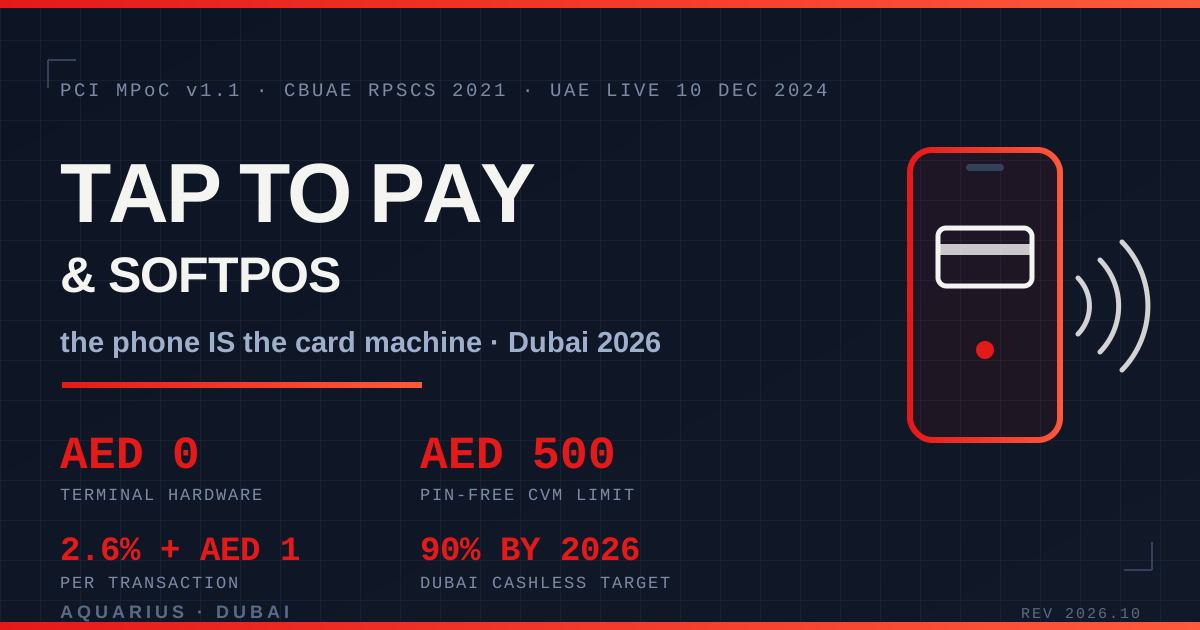
In Dubai in 2026 you no longer need a card machine to take card payments. An iPhone XS or newer, or any NFC Android phone, becomes a contactless terminal through a licensed provider’s app — AED 0 in hardware, no rental contract, live in a day. The going rate is about 2.6% plus AED 1 per transaction with no setup or monthly fee, against AED 50–200 a month in terminal rental plus a 2.5–3.0% merchant discount rate on a traditional POS. The catch most Dubai businesses discover late: the provider you assumed would do this — Stripe — does not offer Tap to Pay in the UAE at all.
The stakes: AED 565 billion on cards and a 90% cashless deadline
Dubai is not drifting toward cashless, it has a date on it. The Dubai Cashless Strategy, launched in October 2024 by Sheikh Hamdan bin Mohammed bin Rashid Al Maktoum and run by Dubai Finance, targets 90% of all transactions — government and private sector — cashless by 2026, with an estimated upside of more than AED 8 billion a year in GDP from fintech-led growth. A dedicated Digital Payment Systems Regulatory Division was stood up inside the Department of Finance in December 2024 to drive it.
The card numbers back the deadline. UAE card transactions were forecast at AED 565.5 billion in 2025, up 10.6% from AED 511.4 billion in 2024. Debit-card point-of-sale transactions alone passed 522 million during 2025, and point-of-sale accounted for roughly 80% of UAE payment value on the back of about 92% NFC-enabled terminal coverage and 87% contactless card penetration. The Central Bank reported 82% of in-store card transactions were contactless in 2024; more recent readings put contactless above 90% of all face-to-face payments.
If 9 in 10 of your walk-in customers are already tapping, the only question left is whether the thing they tap costs you AED 0 or AED 2,400 a year.
That is the gap Tap to Pay closes. Every Dubai business that takes money in person but has no terminal — home salons, personal trainers, delivery drivers, market stalls, field sales reps, pop-up stands, mobile car washes, trade-show booths — has been running on cash and bank-transfer screenshots in a city that is legislating both out of the default.
What Tap to Pay and SoftPOS actually are
SoftPOS means software-only payment acceptance on ordinary consumer hardware. The customer’s card or wallet taps the back of your phone, the phone’s own NFC radio reads it, and the transaction is encrypted and routed to an acquirer. No dongle, no reader, no cable.
The security rules come from the PCI Security Standards Council. MPoC — Mobile Payments on COTS (commercial off-the-shelf devices) — was published in November 2022 and replaces two earlier half-measures: SPoC (PIN entry on a phone paired with an attached reader) and CPoC (contactless with no PIN). MPoC merges both and is modular, with three independently validated pieces: the MPoC Software (the SDK), the Attestation and Monitoring service that continuously checks the phone has not been rooted or tampered with, and the MPoC Solution end to end. The current revision is v1.1 — Ingenico’s SoftPOS SDK certified against it in April 2025, and Castles Technology has completed validation across all three parts.
Why this matters commercially: MPoC is what lets a phone take a PIN on the glass. Without it you are capped at no-PIN contactless, which in the UAE means a hard ceiling on every transaction.
The AED 500 line
The UAE Central Bank sets the cardholder verification method (CVM) limit at AED 500, raised from AED 300 — a 67% increase. Below AED 500 a tap clears with no PIN. Above it the cardholder must verify, and on a phone that means on-screen PIN entry, which Apple supports on iOS 16.4 and later. If your average basket is AED 180 this never bites. If you sell AED 3,000 furniture out of a van, the PIN flow is not optional — confirm with your provider that it is enabled before you commit.
What is actually live in the UAE, and what is not
Apple launched Tap to Pay on iPhone in the UAE on 10 December 2024, with Adyen, Magnati and Network International as the first enabled platforms. It requires an iPhone XS or later on current iOS plus an app from a partner platform, and accepts contactless Visa, Mastercard and American Express cards, Apple Pay and other digital wallets.
Since then the stack has filled in. Dubai fintech Ziina shipped Tap to Pay on both iPhone and Android in April 2025 and has pushed it into the free zones — Dubai CommerCity in July 2025, Meydan Free Zone in October 2025 — as the default acceptance tool for member SMEs. Sharjah Islamic Bank launched SIB Pay in November 2025, bundling soft POS with QR and pay-by-link. On the card side Jaywan, the UAE domestic scheme run by Al Etihad Payments, supports EMV chip and contactless and was accepted at most UAE terminals and ATMs by January 2026, with nationwide issuance and online acceptance expanding from July 2026 — so domestic-scheme volume is arriving on your phone whether you planned for it or not. If you are wiring Jaywan or Aani into a product, see our Aani and Jaywan integration guide.
The myth: we will just use Stripe
This is the single most common wrong assumption in Dubai payment planning. Stripe Terminal’s Tap to Pay is live in 39 countries on iPhone and 34 on Android. The UAE is in neither list. Stripe’s own UAE page returns a request-an-invite waitlist form, not a signup. We have seen product roadmaps built on a Stripe Terminal integration that cannot ship here at all. Validate availability per country, in writing, before anyone writes code — the same discipline we apply when choosing an online gateway in our Dubai payment gateway integration cost breakdown.
What it costs: phone versus terminal
Published UAE rates as at October 2026. Merchant discount rates are negotiable once monthly processing volume reaches roughly AED 50,000.
| Line item | Tap to Pay / SoftPOS | Traditional POS terminal |
|---|---|---|
| Hardware | AED 0 (your phone) | AED 50–200 per month rental, or outright purchase |
| Setup fee | AED 0 typical | Varies by acquirer |
| Monthly / gateway fee | AED 0 typical | Up to AED 500–2,500 per month on bundled gateway plans |
| Per transaction | 2.6% + AED 1 (Ziina published rate) | MDR 2.5–3.0% average; 1.5–2.5% negotiated at volume; up to 4.0% for the smallest merchants |
| International cards | +1.5% | Cross-border and scheme fees on top of MDR |
| Fixed-fee alternative | — | Network International publishes AED 229 + VAT per month per AED 10,000 processed |
| Time to first payment | Hours to days | Weeks (merchant account, delivery, installation) |
| PIN above AED 500 | On-glass PIN, iOS 16.4+ | Native keypad |
Run your own numbers rather than the headline rate. At AED 20,000 a month across 110 transactions, SoftPOS at 2.6% + AED 1 costs about AED 630. A terminal at a negotiated 2.2% plus AED 120 rental costs about AED 560. The phone wins decisively at low volume, on second and third checkout points, and on anything mobile. The terminal wins once volume is high and the rate has actually been renegotiated — which most Dubai SMEs never do. VAT at 5% applies to the fee, not to the transaction value.
Building Tap to Pay into your own app, and the licence boundary
Using a provider’s app is free. Putting Tap to Pay inside your own app — a delivery driver app, a field-service app, a clinic app, a waiter app — is a development project with gates you cannot skip.
- Apple entitlement. Tap to Pay on iPhone requires the
com.apple.developer.proximity-reader.payment.acceptanceentitlement, requested from an organisation-level Apple Developer account by the account holder personally. It is not a toggle in Xcode. - A PSP that supports your country. You integrate the ProximityReader API through a supported payment service provider — in the UAE that means Adyen, Magnati, Network International or a comparable licensed acquirer.
- Apple’s payment-screen design rules are mandatory and reviewed. You do not get to restyle the tap sheet.
- Device floor. iPhone XS or later, iOS 16.0 minimum, iOS 16.4+ for PIN. Audit your staff’s actual handsets first — anyone on an iPhone 8 is excluded.
- Android needs an MPoC-validated SDK plus the attestation and monitoring service, which is a recurring per-device cost, not a one-off licence.
Now the part that sinks projects. Under the CBUAE Retail Payment Services and Card Schemes Regulation — published in the Official Gazette on 15 June 2021, in force one month later with a one-year transition for existing providers — nine activities require a Central Bank licence, including merchant acquiring and payment aggregation. Merchant acquiring is defined as contracting with a payee to accept and process payment transactions resulting in a transfer of funds to that payee. Translation: if your app takes a payment and the money lands in your account before you pass it on to someone else — a marketplace, a multi-vendor platform, a franchise network collecting for branches — you have likely stepped into licensed territory. Structure the flow so each merchant settles directly with the licensed acquirer and you stay a technical layer rather than a money layer, unless you intend to apply for the licence.
What a Tap to Pay build costs in Dubai
Real AED ranges for custom work, assuming a licensed UAE PSP does the acquiring. The decision case is blunt: digital payments were near 70% of UAE retail volume as of July 2026, so every cash-only hour is measurable lost revenue rather than a neutral choice.
| Scope | AED | Typical timeline |
|---|---|---|
| Use a provider app, no build (setup, staff training, reconciliation process) | 0–6,000 | 1–3 days |
| Tap to Pay added to an existing iOS app (entitlement, PSP SDK, receipts, refunds) | 22,000–55,000 | 3–6 weeks |
| iOS + Android SoftPOS in one app (MPoC SDK, attestation, device policy) | 45,000–110,000 | 6–10 weeks |
| Field-collection app from scratch (agents, routes, offline capture, settlement reports) | 85,000–220,000 | 10–16 weeks |
| POS, ERP or accounting reconciliation layer | 18,000–60,000 | 2–5 weeks |
| Arabic and RTL across the payment flow | 12,000–30,000 | 1–3 weeks |
| Care, PSP SDK upgrades and OS-version regressions | 3,000–11,000 per month | ongoing |
How Aquarius does it
We start with a one-page availability and licence memo — which providers are actually live in the UAE for your stack, whether your fund flow trips the CBUAE acquiring definition, and what your device floor excludes — before any code. Then a fixed-price build against a named PSP SDK, with the AED 500 PIN path, refunds and daily settlement reconciliation treated as first-class features rather than afterthoughts. If the honest answer is to use a provider app and spend nothing, we say so. If you need acceptance inside your own product, we quote it fixed. Related reading: POS and inventory software in Dubai and Apple Pay and Google Pay checkout integration.
FAQ
Is Tap to Pay on iPhone available in the UAE?
Yes. Apple launched it in the UAE on 10 December 2024 with Adyen, Magnati and Network International as the first enabled platforms. You need an iPhone XS or later and an app from a supported provider. Android SoftPOS is also available, including through Ziina since April 2025.
What does it cost per transaction in Dubai?
Ziina publishes 2.6% plus AED 1 per transaction, with an additional 1.5% on international cards, no setup fee and no monthly charge; VAT at 5% applies to the fee only. Traditional terminal MDRs average 2.5–3.0%, falling to 1.5–2.5% at negotiated volume and rising toward 4.0% for the smallest merchants.
Can I take payments above AED 500 on a phone?
Yes, but it requires cardholder verification. The UAE Central Bank CVM limit is AED 500; above that the customer enters a PIN, which Apple supports on iOS 16.4 and later. Confirm your provider has PIN on glass enabled if you sell high-ticket items.
Can I use Stripe for Tap to Pay in the UAE?
No. Stripe Terminal Tap to Pay is live in 39 countries on iPhone and 34 on Android, and the UAE is not among them — Stripe offers a waitlist form instead. Use a UAE-licensed acquirer or a local provider such as Network International, Magnati, Adyen or Ziina.
Do I need a CBUAE licence to build this into my app?
Not if each merchant settles directly with a licensed acquirer and your app is only the interface. You likely do if funds pass through your own account before reaching the merchant, which resembles merchant acquiring or payment aggregation under the Retail Payment Services and Card Schemes Regulation of 15 June 2021. Get the fund flow reviewed before launch, not after.
Take cards this week, not next quarter
If you take money in person in Dubai and still say cash or bank transfer, you are the exception in a market heading for 90% cashless by 2026. Tell us how your customers pay today and we will tell you in one call whether you need a build at all — and if you do, what it costs in fixed AED. Talk to Aquarius or see tiers on pricing.