
Telemedicine App Development in Dubai (2026): Real AED Build Costs, DHA Licensing & NABIDH Integration
UAE telemedicine heads from USD 431M to USD 1.25B by 2031. What a DHA-compliant teleconsultation app costs to build in Dubai in 2026 — plus the NABIDH integration and licensing rules most vendors skip.
- PUBLISHED
- 11 SEPT 2026
- READ TIME
- 11 MIN
- AUTHOR
- AQUARIUS · DUBAI
- UNIT
- REV 2026.09
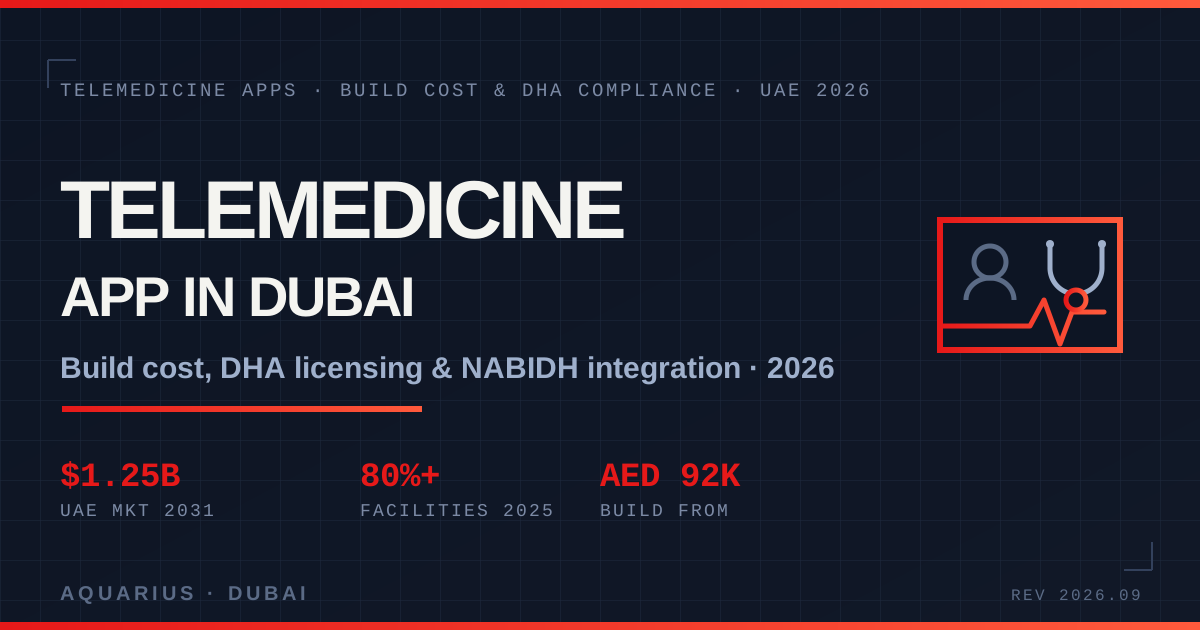
Short answer: a DHA-compliant telemedicine app in Dubai — video consultations, e-prescriptions, patient and clinician apps, scheduling, payments and an admin console — typically costs AED 90,000–400,000+ to build in 2026. A lean MVP (video consult + booking + payments) lands at AED 90,000–180,000; a full clinical platform with EMR, lab integration and NABIDH connectivity runs AED 180,000–400,000. The market rationalising this spend: UAE telemedicine is racing from USD 431 million (2025) to USD 1.25 billion by 2031.
Key takeaways
- UAE telemedicine market: USD 431M (2025) → USD 1,252M (2031), 19.45% CAGR — one of the fastest-growing digital-health segments in the region.
- Over 80% of UAE public healthcare facilities had integrated telemedicine by 2025; the DHA logged 1.2M+ virtual visits by 2024.
- Build cost: AED 90,000–180,000 for an MVP, AED 180,000–400,000 for a clinical platform, AED 400,000–750,000+ for a multi-facility ecosystem.
- There is no separate telemedicine licence in Dubai — telehealth must be approved as a scope of service under your facility licence, and since March 2025 every platform must integrate with NABIDH (Dubai) or Malaffi (Abu Dhabi).
- Patient satisfaction with Dubai telehealth sits at 92%, provider satisfaction at 97% — adoption is not the risk; compliance and build quality are.
The Dubai telemedicine opportunity: why now
Telemedicine in the UAE stopped being a pandemic stopgap and became infrastructure. The market is projected to grow from USD 431.02 million in 2025 to USD 1,252.03 million by 2031, a 19.45% CAGR (a parallel forecast puts it at USD 560M in 2024 rising to USD 1.59B by 2030 at 18.6%). Either way, the direction is the same: double-digit compounding growth for the rest of the decade.
The demand is already measurable. More than 80% of UAE public healthcare facilities had integrated telemedicine by 2025. Dubai Health logged 375,000 telehealth consultations in 2023 — a 28% jump on 2022 — alongside 230,000+ electronic prescriptions issued via telehealth (up 103% year-on-year). By 2024 the DHA reported over 1.2 million virtual visits. Satisfaction is high on both sides of the screen: 92% of patients and 97% of providers reported being satisfied with Dubai telehealth services.
The tailwinds are structural: the Dubai Health Strategy, a high chronic-disease burden, an ageing resident population, near-universal smartphone penetration, and — critically — mandatory insurer coverage of virtual visits. Teleconsultations are now standard in health plans, which removes the single biggest historical barrier to patient adoption: who pays.
What it costs to build — and what drives the number
Telemedicine build costs in Dubai are driven far more by clinical and compliance requirements than by the video call itself. A generic healthcare app in the UAE runs AED 100,000–280,000; telemedicine features, DHA standards and secure patient records push the ceiling higher. Here is how the tiers break down (USD converted at the AED 3.6725 peg):
| Build tier | Typical AED cost | What you get |
|---|---|---|
| MVP teleconsult | AED 90,000–180,000 | Video/audio consults, appointment scheduling, e-payments, patient + clinician apps, basic notifications |
| Clinical platform | AED 180,000–400,000 | Everything in MVP + EMR/EHR, e-prescriptions, lab/pharmacy integration, NABIDH connectivity, admin console, insurance e-claims |
| Enterprise health ecosystem | AED 400,000–750,000+ | Multi-facility, remote patient monitoring (IoT/wearables), AI triage, pharmacy + medicine delivery, full HIE and insurer integrations |
Two numbers people forget: budget 20–25% of the build cost per year for maintenance, security patching and OS/regulatory updates, and expect the compliance workstream (DHA scope approval, NABIDH onboarding, ISO 27001, penetration testing) to add real weeks to the timeline. A teleconsultation MVP is buildable in roughly 3–4 months; a full clinical platform is a 6–9 month programme.
The compliance layer no shortcut survives
This is where most cheap telemedicine builds fail in Dubai. Get it right up front:
- No separate telemedicine licence. A practitioner's existing professional licence covers remote consults — but the facility must hold telehealth authorisation from its regulator, with telehealth explicitly approved as a scope of service under the facility licence, and a licensed medical director appointed.
- NABIDH / Malaffi is mandatory. Since the March 2025 unified MoHAP telehealth guidelines, every platform must integrate with NABIDH in Dubai (or Malaffi in Abu Dhabi) for medical-record sharing. This is an API integration you cannot skip — plan for it in the data model from day one.
- Data protection is non-negotiable. Encrypt data in transit and at rest, enforce MFA, target ISO 27001, keep servers inside the UAE, and offer Arabic and English interfaces. This overlaps directly with UAE PDPL obligations.
- Clinical guardrails. Telehealth excludes emergencies requiring immediate physical intervention, and remote prescribing of narcotic, controlled or semi-controlled medication is prohibited. Build these rules into the prescribing flow, not into a policy PDF.
Non-compliance is not a slap on the wrist — it can mean fines or suspension of the service. The build cost of doing compliance properly is trivial next to the cost of being shut down.
The ROI: why owning beats renting an aggregator
The economics favour ownership faster than most clinics expect. Consider a mid-size Dubai practice running 40 virtual consults a day at an average AED 150 per teleconsultation, 26 days a month — roughly AED 156,000/month in teleconsult revenue.
On a third-party aggregator taking a 20–30% commission, that clinic hands over AED 31,000–47,000 every month — AED 375,000–560,000 a year. On an owned platform, the only variable cost is payment processing at roughly 3–6% (AED 4,700–9,400/month). The commission delta alone repays a AED 180,000 clinical-platform build in under six months, and every month after that the margin stays in the practice.
There is a cost of waiting too. A clinic still routing teleconsults through an aggregator — or turning virtual demand away — is losing AED 25,000–45,000 a month in commissions and missed capacity that an owned platform would capture. In a market compounding at ~19% a year, that gap widens every quarter.
This is how Aquarius approaches it: scope the MVP to the consults you already turn away, build NABIDH and DHA compliance in from the first sprint (not bolted on before audit), and ship a platform you own outright — no per-consult tax to a marketplace. See our transparent build pricing or read how we handle regulated booking flows in our Dubai clinic booking-system guide.
Frequently asked questions
Do I need a special licence to launch a telemedicine app in Dubai?
No separate telemedicine licence exists. Your practitioners' existing professional licences cover remote consultations, but your facility must have telehealth approved as a scope of service under its licence and appoint a licensed medical director. The app is the easy part — the regulatory scope is what you secure first.
What is NABIDH and why does my app have to connect to it?
NABIDH is Dubai's health information exchange. Since the March 2025 unified telehealth guidelines, every telehealth platform operating in Dubai must integrate with NABIDH (Malaffi in Abu Dhabi) so patient records are shared across the health system. It is a mandatory API integration, not an optional feature.
How long does it take to build a telemedicine app in Dubai?
A teleconsultation MVP — video, scheduling, payments, patient and clinician apps — is typically 3–4 months. A full clinical platform with EMR, e-prescriptions, lab integration and NABIDH connectivity is a 6–9 month programme, with compliance and security work running in parallel.
Can patients get prescriptions through the app?
Yes for most medications, issued electronically — Dubai already processes hundreds of thousands of telehealth e-prescriptions a year. But remote prescribing of narcotic, controlled and semi-controlled medication is prohibited, and telehealth cannot be used for emergencies needing immediate physical intervention. Those rules must be enforced in the prescribing flow itself.
Should I build custom or use an off-the-shelf telemedicine SaaS?
If you need standard video consults for a single clinic and under ~100 sessions a month, a SaaS may suffice. Build custom when you need NABIDH integration, EMR/insurer connectivity, Arabic/RTL, UAE data residency and a platform you own without paying per-consult commission — which describes most serious Dubai healthcare providers.
The bottom line
Telemedicine in Dubai is a USD 1.25-billion market by 2031 with insurer-backed demand, 90%+ satisfaction and regulators that now require the integrations serious builders were doing anyway. A compliant, owned platform costs AED 90,000–400,000 depending on clinical depth, and pays for itself in months once you stop leaking commission to an aggregator. The winners will be the providers who build for NABIDH, DHA scope and ISO 27001 from the first sprint — not the ones retrofitting compliance the week before an audit. Talk to Aquarius about scoping yours.