
TLS Certificates Drop to 100 Days in March 2027: We Probed 679 .ae Sites and 34% Are Not Ready
From 15 March 2027 no public TLS certificate may exceed 100 days. We read the live certificate off 679 .ae domains: 34.2% are over the cap and 61 still run year-long certs. Dates, issuers, AED costs.
- PUBLISHED
- 22 NOV 2026
- READ TIME
- 11 MIN
- AUTHOR
- AQUARIUS · DUBAI
- UNIT
- REV 2026.09
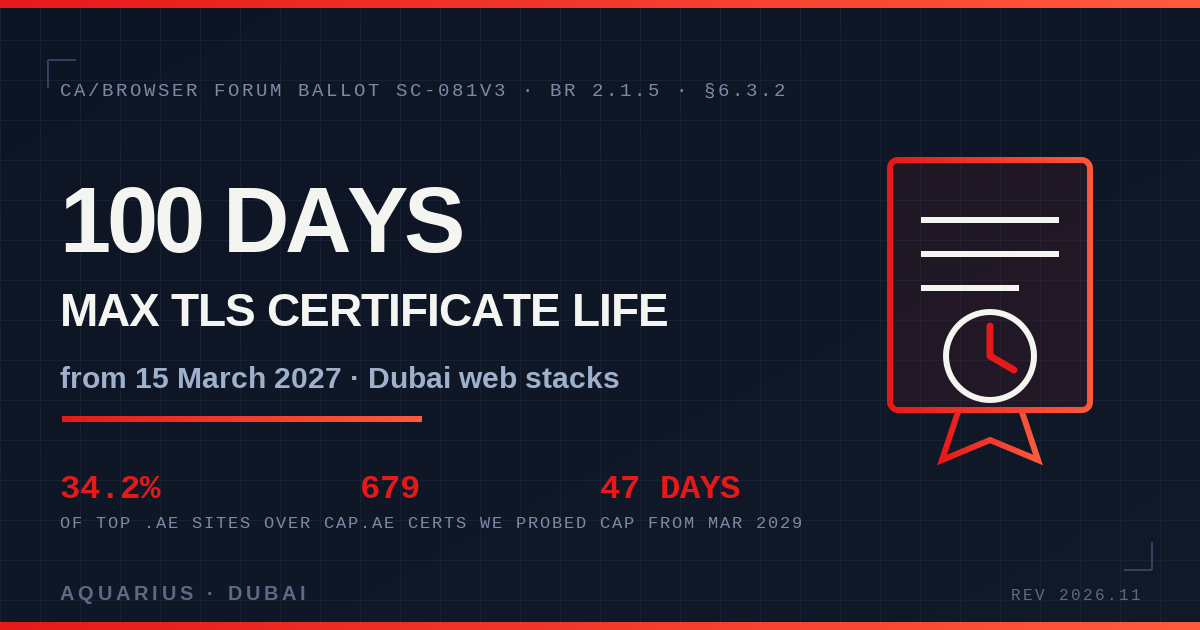
Short answer: from 15 March 2027 no public TLS certificate may be issued with a lifetime longer than 100 days, and the domain-control validation behind it can only be reused for 100 days too. From 15 March 2029 both drop again — 47 days for the certificate, 10 days for the validation. If a human still renews your HTTPS certificate in Dubai, that job is about to happen four times a year, then eight.
This is not a vendor campaign. It is CA/Browser Forum Ballot SC-081v3, passed on 11 April 2025 and written into the Baseline Requirements v2.1.5, section 6.3.2. Every public certificate authority on earth — DigiCert, Sectigo, GlobalSign, GoDaddy, Let’s Encrypt, Google Trust Services, Amazon — is bound by it. Browsers enforce it by distrusting anything longer.
Most Dubai websites are already on the wrong side of the line
We went and measured it rather than guessing. On 22 November 2026 we took every .ae domain inside the Tranco top-one-million list — 780 hosts — opened a TLS connection to each one, and read the real certificate off the wire with openssl. 679 returned a verifiable certificate. Then we did the arithmetic on notBefore and notAfter.
- 447 (65.8%) are already inside 100 days. They will not notice March 2027 at all.
- 232 (34.2%) are running certificates longer than 100 days. Their renewal process stops being legal.
- 61 (9.0%) are still on year-long certificates — we measured lifetimes between 327 and 396 days — which means nobody has touched that pipeline since before the 200-day cap landed in March 2026.
- 39 had under 30 days left on the clock, and 6 had a week or less.
The split is almost perfectly explained by who issued the certificate, and that is the real story.
The schedule, in plain dates
Two numbers shrink on the same four dates. The first is how long a certificate may live. The second — the one that catches teams out — is how long a CA may reuse the proof that you control the domain. When that proof expires, your renewal needs a fresh DNS or HTTP challenge, automated or not.
| Certificate issued on or after | Max certificate lifetime | Max domain-validation reuse |
|---|---|---|
| Today (until 14 Mar 2026) | 398 days | 398 days |
| 15 March 2026 | 200 days | 200 days |
| 15 March 2027 | 100 days | 100 days |
| 15 March 2029 | 47 days | 10 days |
The Baseline Requirements also say CAs should not exceed 199, 99 and 46 days respectively, and that “for the purpose of calculations, a day is measured as 86,400 seconds” — so there is no grace period hiding in timezone maths. That is why we found 108 certificates at exactly 198 days and 26 at 199: the industry already quietly moved once, in March 2026, and most Dubai sites never noticed because their CA handled it.
Who issued your certificate decides whether March 2027 hurts
Here is the issuer breakdown from the same 679 live .ae certificates. The lifetime column is the most common value we actually observed, not the vendor’s marketing number.
| Issuer | .ae certs found | Typical lifetime observed | Over the 2027 cap |
|---|---|---|---|
| Let’s Encrypt | 248 | 89–90 days | 0% |
| Google Trust Services | 186 | 90 days | 0% |
| DigiCert | 121 | 198 days | 98% |
| GlobalSign | 49 | 199 days | 92% |
| Amazon (ACM) | 28 | 197 days | 100% |
| Sectigo | 19 | 198 days | 100% |
| GoDaddy | 16 | >100 days | 88% |
Read that honestly: a long lifetime is not automatically a problem. Amazon’s ACM issues 197-day certificates but renews them for you, and a 198-day DigiCert certificate on a properly automated load balancer is equally fine. The risk is not the number — it is whether a person is in the loop. Of the 434 Let’s Encrypt and Google Trust Services certificates we found, every single one was inside 90 days, because ACME clients do not get bored. Of the 232 long-lifetime certificates, the dangerous subset is the one where renewal means somebody downloading a .pfx file from a CA portal and uploading it to a server.
That subset is large. Sectigo surveyed 500 senior IT and security leaders in July 2026 and found only 4% had certificate management already automated, while 61% had suffered a certificate-related outage or incident in the previous 12 months. DigiCert’s September 2026 Certificate Management Outlook put the outage number at 34% of companies, with 40% reporting downtime from certificate mismanagement and nearly three-quarters losing at least five hours to it.
The six things that actually break
1. Nobody is going to email you any more
Let’s Encrypt stopped sending certificate expiration notification emails on 4 June 2025, citing mature automation, subscriber privacy, and a cost running to “tens of thousands of dollars per year”. If your safety net was an inbox reminder, it was removed 18 months ago.
2. Certificate pinning in mobile apps
Pin a leaf certificate in your iOS or Android app and a 100-day lifetime means your app breaks every 100 days until users update. Pin the intermediate or the public key instead, or drop pinning and rely on the platform trust store.
3. Appliances and anything with a web UI
Firewalls, NAS boxes, VoIP controllers, lift and BMS panels, point-of-sale terminals, and older load balancers often have no ACME client at all. These are the devices in Dubai offices nobody remembers owning a certificate.
4. Shared hosting and control panels
cPanel AutoSSL and Plesk handle renewal well on the main domain, then silently fail on an add-on domain whose DNS points somewhere else. The failure mode is specifically invisible: everything works for 89 days.
5. Domain validation, not just the certificate
Because validation reuse drops to 100 days in 2027 and 10 days in 2029, every renewal effectively needs a live challenge. HTTP-01 breaks behind WAFs and geo-blocks; DNS-01 breaks if your registrar has no API. The durable fix is a CNAME delegation from _acme-challenge to a zone your automation can write to. Note that the DNS TXT Record with Persistent Value method is already capped at 10 days of reuse regardless of the schedule.
6. The renewal window shrinks with the certificate
With a 398-day certificate, a renewal that fails for a fortnight is invisible. With a 47-day certificate renewed at two-thirds of life, your entire margin for error is about 15 days. Use ACME Renewal Info (ARI) so the CA itself tells your client when to renew, and alert on failed renewal attempts, not on days-to-expiry.
Let’s Encrypt is moving faster than the rules require
Worth planning around, because roughly 37% of the .ae certificates we probed come from them. Let’s Encrypt has published that it will cut its maximum certificate lifetime to 45 days by February 2028 — a full year before the 47-day rule bites in March 2029. Their opt-in shortlived profile issues six-day (160-hour) certificates and became generally available on 15 January 2026, though they have said they have “no plan to make them the default at this time”. Certificates for IP addresses must use it. If you run ACME today, the correct posture is simply: renew on ARI, and stop assuming any lifetime number is permanent.
What this costs in Dubai, and what it costs to ignore
Automation is cheap. Outages are not. Indicative Dubai market ranges for getting a stack to a state where March 2027 and March 2029 are non-events:
| Work | Typical Dubai cost (AED) | What you get |
|---|---|---|
| ACME on a single VPS or Nginx host | 1,500 – 3,500 one-off | certbot or acme.sh, DNS-01, reload hooks, zero licence cost |
| Multi-server / load balancer automation | 4,000 – 9,000 one-off | CNAME-delegated DNS-01, central issuance, distribution to edges |
| Managed lifecycle, 10–50 certificates | 6,000 – 15,000 setup, then 900 – 2,500/month | inventory, ARI-driven renewal, failure alerting, on-call |
| Commercial OV/EV certificate (per domain) | 300 – 1,800/year | organisation vetting — worth it only if you need the OV identity |
| Mobile app pinning rework | 6,000 – 18,000 one-off | repin to intermediate or public key, backup pin, store release |
| Appliance behind an ACME-terminating proxy | 2,500 – 6,000 per device class | fixes gear that will never speak ACME itself |
Now the cost of inaction. In DigiCert’s 2026 survey, nearly one in four organisations said their most significant certificate incident cost more than USD 250,000 — about AED 918,000 at the pegged 3.6725 rate. And an expired certificate in the UAE is not a soft degradation: per StatCounter, Chrome, Safari and Edge together account for roughly 91.7% of UAE browser sessions as of October 2026, and all three throw a full-page interstitial that most visitors will not click through. With 11.3 million internet users and 99.0% penetration in the UAE (DataReportal, Digital 2026), an afternoon of browser warnings is not a technical event, it is a revenue one.
How Aquarius handles it
We treat certificates as infrastructure, not admin. For UAE clients that means: a full inventory of every certificate in the estate including the ones in appliances and mobile binaries; ACME with CNAME-delegated DNS-01 so validation never depends on inbound HTTP; renewal driven by ACME Renewal Info rather than a cron guess; and alerting on failed renewal attempts, which is the only signal that gives you time to act. We also pin the renewal pipeline in your repo, so it survives the person who built it leaving.
Risk reversal: if we build your certificate automation and a certificate still expires on our watch, we fix it at our cost, out of hours, and publish the post-mortem. We would rather carry that than have you discover a dead certificate from a customer’s WhatsApp message. Our pricing page lists the retainer tiers this sits inside, and you can book a 20-minute certificate audit — we will run the same openssl probe across your domains and send you the numbers whether or not you hire us.
If you are planning this work, do it once and do it properly: the same automation that survives 100 days survives 47, and the same crypto-agility work shows up again in our post-quantum cryptography migration guide for Dubai. If uptime commitments are on the line, read how we structure SLA uptime and service credits for UAE contracts — an expired certificate is the single most common cause of a service-credit claim we see.
FAQ
Does the 100-day cap apply to certificates I already have?
No. The cap applies at issuance. A 198-day certificate issued on 14 March 2027 stays valid for its full term. But your next certificate is capped, so the only thing the old one buys you is a few months of planning time.
Do I have to switch to Let’s Encrypt?
No. Every public CA is bound by the same rule, and DigiCert, Sectigo, GlobalSign and GoDaddy all support ACME. Choose on support, OV/EV needs and tooling — not on lifetime, because lifetime is now identical everywhere.
Does this affect internal or private certificates?
Not directly. The Baseline Requirements govern publicly trusted certificates. Your internal CA can issue whatever you like — but browsers and mobile OSes keep tightening what they accept, and running two different renewal philosophies is how teams get surprised.
What about wildcard certificates?
Wildcards follow the same schedule. They reduce the number of certificates, not the frequency of renewal. A wildcard renewed by hand is still a manual job four times a year from 2027, and roughly eight times a year from 2029.
How do I check my own site right now?
One line: openssl s_client -connect yourdomain.ae:443 -servername yourdomain.ae </dev/null 2>/dev/null | openssl x509 -noout -dates -issuer. Subtract notBefore from notAfter. Over 100 days means your renewal process has a deadline of 15 March 2027.