
Tutoring Marketplace App Development in Dubai (2026): Real AED Costs and the Jan 2027 Child-Safety Deadline
UAE parents buy 18.6 million tutoring hours a year and Dubai is 52% of the revenue. Real AED build costs for a tutoring marketplace, plus the January 2027 child-safety deadline.
- PUBLISHED
- 05 OCT 2026
- READ TIME
- 12 MIN
- AUTHOR
- AQUARIUS · DUBAI
- UNIT
- REV 2026.09
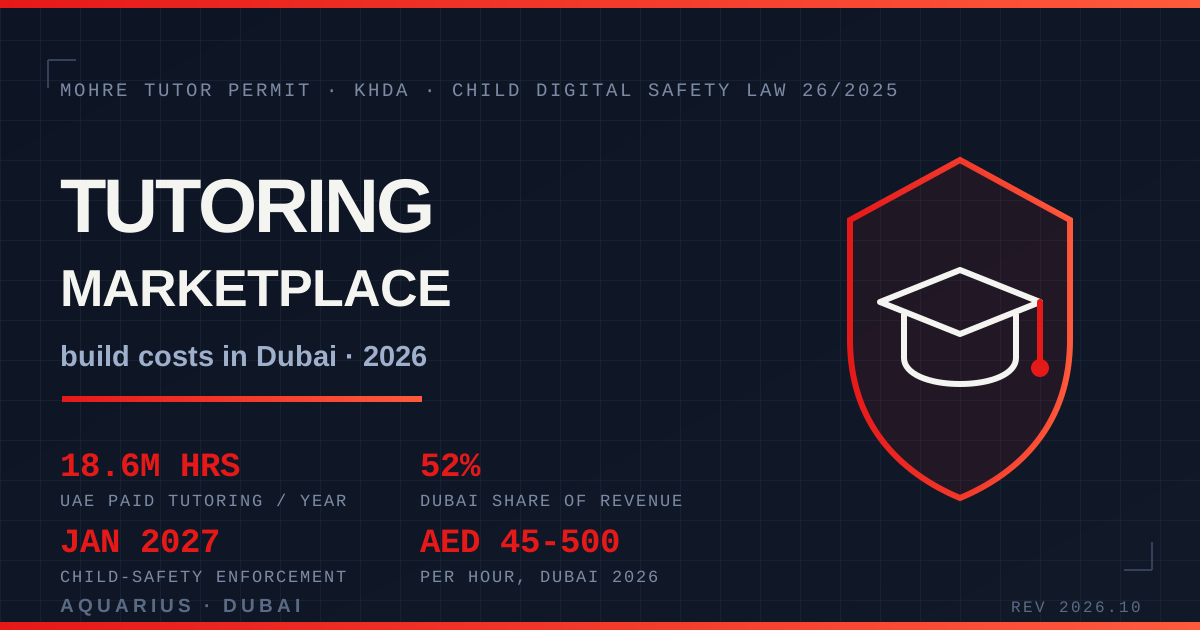
Short answer: a working tutoring marketplace for Dubai costs AED 55,000 to 95,000 for a booking-first MVP, AED 110,000 to 210,000 for a real two-sided platform with tutor vetting and split payouts, and AED 210,000 to 420,000 once you add a live virtual classroom, parent dashboards and child-safety controls. The expensive part is not the booking engine — it is proving every tutor is permitted and every under-18 account is compliant before January 2027.
Dubai is the strongest tutoring market in the Gulf, and 2026 was the year the rules caught up with it. MoHRE made private tutoring legal for ordinary residents, and the UAE passed a child digital safety law that lands on any platform serving school students. Build for the first and ignore the second and you ship a product with a twelve-month shelf life.
Most Dubai businesses get this wrong: they treat a tutoring app as a booking app. It is a compliance app with booking attached. The marketplace that wins here is the one that can prove, per tutor, that a valid MoHRE permit and a current good-conduct certificate are on file — and that is a data problem, not a UI problem.
The Dubai tutoring market in 2026: the numbers that justify the build
The UAE private tutoring market was worth USD 565.0 million in 2025 and is forecast to reach USD 925.2 million by 2031 — an 8.57% CAGR for 2026–31, up from 6.26% across 2020–25 (Ken Research). Growth is accelerating, not maturing.
Three figures matter more than the headline:
- 405,000 paid learners consumed 18.6 million paid tutoring hours in 2025, projected to reach 28.9 million hours by 2031.
- Dubai alone is roughly 52% of UAE tutoring revenue — the emirate is the market, not a slice of it.
- Only about 1,850 tutors are active against an addressable K-12 base of 1.38 million students. Supply, not demand, is the bottleneck — which is exactly what a marketplace fixes.
The feeder is growing too. KHDA confirmed 406,563 students enrolled in Dubai private schools for 2026-27, up 4.6% year on year, with 26 new education institutions opening this year and 51 over the past two academic years. Delivery is shifting online fast: 31% of paid tutoring hours were online in 2025, forecast to hit 49% by 2031. The broader UAE digital education market is tracking USD 322.6 million in 2025 to USD 934.8 million by 2030.
One piece of 2026 context nobody is pricing in: KHDA froze private school fees for 2026-27, announced 22 May 2026 under Sheikh Hamdan’s directives, as part of Dubai’s AED 1.5 billion second economic incentives package. Schools cannot raise fees — so the household budget that would have absorbed an increase stays free, and a share of it goes to tutoring.
What changed in 2026: tutors became legal, platforms became regulated
The MoHRE private tutoring work permit
On 21 June 2026, MoHRE expanded its private tutoring work permit to four categories: school students aged 15–18, private-sector employees, government and semi-government employees, and registered tutors. The permit is free, valid for two years, renewable, and processed within two working days.
Required documents: Emirates ID or residency proof, academic qualification, certificate of good conduct, medical fitness certificate and a photo. School students additionally need parental consent and proof of enrolment. Government and semi-government employees and schoolteachers need an employer NOC.
For a platform, each of those is a field, an expiry date and a verification state. A Dubai Police good conduct certificate costs AED 100 for citizens, AED 200 for residents and AED 300 from abroad, plus AED 20 in knowledge and innovation fees, takes 5 working days — and is valid for only 3 months. That window is the most underestimated requirement in tutoring builds: it means a re-verification cycle, not a one-time upload.
Individual tutor vs tutoring centre: a licensing fork
Individual tutoring on a MoHRE permit does not need KHDA approval. KHDA governs centres — physical classrooms and staff. If your marketplace also onboards tutoring centres, those partners carry real cost: a KHDA Educational Services Permit runs AED 15,000 to 25,000 depending on programme count (about 8 working days), a Dubai Knowledge Park tutoring-services licence is AED 15,000 per year plus AED 10,000 per extra segment, and KHDA authorisation is an AED 5,000 application fee followed by AED 25,000 for 1–2 programmes rising to AED 40,000 for 7 or more. Operating an education business without KHDA approval can draw fines up to AED 100,000 and closure.
The January 2027 wall: Federal Decree-Law No. 26 of 2025
This is the part that reshapes the product. The UAE Child Digital Safety Law came into force on 1 January 2026 with a one-year grace period — meaning full enforcement from January 2027. It applies to digital platforms operating in or directed at UAE users, with extraterritorial reach, and defines a child as anyone under 18. A tutoring marketplace is, by definition, in scope.
What it obliges you to build:
- Age verification that is effective and proportionate to the platform’s risk classification — not a self-declared date-of-birth box.
- Verifiable parental consent for any collection, processing, publishing or sharing of under-13 data, documented, with an accessible withdrawal method.
- No targeted advertising or commercial tracking of under-13 users. That removes the standard retargeting pixel stack from part of your funnel.
- Privacy-by-default settings, plus usage-time limits and mandatory breaks.
- Proactive detection, removal and reporting of harmful content — which, on a platform with tutor-student messaging and video, means real moderation infrastructure.
Oversight sits with the Child Digital Safety Council, chaired by the Minister of Family, with TDRA supervising ISPs. Penalty amounts are deferred to a Cabinet decision, but the law already empowers partial or full blocking, suspension and closure — so the realistic downside is not a fine, it is your platform going dark. Stack this on top of your existing UAE PDPL obligations, because both apply at once.
What the platform actually has to do
Strip out the nice-to-haves and a Dubai tutoring marketplace has six jobs: match, schedule, verify, teach, pay, and prove compliance. Most failed builds nail the first two and treat the last two as phase two.
- Matching — curriculum-aware. Dubai is not one market; it is IB, IGCSE, A-Level, AP, CBSE and MoE curricula in one city. Subject, grade, curriculum and exam board is the minimum filter set — and the main reason generic global platforms convert poorly here.
- Scheduling — Gulf Standard Time, the Friday–Saturday weekend, Ramadan timings, and a pre-exam demand spike that lifts rates.
- Tutor verification — permit number, expiry, good-conduct certificate with its 3-month clock, qualification documents, NOC where required.
- Delivery — with online near half of all paid hours, a virtual classroom with recordings is core, not optional. The architecture overlaps heavily with an LMS platform build.
- Payments and payouts — escrow the session fee, release after delivery, handle the dispute window, and pay tutors who are individuals rather than companies.
- Trust — reviews, in-platform-only messaging, and parent visibility into every session a minor attends.
Dubai tutoring rates: what your pricing engine has to handle
Dubai hourly rates span AED 45 to 500+, which means a single flat commission will either bleed the budget tier or insult the premium tier.
| Tutor tier | Dubai rate (AED/hour, 2026) | Typical demand |
|---|---|---|
| Online / overseas tutor | 45 – 80 | Homework support, primary years |
| University-student tutor | 60 – 80 | Price-sensitive, high volume |
| Tutoring centre (per session) | 80 – 150 | Group and small-cohort |
| Independent in-home tutor | 100 – 250 | Core of the market |
| Qualified home tutor | 150 – 300 | Curriculum specialists |
| IB / IGCSE / A-Level / AP / SEN specialist | 250 – 500+ | Exam season, highest margin |
Take rate: the number that decides whether your marketplace survives
Marketplace commissions run 10–30% industry-wide, with most two-sided platforms landing at 15–30%. The specifics are instructive: Preply slides from 18% to 33% by hours taught and keeps 100% of every trial lesson; Wyzant takes a flat 25%; Clascity takes 8%. Platforms that set the price themselves rather than letting tutors set it take far more — TutorMe around 58%, Tutor.com around 69%.
For Dubai, 15–20% on a tutor-set rate is the defensible band. Push past 25% in a market where tutors now hold their own free MoHRE permits and they will simply take the relationship off-platform after session two. Design the retention mechanic — payment protection, scheduling, parent reporting — before you design the commission.
What it costs to build in Dubai (AED, 2026)
| Scope | AED | Timeline |
|---|---|---|
| Booking MVP — tutor directory, availability, payments, manual ops | 55,000 – 95,000 | 6 – 9 weeks |
| Two-sided marketplace — tutor onboarding, document vetting, split payouts, wallet, reviews | 110,000 – 210,000 | 10 – 16 weeks |
| Full platform — the above plus live virtual classroom, recordings, parent dashboard | 210,000 – 420,000 | 16 – 26 weeks |
| Child Digital Safety workstream — age assurance, parental-consent ledger, privacy defaults, time limits, moderation and reporting | 45,000 – 110,000 | 3 – 6 weeks |
| Permit and credential engine — expiry tracking, re-verification cycles, audit trail | 25,000 – 55,000 | 2 – 4 weeks |
| Arabic / RTL localisation | 15,000 – 35,000 | 2 – 3 weeks |
| Native iOS + Android apps | 60,000 – 140,000 | 8 – 14 weeks |
| Hosting, care and compliance monitoring | 4,000 – 14,000 / month | ongoing |
Two line items people cut and should not. Compliance is far cheaper built in than retrofitted — bolting verifiable parental consent onto a live user base after January 2027 costs multiples. And the permit engine is what makes the marketplace defensible: any competitor can copy your booking flow in a quarter, but an auditable record of every tutor’s permit and conduct certificate is what wins school partnerships. Full ranges sit on our pricing page.
The unit economics, with real numbers
Run the market figures through a take rate. Of the 18.6 million paid UAE tutoring hours in 2025, Dubai’s roughly 52% share is about 9.7 million hours. Capture just 1% of that — around 97,000 hours — at a mid-market AED 150 per hour and you are running AED 14.5 million in annual GMV. At an 18% take rate that is AED 2.6 million a year in platform revenue, against a one-time build in the AED 110,000 to 420,000 band.
A 1% share of one emirate repays the largest build scope inside the first year. A platform blocked in January 2027 for missing age assurance returns nothing.
How Aquarius builds these
We sequence it so revenue starts before the hardest parts finish. Phase one is the booking core with manual tutor vetting — live in 6 to 9 weeks, taking real bookings. Phase two automates the permit and credential engine, including the 3-month good-conduct re-verification clock. Phase three adds the virtual classroom and the Child Digital Safety controls, scheduled to land well ahead of the January 2027 deadline rather than against it.
Fixed scope, fixed price, in writing. Weekly demos on a staging URL you can hand to a partner school. Every compliance requirement traced to the clause it satisfies, so your legal review is a read-through, not an audit. Same pattern as our multi-vendor marketplace builds, with the education layers added.
FAQ
Do I need a KHDA licence to run a tutoring marketplace in Dubai?
You need a DET mainland or free-zone trade licence for the platform business. KHDA approval applies to tutoring centres with classrooms and staff and to programme providers; individual tutors on a MoHRE permit do not need it. Centres you onboard need their own KHDA authorisation — AED 5,000 application plus AED 25,000 to 40,000 by programme count. Take legal advice on your model: a marketplace that directs curriculum delivery can be classified differently from a pure intermediary.
How much does a tutoring app cost in Dubai?
AED 55,000 to 95,000 for a booking-first MVP, AED 110,000 to 210,000 for a full two-sided marketplace with vetting and split payouts, and AED 210,000 to 420,000 with a live virtual classroom and parent dashboards. Add AED 45,000 to 110,000 for the Child Digital Safety compliance workstream and AED 15,000 to 35,000 for Arabic and RTL.
What commission should a Dubai tutoring platform charge?
15–20% on a tutor-set rate. The industry range is 10–30%, with Preply at 18–33%, Wyzant at a flat 25% and Clascity at 8%. Because Dubai tutors now hold free two-year MoHRE permits and can transact independently, high commissions push the relationship off-platform. Earn the rate with payment protection, scheduling and parent reporting.
Does the UAE Child Digital Safety Law apply to my tutoring platform?
Almost certainly yes. Federal Decree-Law No. 26 of 2025 covers digital platforms operating in or directed at UAE users, has extraterritorial reach, and defines a child as anyone under 18 — which is your entire student base. It took effect 1 January 2026 with a one-year grace period, so you are building against January 2027. Core requirements: risk-proportionate age verification, verifiable parental consent for under-13 data, no targeted advertising to under-13s, privacy-by-default settings, usage-time limits, and proactive harmful-content detection and reporting.
How long does it take to launch?
6 to 9 weeks for a booking MVP that takes real money, 10 to 16 weeks for the full marketplace, 16 to 26 weeks with a virtual classroom. The MoHRE permit is free, valid two years and processed in two working days, so tutor supply is rarely the critical path. The constraint is the good-conduct certificate at 5 working days per tutor.
Dubai has 406,563 private school students, a fee freeze that leaves household budgets intact, a market compounding at 8.57% a year — and roughly 1,850 tutors serving it. The gap is real and the regulatory window closes in January 2027. Tell us your model and we will come back with a fixed-price scope, an AED number and a compliance plan mapped to the clauses that apply to you.