
UAE Competition Law 2027: The AED 300M Filing Rule Dubai Digital Businesses Keep Missing
Cabinet Decision 59/2026 went live on 30 July 2026. Deals over AED 300m or 40% market share need filing 90 days before closing, and the SME exemption is gone. What it means for Dubai platforms.
- PUBLISHED
- 20 NOV 2026
- READ TIME
- 13 MIN
- AUTHOR
- AQUARIUS · DUBAI
- UNIT
- REV 2026.09
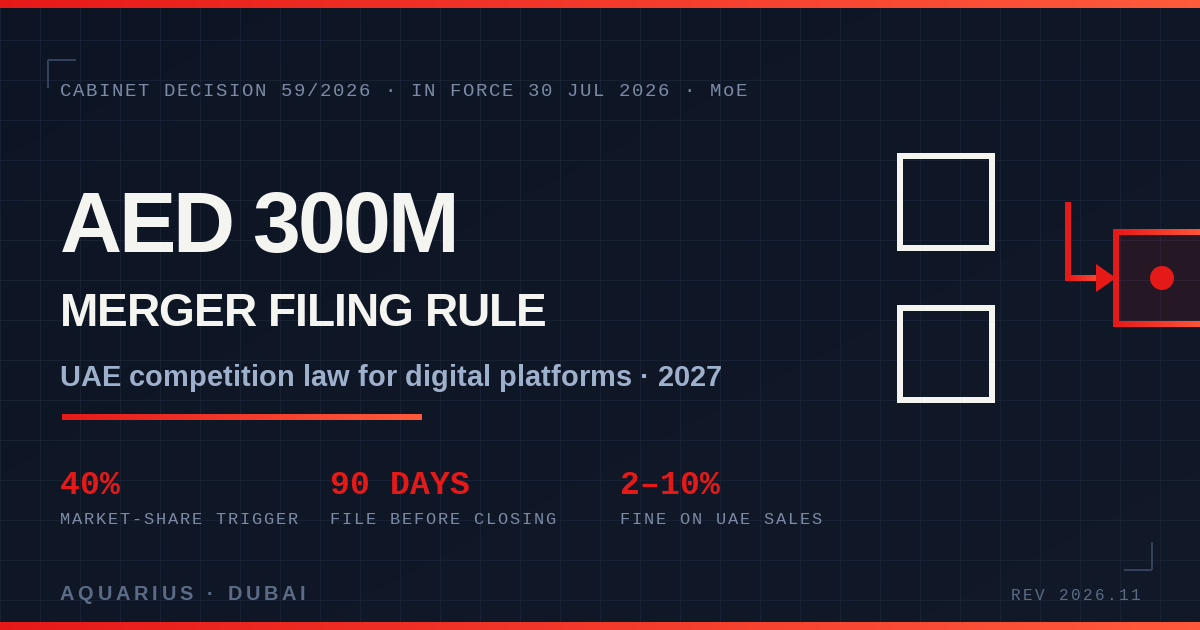
Since 30 July 2026, any deal that gives the parties more than AED 300 million of combined annual sales in a UAE relevant market, or more than 40% of that market, must be filed with the Ministry of Economy at least 90 days before it closes. The small-business exemption that used to keep most Dubai transactions out of scope was repealed in 2025, and the fine for closing without clearance is 2% to 10% of the UAE sales tied to the deal. For digital businesses there is a second, quieter problem: under the 2026 rules your relevant market can be an app or an online marketplace rather than a territory, which makes 40% far easier to hit than founders assume.
Dubai spent 2026 absorbing e-invoicing, PDPL and AI governance. Competition law slipped past almost everyone, because it looks like a lawyer's problem. It is not. It is a product and data problem: the rules now reach pricing logic you ship to sellers, the APIs you refuse to open, and the discount engine your growth team tunes weekly. Here are the real numbers, the three places this bites a digital company first, and what readiness actually costs in AED.
The numbers behind the 2026 rewrite
Three figures explain why the Ministry of Economy built a real merger-control machine and why it arrived now.
- The UAE took 80.9% of all GCC deal value in the first half of 2026. Grant Thornton's UAE and GCC M&A Market Review put UAE transactions at USD 52.6 billion out of USD 65.1 billion across the Gulf, and 131 of the region's 192 disclosed deals. GCC deal value rose 12.1% year on year while volume fell 17.9% — fewer deals, much bigger ones.
- Technology and digital platforms were named among the sectors pulling that strategic money in. EY's MENA review of the same period counted 390 completed deals worth USD 46.7 billion, with Q2 2026 value at USD 25 billion against USD 12.2 billion in Q2 2025, and technology taking the largest share of inbound deal value from March to June.
- The exemption that protected small transactions is gone. Cabinet Decision No. 3 of 2025, issued on 20 January 2025 and effective 31 March 2025, set the AED 300 million turnover test and the 40% share test, and repealed the old SME carve-out. Size alone no longer takes a deal off the radar.
The implementing text is Cabinet Decision No. 59 of 2026, issued on 20 April 2026 and in force from 30 July 2026, replacing the 2014 regulation under Federal Decree-Law No. 36 of 2023. The Ministry published its guidelines in July 2026 and a fee schedule took effect on 29 July 2026. The regime is no longer theoretical.
What counts as an economic concentration
Article 12 of the Decree-Law is the operative provision. Mergers, acquisitions, control transactions and joint ventures are caught, and an application goes to the Ministry at least 90 days before completion if either of two conditions is met in the relevant UAE market, measured on the last fiscal year:
- combined annual sales of the undertakings exceed AED 300 million, or
- their combined share exceeds 40% of total transactions in that market.
Two details catch Dubai companies out. First, these are alternatives, not cumulative: a niche platform with AED 20 million of revenue and a 45% share of a narrowly defined market is notifiable while a conglomerate below both tests is not. Second, Article 3 makes the law extraterritorial. It applies to economic activity carried out outside the UAE that affects competition inside it, and to the exploitation of intellectual property rights both inside and outside the country. A Riyadh or London acquirer buying a competitor with UAE users is in scope without a UAE entity.
If you are already modelling a transaction, the structural choice interacts with this: see our breakdown of share deal versus asset deal in a Dubai acquisition.
The three digital-specific traps in the 2026 rules
1. Your relevant market may be an app, not a territory
The July 2026 guidelines define the relevant market with the SSNIP test: would customers switch to an alternative in response to a small but significant non-transitory price increase, typically 5% to 10%. Where price is not the main competitive parameter — which is most free-to-use digital services — a quality-based variant is applied instead. The guidelines accept that a digital market can be a relevant market in its own right, and that the geographic market for a digital business may be an online marketplace rather than a physical area.
That is what makes 40% reachable. Define the market as "UAE retail" and nobody is dominant. Define it as "online B2B spare-parts marketplaces serving the UAE" and a single platform can clear 40% in its second year. Market definition is the whole argument, and it is decided on your own data.
2. Article 6(1)(k): the API you refuse to open
Article 6 lists abuses of a dominant position, and sub-paragraph (k) is the one no Dubai product team has read. It prohibits an undertaking from unjustifiably preventing or obstructing others from accessing its private networks, its facilities, or any physical or digital infrastructure it owns or exploits, where that infrastructure is the only basic and economically feasible way to carry on the activity or enter the market. This is the essential-facilities doctrine written directly onto software.
If your platform is the practical route to a market — the booking rail, the payment switch, the delivery network, the dealer data standard — then API access decisions, rate limits applied selectively and integration refusals become regulated conduct. The defensible position is a published access policy, consistent technical criteria and a log of who asked, what you answered and why.
Article 7 adds abuse of economic dependence, which bites even without dominance: where a customer has no realistic alternative for supply or marketing, imposing resale prices or conditions, discriminating between customers on identical contracts, or tying unrelated services is prohibited. Marketplace operators with captive sellers should read that twice.
3. Pricing logic you enforce on other people
Article 5 prohibits agreements that fix selling or purchasing prices directly or indirectly, set conditions of sale, allocate markets or customers by geography, customer type or season, or obstruct a competitor's entry. Article 6(1)(a) separately prohibits a dominant undertaking from directly or indirectly imposing resale prices or conditions.
Nothing in those words requires a signed contract. A seller dashboard that rejects a listing below a floor price, a minimum-advertised-price rule enforced in code, or a repricing bot that quietly converges with a competitor's bot all produce the prohibited effect. Predatory pricing has its own test under Article 8: the 2026 regulation treats selling below average variable cost as presumptively predatory unless objectively justified, and below average total cost as predatory where there is clear evidence of anti-competitive intent or strategy. Growth-stage "burn to win the market" plans in a slide deck are exactly that evidence.
One relief for technology companies is written into the regulation: the mere benefit derived from technological superiority resulting from innovation, investment or research and development does not in itself constitute a dominant position, unless it comes with market-distorting competitive influence. Being better is still allowed.
Fees, timelines and penalties in AED
Every figure below is from Federal Decree-Law No. 36 of 2023, Cabinet Decision No. 59 of 2026 or Cabinet Decision No. 105 of 2026 as published in Official Gazette No. 826 on 29 June 2026. Nothing here is a vendor estimate.
| Item | Rule | Amount / period (AED unless stated) |
|---|---|---|
| Turnover trigger | Cabinet Decision 3/2025 | 300,000,000 combined annual sales in the relevant market |
| Market-share trigger | Cabinet Decision 3/2025 | 40% of total transactions in the relevant market |
| Pre-closing filing | Art. 12(1) | at least 90 days before completion |
| Completeness review | Cabinet Decision 59/2026 | 10 working days, extendable by 10 |
| Ministerial decision | Art. 12(2) | 90 days from a complete application, extendable by 45. Silence counts as rejection |
| Remedies offer | Art. 12(3) | with the filing, or within 30 days of a complete application |
| Third-party objections | Cabinet Decision 59/2026 | 15 working days from publication of the basic transaction information |
| Merger filing fee | Cabinet Decision 105/2026 | 0.02% of combined annual sales of all participating establishments, capped at 150,000 |
| Exemption application | Cabinet Decision 105/2026 | 5,000 per application under Arts. 5, 6, 7 or 8 — non-refundable |
| Objection / grievance fee | Cabinet Decision 105/2026 | 1,500 to object; 500 to file a grievance, refunded if accepted |
| Failure to notify or gun-jumping | Art. 25 | 2% to 10% of annual sales of the goods or services subject of the violation; 500,000 to 5,000,000 where sales cannot be computed |
| Restrictive agreement, abuse of dominance, economic dependence, predatory pricing | Art. 24 | from 100,000 up to 10% of annual UAE sales; 500,000 to 5,000,000 where sales cannot be computed |
| Obstructing an investigation | Arts. 26 and 27 | 50,000 to 500,000 |
| Court-ordered closure on conviction | Art. 29 | 3 to 6 months, plus publication of the judgment in two daily newspapers at the violator's cost |
Add the 90-day pre-filing period to a 90-day decision window that can extend by 45 days and the realistic clearance budget is six months or more before completion. That is a term-sheet problem, not a closing-checklist problem. Signing a deal in March to close in May is no longer available if either threshold is met.
What this changes in your actual software
A competition file is an evidence exercise, and the evidence lives in systems that were never built to produce it. Four concrete changes cover most of the exposure.
- Immutable pricing history. Every price, discount rule, floor and promotional override needs a timestamped, append-only record with the actor who changed it. If your platform cannot reconstruct what a seller was allowed to charge on a given date, you cannot rebut a resale-price-maintenance allegation.
- Market-share telemetry you can defend. Transaction volume and value by category, geography and customer segment, computed the same way every quarter. Under the SSNIP framework you will be arguing about market definition using your own analytics, so the definitions have to be stable and documented before a regulator picks them for you.
- An access log for integration decisions. Who requested API or network access, what the technical criteria were, what you decided and when. Article 6(1)(k) makes an undocumented refusal expensive.
- Versioned seller and partner terms. Which version of your terms a given counterparty accepted, and when. Exclusivity, non-dealing and tying clauses are where Articles 5 and 7 are actually breached, and most platforms only store the current version.
If a transaction is on the horizon, this overlaps heavily with buyer-side scrutiny of the codebase — see technical due diligence and code audits in Dubai — and with the wider compliance surface covered in our UAE website legal pages guide.
What readiness costs, and how we build it
Set the cost of being ready against the downside. A platform doing AED 40 million of UAE revenue in the affected product line faces an Article 25 exposure of AED 800,000 to AED 4 million for closing a notifiable deal without clearance — before the deal itself is unwound or conditioned, and before a court considers a three-to-six-month closure under Article 29. Against that, the engineering work is small.
We scope it in three tiers. A two-week evidence audit maps what your systems can already prove and writes the gap list — typically AED 12,000 to 30,000. Instrumentation — pricing-change ledger, access-decision log, terms versioning, market-share reporting — usually lands at AED 35,000 to 110,000 depending on how many services touch pricing. A platform-level rework for operators who are genuinely near the 40% line, including separation of marketplace operations from any first-party selling arm, runs higher and should be scoped against a specific transaction timetable.
Fixed scope, fixed price, your code and your data in your own accounts, and the documentation pack is yours whether or not you continue with us. We are engineers, not counsel: we build the systems that produce the evidence, and we work alongside your UAE competition lawyers rather than pretending to replace them. See what we build and how we scope and price, or tell us about your platform and we will tell you honestly whether you are anywhere near these thresholds.
FAQ
Does the UAE competition law apply to free zone companies?
Article 3 applies the Decree-Law to all undertakings in relation to their economic activities in the UAE, and Article 4 excludes only activities a sectoral regulator has been charged with policing by another law, federal government-owned undertakings designated by Cabinet resolution, and emirate-government-owned undertakings operating in their own emirate. Being incorporated in a free zone is not on that list. Where a financial free zone regulator has its own competition mandate, check which authority leads before assuming either answer.
We are a startup with AED 8 million of revenue. Are we really in scope?
Possibly, on the share test. The SME exemption was repealed by Cabinet Decision No. 3 of 2025, so revenue size alone no longer exempts you. If your acquisition takes you past 40% of a narrowly defined relevant market — and digital markets are often narrow — the filing obligation is live regardless of turnover. Run the market-definition analysis before you sign, not after.
What happens if the Ministry does not respond within 90 days?
Under Article 12(2), failure by the Minister or an authorised representative to issue a resolution is deemed a rejection, not an approval. There is no deemed-clearance safety net. Parties also may not take any step to complete the concentration during the review period.
Can an algorithm breach Article 5 without anyone agreeing to anything?
Article 5 reaches agreements whose subject, purpose or impact is to restrict competition, including setting prices directly or indirectly. Pricing software that converges on a competitor's prices, or a marketplace rule that enforces a floor across independent sellers, produces that impact. The absence of a signed document is not a defence, which is why the change log matters more than the contract.
How much does a merger filing cost in fees?
The filing fee is 0.02% of the combined annual sales of all participating establishments, capped at AED 150,000, payable through the Ministry's online portal once the completeness review is done. Exemption applications under Articles 5 to 8 are AED 5,000 each and non-refundable. Legal and economic-report costs sit on top and are usually the larger line.
Dubai's competition regime stopped being a formality in July 2026. Most digital businesses here will never file a merger notification — but almost all of them are one narrow market definition away from an Article 5 or Article 6 question they currently cannot answer with data. The fix is a few weeks of instrumentation. The alternative is discovering the gap during a regulator's 20-working-day information request.