
UAE FIU Regulation 1 of 2026: The Freeze Order Your Dubai Platform Cannot Execute Yet
Gazette 833 takes effect 14 December 2026. The FIU can order a 10-working-day transaction suspension or a 30-day freeze, and expects you to act within hours. What Dubai platforms must build.
- PUBLISHED
- 20 NOV 2026
- READ TIME
- 12 MIN
- AUTHOR
- AQUARIUS · DUBAI
- UNIT
- REV 2026.09
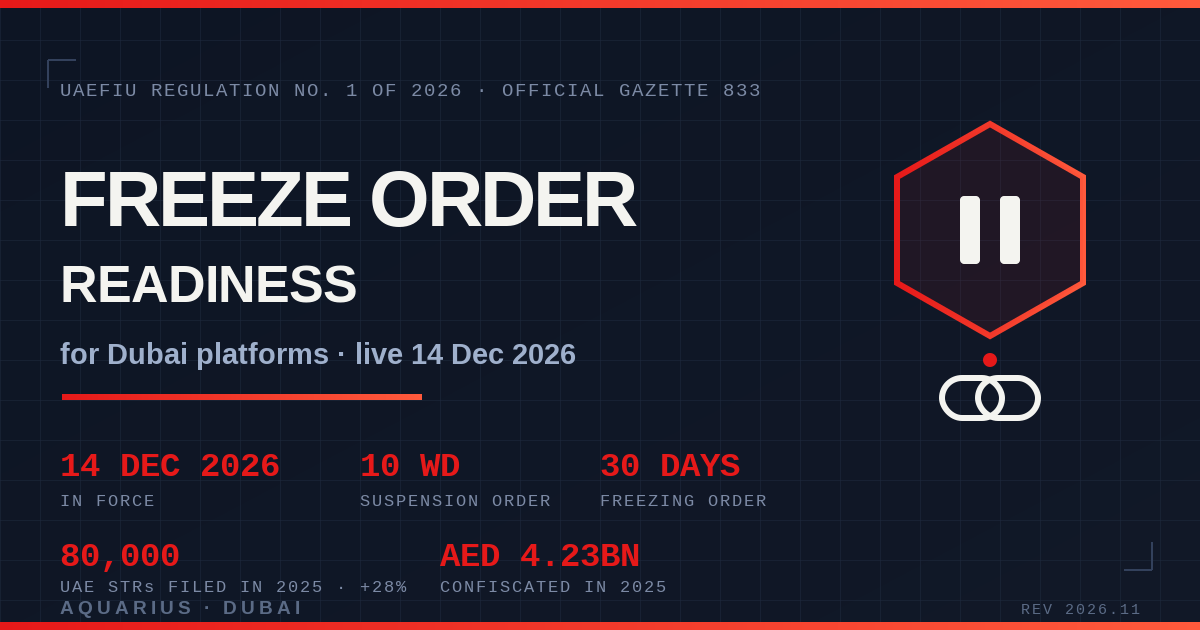
UAEFIU Regulation No. (1) of 2026 was published in Official Gazette No. 833 on 14 October 2026 and takes effect on 14 December 2026. It sets out how the UAE Financial Intelligence Unit orders a reporting entity to postpone or suspend a suspicious transaction, freeze funds, or monitor an account — and it expects you to execute that order on demand, not at the next business day. Most Dubai platforms have software that can report a transaction. Very few have software that can stop one.
That is the whole gap. Your AML stack was built to push a report out to goAML. This regulation runs the other way: an instruction arrives from the FIU, and your systems have to apply a hold, hold it for a defined number of days, keep the customer unaware, and prove every step afterwards. If that path is a person opening a database client at 2am, you do not have a control — you have a hope.
The numbers behind the rule
The UAE did not add freeze powers in a vacuum. Reporting volume and enforcement both stepped up sharply through 2025 and 2026:
- Suspicious transaction reports filed in the UAE rose 28% to roughly 80,000 in 2025, according to performance figures published by the National Committee for Anti-Money Laundering and Combating the Financing of Terrorism and Illegal Organisations. Banks accounted for 82.2% of them — which tells you how thin reporting still is outside the banking sector.
- Money-laundering cases referred by law enforcement climbed 46%, from 646 in 2024 to 942 in 2025.
- Domestic confiscations reached AED 4.23 billion, with a further AED 750 million returned to victims.
- The Central Bank of the UAE has issued penalties at a scale that is no longer symbolic: in 2026 it fined one foreign bank branch AED 200 million, fined another AED 20 million and separately imposed AED 300,000 personally on that branch's head of compliance, and fined a third branch AED 1.82 million.
Read those together and the direction is obvious. Reporting alone is now table stakes. The regulator's next lever is interdiction — stopping the money while it is still inside your system.
What Regulation No. (1) of 2026 actually changes
The parent law is Federal Decree-Law No. (10) of 2025 on anti-money laundering, counter-terrorist financing and counter-proliferation financing. It was gazetted on 30 September 2025, came into force on 14 October 2025, repealed Federal Decree-Law No. (20) of 2018, and is implemented by Cabinet Resolution No. (134) of 2025. Two of its changes matter here: it added proliferation financing to the regime for the first time, and it extended the FIU's own freezing power from 7 days to 30 days, alongside a power to suspend a transaction for up to 10 working days without prior notice to the customer.
Regulation No. (1) of 2026 — formally the system governing the postponement or suspension of suspicious transactions and the freezing of funds — is the operating manual for those powers. It introduces the PSTR: a report filed to postpone or suspend a transaction before it executes, rather than a standard STR filed after the fact. And it defines the order types the FIU can push back down to you.
Scope is broad. It reaches financial institutions (banks, exchange houses, finance companies, insurers), designated non-financial businesses and professions — real-estate brokers, dealers in precious metals and stones, lawyers and notaries, accountants and auditors, corporate and trust service providers — and virtual asset service providers. If you are already registered on goAML, you are in scope of this.
The four orders, and what each one demands of your software
Each order has a different shape in code. A suspension is a tactical pause on one transaction. A freeze leaves the customer holding the asset but strips their ability to move it. Monitoring changes nothing for the customer but turns on a reporting obligation for you. Seizure moves control out of your hands entirely.
| Order | Duration | What it means operationally | What your system needs |
|---|---|---|---|
| Suspension / postponement | up to 10 working days | A specific transaction is held before execution; no notice to the customer | Pre-execution hold hook on every payment rail, with a reason code invisible to the customer |
| Freezing order | 30 days, extendable by the Public Prosecutor | Holder keeps possession but cannot use, transfer or dispose of the funds | Account- or balance-level lock, partial-amount support, auto-expiry plus extension handling |
| Account monitoring order | 30 days | Account operates normally; activity must be reported to the FIU | Per-account surveillance flag that routes activity into a reporting queue without alerting the customer |
| Seizure order | up to 10 days, extendable | Control of the asset transfers to the competent authority | Custody transfer workflow, asset inventory export, chain-of-custody log |
The response-time problem
The operational detail that has drawn the most attention from UAE compliance advisers is readiness. Law firms and consultancies summarising the regulation describe a two-hour response capability on the FIU's Integrated Enquiry Management System (IEMS), with designated points of contact plus named backups, and round-the-clock availability — because an order does not wait for Sunday morning. Treat the specifics as guidance to confirm with your own counsel against the gazetted Arabic text, but plan for the shape of it: a two-hour clock that can start at any hour.
Two hours is not a compliance problem. It is an architecture problem. Two hours means the hold has to be a button in an internal console with the right role gating, not a change request, not a vendor ticket, not a DBA. It means an on-call rota with paging. It means the person on call at 3am on a Friday can apply a freeze without being able to accidentally delete a ledger.
The build checklist: what has to exist before 14 December
- A pre-execution hold hook. Every outbound rail — local transfer, international wire, card settlement, crypto withdrawal, payout batch — needs one chokepoint that can return "held" instead of "sent". If a rail bypasses it, that rail is your breach.
- Partial freezes. Orders routinely name an amount, not an account. A system that can only lock the whole customer is both over-compliant and a service incident.
- Timers, not tickets. 10 working days and 30 days should be enforced by the system, with UAE public holidays in the working-day calculation, an extension path, and automatic release on expiry. Manual expiry tracking is how an unlawful hold happens.
- No-tipping-off UX. Customer-facing copy, emails, push notifications, webhooks and support macros must all show a neutral state. Tipping off carries criminal exposure under the regime, and your notification service does not know that.
- An immutable audit trail. Order reference, who applied it, timestamp to the second, affected balances, every state change, every release. Append-only. Exportable without an engineer.
- Idempotent reversal. Releasing a freeze must restore the exact pre-hold state once, even if the release is clicked three times.
- Role-gated console access. MLRO and designated contacts can act; engineering does not need production write access to make compliance work.
- 24/7 escalation. Primary contact, backup, paging, and a documented runbook that someone has actually rehearsed.
Teams that already built proper goAML reporting have perhaps half of this. If you are starting from a reporting-only posture, our walkthrough of AML and KYC compliance software for Dubai and goAML is the layer underneath this one.
Who is actually in scope in Dubai
The sector most exposed is not banking — banks have had order-handling desks for years. It is the long tail of DNFBPs and virtual asset firms running on software that was never designed to be commandeered.
Dubai Land Department figures put 32,294 registered real-estate brokers across 9,785 brokerage offices in Dubai, earning AED 13.59 billion in commissions in 2025, up 31% year on year. Those firms are DNFBPs. They are required to register on goAML within 30 days of trade-licence issuance, and the Ministry of Economy and Tourism DNFBP annual fee is AED 3,000. Supervisors conducted roughly 8,900 DNFBP inspections in the most recent reporting period and issued fines totalling AED 160.33 million.
On the virtual asset side, the Dubai Virtual Assets Regulatory Authority had 60 licensed VASPs as of 7 November 2026 — Bybit Fintech FZE being among the most recent, licensed on 20 October 2026 — with VARA publicly targeting more than 70 by the end of 2026 and 150 to 180 by 2030. Crypto makes the engineering harder, not easier: an on-chain withdrawal is irreversible, so the hold has to sit in front of signing. If you are building in that space, see our notes on crypto exchange development under a VARA licence and on e-wallet development under a CBUAE stored value facility licence.
What this costs to build
Freeze-order capability is a focused piece of work, not a platform rewrite — if your money movement already funnels through a service layer. Indicative Dubai build ranges:
| Scope | What you get | Indicative cost (AED) | Timeline |
|---|---|---|---|
| Readiness audit | Rail-by-rail gap map, order-handling runbook, prioritised backlog | 18,000 – 32,000 | 1 – 2 weeks |
| Core hold engine | Pre-execution hook, partial freeze, timers with UAE holiday calendar, auto-release | 55,000 – 110,000 | 3 – 5 weeks |
| Compliance console | Role-gated order entry, order register, immutable audit log, one-click export | 45,000 – 90,000 | 3 – 4 weeks |
| No-tipping-off sweep | Notification, webhook, statement and support-macro suppression across all channels | 20,000 – 40,000 | 1 – 2 weeks |
| On-call + rehearsal | Paging setup, two-hour drill, documented escalation to IEMS contacts | 12,000 – 25,000 | 1 week |
Full scope typically lands between AED 150,000 and AED 295,000. See our pricing for how we structure phased builds.
The cost of not being ready
Federal Decree-Law No. (10) of 2025 raised the corporate ceiling for money laundering, terrorist financing and proliferation financing offences to AED 100 million, from AED 50 million under the previous law, with fines that may equal or double the value of the criminal property and no upper limit for certain offences including tipping off. Proliferation financing carries up to 15 years imprisonment plus AED 1 million to AED 10 million. Administrative penalties for supervisory breaches run from AED 10,000 to AED 5,000,000 per violation — per violation being the phrase that turns a systemic gap into a multiple.
Set that against a build in the low hundreds of thousands of dirhams. The AED 300,000 personal fine the Central Bank imposed on a compliance head in 2026 is the detail worth repeating internally: the exposure is not only corporate.
How Aquarius builds this
We start with the rail map, because the failure mode is always a forgotten path — a legacy batch payout, an admin override, a partner API that writes straight to the ledger. Then one hold service in front of all of them, so the control exists once rather than in six places. Timers and audit come next because they are what an inspection actually reads. The console last, built for the MLRO rather than for us.
Fixed scope, fixed price, in writing before anyone touches code. Weekly demos on a staging environment you control. You get the repository, the infrastructure and the runbook — there is no lock-in to us, which is the only risk reversal that means anything in compliance work. And we rehearse the two-hour drill with your team before sign-off, because an untested freeze path is the same as no freeze path.
FAQ
When does UAEFIU Regulation No. (1) of 2026 come into force?
It was published in Official Gazette No. 833 on 14 October 2026 and takes effect on 14 December 2026 — a two-month implementation window. Confirm the exact text and any transitional provisions with UAE counsel.
What is a PSTR?
A postponement or suspension of transaction report: an urgent filing that asks the FIU to hold a transaction before it executes, as distinct from a standard suspicious transaction report filed after the event. It is the mechanism that turns a suspicion into a stop.
How long can the UAE FIU freeze funds?
Under Federal Decree-Law No. (10) of 2025 the FIU can freeze funds for 30 days, extendable by the Public Prosecutor, and suspend a transaction for up to 10 working days without prior notice to the customer. The 30-day period replaced the 7 days available under the 2018 law.
Does this apply to real-estate brokers and crypto firms, or only banks?
It applies across reporting entities: financial institutions, DNFBPs including real-estate brokers, precious metals dealers, lawyers, accountants and corporate service providers, and virtual asset service providers. If you report to goAML, you are in scope.
Is there a minimum transaction value that triggers this?
No. The reporting trigger under the UAE regime is suspicion, not value — there is no minimum monetary threshold for filing. Sector-specific cash thresholds exist for some DNFBP obligations, but suspicion-based reporting stands on its own.
Can we handle freeze orders manually instead of building for it?
Only if you can do it reliably within hours, at any hour, with a complete audit trail and no customer notification leaking out. Most teams discover in the first drill that at least one payment path cannot be stopped without a deployment. That is the finding you want in a rehearsal, not in an inspection.
Twenty-four days
14 December 2026 is close. The useful move this week is not a policy document — it is listing every way money leaves your platform and marking which ones you can stop in the next two hours. If any row on that list says no, that is the scope.
Aquarius builds AML and compliance engineering for Dubai financial institutions, DNFBPs and virtual asset firms. Tell us what rails you run and we will come back with a gap map and a fixed-price build plan.