
The UAE R&D Tax Credit for Dubai Software Teams (2026): AED 2 Million a Year, and a Pre-Approval You Cannot Backdate
Up to AED 2 million a year at 50% of qualifying spend, live for tax periods from 1 January 2026. But pre-approval cannot be backdated, and the only window for FY2026 closes on 26 February 2027.
- PUBLISHED
- 13 NOV 2026
- READ TIME
- 13 MIN
- AUTHOR
- AQUARIUS · DUBAI
- UNIT
- REV 2026.09
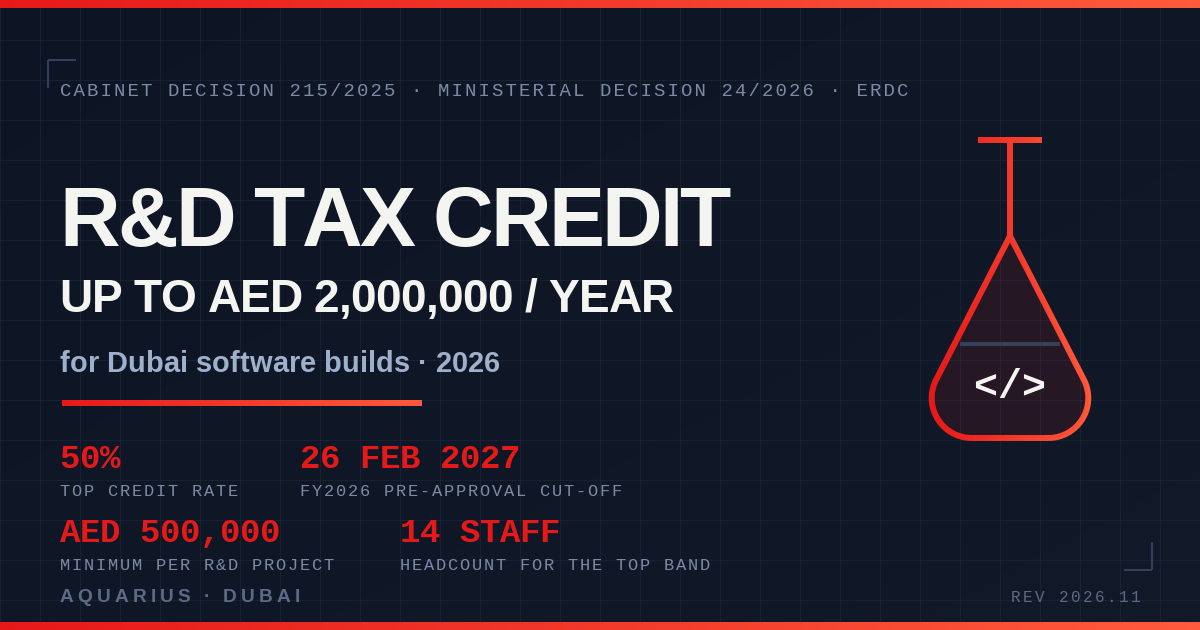
Short answer: From tax periods starting on or after 1 January 2026, a UAE company that builds genuinely novel software in the UAE can claim a Corporate Tax credit worth up to AED 2,000,000 a year — 15% on the first AED 1 million of qualifying R&D spend, 35% on the next million and 50% on the slice from AED 2 million to AED 5 million. The catch is procedural, not technical: every project needs pre-approval from the Emirates Research and Development Council through the TAWWER portal, and pre-approval cannot be obtained retrospectively. For a calendar-year 2026 business, the one and only window closes on 26 February 2027.
That date is the whole article. Cabinet Decision No. 215 of 2025 and Ministerial Decision No. 24 of 2026 built a credit that is unusually generous by global standards and unusually unforgiving on process. Miss a filing window by a day and a seven-figure credit does not shrink — it disappears.
Dubai builds a lot of software, and almost none of it is documented as research
The denominator is large. The Dubai Chamber of Digital Economy supported the establishment or expansion of 1,690 digital startups during 2025, up 39.7% year on year, with AI firms about 15% of them and fintech around 12%. DIFC Innovation Hub added 361 companies in the first half of 2026 alone, taking it past 1,933 AI, fintech and innovation firms. Dubai now counts roughly 473 deep tech companies, 113 of them funded, having raised about USD 2.27 billion between them. The Dubai Economic Agenda D33 target is 30 Dubai-grown unicorns by 2033.
Set that against the tax base: more than 651,000 businesses are registered for UAE Corporate Tax. A large share of the engineering-heavy ones are doing work that meets the OECD definition of experimental development every single sprint — and recording it as “Q3 platform work” in a Jira board that nobody will ever be able to turn into a claim.
Most Dubai software companies will not lose this credit because their work fails the science test. They will lose it because nobody filed a form in a portal that opened on 27 October 2026.
What the credit actually pays
The credit is tiered on two axes at once: how much you spend, and how many R&D people you actually employ. Both conditions have to be satisfied for a band to apply. Where the headcount threshold is missed, Article 2(7) of MD 24/2026 steps the rate down to the highest rate for which both tests are met, rather than voiding the slice.
| Qualifying R&D expenditure | Credit rate | Minimum average R&D staff | Maximum credit from this slice |
|---|---|---|---|
| First AED 1,000,000 | 15% | 2 | AED 150,000 |
| AED 1,000,000 – 2,000,000 | 35% | 6 | AED 350,000 |
| AED 2,000,000 – 5,000,000 | 50% | 14 | AED 1,500,000 |
| Above AED 5,000,000 | No credit | — | Capped — AED 2,000,000 total per entity or tax group per period |
Qualifying expenditure is not just payroll. It covers R&D staff costs — salaries, wages, benefits, allowances and pensions, but not employee stock options — plus a flat 30% uplift on those staff costs to stand in for overheads. Consumables such as power, water and materials consumed in the work qualify. So do fees paid to a UAE-based subcontractor for activity physically performed in the UAE, provided that subcontractor does not sub-subcontract it onward. Arm’s-length cost contribution arrangements and capitalised internally generated intangibles are in scope too. Externally provided workers count if you supervise them in the UAE.
What is carved out: any portion funded by government money, expenditure already benefiting from another UAE tax incentive, and recharges between group members. R&D in the social sciences, humanities and the arts is excluded outright, and only activity physically performed in the UAE counts — your Bangalore or Lahore development pod does not.
Does your Dubai build actually qualify?
MD 24/2026 points at the OECD Frascati Manual, which sets five cumulative tests. The work must be novel, creative, uncertain in outcome, systematic, and transferable or reproducible. Applied honestly to a software shop, that line falls in a specific place:
- Likely qualifying: a new matching or routing algorithm with no known solution at the outset; a model you train and evaluate rather than call; performance engineering where the outcome is genuinely in doubt; novel data structures or protocol work; original Arabic natural-language processing where off-the-shelf models underperform.
- Not qualifying: building a standard CRUD application on a known framework; integrating a documented API; UI and UX improvement; bug fixing; configuring or implementing packaged software; cosmetic rebuilds. Competent, valuable, billable — and not research.
The uncomfortable implication is that one product usually splits in two. A single Dubai platform build might contain AED 1.8 million of routine delivery and AED 700,000 of genuine experimental development, and the claim depends entirely on whether your systems can tell those apart after the fact, with evidence.
The arithmetic, in Dubai salaries
Each project must clear AED 500,000 of qualifying expenditure per tax period, measured before the 30% uplift. That floor is where most small Dubai teams fall over, and it is worth doing the sum with real local numbers. Mid-level software engineers in Dubai run roughly AED 15,000–25,000 a month in 2026, with senior and lead engineers at AED 30,000–35,000.
| R&D team on the project | Annual staff cost at AED 20,000/month | Clears the AED 500k project floor? | Band unlocked |
|---|---|---|---|
| 2 engineers | AED 480,000 | No — AED 20,000 short before uplift | None, unless consumables or UAE subcontract fees close the gap |
| 2 engineers + UAE test subcontractor | AED 480,000 + AED 60,000 | Yes — AED 540,000 | 15% band (AED 702,000 after uplift on staff cost) |
| 6 engineers | AED 1,440,000 | Yes | 35% band available on the AED 1m–2m slice |
| 14 engineers | AED 3,360,000 | Yes | 50% band on the AED 2m–5m slice |
A worked claim makes the shape obvious. Take a Dubai product company with 15 R&D staff and a calendar-year 2026 period: AED 2,000,000 of R&D payroll, plus the AED 600,000 uplift, plus AED 150,000 of consumables and AED 250,000 paid to a UAE testing subcontractor — AED 3,000,000 of qualifying expenditure. The credit comes to AED 150,000 + AED 350,000 + AED 500,000 = AED 1,000,000. On AED 6,000,000 of taxable income the Corporate Tax bill is AED 506,250 (the first AED 375,000 is taxed at 0%, the rest at 9%), so the credit wipes the bill to zero and AED 493,750 carries forward. It is non-refundable: no cheque arrives, but no tax is paid either.
Note how the average headcount is computed. MD 24/2026 adds up each month’s R&D headcount and divides by the number of months in which R&D actually took place — not automatically by twelve. A four-month burst with six engineers is an average of six, not two. Part-time staff count for the months they worked, and a subcontractor’s qualifying staff count toward your average. That single rule rewards concentrated, well-logged effort and punishes teams who cannot say which months the research happened in.
Three deadlines, and the one that cannot be fixed later
The claim runs through two authorities. The Emirates Research and Development Council decides whether the project is R&D; the Federal Tax Authority processes the credit inside your Corporate Tax return. Each step has a hard date.
| Step | Where | Deadline | If you miss it |
|---|---|---|---|
| Project pre-approval | TAWWER (ERDC) | Periods ending on or before 31 Dec 2026: within 40 business days after period end — 26 February 2027 for a calendar-year 2026 business. Later periods: on or before the last day of the period itself. | No credit. Pre-approval is valid for one year and is not available retrospectively. |
| Expenditure Confirmation | TAWWER (ERDC) | Within 6 months after period end — 30 June 2027 for FY2026 | Pre-approval lapses and the credit cannot be claimed, barring exceptional circumstances. There is no internal appeal route on this check. |
| Credit claim | EmaraTax (FTA) | With the Corporate Tax return, 9 months after period end — 30 September 2027 for FY2026 | Claims after the return deadline are not considered unless the FTA accepts exceptional circumstances. |
Read the first row twice. 2026 is the only year this credit can be claimed after the fact. From the 2027 period onwards, pre-approval must be filed on or before the last day of the tax year — so a calendar-year company has to decide in December 2027, before the work is finished and before anyone has reconciled the costs, which projects are research. That is a planning discipline, not a tax-season task. And if the Council comes back with questions, you have 20 business days to respond.
The free zone trap
This is the part Dubai gets wrong more than anywhere else in the UAE. The credit is only available where the entity is subject to 9% Corporate Tax on the income from the qualifying R&D activity, or to Top-up Tax. A Qualifying Free Zone Person enjoying 0% on qualifying income is, by construction, outside it. So is any business claiming Small Business Relief under Article 21.
Worse, the claw-back runs forward. If within five years of the final period you claimed in, the entity ceases to be a Taxable Person, becomes a Free Zone Person, elects Small Business Relief, enters liquidation or redomiciles outside the UAE, the used credit is repayable with penalties. Qualifying restructurings under Article 27(2) of the Corporate Tax Law are carved out, and a transferee can keep the credit if it carries on the R&D business for at least two years — stop inside two years and the repayment follows.
For a Dubai group with a mainland operating company and a free zone IP holder, the structuring question is therefore genuinely new: the entity that does the engineering, employs the engineers and pays 9% is the one that can claim. Unused credit can be passed to another company under 75% common ownership, but the recipient must use it in that same year — no carry-forward, no onward transfer.
Where the data layer breaks
None of this is hard arithmetic. It is the same data problem that defeats every other UAE tax computation we see: the system records the total, not the composition. A Dubai software company can tell you payroll for the year to the dirham. It cannot tell you, per project, per month, how many engineers worked on the experimental part and what evidence exists that the outcome was uncertain at the start.
The fields that need to exist, and usually do not:
- A project register with R&D flagged at project level, not cost-centre level — because the AED 500,000 floor and the pre-approval both bite per project.
- Monthly R&D headcount per project, including part-timers and supervised external workers, stored as a time series so the average can be computed over the months R&D actually ran.
- Staff cost attribution that excludes stock options and separates them cleanly, so the 30% uplift is applied to the right base.
- Subcontractor provenance — UAE-based, UAE-performed, and a contractual bar on onward subcontracting, evidenced on the purchase order rather than remembered.
- A funding-source tag per cost line, so government-funded portions and amounts already benefiting from another incentive drop out automatically.
- Contemporaneous technical evidence — the hypothesis, the alternatives rejected, the failed branches. Failed experiments are the strongest proof of technological uncertainty, and they are precisely what teams delete.
- The IAS 38 split — which development costs were capitalised as an internally generated intangible and which were expensed, since capitalised intangibles are explicitly in scope and your fixed asset register will not have kept the project link.
Records must survive seven years after the relevant tax period, and failing to maintain required records carries an administrative penalty of AED 10,000, rising to AED 20,000 for a repeat within 24 months. The penalty is trivial. Being unable to evidence a claim you have already used against your tax bill is not — see our note on how the same evidence gap plays out in deferred tax provisioning.
How it lands in your financial statements
Here is a question your auditor will ask and most UAE finance teams have not thought about. Investment tax credits sit outside the scope of both IAS 12 and IAS 20, so the treatment is an accounting policy judgement under IAS 8. The usual rule of thumb: a credit that is refundable in cash regardless of taxable profit looks like a government grant and goes through IAS 20 as other income; a credit that can only reduce an income tax liability is accounted for by analogy to IAS 12 as a reduction of tax expense.
The UAE credit sits in the awkward middle. It is non-refundable, which points firmly at IAS 12 — but it is transferable to a 75%-owned affiliate, which is the characteristic that normally opens the door to IAS 20 treatment. Pick a policy, document the reasoning, and apply it consistently, because the two choices put a seven-figure number in different places: above the operating line or below it. That matters to anyone reading your EBITDA — lenders, investors and, if you are in a multinational group, the Pillar Two effective tax rate calculation. Related reading: how capitalised costs distort the same subtotals.
What it costs to be able to claim
The cost of inaction is easy to size: a Dubai team of fourteen engineers at AED 20,000 a month that never files loses up to AED 1,185,000 of credit in a single year — more than the fully loaded cost of five of those engineers. Build the data layer once and it pays for itself in the first claim, then every year after.
| Scope | What it covers | Indicative AED |
|---|---|---|
| R&D project cost-attribution layer | Project register, R&D flags, monthly headcount series, payroll and subcontractor mapping on your existing stack | 35,000 – 85,000 |
| Full claim data room | The above plus evidence vault, Frascati-aligned project narratives, funding-source tagging, 7-year retention and export packs for TAWWER and EmaraTax | 85,000 – 180,000 |
| IAS 38 capitalisation split integration | Linking capitalised development cost in the asset register back to the R&D project that generated it | 25,000 – 60,000 |
| Multi-entity / tax group consolidation | Claim roll-up, 75% transfer tracking, claw-back monitoring across a Dubai mainland and free zone structure | 120,000 – 260,000 |
| Ongoing care | Monthly data checks, deadline monitoring, filing-pack refresh | 3,500 – 12,000 / month |
Aquarius does the engineering half of this, not the tax opinion. We instrument your delivery stack so that the project register, headcount series and cost attribution are produced as a by-product of how your team already works, then hand your tax adviser a pack they can file without a three-week reconstruction exercise. If you want the commercial shape first, our pricing and services pages set out how we scope this.
FAQ
Can we claim the UAE R&D tax credit for 2026 if we have not filed anything yet?
Yes, but only until 26 February 2027 for a calendar-year period. Tax periods ending on or before 31 December 2026 get a transitional window of 40 business days after period end to submit pre-approval through TAWWER. From the 2027 period onward, pre-approval must be submitted on or before the last day of the tax period itself.
Does normal software development count as R&D?
Not on its own. The assessment follows the OECD Frascati Manual, so the work must be novel, creative, uncertain in outcome, systematic and reproducible. Writing proprietary software to solve a problem with no known solution can qualify; routine development on established frameworks, integrations, UI and UX work, bug fixing and packaged-software implementation do not.
We are a free zone company on 0% — can we claim?
Generally no. The credit requires the entity to be subject to 9% Corporate Tax on the income from the qualifying R&D activity, or to Top-up Tax. On top of that, becoming a Free Zone Person within five years of your final claim period triggers repayment of credits already used, with penalties.
What if we only hire ten R&D engineers instead of fourteen?
You do not lose the slice entirely. Where a staffing threshold is not met, the rate steps down to the highest rate for which both the expenditure and headcount tests are satisfied — so a ten-person team spending into the AED 2m–5m band would be rated at 35% rather than 50%, subject to FTA confirmation of the mechanics.
Do offshore developers count towards the claim?
No. Only R&D activity physically performed in the UAE qualifies, and subcontracted work must go to a UAE-based provider performing it in the UAE without subcontracting it onward. An offshore pod in another country is outside the regime entirely, which changes the maths on where you put your engineering team.
How long do we need to keep the evidence?
At least seven years after the end of the relevant tax period. Failure to maintain required records carries an AED 10,000 penalty, rising to AED 20,000 for a repeat within 24 months — but the real exposure is a claw-back of a credit you can no longer substantiate.
If your team shipped something genuinely hard this year and nobody wrote down why it was hard, that is the entire problem in one sentence. Talk to Aquarius — we will look at your 2026 delivery history and tell you within a week whether there is a claim worth filing before the February window shuts.