
We Scanned 575 .ae Homepages for WCAG Failures: 74.8% Fail a Basic Check (2027 Data)
First-hand scan of 575 live .ae homepages: 74.8% fail a basic WCAG check, 18.1% block pinch-zoom including the regulator, and 24 of 31 overlay-widget sites still fail. Plus AED fix costs.
- PUBLISHED
- 23 NOV 2026
- READ TIME
- 11 MIN
- AUTHOR
- AQUARIUS · DUBAI
- UNIT
- REV 2026.09
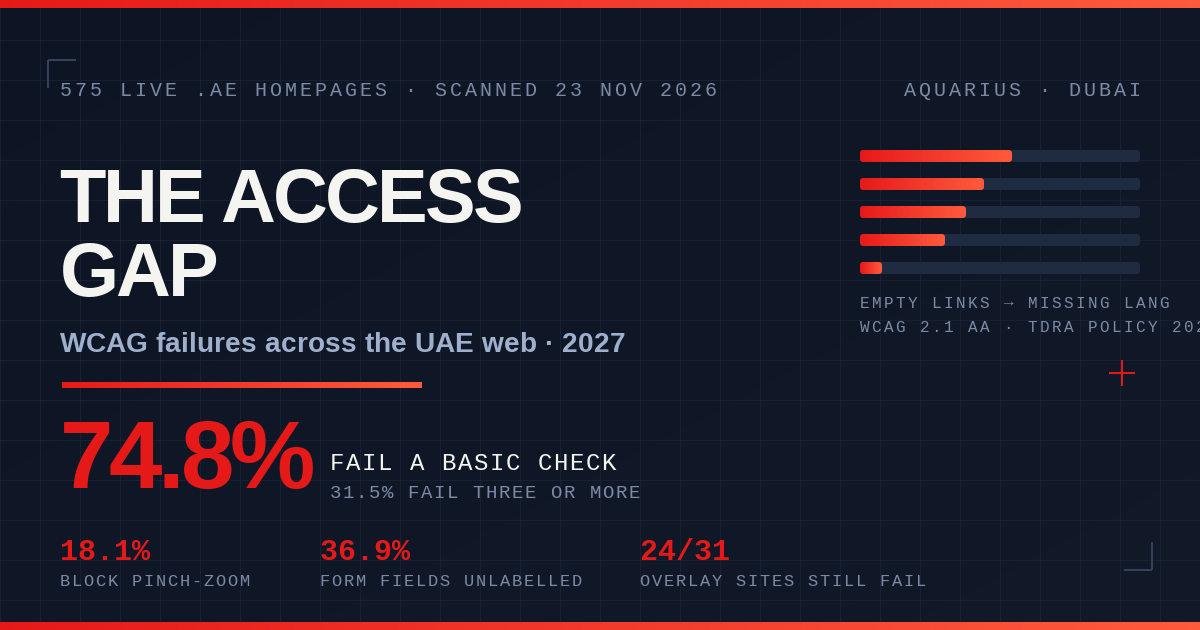
Short answer: we fetched the homepages of 785 of the most-visited .ae domains on 23 November 2026 and machine-checked the 575 that returned usable HTML. 74.8% fail at least one of five basic WCAG checks, 31.5% fail three or more, and only 25.2% are clean. The single most damaging finding: 18.1% of UAE homepages still block pinch-zoom on a phone — including the two domains belonging to the regulator that owns the national digital accessibility policy.
Why this matters in the UAE right now
Accessibility stopped being a nice-to-have here. The UAE issued its National Policy for Digital Accessibility in March 2024, owned by the TDRA, which pushes federal digital services towards WCAG 2.1 Level AA and a published accessibility statement. The Dubai Universal Design Code applies WCAG 2.1 AA to digital platforms for public and private operators, with penalties reported up to AED 200,000 and exclusion from government tenders. Underneath both sits Federal Law No. 29 of 2006, as amended by Federal Law No. 14 of 2009.
The audience is real and counted. The Ministry of Family put the number of People of Determination in the UAE at roughly 49,000 in 2026 as a new national strategy was drafted, while the WHO’s global baseline is that 1.3 billion people live with a significant disability. Add the UAE’s ageing expatriate professionals, anyone on a cracked phone in direct Dubai sunlight, and every customer who pinches to read a price — and the group your site locks out is far wider than a compliance register suggests.
For context on the global baseline: the WebAIM Million 2026 found WCAG 2 failures on 95.9% of the one million home pages it tested, averaging 56.1 errors per page, up 10.1% year on year. Our scan is deliberately narrower — five unambiguous, machine-verifiable failures — so our 74.8% is a floor, not a ceiling.
The five failure families across 575 .ae homepages
| Failure | WCAG reference | .ae homepages affected | Raw element rate |
|---|---|---|---|
| At least one empty link (no accessible name) | 2.4.4 Link Purpose | 54.4% | 5,532 of 116,634 links |
| At least one unlabelled form control | 3.3.2 Labels or Instructions | 44.3% | 1,468 of 3,980 controls (36.9%) |
At least one image with no alt attribute | 1.1.1 Non-text Content | 37.7% | 5,202 of 45,616 images (11.4%) |
| At least one empty button | 4.1.2 Name, Role, Value | 30.3% | — |
| No document language declared | 3.1.1 Language of Page | 7.8% | — |
Stacking them: 74.8% of homepages hit at least one family, 31.5% hit three or more, and 7 sites manage all five. 76 sites ship 20 or more empty links on the homepage alone; 78 sites ship 10 or more images with no alt attribute at all.
The pinch-zoom problem — and the regulator’s own site
WCAG 1.4.4 requires text to scale to 200%. The cheapest way to break it is one meta tag: user-scalable=no or maximum-scale=1. It is a single line of HTML, usually copied in years ago to stop iOS zooming on form focus, and it silently disables the one accessibility feature every phone ships by default.
104 of 575 UAE homepages (18.1%) still carry it. Among them: tdra.gov.ae and tra.gov.ae — the Telecommunications and Digital Government Regulatory Authority, custodian of the national digital accessibility policy. Both pages also declare zero <h1>, carry four unlabelled form controls and eleven empty links, and both run a third-party accessibility overlay. Seven .gov.ae domains in the sample block zoom, alongside dubaicustoms.gov.ae and ncm.gov.ae.
If your site blocks pinch-zoom, nothing else in your accessibility programme matters to the user holding the phone. It is a one-line fix and the single highest-return change in this entire dataset.
Myth-bust: the overlay widget does not fix it
31 of 575 sites (5.4%) run an accessibility overlay — UserWay on 23, accessiBe on 5, EqualWeb on 2, Recite Me on 1 — concentrated in government and banking. The widget is sold as compliance. The underlying HTML says otherwise:
- 24 of the 31 overlay sites still fail at least one basic family; 11 fail three or more.
- 11 of 31 (35.5%) block pinch-zoom — double the 17.1% rate of sites with no overlay at all.
- 74.2% ship empty links (vs 53.3% without an overlay); 48.4% ship unlabelled form controls; 41.9% ship images with no
alt.
This is not a UAE-specific observation. In January 2025 the US Federal Trade Commission ordered accessiBe to pay USD 1 million over claims that its AI widget could make any website WCAG-compliant, with the final order approved in April 2025; it also barred the company from repeating those claims without evidence. A toolbar sits on top of your markup. It does not rewrite your form labels, and in this sample the sites buying one were more likely to be breaking zoom. The detail of why overlays fail conformance is in our guide to web accessibility compliance for Dubai websites.
Where the real work is hiding
Three patterns in the data decide how much a remediation actually costs.
1. Forms are the worst layer of the UAE web
Of 3,980 form controls across the sample, 1,468 (36.9%) have no programmatic label — no <label for>, no aria-label, no aria-labelledby, no title. On the sites that actually have a form, 56.5% have at least one unlabelled field. These are enquiry forms, search boxes and login fields: the exact elements that carry revenue. Separately, 340 of 452 iframes (75.2%) have no title, which means 87.8% of sites that embed anything — maps, booking engines, video — hand screen-reader users an unnamed frame.
2. Arabic-first pages are measurably worse than English
73 homepages served Arabic as the document language. They fail harder on every axis: 86.3% hit at least one family (vs 73.1% for non-Arabic), 49.3% miss alt attributes, 68.5% ship empty links, 26.0% block pinch-zoom, and only 13.7% are clean against 26.9%. Arabic is usually the second build, done under time pressure after the English site shipped — and the RTL pass gets the design budget while the semantics get copied across unchecked.
3. Complexity is the tax
Split the sample by page weight and the curve is brutal. Homepages with more than 2,000 HTML elements fail at least one family 92.1% of the time and three or more 53.2% of the time. Homepages under 500 elements: 59.7% and 10.1%, with 40.3% clean. The median .ae homepage now ships 1,005 elements and the 90th percentile 3,715 — the same bloat that wrecks interaction latency in our study of third-party scripts and INP on UAE websites. Every component you add is another place to forget a label.
And the paperwork is thinner than the policy implies: only 8.0% of all sites link an accessibility statement, rising to 31.5% across .gov.ae. Meanwhile 16.7% of government homepages declare no document language at all — worse than the 9.0% private-sector rate, on the simplest requirement in the standard.
What it costs to fix in Dubai (2026 AED)
Priced by failure class rather than by page count, because that is what the data says drives the effort. These are our ranges for a typical UAE business site:
| Fix | Sites in our scan needing it | Effort | Indicative cost (AED) |
|---|---|---|---|
| Remove the zoom block (viewport meta) | 18.1% | Minutes | Included in any engagement |
| Document language + accessibility statement | 7.8% / 92.0% | Half a day | 1,500 – 4,000 |
| Alt-text and empty-link pass | 37.7% / 54.4% | 2 – 5 days | 4,000 – 14,000 |
| Form labels, buttons, iframe titles | 44.3% / 30.3% | 3 – 8 days | 6,000 – 22,000 |
| Full audit (manual + automated, WCAG 2.2 AA) | — | 1 – 3 weeks | 8,000 – 35,000 |
| Remediation of an existing site | 74.8% | 3 – 10 weeks | 15,000 – 90,000+ |
| Accessible-by-design new build | — | Built in | ~5 – 10% of build cost |
The cost of doing nothing is no longer theoretical. Beyond the AED 200,000 ceiling in the Dubai code and the loss of government tender eligibility, any UAE business selling to EU consumers has been inside the European Accessibility Act since 28 June 2025, which requires EN 301 549 — WCAG 2.1 AA — for new e-commerce, banking and transport services regardless of where the company is based. Services already on the market get until 28 June 2030; anything new launched today does not. Compare that with roughly 5–10% of build cost to do it properly the first time, and the arithmetic is not close. Our pricing page shows where accessibility work sits inside a full build.
How we ran this, and what it cannot see
We took the most-visited .ae domains from the Tranco top-1M list, fetched each homepage over HTTPS with a desktop browser user-agent on 23 November 2026, and kept the 589 that returned 2xx HTML (112 refused to connect, 64 returned 403). Of those, 575 parsed cleanly. Checks were run against the delivered HTML with a conservative rule set: a form control counts as labelled if it has for, aria-label, aria-labelledby, title or a wrapping label; a link counts as named if it holds visible text or an image with alt.
Three honest limits. We read static HTML, not the rendered DOM — markup injected by JavaScript is invisible to us, so every number here is a floor. We cannot test colour contrast or focus visibility statically, and contrast is the single most common real-world failure: WebAIM found it on 83.9% of pages. And we tested one page per domain; checkout, booking and account flows are where accessibility usually collapses hardest. A real audit uses a screen reader and a keyboard, not a regex.
One more signal worth noting: 85.2% of these sites use ARIA, with a median of 41 attributes and 281 at the 90th percentile. WebAIM has repeatedly found that pages using ARIA average more detected errors than pages without it — 59.1 against 42.0 in the 2026 run. ARIA is a scalpel. Most of this is decoration.
FAQ
Is WCAG compliance legally mandatory for a private company in Dubai?
Treat it as mandatory. The Dubai Universal Design Code applies WCAG 2.1 AA to digital platforms across public and private operators, the TDRA’s National Policy for Digital Accessibility (March 2024) sets the federal baseline, and Federal Law No. 29 of 2006 as amended underpins both. If you tender for government work, hold a regulated licence, or sell into the EU, the question is already settled.
Will an accessibility widget make my site compliant?
No. In our scan, 24 of the 31 .ae sites running an overlay still failed a basic WCAG check in their own HTML, and overlay sites blocked pinch-zoom at double the rate of everyone else. The FTC fined accessiBe USD 1 million in 2025 over exactly this claim. Fix the markup; the widget is at best a cosmetic layer on top.
What should I fix first?
In order: delete the user-scalable=no / maximum-scale=1 from your viewport meta tag, declare lang on <html>, label every form control, give every icon-only link and button an accessible name, and add alt to every image. Those five moves clear the failures that hit 74.8% of UAE homepages, and four of the five are code-level edits rather than redesigns.
How long does a WCAG 2.2 AA remediation take?
For a typical UAE marketing site: one to three weeks for a proper audit, then three to ten weeks of remediation depending on how many components are involved. Sites over 2,000 HTML elements sit at the top of that range — they failed three or more checks 53.2% of the time in our data, so there is simply more surface to repair.
Does Arabic content need separate accessibility work?
Yes, and it is routinely skipped. Arabic-language .ae homepages in our sample were clean only 13.7% of the time against 26.9% for the rest, and 26.0% blocked pinch-zoom. Declare lang="ar" and dir="rtl", re-check every label and alt string after translation, and test the RTL layout at 200% zoom.
Where to start
Three quarters of the most-visited UAE homepages fail a check that takes a developer an afternoon to clear. That is not a budget problem — it is a measurement problem, because nobody ran the scan. We build and remediate UAE sites to WCAG 2.2 AA, in Arabic and English, and we will tell you which of the five families your own site is in before you spend anything. Send us your URL and we will run the same checks on it.