
Whistleblowing and Speak-Up Platforms in Dubai (2026): DFSA, ADGM Rules and Real AED Build Costs
DFSA firms have needed a channel since 2022 and ADGM entities since 31 May 2025. The rules, the USD 50,000 exposure, and what a UAE-hosted speak-up platform really costs in AED.
- PUBLISHED
- 27 OCT 2026
- READ TIME
- 12 MIN
- AUTHOR
- AQUARIUS · DUBAI
- UNIT
- REV 2026.09
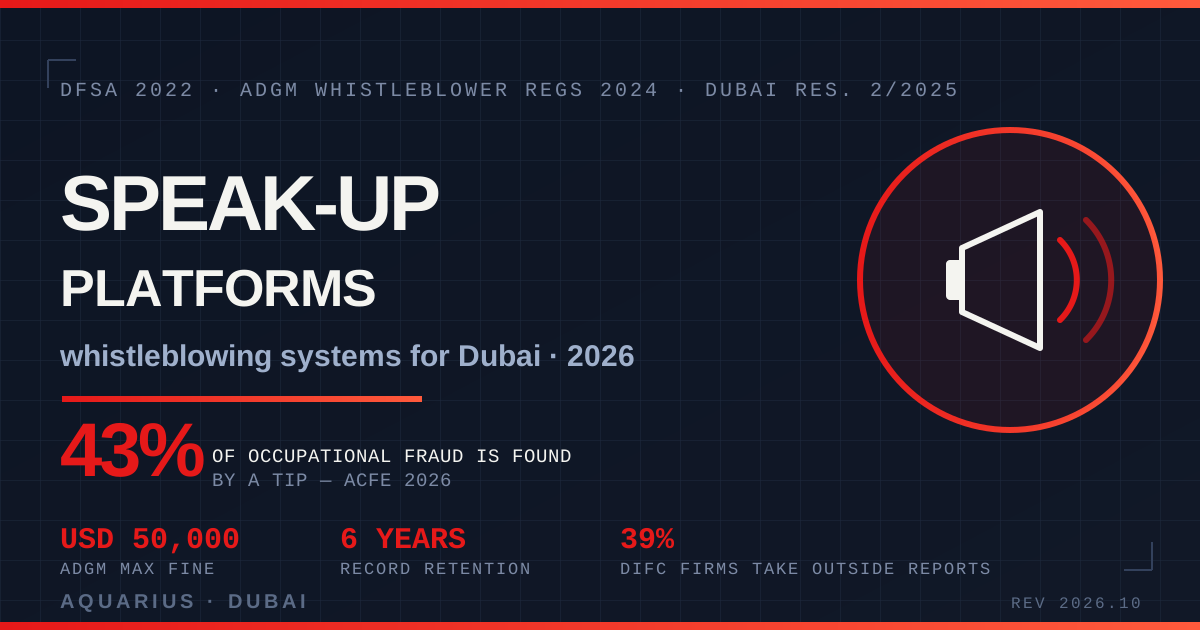
Yes — if you are regulated in the DIFC or registered in ADGM, a whistleblowing channel is not optional in 2026, and an email inbox monitored by HR does not satisfy it. The DFSA Whistleblowing Regime has been binding on every DFSA-authorised firm since 7 April 2022, and ADGM’s Whistleblower Protection Regulations 2024 gave every registered entity until 31 May 2025 to put proportionate arrangements in place, with written policies, six-year record retention and fines up to USD 50,000 for entities that fall in scope. Onshore Dubai has no equivalent general statute — which is exactly why most groups build one platform and route reports by jurisdiction.
The numbers that make this a 2026 problem, not a 2027 one
Three data points frame the whole exercise.
- The DIFC crossed 10,000 companies. DIFC reported 10,018 active registered companies in H1 2026 — the first time above five figures — including 1,134 regulated financial services firms, up 16% year on year. Every one of those 1,134 carries the DFSA whistleblowing obligations in full.
- ADGM grew faster than its compliance teams. ADGM reported 13,353 active licences by Q1 2026, with operational entities up 34.5% to 3,741 and financial services entities up 30% to 365. All of them passed the 31 May 2025 deadline, whether or not anyone told the board.
- Tips still beat audit by a wide margin. The ACFE 2026 Report to the Nations found 43% of occupational fraud is detected by a tip — the leading detection method for 30 consecutive years — against 15% for internal audit. A channel is not a paperwork exercise; it is the single most productive detection control an organisation owns.
The myth: “Head office runs a group hotline, so our Dubai entity is covered.” The DFSA tested that assumption. Its Whistleblowing Thematic Review, published 16 January 2025, found that only 39% of firms offered staff the option to report to a third party — 61% did not — and that group policies frequently failed to state that DFSA requirements take precedence inside the DIFC. A group policy that never names the DIFC standard is a finding waiting to happen.
Which rulebook applies to you
Dubai and Abu Dhabi run parallel regimes, and a UAE group of any size usually touches more than one. The practical map:
DFSA (DIFC financial firms)
In force since 7 April 2022 with no grace period, under the Regulatory Law. Firms must accept reports of a “regulatory concern” — a reasonable suspicion of a breach of DFSA law or rules, money laundering, fraud or other financial crime — permit anonymous reporting, offer both internal and external escalation routes, protect reporters from detriment and dismissal, run awareness programmes, and keep written records of each report and the outcome of its assessment. The DIFC Courts can order relief for loss of employment or other detriment. Note the scope trap the DFSA flagged: firms that widened “regulatory concerns” to cover ordinary HR grievances ended up with a channel clogged by disputes it was never designed to handle.
ADGM (all registered entities)
The Whistleblower Protection Regulations 2024 were published on 5 July 2024 with a compliance date of 31 May 2025. Every registered entity needs proportionate arrangements. FSRA-regulated entities, DNFBPs, DLT Foundations and “Large Establishments” need a written policy. A Large Establishment means more than 35 employees and more than USD 13.5m in turnover or assets. Records are retained for six years, fines reach USD 50,000, and non-retaliation is reinforced in the ADGM Employment Regulations 2024.
Dubai public sector
Resolution No. (2) of 2025 on Employment Protection of Public Sector Whistleblowers was issued on 20 May 2025 by Sheikh Maktoum bin Mohammed as Chairman of the Financial Audit Authority. It protects reporters inside FAA-supervised entities from retaliation and imposes strict confidentiality duties on the investigators handling the file.
Onshore UAE
No general whistleblower statute. Protection is indirect: Article 47 of Federal Decree-Law 33/2021 caps unlawful-termination compensation at three months of wage, which is a weak deterrent by design. Groups that want a single defensible standard across free zone and mainland entities build to the DFSA and ADGM bar everywhere, because the regulated entities set the floor anyway.
Groups with EU exposure
EU Directive 2019/1937 bites at 50 employees per member state, requires a confidential channel separate from HR, and sets hard clocks: acknowledge within 7 days, substantive feedback within 3 months. If your Dubai HQ runs the group channel for a European subsidiary, those deadlines become your SLA.
What the platform actually has to do
Strip the vendor language away and the requirement list is short and testable.
- Genuinely anonymous intake with two-way follow-up. Anonymity is worthless if you cannot ask the reporter a clarifying question. A case code plus a secure reply thread is the standard pattern — and the channel mix has shifted hard: ACFE 2026 puts web-based reporting at 46%, email at 34%, and phone hotlines down to 23% from 40% a decade earlier. A phone-only hotline in Dubai is a 2016 control.
- Arabic and English, properly. Not machine-translated boilerplate — RTL layout, Arabic intake forms, and translation inside the case workflow so investigators read what was actually written.
- Access segregation. The named recipient, not the whole compliance team, and never the line manager implicated in the report. This is the single most common design failure.
- A defensible case record. Immutable timeline, assessment outcome, decision rationale, six-year retention for ADGM, and an export the regulator can read without a walkthrough.
- Data protection that survives review. A whistleblowing case file is sensitive processing about identified individuals. Under the UAE PDPL (Federal Decree-Law 45/2021, in force 2 January 2022) the Executive Regulations and the Article 26 penalties decision remain unpublished as of October 2026 — so the AED fine figures circulating online are forecasts, not statute. The DIFC is the opposite: its Data Protection Law 5/2020, as amended on 8 July 2025, carries real numbers — up to USD 50,000 for a failed DPIA or improper data sharing, and up to USD 50,000 for not appointing a required DPO. Run the DPIA before launch, not after the first report.
ISO 37002:2021 is the structural reference most groups quote — receive, assess, address, conclude, built on trust, impartiality and protection. One caveat worth knowing before a vendor sells you a badge: it is a Type B guidance standard and is not certifiable. You can attest alignment and audit yourself against clause 9. You cannot be certified to it.
Buy a licence or build the platform?
Both work. The economics diverge sharply at the two-to-three year mark, and in the UAE the deciding factor is usually data residency and bilingual depth rather than price.
| Option | Typical cost | Best for | Watch out for |
|---|---|---|---|
| Global SaaS hotline, enterprise tier | USD 30,000–80,000/yr for 2,000–5,000 staff; USD 50,000–120,000/yr mid-size, plus USD 25,000–60,000 implementation | Multinationals with an existing global vendor | Offshore data residency; per-seat creep; Arabic often an add-on |
| Mid-market SaaS | From roughly USD 3,500/yr; SMB tiers from about USD 49/month; market band USD 1–15 per employee per year | Single-entity DIFC or ADGM firms under 200 staff | Shallow case management; weak audit export; limited role segregation |
| Custom build, owned | AED 45,000–350,000 one-time by scope — see the bands below | Groups with three or more entities across DIFC, ADGM and mainland | Needs real security engineering, not a contact form with a checkbox |
| Outsourced call-centre hotline | Retainer plus per-call fees | Regulatory box-ticking only | 23% of tips now arrive by phone — you are buying the shrinking channel |
The AED number that matters: a licensed enterprise platform at USD 50,000 a year is roughly AED 183,600 annually — recurring, forever, with implementation on top. A purpose-built platform sits in the same range once, then drops to a support retainer. For a three-entity UAE group, the crossover usually lands inside year two.
Real AED build costs in Dubai
What we quote in 2026 for a speak-up platform built and hosted for UAE entities:
| Scope | AED | Timeline |
|---|---|---|
| Core intake portal — anonymous submission, case code, secure two-way messaging, encrypted case log | 45,000–85,000 | 3–5 weeks |
| Full case management — triage, workflow states, role-based access, conflict-of-interest recusal, immutable audit trail, regulator export | 90,000–180,000 | 6–10 weeks |
| Multi-entity group build — jurisdiction routing across DIFC, ADGM and mainland, separate rulebook clocks, board-level analytics | 180,000–350,000 | 10–16 weeks |
| Arabic and RTL intake plus in-case translation workflow | 12,000–30,000 | 1–2 weeks |
| UAE data residency hosting, hardening and penetration test | 25,000–60,000 | 2–3 weeks |
| Policy alignment to ISO 37002, DPIA pack and staff awareness microsite | 20,000–45,000 | 2–3 weeks |
| Care retainer — hosting, patching, support, annual review | 3,500–12,000/month | ongoing |
The cost of not having one
This is where the business case stops being about compliance. ACFE 2026 data on organisations that suffered occupational fraud: those with a reporting hotline recorded a median loss of USD 100,000 over 11 months; those without one lost a median USD 150,000 over 17 months — 50% more money, six months longer. Duration is the real multiplier: schemes caught inside six months cost a median USD 40,000, while those running past five years cost USD 1,115,000, a 28× difference driven almost entirely by how fast someone could speak up.
Two more figures worth putting in front of a board. Formal reporting mechanisms exist at 85% of organisations with 100 or more employees but only 24% of those below 100 — which is most of the 10,018 DIFC registrants. And training works: organisations that trained staff on how to report received roughly twice as many tips and recorded median losses of USD 84,000 against USD 150,000. The awareness microsite is not the soft part of the budget; it is the part that generates the tips.
Context on timing: the UAE exited the FATF grey list in February 2024 and its next mutual evaluation is scheduled for June 2026. Financial-crime controls across DIFC and ADGM firms are being looked at closely this year, and the updated DFSA AML Module took effect on 1 April 2026.
How Aquarius builds it
We build the channel as a product, not a form. Anonymous intake with a reply thread that cannot be traced back to a device. Role-based access where the recipient list is configurable per entity and per report category, so an allegation about the CFO never lands in the CFO queue. Immutable case timeline with a regulator-ready export. Arabic and English from day one. UAE-resident hosting with a documented transfer-adequacy assessment where data does leave. A DPIA delivered with the build, not sold as a later engagement.
Fixed-price scope, a written compliance mapping against the DFSA and ADGM requirements before a line of code is written, and a fixed-fee remediation commitment if a regulator finds a gap in what we specified. If your obligations overlap with AML reporting or HR monitoring, read our guides on AML and KYC compliance software for Dubai, whether employee monitoring is legal in Dubai, and the UAE PDPL compliance checklist — all three touch the same data.
FAQ
Is a whistleblowing policy mandatory for a mainland Dubai company?
No. There is no general onshore whistleblower statute. Mainland companies rely on Article 47 of the UAE Labour Law, which caps unlawful-termination compensation at three months of wage. If your group includes a DIFC-regulated firm or an ADGM registration, those entities are mandatory, and most groups build once to the higher standard.
Does the ADGM deadline still matter if we missed 31 May 2025?
Yes — the obligation did not expire with the deadline. Entities in scope still need proportionate arrangements, written policies where required, six-year retention, and exposure runs to USD 50,000. Remediate now; the arrangements are judged on whether they exist and work, not on when you started.
Can we run the channel through HR?
Not well, and in the EU not at all. The DFSA expects escalation routes that do not depend on the chain of command a reporter may be accusing, and EU Directive 2019/1937 requires a channel separate from HR. Technically HR can be one recipient, but never the only one, and never for reports naming HR or senior management.
How long does a build take?
Three to five weeks for a core intake portal, six to ten weeks for full case management, ten to sixteen for a multi-entity group platform with jurisdiction routing. Most Dubai clients launch the portal first and layer case workflow in a second phase, so the channel is live inside a month.
Can we get ISO 37002 certified?
No. ISO 37002:2021 is a Type B guidance standard with no certification scheme. You can document alignment and run internal audits against clause 9, and that alignment statement is what regulators and insurers actually ask to see.
Next step
If you hold a DFSA licence or an ADGM registration, the question is no longer whether to have a channel — it is whether yours would survive a thematic review. Send us your current arrangement and your jurisdictions, and we will map it against the 2026 requirements and return a fixed-price build scope. Our pricing page has the standard bands, or talk to us about your entity structure.