
Workforce Scheduling and Labour Forecasting Software in Dubai (2026): Demand-Based Rotas, UAE Labour Law Rules and Real AED Costs
Labour is 25 to 30 percent of revenue in Dubai service businesses and most rotas are still spreadsheets. How demand forecasting, UAE Labour Law rule checks and open-shift apps cut 7 to 9 percent, with AED costs.
- PUBLISHED
- 11 NOV 2026
- READ TIME
- 11 MIN
- AUTHOR
- AQUARIUS · DUBAI
- UNIT
- REV 2026.09
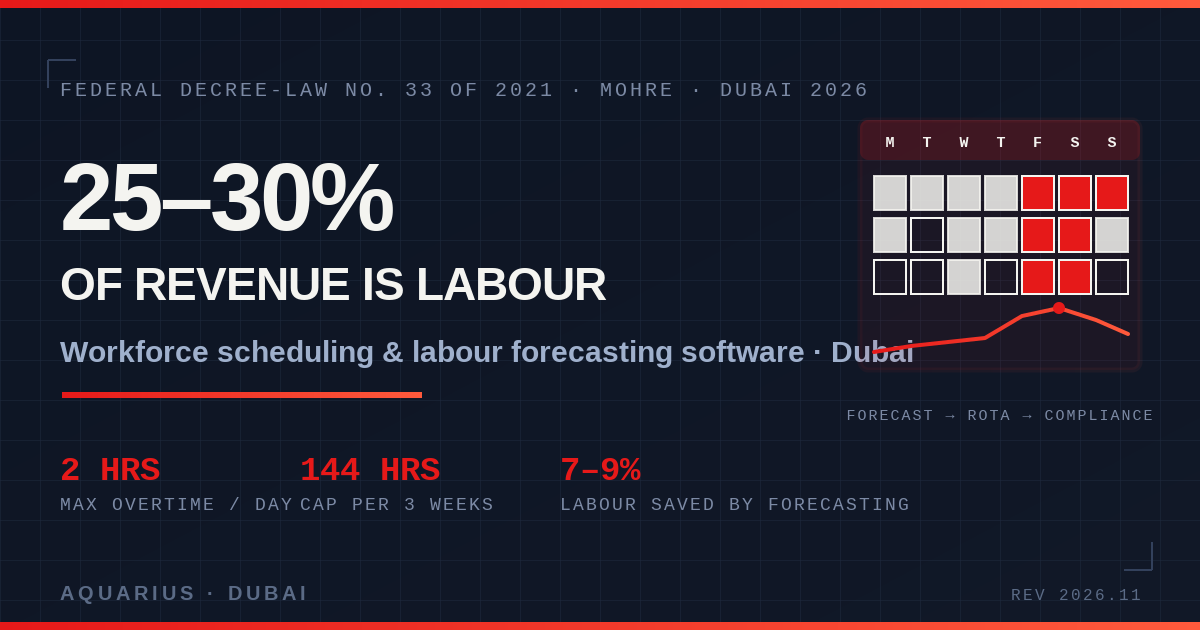
Short answer: Workforce scheduling software builds the weekly rota from a demand forecast (covers, footfall, occupancy, orders) instead of copying last week, then checks every shift against UAE Labour Law before it is published: the 8-hour day, the 2-hour overtime cap, the 144-hour three-week ceiling, the paid weekly rest day, Ramadan’s 2-hour reduction and the summer midday break. For a Dubai operator where labour is 25–30% of revenue, demand-based scheduling typically removes 7–9% of labour spend and 40–80% of the manager hours spent building rotas. A capable UAE build costs AED 45,000–260,000 depending on how many sites, roles and systems it has to talk to.
Most Dubai restaurants, retailers, clinics and hotels still schedule in Excel or WhatsApp, then discover the overtime bill and the compliance gap at payroll time. This guide covers what the 2026 numbers say about labour in Dubai’s service economy, the UAE rules a rota must obey, how forecasting actually works, what the off-the-shelf tools cost, and what a custom platform costs in AED.
Dubai’s 2026 labour problem in three numbers
The service workforce is enormous and still growing. Dubai had around 730 hotels and 152,000 rooms by mid-2025, with inventory projected to reach 161,218 rooms by the end of 2026. Hotels here create roughly 1.5 jobs per room, and the 11,300 rooms in the pipeline to 2027 are expected to add about 15,000 direct jobs, according to figures reported by Khaleej Times. Nationally the accommodation and food service sector employed an estimated 312,000 people in 2025. Every one of them is on somebody’s rota.
Labour is the second-largest line on the P&L. Dubai restaurant benchmarks put labour at 25–30% of revenue, with quick service at 22–30%, casual dining at 28–38% and fine dining at 35–45%. Mordor Intelligence values the UAE foodservice market at USD 27.28 billion in 2026, with quick service alone at USD 7.84 billion and growing near 20% a year. Retail is bigger still: the UAE retail market is sized at USD 162.31 billion in 2026, and Dubai Mall logged 111 million visitors in 2024. Those visitors do not arrive evenly across the week, and a flat rota pays for the gaps.
Demand is more volatile than ever. Dubai welcomed 19.59 million international overnight visitors in 2025, then saw hotel occupancy swing from above 80% to 36% in March 2026 before recovering through the summer. Ramadan moves roughly 11 days earlier every year, Eid and DSF reshape trading hours, and 45°C July afternoons empty terraces that are packed in January. A schedule built on “same as last week” is wrong by design.
The myth: “attendance software already handles our rota”
This is where most Dubai businesses get it wrong. Time-and-attendance tells you what happened: who clocked in, who stayed late, what overtime is owed. Scheduling decides what should happen: how many people, with which skills, in which hours, for the demand you expect. The first is a payroll input. The second is where the labour money is actually saved or wasted. If your biometric terminal is excellent and your rota is still a spreadsheet, you have precise records of an expensive mistake. We covered the attendance side, including the 125% and 150% overtime maths, in our guide to time and attendance software in Dubai; this article is about the decision that comes before the clock-in.
The UAE rules every rota has to pass
Federal Decree-Law No. 33 of 2021 and Cabinet Resolution No. 1 of 2022 set hard constraints that a scheduling engine should enforce at the moment a manager drags a shift, not at month-end. The ones that matter most for shift-based businesses:
| Rule | What the law says | What the scheduler must do |
|---|---|---|
| Normal hours | 8 hours a day or 48 hours a week in the private sector | Flag any shift pattern that exceeds 8 paid hours or 48 in the week before publishing |
| Overtime cap | Overtime may not exceed 2 hours in a day; total hours may not exceed 144 in any three weeks | Block shifts over 10 hours; run a rolling 21-day hour counter per employee |
| Overtime pay | Basic hourly rate plus 25% by day; plus 50% between 10pm and 4am; rest-day work at plus 50% or a substitute day off | Cost each draft rota live so the manager sees the AED consequence of a late shift before approving it |
| Breaks | No more than 5 consecutive hours without rest, food and prayer breaks totalling at least 1 hour | Insert mandatory breaks into long shifts and exclude them from paid hours where the contract allows |
| Weekly rest | At least one paid rest day per week | Refuse a seventh consecutive working day unless a substitute day is scheduled |
| Ramadan | Working hours reduced by 2 hours a day for every employee, regardless of religion; work beyond the reduced day is overtime | Apply a date-range rule that shortens every template by 2 hours and re-prices overtime automatically |
| Midday break | 15 June to 15 September, no outdoor work under direct sun 12:30–15:00; fine AED 5,000 per worker, up to AED 50,000 per incident | Block outdoor roles in the banned window; keep the shift log MOHRE inspectors ask for |
| Work models | Six recognised models: full-time, part-time, temporary, flexible, remote and job-sharing; part-time needs a MOHRE permit and can span multiple employers | Store the permit type per person so a part-timer is never auto-filled into full-time hours |
Two of these rules catch Dubai operators every year. The 144-hour three-week ceiling is invisible in a weekly spreadsheet, because nobody is adding three weeks together. And the Ramadan reduction applies to everyone, not only to fasting staff, so a rota that keeps non-Muslim employees on 8-hour shifts in Ramadan is quietly generating 2 hours of unpaid overtime a day per person for a month.
How demand-based scheduling actually works
1. Forecast the work, not the people
The engine pulls the signals that predict volume for your business: POS transactions by half-hour, reservation covers, hotel occupancy and arrivals, footfall counters, appointment bookings, delivery orders from Talabat and your own app, plus a Dubai calendar of public holidays, Ramadan, Eid, DSF, school terms and major events. It then produces a demand curve per location per 15 or 30 minutes for the next two to four weeks. Operators that review forecasts monthly rather than yearly report labour cost cuts of up to 18%, and large retailers using AI-driven scheduling have taken 7–9% out of labour while improving customer satisfaction scores.
2. Convert demand into labour standards
A labour standard is a rule like “one barista per 25 transactions an hour” or “one housekeeper per 14 checkouts” or “two nurses on the floor whenever more than six appointments overlap”. The engine multiplies the forecast by these standards to produce required hours by role by interval. This is the step most Dubai businesses skip, which is why their rotas are built on headcount habit rather than workload.
3. Generate and cost the rota
The optimiser fills required hours with real people, respecting contracts, skills, visas, availability, preferences and every rule in the table above, then shows the fully loaded AED cost of the week against budget before anyone publishes it. Managers edit, the engine re-checks and re-costs in real time. Forrester’s study of automated scheduling found managers spend 40–80% less time building schedules, with payback inside six months.
4. Publish, swap and fill
Staff get the rota in Arabic, English, Hindi, Tagalog or Urdu on their phones, request swaps that managers approve with one tap, and pick up open shifts from a pool. Last-minute no-shows trigger an offer to qualified staff who are under their hour ceilings rather than a panicked WhatsApp broadcast.
5. Close the loop with attendance and payroll
Planned versus actual hours flow to payroll with overtime already classified at 125% or 150%, rest-day work tagged for pay or substitute day, and Ramadan hours already adjusted. WPS files, gratuity accruals and the Emiratisation headcount report all read from the same data. If you are rebuilding that side too, see our notes on HR and payroll software with WPS in Dubai and the end-of-service savings scheme.
Off-the-shelf tools: what they cost and where they break in Dubai
| Tool | Published 2026 pricing | Fit for Dubai operators |
|---|---|---|
| Deputy | USD 5–9 per user per month annual (about AED 18–33) | Strong scheduling and demand forecasting from POS data; UAE rules (144-hour ceiling, Ramadan, midday break) are manual configuration |
| Planday | USD 2.99–4.49 per user per month plus a USD 15 monthly fee on Plus; 5–10 user minimum | Cheapest per seat; hospitality-oriented; no WPS or MOHRE awareness |
| 7shifts | Free up to 15 staff at one location; from USD 44.99 per location per month | Restaurant-specific with labour-cost forecasting; US-centric compliance library |
| Connecteam | Free up to 10 users; USD 29–99 per hub per month for 30 users | Good communications layer; scheduling rules are generic |
| Zoho People + Payroll | About AED 45 per organisation plus AED 9 per employee per month | UAE payroll yes; demand forecasting no |
| UAE HRMS (Bayzat, ZenHR, Yomly, HR Chronicle) | Quote-based; roughly AED 11 and up per employee per month | WPS, gratuity and overtime warnings built in; forecasting and optimisation are thin or absent |
| Custom platform (Aquarius) | AED 45,000–260,000 build; AED 2,500–8,000 a month to run | Forecasting from your own POS, PMS and booking data, UAE rules as code, multi-site, your data |
The pattern is consistent: the global tools forecast well and know nothing about MOHRE, while the UAE HR suites know MOHRE and do not forecast. A 300-person operator on Deputy pays roughly AED 5,400–9,900 a month and still needs someone to maintain the UAE rules by hand. That gap is the business case for a custom build once you pass a few hundred staff or a handful of sites.
What a custom build costs in AED
Our bands for Dubai and UAE operators. These are Aquarius quote ranges, not market averages; the enterprise WFM suites do not publish list prices.
| Scope | AED band | Timeline |
|---|---|---|
| Labour audit: planned versus actual hours, overtime leakage, 144-hour and Ramadan exposure, labour-standard draft for each role | 12,000–28,000 | 2–3 weeks |
| Rota and compliance engine: templates, UAE rule checks, live AED costing, staff app with swaps and open shifts, Arabic and English, single business unit | 45,000–110,000 | 6–9 weeks |
| Forecasting platform: POS, PMS or booking integrations, demand model per site, labour standards, auto-generated rotas, budget variance dashboards, payroll and WPS export, multi-site | 120,000–260,000 | 12–18 weeks |
| Integrations: biometric or face terminals, Talabat and Deliveroo order feeds, Opera or Cloudbeds, Foodics or Oracle Micros, Bayzat or ZenHR payroll | 15,000–60,000 per system group | Parallel |
| Run and tune: hosting, model retraining each season, rule updates when MOHRE changes, manager training | 2,500–8,000 / month | Ongoing |
Set that against the spend it governs. A Dubai casual-dining group with six outlets turning over AED 60 million a year at 30% labour is paying AED 18 million a year in wages. A conservative 5% improvement from forecast-driven rotas is AED 900,000 a year, which pays for the top of our build band in about four months. The compliance side has its own number: with Emiratisation shortfalls now costing AED 9,000 a month per unfilled position, or AED 108,000 a year, for firms with 50 or more skilled staff, the same headcount data that drives the rota should be telling finance exactly where the quota stands.
How Aquarius builds it
We start with the labour standards, not the screens. Two weeks on site with your ops leads produces the ratio table for every role, the list of demand signals you already capture, and an honest measure of your current overtime and compliance exposure. That audit alone often changes the rota before any software ships.
Then we build the rule engine as code: 8 and 48 hours, the 2-hour and 144-hour caps, break insertion, weekly rest, Ramadan date ranges, midday-break windows for outdoor roles, and permit type per person. Every rule has a test, so when MOHRE changes a date or a cap, we change one line and the whole business is compliant the same day. The forecast model trains on your own POS, PMS and booking history and is retrained each season, because a model built on a 2024 January will not understand a 2026 March.
Finally we connect it: attendance terminals in, payroll and WPS out, and the open-shift marketplace that turns a no-show into a notification rather than a crisis. If delivery is a big part of your demand curve, our note on cutting Talabat commission with a branded ordering app explains how to get that order data flowing into the forecast as well.
Not sure which band you are in? Run the labour audit first. It is two to three weeks, it puts an AED figure on your overtime and compliance exposure, and it tells you honestly whether a per-seat tool is enough. See our pricing, browse what we build, or send us last month’s rota and payroll summary and we will show you where the hours went.
FAQ
How much does workforce scheduling software cost in Dubai?
Per-seat tools run from about AED 11 to AED 33 per employee per month (Planday, Deputy, UAE HR suites), with restaurant tools like 7shifts priced per location from USD 44.99 a month. A custom Aquarius build costs AED 45,000–110,000 for a rota and UAE compliance engine, AED 120,000–260,000 for a multi-site forecasting platform with POS and payroll integrations, plus AED 2,500–8,000 a month to run.
What are the UAE legal limits a shift rota must follow?
Eight hours a day or 48 a week, overtime capped at 2 hours a day and 144 total hours in any three weeks, at least one paid rest day a week, no more than 5 consecutive hours without breaks totalling an hour, a 2-hour daily reduction for all employees during Ramadan, and no outdoor work between 12:30 and 15:00 from 15 June to 15 September. Overtime is paid at basic rate plus 25%, or plus 50% between 10pm and 4am and on rest days.
Does the Ramadan 2-hour reduction apply to non-Muslim staff?
Yes. Under Federal Decree-Law No. 33 of 2021 the reduction applies to every private-sector employee regardless of religion or nationality, and any work beyond the reduced day counts as overtime. A rota that keeps non-fasting staff on full shifts in Ramadan is accruing unpaid overtime.
How much labour cost does demand-based scheduling save?
Published results range from 7–9% for large retailers using AI-driven scheduling to up to 18% for operators that move from annual to monthly forecast reviews, with managers spending 40–80% less time building rotas. For a Dubai restaurant at 25–30% labour, even a 5% improvement is worth more than 1% of total revenue.
Can scheduling software handle part-time and job-sharing staff in the UAE?
Yes, if it stores the MOHRE permit type per person. Cabinet Resolution No. 1 of 2022 recognises full-time, part-time, temporary, flexible, remote and job-sharing models; part-time workers can hold permits for more than one employer and accrue leave and gratuity pro rata. The scheduler should cap each part-timer at contracted hours and never auto-fill them into full-time patterns.
Figures cited are from MOHRE and u.ae guidance on Federal Decree-Law No. 33 of 2021, Khaleej Times hotel pipeline reporting, Mordor Intelligence, Dubai restaurant cost benchmarks, vendor pricing pages and published scheduling ROI studies as of November 2026. Rates and quotas change; confirm current MOHRE rules before modelling.