
3D Printing and Additive Manufacturing Software in Dubai (2026): Quoting, Job Tracking and the Conformity Paperwork Nobody Automates
Software is only 6% of a USD 24.2bn additive manufacturing industry. Real 2026 AED costs for AM quoting and job-tracking software in Dubai, plus Decree 24 of 2021 and the 3DCP conformity rules.
- PUBLISHED
- 29 OCT 2026
- READ TIME
- 12 MIN
- AUTHOR
- AQUARIUS · DUBAI
- UNIT
- REV 2026.09
Short answer: software is the smallest slice of additive manufacturing and the biggest bottleneck in it. Wohlers Report 2026 values the global AM industry at USD 24.2 billion for 2025, of which software is just 6% while printing services take 48%. For a Dubai print bureau or in-house AM cell, the money is not lost at the nozzle: it is lost in the quote queue, in WhatsApp threads and in the conformity paperwork. Off-the-shelf AM workflow platforms start around AED 29,200 a year; a custom quoting and job-tracking portal built for UAE VAT, e-invoicing and Dubai Municipality documentation runs AED 28,000 to AED 380,000 once, depending on scope.
The Dubai additive manufacturing market in 2026, in numbers
Three figures set the stakes before you spend anything on tooling.
One: the industry grew up, slowly. Wohlers Report 2026 (published by ASTM International) puts 2025 global AM revenues at USD 24.2 billion, up 10.9% year on year — healthy, but far off the 20%-plus years before the pandemic. The internal split matters more than the headline: printing services 48%, systems and servicing 26%, materials 20%, software 6%. Services grew 15.5% while system sales rebounded only 3.6%. Regionally, Europe, the Middle East and Africa averaged 9% growth against 19.8% in Asia-Pacific. Translation: the demand is in making parts for other people, and the firms that win are the ones who can take an order without friction.
Two: the UAE is a top-tier AM market by policy, not accident. The Dubai 3D Printing Strategy, launched in 2016, set the target of 25% of new Dubai buildings being 3D printed by 2030, with sector market values of AED 3 billion (construction), AED 1.7 billion (medical products) and AED 2.8 billion (consumer products). Knowledge Sourcing Intelligence sizes the UAE additive manufacturing market at roughly USD 0.3 billion in 2026 growing to USD 0.6 billion by 2031 at a 14.9% CAGR; Future Market Insights expects the UAE to be the fastest-growing Middle East market at about 20.2% CAGR in its 2026–2036 outlook. On the ground, Orbit3D reports roughly a 200% increase in requests for industrial-grade end-use parts versus concept models, with powder-bed nylon (MJF) leading industrial demand.
Three: the industrial base funding all of this is real. Under Operation 300bn, the UAE industrial sector reached AED 200 billion of GDP contribution as of May 2026 — a 70% increase since 2021 — against a target of AED 300 billion by 2031. Industrial exports hit AED 262 billion, including AED 92 billion of advanced industrial exports, and Emirates Development Bank has AED 30 billion earmarked for priority industrial sectors. Make it in the Emirates 2026 ran at ADNEC in May with 1,245 exhibitors. Your buyers are being paid to localise parts. Your job is to be quotable.
Most Dubai bureaus get this wrong: the bottleneck is the quote, not the printer
Ask a Dubai service bureau what limits growth and you will usually hear machine hours. The data says otherwise.
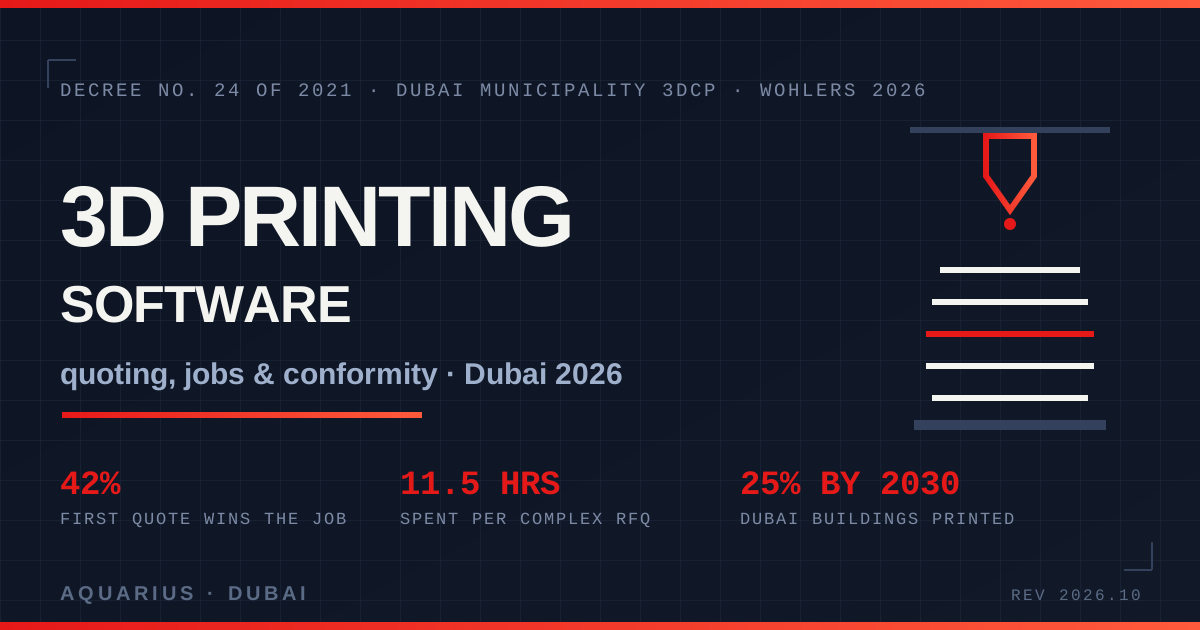
A Precision Machined Products Association survey found the first respondent to an RFQ won 42% of quoted jobs, the second 23%, and the third 12%. Quotes returned within 24 hours won at 2.1x the rate of quotes sent at 48–72 hours, and 3.4x the rate of quotes sent after 72 hours.
And quoting is expensive labour. Fictiv's 2025 State of Manufacturing report found manufacturers spend an average of 11.5 hours per complex RFQ, with 65% of that time spent gathering and verifying data rather than actually pricing the job.
Run the arithmetic for a mid-sized Dubai bureau. One application engineer at a fully loaded AED 120 per hour, 11.5 hours per complex RFQ, is AED 1,380 of labour per quote — of which roughly AED 900 is data chasing. Twenty complex RFQs a month is about AED 18,000 a month, or AED 215,000 a year, spent on file hunting. That is before a single lost job. Apply the PMPA multiples to 60 RFQs a month at an average order value of AED 7,500 and the gap between a 72-hour reply and a same-day reply is the difference between winning a handful of jobs and winning most of them. Those multiples are industry averages, not a guarantee — but they point the same direction every time.
What an AM software stack actually has to do
Strip the marketing away and a working additive stack covers six jobs. Slicers and build preparation are not on this list — that part is solved.
- File intake and printability checks. Upload STL or STEP, auto-measure bounding box, volume and surface area, flag thin walls, trapped powder and unsupported overhangs before a human looks at it.
- Pricing logic. Material cost per gram, machine time, nesting efficiency, post-processing steps, finishing, 5% VAT, and a margin rule you can change without a developer.
- Order and job routing. Which machine, which batch, which operator, which due date — and what happens when a build fails at 80%.
- Traceability. Material lot numbers, machine logs, operator, parameters, and the test results tied to each delivered part. This is what turns a print shop into a supplier.
- Documents and compliance. Certificates, permits, conformity records, retention. In Dubai construction printing this is not optional (see below).
- Money. Tax invoices that survive a Federal Tax Authority review, and a path into UAE e-invoicing — which is why your quoting tool and your e-invoicing integration should be designed together, not six months apart.
Off-the-shelf AM platform pricing, 2026
Published prices are rare in this category; these are the current public numbers, converted at AED 3.6725 to the US dollar.
| Platform | Public 2026 pricing | Approx. AED | What it is good at |
|---|---|---|---|
| AMFG — Quoting | From USD 7,950/year + USD 59/user/month | About AED 29,200/year + AED 217/user/month | Quoting-only entry point for a single-site bureau |
| AMFG — Quoting and Production | From USD 14,950/year + USD 59/user/month | About AED 54,900/year + AED 217/user/month | Adds scheduling and production workflow |
| Authentise Flows / FlowsAM | From USD 2,500/month + setup fee; Digital Warehousing add-on from about USD 1,900/month; Material Management from USD 26,000/year | From about AED 9,200/month (AED 110,000/year); add-ons AED 7,000/month and AED 95,000/year | Deep process data capture and machine connectivity |
| 3YOURMIND | Quote-based; Capterra lists from EUR 10,000 per user/year | Roughly AED 42,000+ per user/year | Enterprise order management and part identification |
| Materialise CO-AM / Oqton | No public list price; no free version | Quote on request | Large multi-site operations already on vendor hardware |
| 3DPrinterOS | Not published | Quote on request | Print-farm management, embeddable quote widget and API |
| Custom build (Aquarius) | One-off project, you own the code | AED 28,000–380,000 depending on scope | UAE VAT and e-invoicing, Arabic and English, your pricing rules, your ERP |
Read that table next to the Wohlers split: a platform licence at AED 110,000 a year is a serious line item for a bureau whose entire software category is 6% of industry revenue. For a single-site Dubai operation with its own pricing quirks — AED per gram by material, free local delivery above a threshold, trade-licence-verified B2B accounts, Arabic quotations — a one-time custom build usually beats a per-seat subscription inside two to three years, and it does not charge you more for growing your team.
If you print buildings in Dubai, the paperwork is the product
Construction 3D printing in Dubai is one of the most regulated AM environments anywhere, and almost nobody builds software for it. The spine:
- Decree No. (24) of 2021 regulates the use of three-dimensional printing in construction works in the Emirate of Dubai. No person may carry out 3D-printed construction work without a Dubai Municipality permit and without being classified and entered in the Municipality register.
- Administrative Resolution No. (217) of 2023 sets the requirements and specifications. Engineers and contractors must be registered through the electronic system and classified by specialised work. Factories supplying printing mixtures must hold a Conformity Certificate and Conformity Mark from the Dubai Central Laboratory, and contractors may only use mixtures from certified factories. Factories must use approved raw materials with safety documentation, prefer locally available materials, meet mandatory mix ratios and thermal insulation specifications, run the required mixture testing, and keep the results of all laboratory tests inside their quality control plan. Permits run one year, renewable, with renewal due within 30 days of expiry. Qualification floors are explicit: engineers and contractors need a civil or architecture engineering degree plus five years of experience, factory technical staff three years, and engineers must pass a Dubai Municipality professional competence examination.
- Dubai Municipality 3DCP Guideline, 1st Edition (June 2024) is the technical companion, alongside the certification and conformity mark system Dubai Municipality introduced in 2023 — billed as the world's first for construction printing.
Every one of those obligations is a record that must exist, stay current and be produced on demand: permit expiry dates, operator qualifications and exam results, factory conformity certificates, mix ratios, test results per batch, structural approvals. Spreadsheets handle this until the day an auditor or a renewal window finds the gap. A document-control module is unglamorous and it is the single highest-value thing most 3DCP contractors can automate. The same discipline pays off next door in construction project management.
The capability is proven here. 3DXB Group printed a Guinness World Record villa in Dubai with Mohammed Bin Rashid Housing Establishment: 300 square metres of built-up area, four metres high, printed in a single continuous session over about 190 hours — roughly 20 days — using locally sourced concrete in Al Awir 1, completed in December 2023. Printing the structure was never the hard part. Repeating it at the volume the 2030 target implies, with an audit trail per pour, is.
What it costs to build, and when it pays back
Our AED ranges for AM software work in Dubai, as one-off builds you own:
| Build | What you get | AED | Timeline |
|---|---|---|---|
| Instant-quote widget | File upload, geometry analysis, per-material pricing rules, VAT, emailed PDF quote, lead capture into your CRM | 28,000–55,000 | 3–5 weeks |
| Quote and customer portal | Accounts, order history, one-click reorder, job status, invoices, Arabic and English | 60,000–140,000 | 6–10 weeks |
| Bureau operations platform | Machine and job routing, batch and material traceability, post-processing steps, QC test register, e-invoicing and VAT, ERP or accounting sync | 150,000–380,000 | 3–6 months |
| 3DCP compliance module | Permit and renewal register, operator qualification records, factory conformity certificates, mix and test-result log, expiry alerts | 45,000–90,000 | 4–7 weeks |
The payback case is the AED 215,000 a year of quote-chasing labour calculated earlier, plus the win-rate shift from answering first. A bureau turning 20 complex quotes a month from a two-day turnaround into a same-day one recovers the cost of an instant-quote widget in well under a year on labour alone — the extra jobs are upside, not the business case. Compare that with a subscription at AED 110,000 a year that never stops. If you are also weighing a full ERP, our Dubai ERP implementation cost guide covers how that scope inflates.
How Aquarius builds it
We are a Dubai software studio, not an AM vendor, and that is the point: we integrate with whatever printers, slicers and ERP you already run instead of asking you to replace them. A typical engagement starts with a two-week pricing-logic workshop — we turn your estimator's judgement into rules a machine can apply, including the exceptions — then ships the quote path first, so revenue moves before the back office is finished. Fixed scope, fixed price, code and data in your own accounts, Arabic and English from day one, and VAT and e-invoicing handled in the build rather than bolted on afterwards. See pricing and services for how we scope work, or read the companion guides on MRP and shop-floor software and print MIS.
FAQ
How much does 3D printing quoting software cost in Dubai in 2026?
Off-the-shelf starts at about AED 29,200 a year plus roughly AED 217 per user per month (AMFG's quoting package, from USD 7,950 a year plus USD 59 per user per month). Fuller platforms run from about AED 9,200 a month (Authentise, from USD 2,500 a month plus a setup fee). A custom instant-quote widget built to your own pricing rules is AED 28,000–55,000 once, and a full bureau operations platform AED 150,000–380,000.
Do I need a permit to 3D print buildings in Dubai?
Yes. Under Decree No. (24) of 2021 you cannot carry out 3D-printed construction work in Dubai without a Dubai Municipality permit and registration and classification in its register. Administrative Resolution No. (217) of 2023 adds engineer and contractor qualification minimums (degree plus five years, with a Municipality competence exam for engineers), requires printing mixtures to come from factories holding a Dubai Central Laboratory Conformity Certificate and Mark, and makes permits valid for one year with renewal due within 30 days of expiry.
Should a Dubai bureau buy an AM platform or build custom?
Buy if you are multi-site, already standardised on one hardware vendor's ecosystem, and your pricing is conventional. Build if your pricing logic is specific (AED per gram by material, local delivery rules, trade-licence-verified B2B accounts), you need Arabic quotations and UAE VAT and e-invoicing done properly, or you want the asset on your balance sheet instead of a per-seat bill that grows with headcount.
Can a quoting engine price a job accurately from an uploaded file?
For most polymer work, yes: volume, bounding box, surface area and orientation give you material, machine time and nesting efficiency within a workable tolerance, and you set a rule that routes anything unusual — oversized, metal, tight tolerance, certification required — to a human within the hour. The win is not perfect automation; it is answering 80% of enquiries instantly so your engineers only touch the 20% that needs judgement.
How long does a custom AM quoting portal take to build?
Three to five weeks for an instant-quote widget, six to ten weeks for a customer portal with order history and job status, and three to six months for a full bureau operations platform with traceability and finance integration. Pricing-logic discovery is the critical path, not the code.
Is additive manufacturing software a big enough category to matter?
It is small, and that is the opportunity. Software is 6% of a USD 24.2 billion industry (Wohlers Report 2026) while services — the firms actually selling parts — are 48% and growing 15.5% a year. The tooling gap is exactly why so many Dubai bureaus still quote from WhatsApp and a spreadsheet.
Where to start
Pick the one number you cannot currently produce on demand: your average quote turnaround, or the material lot behind a part you shipped last month. Whichever one you cannot answer is where your software project starts. If you run a Dubai print bureau, an in-house AM cell or a 3DCP contractor, send us your current quoting process — screenshots and all — and we will tell you in one call what should be automated first and what should be left alone.