
Subscription and Recurring Billing in the UAE (2026): Gateway Fees, Card-on-File Rules, and the 30% Failure Tax
UAE cards cost 2.49-2.95% + AED 1 to charge. But 30-35% of recurring payments fail, and 10-15% are never recovered. Real fees, CBUAE rules, and AED build costs.
- PUBLISHED
- 22 SEPT 2026
- READ TIME
- 12 MIN
- AUTHOR
- AQUARIUS · DUBAI
- UNIT
- REV 2026.09
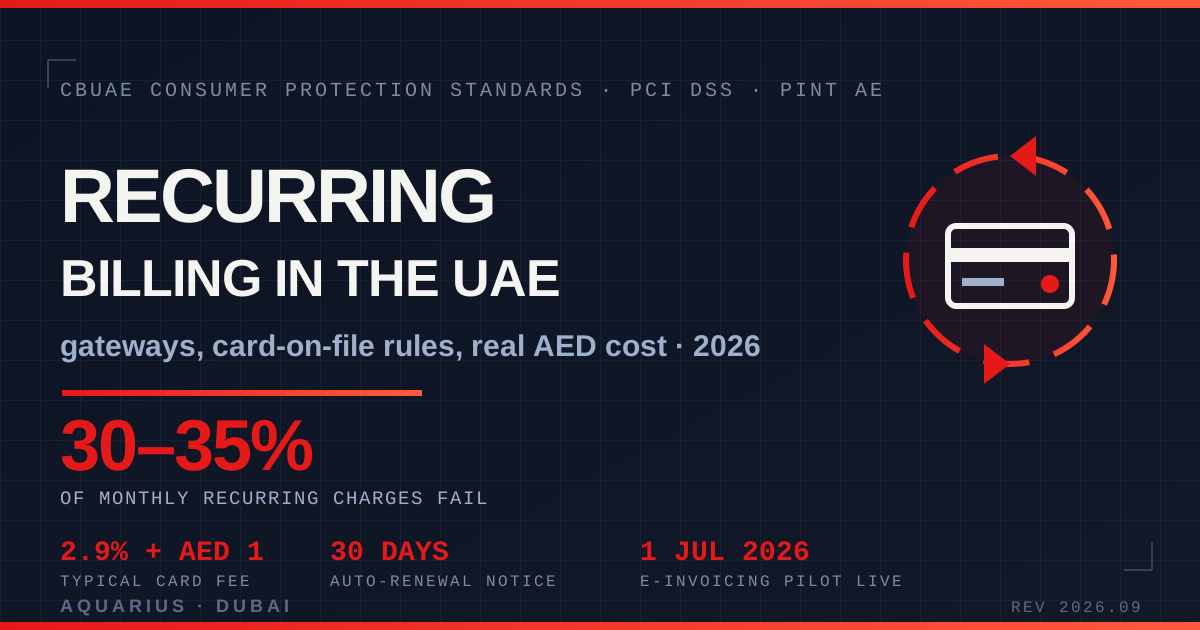
Short answer: Running subscriptions in the UAE costs roughly 2.7% to 2.95% + AED 1 per charge on local cards and 3.2% to 3.4% + AED 1 on international cards, plus about 0.7% of billing volume if you use a managed billing engine like Stripe Billing. Building your own recurring-billing layer runs AED 35,000 to AED 280,000+ depending on dunning, proration and VAT handling. But the number that decides whether any of it is profitable is not the fee — it is that 30–35% of monthly recurring charges fail for a payment reason, and 10–15% of those are never recovered. Updated September 2026.
The part most Dubai businesses get wrong: they negotiate 0.2% off their gateway rate and ignore a failure rate a hundred times larger. A UAE subscription business billing AED 500,000 a month loses more revenue to expired cards, issuer declines and missing pre-charge notices than it pays in processing fees all year.
Why 2026 is the year UAE subscriptions got complicated
Three things converged. First, demand: the global subscription economy is projected to grow from USD 623.61 billion in 2025 to USD 738.82 billion in 2026, an 18.5% CAGR, and UAE merchants are riding it — the UAE e-commerce market reached USD 12.30 billion in 2026 and is forecast at USD 21.01 billion by 2031, an 11.29% CAGR. The UAE fintech market alone is projected at USD 52.07 billion in 2026.
Second, churn: more than 50% of consumers cancelled at least one subscription in the past 12 months. Retention is the whole game now, and in the Gulf a large share of those “cancellations” were never decisions at all. They were a card that got reissued and a charge that silently failed.
Third, regulation. The CBUAE Consumer Protection Standards, the Payment Token Services Regulation, PCI DSS obligations on stored credentials and the UAE e-invoicing programme all landed on the same billing table. If you sell anything recurring in Dubai, your billing code is now a compliance surface, not a cron job.
The UAE rules that apply to every recurring charge
These are the obligations that change how the software has to be written — not general good practice, but the things that fail an audit or void a contract if you skip them.
- 30 calendar days’ written notice before an annual auto-renewal. The CBUAE Consumer Protection Standards require the notice to state how and when the renewal can be cancelled. UAE practice has extended the same expectation well beyond financial institutions — an annual gym or service contract that auto-renews without that notice is treated as unenforceable.
- Pre-charge notification, minimum 3 days. Merchants are expected to warn the customer before a recurring transaction hits the card. That is a scheduled job plus a template, and it has to be logged.
- PCI DSS on stored credentials. Store a card and you are in scope. In practice the answer is to not store cards at all — hold a gateway token or a network token and let the acquirer carry the burden.
- 3D Secure 2.0 on the initial card-on-file transaction and anything high-risk, with subsequent merchant-initiated charges correctly flagged. Flag them wrong and issuers decline them.
- 5% VAT on the subscription, with a correctly formatted AED tax invoice carrying your TRN for every billing cycle — not once a year.
- E-invoicing. The UAE pilot went live 1 July 2026. Businesses at AED 50 million revenue or above had to appoint an Accredited Service Provider by 31 July 2026 and go mandatory 1 January 2027. Below AED 50 million: ASP appointed by 31 March 2027, mandatory 1 July 2027. Invoices move as structured XML under the PINT AE schema through an accredited provider. Late VAT filing also now carries 14% annual interest as of April 2026.
Those e-invoicing dates matter more for subscriptions than for one-off sales. A subscription business does not issue a handful of invoices a month; it issues one per customer per cycle, automatically, forever. Retrofitting PINT AE output into a billing engine that was never designed to emit structured invoices is the expensive version of this project.
What UAE payment gateways actually charge for recurring
Below are published or widely quoted 2026 UAE merchant rates. All are before 5% VAT on the provider’s own fees, and all move with volume — above roughly AED 200,000 a month, every one of them is negotiable.
| Provider | Local card rate | Fixed / monthly | Native recurring |
|---|---|---|---|
| Tap Payments | 2.49% – 2.75% | No minimum, no monthly | Yes, tokenised |
| Telr | 2.49% + AED 0.50 | From AED 349 / month | Functional, largely merchant-scheduled |
| Stripe (UAE) | 2.9% + AED 1.00 | No monthly on Payments | Yes — subscriptions, dunning, smart retries |
| Typical local acquirer | 2.7% – 2.95% + ~AED 1 | Setup + monthly common | Varies, often an add-on |
| International cards (any provider) | 3.2% – 3.4% + AED 1 | — | As above |
Then there is the billing layer on top of processing. Stripe Billing in the UAE is 0.7% of billing volume pay-as-you-go, or a committed tier: AED 2,200 a month covers AED 350,000 of billing volume, AED 5,400 covers AED 900,000, AED 10,600 covers AED 1.8 million and AED 21,000 covers AED 3.6 million, with 0.67% on anything above the tier. Note the trap: billing volume counts transactions processed off Stripe too. Run cards through a local acquirer and use Stripe only for subscription logic, and you still pay the billing percentage.
Stack it honestly for a UAE SaaS billing AED 500,000 a month on local cards: roughly AED 14,500 in processing at 2.9%, plus AED 3,500 in billing at 0.7% — about AED 216,000 a year before a single failed payment. Hold that number against a build.
The 30% failure tax, and what recovering it is worth
This is the section the competing Dubai articles skip. Across subscription businesses, roughly 30–35% of monthly recurring payments fail for a payment-related reason, and 10–15% of those failures are never recovered. Involuntary churn — churn nobody chose — accounts for 20–40% of total churn, and about 40% of it traces to a payment credential problem: an expired card, a reissued card, a changed PAN. The average subscription business is estimated to risk 5.6% to 8.3% of its subscriber base every month to payment failures alone.
In the UAE this bites harder than the global average for a very local reason. High expat turnover means cards are cancelled and reissued constantly, and a large share of customers pay with cards issued outside the UAE, which route cross-border and decline more often.
Two fixes do most of the work, and both are engineering, not negotiation.
- Network tokenisation (Visa Token Service, Mastercard MDES). When the plastic is reissued, the token survives, so the renewal charges a credential that never expired. Published uplift is about 3% on Visa authorisation rates and roughly 4% typical across merchants, with retention improvements of up to 7.5% attributed to token lifecycle management. The CBUAE Payment Token Services Regulation is the framework this sits inside — in the UAE, tokenisation is regulated infrastructure, not a vendor feature.
- Intelligent dunning. Retry timing that respects issuer behaviour, decline-code-aware logic (a “do not honour” and an “insufficient funds” need completely different treatment), in-app and WhatsApp recovery prompts in Arabic and English, and a card-update flow that takes two taps. Better dunning logic is credited with 10–15% revenue recovery.
Run the arithmetic on that AED 500,000 a month book. If 32% of charges fail and a third of those are lost permanently, you are leaking somewhere near AED 50,000 a month. Recovering even 12% of failed volume is worth roughly AED 19,000 a month, or AED 228,000 a year. That single line item exceeds the entire annual fee stack above, and it dwarfs any rate you could have negotiated.
Build or buy: what a UAE subscription engine costs in AED
Most Dubai businesses should start on a managed billing product and build only when a real constraint appears — usually Arabic invoicing, AED-native proration, local acquirer routing, or a pricing model the SaaS product cannot express. These are our 2026 build bands.
| Scope | What you get | Cost (AED) | Timeline |
|---|---|---|---|
| Managed integration | Stripe Billing or Tap recurring wired into an existing product — plans, webhooks, basic dunning | 35,000 – 70,000 | 3 – 5 weeks |
| Full subscription layer | Plans, trials, proration, upgrades and downgrades, coupons, VAT tax invoices with TRN, customer billing portal | 70,000 – 150,000 | 6 – 10 weeks |
| Recovery & compliance build | Network tokens, decline-code dunning ladder, 3-day pre-charge notices, 30-day renewal notices, audit logging | 45,000 – 110,000 | 4 – 8 weeks |
| E-invoicing readiness | PINT AE structured output, ASP integration, credit notes, archive | 40,000 – 120,000 | 4 – 8 weeks |
| Usage-based / metered billing | Event ingestion, rating engine, mid-cycle plan changes, revenue reporting | 90,000 – 280,000+ | 10 – 16 weeks |
Add 5% VAT to all of the above. The honest guidance: under roughly AED 150,000 a month in recurring volume, a managed product plus a good integration wins on every metric. Above that, the 0.7% billing fee starts funding a build on its own — and the compliance work you have to do anyway, PINT AE output, Arabic tax invoices, CBUAE notice logs, is the same work either way.
How Aquarius builds recurring billing for UAE businesses
We treat recurring revenue as a retention system with a payment API attached, not the reverse. In practice that means five things.
- Tokens first. No raw card numbers anywhere in your estate. Network tokens wherever the acquirer supports them, so reissued cards keep billing.
- A dunning ladder that reads decline codes. Soft declines retry on an issuer-aware schedule; hard declines go straight to a bilingual card-update flow instead of burning retries and risking scheme penalties.
- Notices as first-class features. The 3-day pre-charge notice and the 30-day annual renewal notice are scheduled, templated, logged and auditable, in Arabic and English.
- VAT and e-invoicing built in from day one. Every cycle emits a compliant AED tax invoice with your TRN, structured so PINT AE output is a mapping job rather than a rewrite when your 2027 deadline arrives.
- Revenue instrumentation. MRR, involuntary versus voluntary churn, recovery rate and failure reasons on one dashboard — because you cannot fix a 30% failure rate you are not measuring.
If you are still choosing an acquirer, start with our Dubai payment gateway integration cost guide. If VAT and the e-invoicing mandate are the pressing part, read VAT-compliant invoicing and UAE e-invoicing. If the subscription is the product, our Dubai SaaS MVP guide covers the build around it. Otherwise see our services and pricing, or tell us your monthly recurring volume and we will model the fee stack, the leakage and the build against each other in real AED.
FAQ
What does recurring billing cost in the UAE in 2026?
Processing runs about 2.49% to 2.95% plus around AED 1 on UAE-issued cards, and 3.2% to 3.4% plus AED 1 on international cards. A managed billing layer adds roughly 0.7% of billing volume — Stripe Billing in the UAE starts at AED 2,200 a month for up to AED 350,000 of billing volume, with 0.67% above the tier. Telr’s entry plan is AED 349 a month plus 2.49% + AED 0.50. All fees carry 5% VAT.
Is it legal to auto-renew subscriptions in the UAE?
Yes, with conditions. The CBUAE Consumer Protection Standards require at least 30 calendar days’ written notice before an annual automatic renewal, including how and when the renewal can be cancelled, and merchants are expected to notify customers at least 3 days before a recurring charge lands. Auto-renewal terms that were never clearly disclosed, or renewals pushed through without that notice, are treated as unenforceable in practice.
Why do so many of my UAE subscription payments fail?
Across subscription businesses, roughly 30–35% of monthly recurring charges fail for a payment reason and 10–15% of those are never recovered. About 40% of involuntary churn comes from credential problems — expired or reissued cards. The UAE compounds it with high expat turnover and a heavy share of foreign-issued cards that route cross-border and decline more often. Network tokenisation and decline-code-aware dunning are the two fixes with measurable uplift, around 3–4% on authorisation rates.
Does the UAE e-invoicing mandate apply to subscription invoices?
Yes, and it applies per cycle. The pilot went live 1 July 2026. Businesses with revenue of AED 50 million or more had to appoint an Accredited Service Provider by 31 July 2026 and go mandatory on 1 January 2027. Businesses under AED 50 million appoint an ASP by 31 March 2027 and go mandatory on 1 July 2027. Invoices must be structured XML under the PINT AE schema, exchanged through an accredited provider — which means your billing engine has to emit them automatically, not your accountant.
Should I build my own subscription system or use Stripe Billing?
Under roughly AED 150,000 a month in recurring volume, use a managed product and spend the budget on a clean integration — AED 35,000 to AED 70,000 buys plans, webhooks and working dunning. Above that, the percentage-of-volume billing fee alone starts funding a build, and you will be doing the Arabic tax invoicing, PINT AE output and CBUAE notice logging regardless. A full custom subscription layer runs AED 70,000 to AED 150,000, and metered usage-based billing AED 90,000 to AED 280,000 or more.
Can I store customer cards for recurring charges in Dubai?
You can charge a stored credential, but you should not hold the card yourself. Storing card numbers puts you fully in PCI DSS scope. Use gateway tokens or, better, network tokens under the CBUAE Payment Token Services Regulation, authenticate the initial transaction with 3D Secure 2.0, and correctly flag subsequent merchant-initiated charges — mis-flagged MIT transactions are a common and entirely avoidable source of declines.