
AR & VR Development Cost in Dubai 2026: Real AED Prices and ROI
360 tours and WebAR cost AED 9,000 to 45,000 in Dubai; VR showrooms and training run AED 90,000+. Real 2026 AED pricing, ROI data and PDPL rules.
- PUBLISHED
- 28 SEPT 2026
- READ TIME
- 11 MIN
- AUTHOR
- AQUARIUS · DUBAI
- UNIT
- REV 2026.09
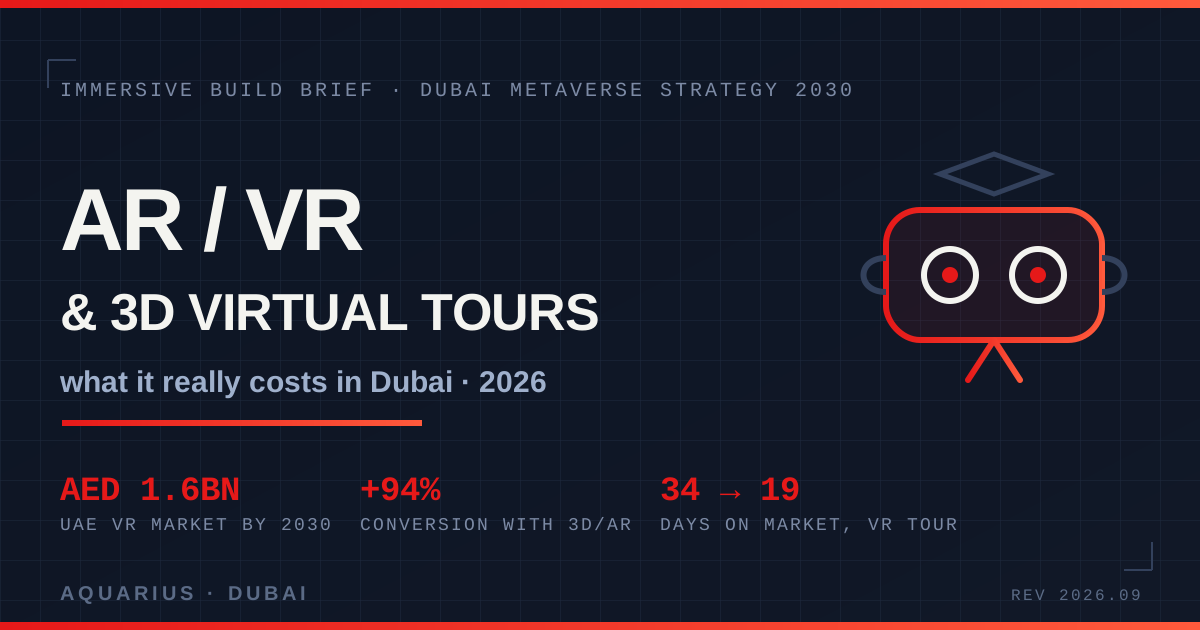
Short answer: immersive work in Dubai splits into two very different budgets. A browser-based 360 degree virtual tour or a WebAR "view it in your room" product viewer costs roughly AED 9,000-45,000 and needs no headset at all. A full interactive VR showroom or enterprise training simulator runs AED 90,000-700,000+. For most UAE businesses in 2026, the cheap half is where almost all of the measurable return sits.
Key takeaways
- Market: the UAE VR market was AED 366.1 million in 2024 and is forecast to pass AED 1.612 billion by 2030, a CAGR of about 28%.
- The mistake: most Dubai companies budget for headsets. Headsets are the smallest audience you will ever build for - Apple Vision Pro starts at AED 13,999 in the UAE.
- Where it pays: property listings with a 3D tour generate 49% more qualified leads and cut time on market from 34 days to 19.
- Retail: Shopify reports products with 3D/AR media convert 94% higher on average and return up to 40% less often.
- Training: PwC measured VR learners completing modules 4x faster than classroom, with cost parity at 375 learners.
The Dubai numbers that make immersive worth a line in your 2026 budget
Immersive technology stopped being a novelty in the UAE the moment it got a government target attached to it. The Dubai Metaverse Strategy commits the emirate to becoming one of the world's top 10 metaverse economies, to multiplying its blockchain company count fivefold on a base of more than 1,000 blockchain and metaverse companies already attracted, and to supporting more than 40,000 virtual jobs by 2030. The named target sectors are tourism, education, retail, remote work, healthcare and the legal sector - which is a fairly precise description of Dubai's SME economy.
The spending follows. The UAE immersive virtual reality market stood at AED 366.1 million in 2024 and is projected to grow more than fourfold to AED 1.612 billion by 2030, a CAGR of roughly 28%. The wider UAE immersive technology market - AR, VR and mixed reality combined - is forecast to reach USD 962.4 million by 2030 at a 29.3% CAGR from 2025. Globally the AR/VR market is projected at USD 97.41 billion in 2026, rising to USD 268.58 billion by 2032 at an 18.4% CAGR.
Numbers like these get quoted in board meetings and then translated into the wrong purchase order. Here is the part that matters more.
Most Dubai businesses get this wrong: you almost certainly do not need headsets
The default immersive brief we receive in Dubai reads something like "we want a VR experience for the showroom, with headsets." It is the most expensive way to reach the fewest people.
Apple Vision Pro launched in the UAE from AED 13,999. Headset ownership in the Emirates is a rounding error next to smartphone penetration, and a headset experience can only be used by someone standing in your showroom, one person at a time, with a staff member to sanitise it between users. Meanwhile the phone already in your customer's hand in Jumeirah, Mumbai or London runs WebAR and WebGL in the browser with no app install.
So the useful split for a 2026 UAE budget is not "AR versus VR." It is:
- Reach tier (browser): 360 degree tours, WebAR product placement, 3D configurators. Works on every phone, indexable, linkable, trackable in GA4. This is where lead volume and conversion lift come from.
- Depth tier (headset): VR showrooms, training simulators, digital twins. Small audience, high impact per session. Justified by training cost savings or by a single high-value sale, not by traffic.
Build the reach tier first. Fund the depth tier out of what it earns.
Where immersive actually pays in Dubai (with the numbers)
1. Real estate - by far the strongest case in the UAE
Dubai recorded roughly AED 917 billion in real estate transactions across about 270,000 deals in 2025, and Q1 2026 alone hit AED 252 billion, up 31% year on year according to Dubai Land Department figures. Buyers came from more than 150 countries, and foreign investors account for over 40% of residential ownership. That is a market where a large share of your buyers will never physically walk the unit before signing.
The measured effect of 3D tours on listings is consistent: 49% more qualified leads, 95% more phone enquiries, 65% more email enquiries and 87% more listing views, with prospects spending five to ten times longer on the page. A 2025 study published in Information Systems Research found average days on market fell from 34 to 19 when a VR tour was present. Matterport's own data puts homes with 3D tours at 20% faster sales at 4.8% higher prices. Around 90% of prospective buyers say they are more likely to buy a property whose listing includes a virtual tour.
Emaar, DAMAC, Aldar, Danube and Ellington all run 360 or VR property experiences already. If you are a brokerage competing on the same portals, a tour is no longer a differentiator - its absence is a penalty. Pair it with clean portal feeds: see our guide to property portal feed integration in Dubai and to RERA and Trakheesi-compliant real estate websites.
2. Retail and ecommerce - AR try-on and 3D product media
Shopify reports that products with 3D or AR media convert at an average 94% higher rate than those without, and that 3D/AR media can reduce returns by up to 40% by aligning expectations before purchase. A 2025 Snap and Publicis study of 4,028 shoppers found 80% felt more confident buying after using AR and 66% were less likely to return the item. Brand-level results line up: Rebecca Minkoff saw shoppers 65% more likely to order after an AR interaction; Gunner Kennels recorded a 40% conversion increase.
In a UAE context the return-rate number is the one to underline. Cash on delivery plus generous returns is the standard local playbook, and every avoided return saves both the outbound and reverse last-mile leg. Furniture, lighting, eyewear, watches, jewellery and perfume packaging are the categories where 3D models pay back fastest. Before commissioning models, read our product photography and 3D rendering cost guide.
3. Training, safety and compliance
PwC's enterprise study of more than 1,600 managers found VR learners completed training 4x faster than in a classroom and 1.5x faster than e-learning, were 275% more confident applying what they learned, felt 3.75x more emotionally connected to the content and were 4x more focused than e-learners. Critically for a CFO: VR reached cost parity with classroom training at 375 learners and with e-learning at 1,950 learners, and at 3,000 learners it cost 52% less than classroom delivery.
That headcount threshold is exactly why VR training works in Dubai construction, logistics, hospitality, aviation and facilities management - sectors that onboard thousands of workers a year and run mandatory HSE refreshers. Below a few hundred learners, build an LMS instead; see our Dubai LMS development guide.
4. Tourism, attractions, events and exhibitions
Tourism is a named Dubai Metaverse Strategy sector. Practical wins here are unglamorous: a 360 walkthrough of a hotel's meeting floor that closes MICE bookings without a site visit, an AR wayfinding layer at a DWTC stand, a virtual preview of an attraction embedded in an OTA listing. These are reach-tier builds, priced in the tens of thousands of dirhams, not the hundreds.
What AR and VR development costs in Dubai in 2026
Published 2026 global ranges convert to AED as follows (USD 1 = AED 3.67), alongside the ranges we quote locally for UAE scope:
| Build type | Typical scope | AED range | Timeline |
|---|---|---|---|
| 360 degree virtual tour | 10-20 scenes, hotspots, floorplan, embed on site and portals | 9,000-30,000 | 1-3 weeks |
| WebAR product viewer | View-in-your-room on mobile web, no app install, 5-15 SKUs | 15,000-45,000 | 3-6 weeks |
| 3D product configurator | Real-time material, colour and layout options, priced cart hookup | 45,000-150,000 | 6-12 weeks |
| Simple VR app | Single-scene headset experience, guided walkthrough | 73,000-260,000 | 8-14 weeks |
| Interactive VR showroom | Multi-unit, customisable finishes, CRM capture, headset + desktop | 90,000-660,000 | 12-20 weeks |
| Enterprise VR training | Single-scenario pilot to multi-scenario programme with analytics | 147,000-1,470,000 | 12-28 weeks |
| Advanced XR / digital twin | Multiplayer, AI, IoT or ERP integration, live building data | 735,000-1,800,000+ | 20-40 weeks |
All figures exclude 5% VAT. Two line items surprise people:
- 3D asset production is the real cost, not the code. Budget AED 900-2,500 per production-grade 3D model. A 200-SKU catalogue is a six-figure asset bill before a single line of application code is written. Start with your top 15 sellers.
- Performance work is mandatory, not optional. A 40 MB model on a Dubai 4G connection kills the conversion lift you bought it for. Draco compression, KTX2 textures and lazy loading are part of scope - the same discipline as our Core Web Vitals optimisation work.
The compliance bit nobody scopes: PDPL and immersive data
AR and VR applications collect categories of data that a normal website never touches: camera frames of a customer's home or face, room geometry, gaze and motion telemetry, and in try-on cases biometric-adjacent facial measurements. All of it is personal data under Federal Decree-Law No. 45 of 2021 (the UAE PDPL).
Three rules keep an immersive build clean: process AR camera frames on-device and never upload them unless you have a stated purpose; declare spatial and gaze telemetry explicitly in your privacy notice rather than burying it under "analytics"; and keep session recordings out of third-party analytics tools entirely. Our UAE PDPL compliance checklist covers consent, retention and deletion mechanics in full.
How Aquarius builds immersive projects
We run immersive work in the order that protects your budget. Stage one is a reach-tier build - a 360 tour or a WebAR viewer on your existing site - shipped in two to six weeks with the conversion event wired into GA4 from day one. Stage two only starts once stage one has produced a number: leads per tour, conversion delta on AR-enabled SKUs, or return-rate change. Stage three is the headset or digital twin build, funded by a proven metric rather than a strategy slide.
Consider the cost of inaction in the strongest local case. On a Dubai property market turning over AED 917 billion a year with buyers in 150+ countries, a listing without a tour draws 49% fewer qualified leads and sits on the market roughly 15 days longer. A single additional closed unit pays for the entire tour programme several times over.
You own the code, the 3D source files and the hosting accounts from day one - the same terms as every other build we ship. See our pricing, what each service covers, or the wider UAE website and app cost guide if immersive is one part of a bigger project.
FAQ
How much does AR/VR development cost in Dubai in 2026?
Browser-based work - a 360 degree virtual tour or a WebAR product viewer - costs AED 9,000-45,000. A 3D configurator runs AED 45,000-150,000. Headset builds start around AED 73,000 for a simple VR app and reach AED 1.47 million for a multi-scenario enterprise training programme. All figures exclude 5% VAT.
Do I need VR headsets to run a virtual tour in Dubai?
No. 360 tours and WebAR run in a normal mobile browser with no app install and no hardware. Headsets only make sense for training simulators or high-value showroom sales, where one deep session justifies the cost. Apple Vision Pro starts at AED 13,999 in the UAE, so headset-first briefs shrink your audience dramatically.
Does a virtual tour actually sell more property in Dubai?
The measured effect is large: 49% more qualified leads, 95% more phone enquiries, 87% more listing views, and average days on market falling from 34 to 19. Matterport reports 20% faster sales at 4.8% higher prices. With over 40% of Dubai residential ownership held by foreign investors, remote buyers make the effect stronger here than in most markets.
How long does an AR or VR project take to build?
A 360 tour takes 1-3 weeks. A WebAR product viewer takes 3-6 weeks. A VR showroom takes 12-20 weeks, and an enterprise training programme 12-28 weeks. 3D asset production, not coding, is usually the critical path.
Is AR/VR data covered by the UAE PDPL?
Yes. Camera frames, room scans, gaze tracking and facial measurements from try-on features are all personal data under Federal Decree-Law No. 45 of 2021. Process camera data on-device where possible, disclose spatial and gaze telemetry explicitly, and keep session recordings out of third-party analytics.
What should a Dubai SME build first?
Whatever touches the most buyers for the least money: a 360 tour if you sell space, a WebAR viewer on your top 10-15 SKUs if you sell objects. Measure the lift for one quarter, then decide whether a headset build earns its budget.
Weighing up an immersive build for 2026? Tell us what you sell and we will send back a scoped reach-tier build with the exact KPI it should move - usually in under 48 hours.