
Aviation MRO and Ground Handling Software in Dubai (2026): CAR-145 Records, AOG Maths and AED Build Costs
What aviation MRO and ground handling software really costs in Dubai: AED build ranges, GCAA CAR-145 three-year record rules, AMOS licence maths and the AOG hour that decides the budget.
- PUBLISHED
- 02 OCT 2026
- READ TIME
- 13 MIN
- AUTHOR
- AQUARIUS · DUBAI
- UNIT
- REV 2026.09
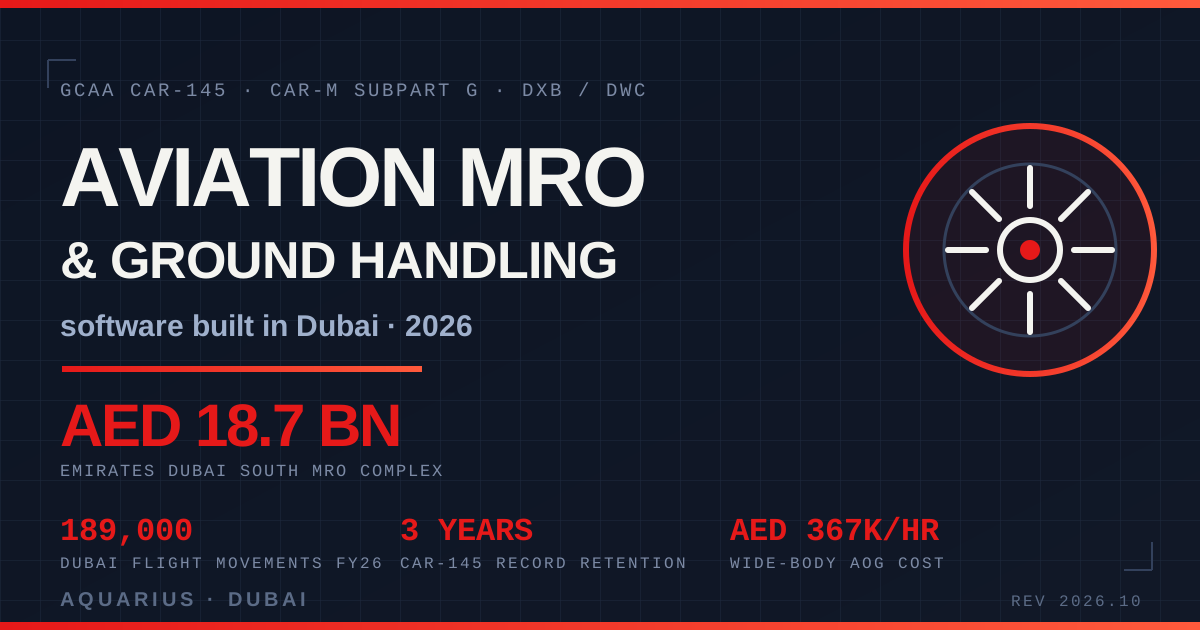
Short answer: A custom aviation MRO or ground handling system in Dubai costs roughly AED 180,000–450,000 for a focused build (digital task cards, parts and tool control, certifying-staff authorisations, CAR-145 record retention), AED 500,000–1.2 million once you add CAMO airworthiness planning, AOG workflows and customer-facing turnaround reporting, and AED 1.5 million+ for a multi-station operation feeding finance, rostering and airline portals. Off-the-shelf suites like AMOS price around USD 500–1,500 per user per month (about AED 1,840–5,500), with implementation, configuration and data migration adding USD 50,000–500,000 (roughly AED 184,000–1.84 million) in year one. The deciding number is not licence cost. It is that a grounded wide-body burns USD 100,000–150,000 per hour — about AED 367,000–551,000 — so software that removes two hours of paperwork from a defect cycle has already paid for itself.
Dubai is building the world's biggest MRO demand pool. Most of its operators still run on paper
The scale here is not a pitch deck projection. IATA's April 2025 UAE study put aviation at 18.2% of UAE GDP, USD 92 billion in total economic value and 992,000 supported jobs. Dubai International handled a record 95.2 million passengers in 2025 — the highest annual international traffic ever recorded by a single airport — and Dubai Airports has revised its 2026 forecast to 99.5 million. Aviation contributed AED 137 billion, about 27% of Dubai's GDP, in 2023, with a projected AED 196 billion and 32% share by 2030.
The maintenance side is scaling to match. The Middle East aircraft MRO market stands at USD 10.55 billion in 2026 and is forecast to reach USD 13.35 billion by 2031 at a 4.82% CAGR, with engine work alone taking 46.73% of 2025 revenue and single shop visits on LEAP and GTF engines exceeding USD 8 million. In May 2026 Emirates broke ground on a USD 5.1 billion (AED 18.7 billion) engineering complex at Dubai South — 1.1 million square metres, a 285-metre-wide hangar servicing 28 wide-body aircraft simultaneously, completion targeted for mid-2030. Next door, the AED 128 billion Al Maktoum International expansion is being built toward 260 million passengers, 400 gates and five parallel runways, with phase one operational in 2032 at 150 million passengers.
Ground handling is already operating at a volume most software cannot absorb. In its 2025-26 financial year dnata handled more than one million tonnes of cargo, 189,000 flight movements and 46,000 truck movements in Dubai alone, against 888,793 aircraft turns globally (up 12%) and group revenue of AED 23.6 billion.
Here is the part most Dubai businesses get wrong: they assume this scale has already been digitised. Walk into a mid-sized CAR-145 shop, a business-aviation handler at DWC, or a line-maintenance provider serving transiting carriers, and you will still find defect reports on carbon paper, tool calibration tracked in Excel, certifying-staff authorisations in a binder, and a CAMO planner reconciling flight hours by email. The hangar is world class. The information layer is 1998.
What GCAA actually requires from your records
This is where generic maintenance software fails in the UAE. CAR-145 governs approved maintenance organisations for UAE-registered aircraft across all categories of commercial air transport operations, excluding aircraft below 5,700 kg MCTOM in non-commercial use, plus the components fitted to them. Continuing airworthiness management sits under CAR-M Subpart G (CAMO) — either held as part of your air operator certificate, approved separately, or contracted in writing to a CAR-145 organisation.
Three regulatory facts should shape your data model before a single screen is designed:
- Three-year retention. Under CAR 145.A.55 the organisation must retain a copy of all detailed maintenance records, including certificates of release to service, and any associated maintenance data, for three years from the date the CRS was issued. That is a retention policy, an immutability requirement and a disaster-recovery obligation in one line. Soft-deleting a work order is not an option.
- Attributable certification. Every release to service traces to a named, currently authorised certifying individual with the right scope. If your system lets an expired authorisation sign a task, you have built a finding generator.
- The regulator is already digital. CAR-145 approval and continuing-airworthiness applications run through the GCAA e-Services portal, with supporting documentation uploaded. Your Maintenance Organisation Exposition, capability list and staff records should be exportable in the shape the regulator asks for, not reassembled by hand the week before an audit.
Two more constraints that routinely surprise teams: data residency expectations for operational records, and the fact that a GCAA-acceptable electronic records system needs documented controls — access, change history, backup, legibility over the retention period — described in your exposition. That is an architecture decision, not a feature toggle. If residency is on your list, our note on hosting and data residency in the UAE covers where the lines fall.
Build vs buy: the honest comparison
AMOS, Ramco Aviation and the other established suites are genuinely good at heavy MRO and fleet-wide continuing airworthiness. They are also priced and scoped for airlines. Published figures put AMOS at roughly USD 500–1,500 per user per month, a ten-user licence at USD 4,000–12,000 per month, and implementation, customisation, training and data migration anywhere from USD 50,000 to USD 500,000. Ramco is quote-based from around USD 2,000 annually depending on configuration.
For a 40-person CAR-145 shop in Dubai Investments Park or a handler running three stations, that maths is brutal: you pay airline-grade licensing for 20% of the functionality, then spend a year configuring a workflow that was designed around someone else's fleet.
| Option | Year-1 cost (AED) | Fits | Breaks when |
|---|---|---|---|
| Spreadsheets and paper task cards | Near zero, plus unpriced risk | Under 10 staff, single type rating | First audit finding or disputed CRS |
| Global MRO suite (AMOS, Ramco class) | 400,000 – 2,000,000+ | Airline or large third-party MRO | You need a niche workflow their roadmap will not prioritise |
| Generic CMMS or field-service tool | 40,000 – 120,000 | Facilities, GSE upkeep | It has no concept of a CRS, an authorisation scope or a life-limited part |
| Custom build, phased | 180,000 – 1,200,000 | Specialist MRO, handler, business-aviation operator | You skip the compliance model and bolt it on later |
The crossover is usually headcount and licence maths. Past roughly 30–40 named users, per-seat suite pricing starts to exceed the amortised cost of a system you own outright — the same pattern we documented in custom software costs in Dubai.
The module map: what to build, in what order
| Module | What it kills | Typical build (AED) | Phase |
|---|---|---|---|
| Digital task cards and defect reporting, offline-capable on hangar tablets | Carbon paper, illegible sign-offs, lost pages | 60,000 – 140,000 | 1 |
| Certifying-staff authorisation register with scope and expiry blocks | An out-of-scope or expired signature on a CRS | 35,000 – 80,000 | 1 |
| CAR-145 compliant record store: immutable history, 3-year retention, audit export | Two weeks of pre-audit document assembly | 45,000 – 110,000 | 1 |
| Parts, serialised components, life-limited parts and tool calibration control | Unapproved parts, out-of-calibration tooling | 70,000 – 180,000 | 2 |
| CAMO planning: AD and SB tracking, maintenance forecast by hours and cycles | Missed intervals, reactive scheduling | 90,000 – 220,000 | 2 |
| AOG workflow: escalation, parts sourcing, hour-by-hour cost clock | Silent delays nobody is accountable for | 50,000 – 130,000 | 2 |
| Ground handling turnaround tracking, GSE assignment, SLA and billing evidence | Disputed invoices, unbillable services | 80,000 – 200,000 | 2–3 |
| Airline and owner portal: live status, quotes, certificates, invoices | Status-chasing emails, renewal churn | 60,000 – 150,000 | 3 |
| Integrations: finance, rostering, e-invoicing, e-signature | Double entry and month-end reconciliation | 50,000 – 160,000 | 3 |
Phase 1 is the compliance spine and it is where the payback sits. Phase 2 is where margin appears, because parts discipline and planning accuracy are what stop AOG events. Phase 3 is how you win contracts against larger competitors, for the same reason a freight operator wins on visibility — see freight and customs clearance software for the same pattern in logistics.
The AOG number that decides your budget
Every aviation software business case eventually reduces to one figure. A grounded narrow-body costs an operator USD 10,000–50,000 per hour in lost revenue, crew repositioning, rebooking and downstream disruption. A wide-body such as a 777 or A350 runs USD 100,000–150,000 per hour — AED 367,000–551,000. Industry-wide, disruption costs airlines roughly USD 60 billion a year, about 8% of total revenue.
Now price the paperwork. If a defect cycle loses two hours to finding the right manual revision, chasing a certifying engineer's availability, or locating a calibration certificate, that delay on a single wide-body is worth more than AED 700,000. One avoided incident clears a Phase 1 build outright. This is why the right question is never "what does the software cost" but "what is an hour of ambiguity worth in our hangar".
How Aquarius builds it
We are a Dubai web, app and software team, not an aviation consultancy, and we work the way regulated builds need to be worked: your Maintenance Organisation Exposition and procedures are the specification. We read them first, model the compliance objects before the UI, and keep the retention, authorisation and audit-trail rules in the data layer where they cannot be bypassed by a future feature.
Phased, fixed-scope, fixed-price, with source code and infrastructure handed to you at the end — no per-seat tax on your own operational data. A Phase 1 compliance spine typically runs 8–14 weeks; Phase 2 adds 10–16 weeks depending on parts and planning complexity. See transparent pricing, or book a 30-minute scoping call and we will map your approvals, station count and fleet mix into a build plan with AED numbers attached.
One closing figure for the cost of waiting: with Dubai aviation heading from AED 137 billion to AED 196 billion of annual economic contribution by 2030, the airlines and lessors awarding contracts in that window are selecting partners on data maturity. The shops still assembling audit evidence by hand are not losing a finding. They are losing the tender.
FAQ
Does aviation maintenance software need GCAA approval?
The software is not separately certified. Your organisation is approved under CAR-145 or CAR-M Subpart G, and your electronic record-keeping system must be described in your exposition with documented controls over access, change history, backup and legibility across the retention period. In practice GCAA assesses the procedure the software enforces, not the product badge.
How long must maintenance records be kept in the UAE?
Under CAR 145.A.55, detailed maintenance records including certificates of release to service, and any associated maintenance data, must be retained for three years from the date the CRS was issued for the aircraft or component concerned.
Is a custom build cheaper than AMOS for a Dubai MRO?
Below about 30 users, usually not on licence cost alone — a configured suite can be faster to stand up. Above that, per-seat pricing of USD 500–1,500 per user per month plus USD 50,000–500,000 of implementation generally makes an owned, phased build cheaper within two to three years, and far cheaper if your workflow is specialist.
How long does it take to build a CAR-145 ready system?
A Phase 1 compliance spine — digital task cards, authorisation register, compliant record store with audit export — takes 8–14 weeks. Parts, tooling and CAMO planning add 10–16 weeks. Ground handling turnaround and customer portals follow in a third phase.
Can one system cover both MRO and ground handling?
Yes, and in Dubai it often should, because the same operators run both and the shared objects — aircraft registration, station, staff authorisation, equipment, SLA evidence — are identical. Keep the certification workflow strictly separate from commercial turnaround tracking so a billing change can never touch an airworthiness record.
Does the software need to work offline in the hangar?
Assume yes. Hangar and apron coverage is unreliable at both DXB and DWC, and a technician who cannot file a task card at the aircraft will file it on paper later, which is exactly the failure you are paying to remove. Offline capture with a signed sync queue is a Phase 1 requirement, not a refinement.