
HTTP/3 on .ae Websites in 2027: We Scanned 785 UAE Domains and 87.6% of the QUIC Came From Two Vendors
We probed 785 .ae hosts. 249 of 560 live sites (44.5%) advertise HTTP/3 — but 87.6% of those just inherit it from Cloudflare or LiteSpeed. Self-hosted nginx: 5.4%. IIS: 0%. .gov.ae: 9.7%.
- PUBLISHED
- 23 NOV 2026
- READ TIME
- 11 MIN
- AUTHOR
- AQUARIUS · DUBAI
- UNIT
- REV 2026.09
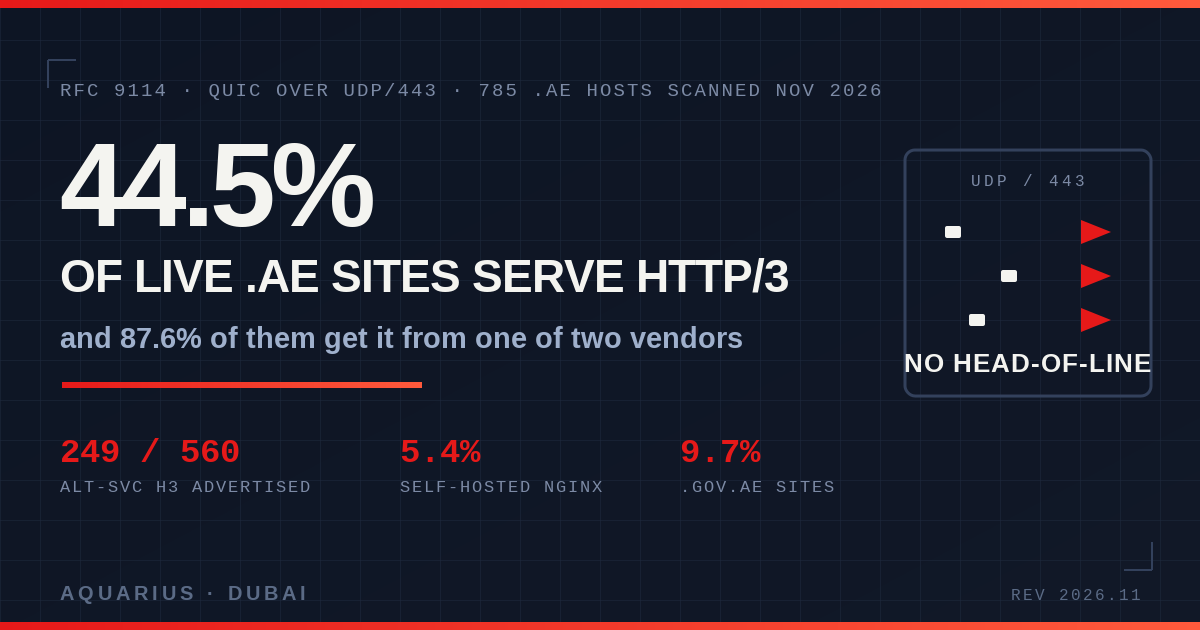
Short answer: HTTP/3 is the current version of the web's transport protocol — it runs over QUIC on UDP port 443 instead of TCP, which removes head-of-line blocking, cuts the handshake to a single round trip (zero on a resumed connection), and survives a phone switching from Wi-Fi to 5G mid-request. In November 2026 we probed 785 .ae hosts from the Tranco top-one-million list. Of the 560 that answered, 249 (44.5%) advertise HTTP/3. But 87.6% of those got it by accident — they sit behind Cloudflare or run LiteSpeed, and somebody else switched it on.
Strip the two vendors out and UAE HTTP/3 adoption collapses: self-hosted nginx sites are at 5.4%, IIS sites at 0%, and .gov.ae at 9.7%. This is not a protocol problem. It is a configuration problem, and it is free to fix.
What the numbers say about the UAE web
Three figures set the stakes.
1. The UAE is not behind on HTTP/3 — it is averagely lucky. W3Techs puts HTTP/3 at 41.2% of all websites as of November 2026. Our measured 44.5% of live .ae sites sits slightly above that line. The interesting part is not the headline rate, it is the source: 218 of the 249 HTTP/3 advertisers (87.6%) are Cloudflare-fronted or LiteSpeed-powered. Of the remaining 31, almost every one is an international platform with a UAE domain — amazon.ae on CloudFront, google.ae, youtube.ae, hsbc.ae, airbnb.ae, skyscanner.ae, propertyfinder.ae. Deliberate local enablement is rare enough to count on one page.
2. Government sites are the worst performers in the dataset. Of 62 live .gov.ae hosts, 6 advertise HTTP/3 (9.7%). Forty of them send no Server header at all and eight run IIS — the two groups with the lowest HTTP/3 rates anywhere in the scan.
3. The UAE has the network to exploit it and mostly is not. Ookla's Speedtest Global Index ranked the UAE first in the world for mobile download speed with a 663.50 Mbps median and 18 ms median latency in July 2026. HTTP/3's biggest wins show up on exactly that kind of connection — fast but lossy, mobile, moving between cells. Meanwhile the UAE e-commerce market is tracked at USD 12.30 billion in 2026, heading to USD 21.01 billion by 2031 at an 11.29% CAGR (Mordor Intelligence), with smartphones processing 78.67% of orders. The traffic that benefits most is the traffic that pays.
How we measured it
We took every .ae host in the Tranco top-one-million ranking — 785 of them — and requested each homepage over HTTPS with a desktop Chrome user agent, following redirects and dumping full response headers. 560 returned a 2xx; 113 refused or failed to connect and 98 answered 403 to an automated client. For each live host we recorded the Alt-Svc header (how a server tells a browser "I also speak HTTP/3, come back over QUIC"), the Server header, and whether Cloudflare was in front.
One honest caveat about method: Alt-Svc advertisement is the standard way to measure HTTP/3 availability, and it is what every browser acts on — but it measures the offer, not a completed QUIC handshake. A site can advertise HTTP/3 and still fail for a user whose network drops UDP. We flag where that matters below.
HTTP/3 adoption by what the server actually runs
Stack (from Server header) | Live .ae sites | Advertise HTTP/3 |
|---|---|---|
| LiteSpeed / OpenLiteSpeed | 18 | 100% (18) |
| Cloudflare | 256 | 76.2% (195) |
| Apache | 32 | 18.8% (6) |
| openresty | 5 | 40.0% (2) |
| Vercel | 9 | 11.1% (1) |
| nginx | 56 | 5.4% (3) |
No Server header | 110 | 5.5% (6) |
| Microsoft IIS | 19 | 0% (0) |
| AWS Application Load Balancer | 3 | 0% (0) |
| — by edge, not by stack — | ||
Cloudflare-fronted (detected by cf-ray) | 261 | 76.6% (200) |
| Everything not behind Cloudflare | 299 | 16.4% (49) |
Two things fall out of that table. First, 61 Cloudflare-fronted .ae sites are not advertising HTTP/3 — among them adnoc.ae, adx.ae, centralbank.ae, cbd.ae, deliveroo.ae, desertcart.ae, dubailand.gov.ae and ega.ae. These organisations are already paying for an edge network that does QUIC. HTTP/3 on Cloudflare is a toggle in the Network tab; on a proxied zone it is typically on by default. Sixty-one sites have either turned it off or sit on a configuration that suppresses it.
Second, 29 sites still advertise the obsolete h3-29 draft alongside or instead of final HTTP/3. Draft 29 predates RFC 9000 and modern Chrome and Safari ignore it. If h3-29 is the only token in your Alt-Svc, you are advertising a protocol no current browser will use — a stale build pretending to be modern.
Why self-hosted nginx in the UAE sits at 5.4%
This is the single most actionable finding, and the cause is boring. HTTP/3 support landed in nginx mainline 1.25.0 and requires three separate things to be true:
- nginx compiled
--with-http_v3_moduleagainst a QUIC-capable TLS library, listen 443 quic reuseport;in the server block alongside the existinglisten 443 ssl;, plus anAlt-Svcheader so browsers know to try it,- inbound UDP port 443 open in the security group, firewall and any upstream appliance.
The trap is the first one. The nginx package in Ubuntu 24.04 LTS is 1.24 and is built without the HTTP/3 module — so apt install nginx on the most common UAE VPS image gives you a server that structurally cannot speak HTTP/3, no matter what you put in the config. You need the nginx.org mainline repository or a newer distribution. That one packaging detail explains most of our 5.4%.
The equivalent trap on AWS: CloudFront has supported HTTP/3 since 15 August 2022 at no extra cost, as a per-distribution setting (the origin leg stays HTTP/1.1, which is fine). Application Load Balancer does not support HTTP/3 at all. If your Dubai site terminates TLS at an ALB, no amount of nginx tuning behind it will help — which is exactly why all three ALB-fronted sites in our scan score zero.
The myth: "HTTP/3 will help my Google rankings get crawled faster"
It will not, and this is worth being precise about because UAE agencies sell it as an SEO upgrade. Google's own crawler documentation states that Google's crawlers and fetchers support HTTP/1.1 and HTTP/2, defaulting to HTTP/1.1. HTTP/3 and QUIC are not mentioned anywhere in it. Googlebot will not crawl your site over HTTP/3 in 2027.
So the value is not crawl budget. It is real-user performance — the field data in CrUX that feeds Core Web Vitals, which is collected from actual Chrome users on actual UAE mobile networks. HTTP/3 improves connection setup and loss recovery for those humans, and the ranking effect, where there is one, arrives through the Core Web Vitals those humans generate. If you want the mechanics of that chain, we cover it in our Core Web Vitals optimisation guide for Dubai sites.
Be equally honest about the ceiling. HTTP/3's gains are largest on high-latency, lossy, mobile connections and smallest on a desktop sitting on Dubai fibre. On a site that ships 4 MB of JavaScript, the transport is not your problem. We publish our own measured numbers rather than the inflated figures that circulate in HTTP/3 blog posts, and we recommend you ask for the same before paying anyone for this.
What enabling HTTP/3 costs in Dubai
Realistic AED ranges. Note how cheap the top of the table is — that is the point of this article.
| Scope | What you get | Typical AED | Timeline |
|---|---|---|---|
| Transport audit | Alt-Svc, TLS, HTTP version, compression and h3-29 check on your live site plus a fix list | AED 1,500 – 3,500 | 1 – 2 days |
| CDN-level enablement | HTTP/3 switched on and verified at Cloudflare or CloudFront, stale draft tokens removed, cache rules reviewed | AED 2,500 – 6,000 | 2 – 4 days |
| Self-hosted nginx / VPS | Mainline nginx with http_v3_module, listen 443 quic, UDP/443 opened, TCP fallback verified, zero-downtime cutover | AED 7,000 – 18,000 | 1 – 2 weeks |
| Edge delivery migration | CDN in front of a UAE or me-central-1 origin, HTTP/3 + Brotli + cache strategy, ALB bypass where needed | AED 22,000 – 60,000 | 3 – 6 weeks |
| Ongoing performance care | Monthly real-user Core Web Vitals reporting with protocol regression alerts | AED 2,500 – 9,000 / month | — |
If you are behind Cloudflare and not advertising HTTP/3, the honest answer is that this is a ten-minute change and you should not be paying AED 20,000 for it. Most Dubai businesses in our scan fall into exactly that bucket.
How to check your own site in two minutes
Three checks, in order:
1. Does your server offer it?
Run curl -sI https://yourdomain.ae/ | grep -i alt-svc. You want to see h3=":443" with a ma= lifetime — ma=86400 is the most common value in our dataset, appearing on 216 of the 249 advertisers. Nothing back means no HTTP/3. Only h3-29 means stale.
2. Does a browser actually use it?
Open DevTools, Network tab, enable the Protocol column, and hard-reload. The first navigation request will usually show h2 — the browser has to learn about HTTP/3 from the Alt-Svc header first. Reload again; it should flip to h3. If it never flips, UDP/443 is being blocked somewhere between you and the origin.
3. Does it survive your users' networks?
QUIC rides on UDP, and corporate firewalls, hotel Wi-Fi and some inspection appliances block or throttle UDP/443. Browsers handle this correctly by falling back to TCP, so enabling HTTP/3 is safe — but it means the benefit is uneven across your audience and the only way to know your real split is field data, not a lab test.
How Aquarius does it
We treat transport as part of the build, not an upsell. Every site we ship terminates TLS 1.3 at an edge that speaks HTTP/3, advertises the current h3 token with no obsolete drafts, keeps a verified TCP fallback, and is tested on a mid-range Android handset on a UAE mobile network rather than on a laptop on fibre. When the stack is self-hosted we build nginx from mainline so the module is actually present, and we open UDP/443 explicitly instead of assuming it.
Risk reversal: the transport audit is fixed-fee and fixed-scope, and you are free to hand the report to whoever currently maintains your site. If the fix turns out to be a toggle on your existing CDN, we will tell you that and charge you for the audit only.
The conversion case is straightforward. Deloitte Digital and Google's Milliseconds Make Millions study measured an 8.4% lift in retail conversions from a 0.1-second improvement in mobile load time. In a market where smartphones drive 78.67% of orders and the e-commerce pool is growing 11.29% a year, a free protocol upgrade that your competitors have not switched on is not a technical curiosity. Our published pricing starts at AED 2,500 for a Business Site and AED 10,000 for custom app work — AED-first quotes, fixed scope, and you own the code and the accounts at handover. If you want the sister finding from the same scan methodology, our IPv6 readiness audit of .ae domains found the same pattern: modern infrastructure arrives in the UAE with a global platform, never with a local build.
FAQ
Is HTTP/3 safe to enable on a UAE business website in 2027?
Yes. It is purely additive — the server keeps listening on TCP 443 and any client that cannot or will not use QUIC simply uses HTTP/2 as before. The one real prerequisite is that inbound UDP port 443 must be open, otherwise browsers attempt QUIC, time out, and fall back, which costs you a little time instead of saving it.
Will HTTP/3 improve my Google rankings?
Not directly, and not through crawling — Google's crawlers support only HTTP/1.1 and HTTP/2. Any ranking effect is indirect, via improved real-user Core Web Vitals in CrUX field data. Treat it as a user-experience change that happens to feed a ranking signal, not as an SEO tactic.
How much faster is HTTP/3 really?
It depends entirely on your network conditions, and most published figures are marketing. The mechanisms are real and well specified in RFC 9000 and RFC 9114: one round trip for a new connection instead of two, zero for a resumed one, per-stream loss recovery instead of one lost packet stalling every parallel download, and connection migration when a device changes network. Those matter most on mobile with packet loss and least on desktop fibre. Measure your own before and after on real devices.
My site is behind Cloudflare. Do I already have it?
Probably, but check — 61 Cloudflare-fronted .ae sites in our scan were not advertising HTTP/3. Run curl -sI against your domain and look for alt-svc: h3=":443". If it is missing, the toggle is in the Network section of your Cloudflare dashboard.
What about HTTP/2? Should I skip straight to HTTP/3?
Keep both. HTTP/3 is advertised through a header that the browser can only read over an HTTP/1.1 or HTTP/2 connection in the first place, so the older protocol is not optional — it is the discovery path. If you are still on HTTP/1.1 only, fix that first; it is the bigger win. The same "already-available capability nobody switched on" pattern shows up across the UAE front end, which we quantified in our Baseline 2026 scan of 598 .ae sites.
Method: 785 .ae hosts from the Tranco top-one-million list, probed over HTTPS with a desktop Chrome user agent in November 2026; 560 returned a 2xx response. HTTP/3 availability measured by Alt-Svc advertisement. Sources: IETF RFC 9000 (QUIC) and RFC 9114 (HTTP/3); W3Techs usage statistics of HTTP/3, November 2026; Google Search Central crawler and fetcher documentation; nginx 1.25.0 release notes and HTTP/3 configuration documentation; AWS CloudFront HTTP/3 announcement, 15 August 2022; Ookla Speedtest Global Index, July 2026; Mordor Intelligence UAE E-commerce Market report; Deloitte Digital and Google, Milliseconds Make Millions.