
CAA Records on .ae Domains: 94.5% Let Any CA Issue Their Certificates
We queried CAA records for 787 .ae domains in November 2026: only 43 restrict which certificate authority can issue for them. What the gap costs Dubai businesses, and the fix.
- PUBLISHED
- 29 NOV 2026
- READ TIME
- 11 MIN
- AUTHOR
- AQUARIUS · DUBAI
- UNIT
- REV 2026.09
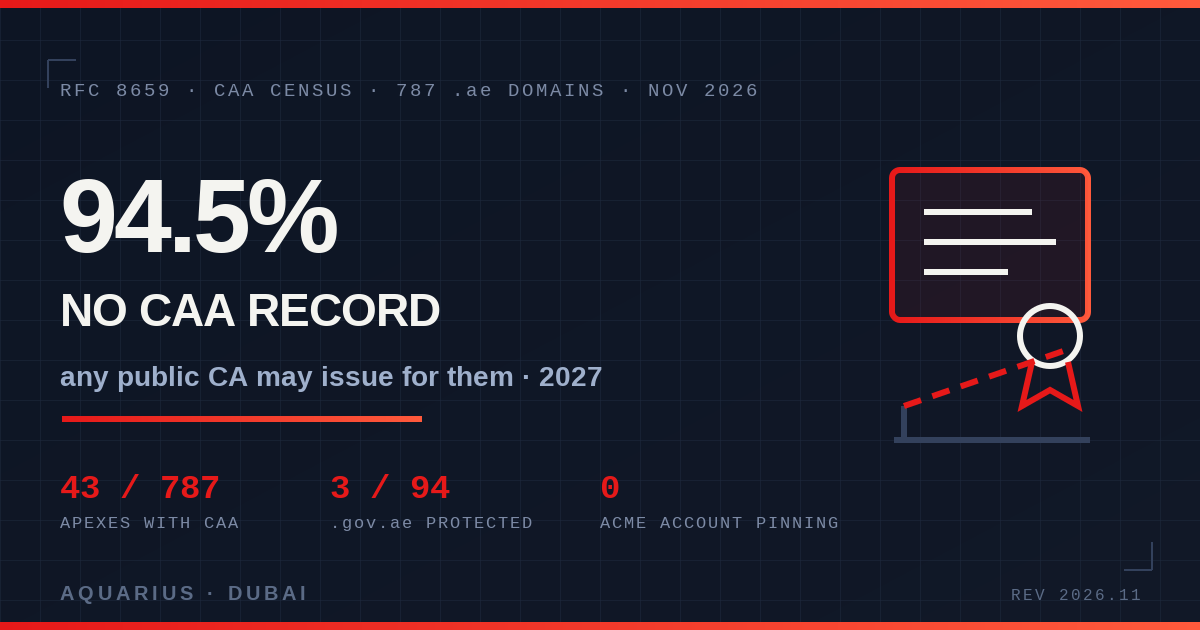
We queried the CAA records of 787 .ae domains in November 2026. Only 43 of them — 5.5% — publish one. For the other 744, every publicly trusted certificate authority on earth is still allowed to issue a TLS certificate for your domain, and the first you would know about it is a Certificate Transparency alert you probably are not subscribed to. A CAA record is three lines of DNS, costs nothing, and is the only control that tells CAs "no" before a certificate exists rather than after.
The measurement: 787 .ae domains, two independent resolvers
This is first-party data, not a vendor survey. We built the apex list from Tranco-ranked .ae hostnames, collapsed each to its registrable domain (handling .gov.ae, .ac.ae, .co.ae, .net.ae and friends as public suffixes), and queried type-257 CAA for both the apex and the www label over DNS-over-HTTPS. Every finding below was re-confirmed on a second independent resolver. One domain returned a query error; 786 answered cleanly.
Three numbers set the stakes before we get into the records themselves:
- Daily cyberattack attempts against the UAE passed 800,000 per day in July 2026, up from a 90,000–200,000 baseline, with 640,000 recorded in a single day in September 2026 (UAE Cyber Security Council).
- Phishing was the single most common initial attack vector in 2026 at 18% of breaches, and the most expensive, averaging USD 10.41m per incident — roughly AED 38.2m at the pegged rate (IBM Cost of a Data Breach 2026).
- The average Middle East breach now costs USD 8m (about AED 29.4m), with lost business alone at USD 3.57m. A fraudulently issued certificate for your domain is the ingredient that makes a phishing page indistinguishable from you.
What a CAA record actually does — and what it does not
CAA (Certification Authority Authorization, RFC 8659) is a DNS record that names which CAs may issue for your domain. Before issuing, a CA is required by the CA/Browser Forum Baseline Requirements to look up your CAA record set, climbing the DNS tree from the requested name upward until it finds one. If a record set exists and your chosen CA is not on it, issuance must stop.
Three property tags matter:
issue— which CAs may issue normal certificates. The value";"means "nobody".issuewild— which CAs may issue wildcard certificates. If present, it overridesissuefor wildcards only.iodef— a URL or mailto where a CA should report a request that your policy refused.
Here is the clause that most people deploying CAA have never read, and it is the reason three large UAE institutions in our sample have a record that enforces nothing. RFC 8659 states that if no issue property exists in the relevant record set but other properties are present, "CAA does not restrict issuance." An iodef-only record set is not a policy. It is a contact form.
The .ae census, by category
| Segment | Domains probed | Apex CAA present | Share |
|---|---|---|---|
| Second-level .ae (commercial) | 667 | 37 | 5.5% |
| .gov.ae (government) | 94 | 3 | 3.2% |
| .ac.ae (universities) | 19 | 1 | 5.3% |
| .net.ae / .co.ae / .org.ae | 7 | 2 | — |
| All .ae apexes | 787 | 43 | 5.5% |
The government column is the one that should sting. Of 94 .gov.ae domains, exactly three publish CAA: customerpulse.gov.ae, fcsc.gov.ae and mohap.gov.ae. The .ae registry itself publishes no CAA at the TLD level, so nothing is inherited — there is no policy upstream doing this for you.
For context, a 2024 Web PKI measurement study of 4 million Tranco domains found CAA on 5.2% of them. So .ae tracks the global average. That is not reassuring: our sample is the top-ranked slice of the namespace — banks, government, airlines, universities — and top-1,000 lists elsewhere reach up to 28% adoption. The .ae upper tier is performing like the general population.
Five ways .ae CAA deployments fail (MOFU)
1. The allowlist that allows almost everyone
Among the 43 domains with CAA, the median allowlist names five different certificate authorities. The widest, gulftoday.ae, names nine. Across the sample the permitted CAs break down as pki.goog (31 domains), digicert.com (30), letsencrypt.org (29), ssl.com (21), comodoca.com (20), globalsign.com (10), sectigo.com (7), then Amazon, GoDaddy, Certainly and eMudhra in single digits. Five CAs is better than all of them, but it is a wide door. Only nine domains pin a single CA: airbnb.ae, blogspot.ae, cleartrip.ae, google.ae, mohap.gov.ae, sharjah.ae, shj.ae, youtube.ae and youtube.co.ae.
2. CAA on www, nothing on the apex — and it was an accident
Another 33 domains returned CAA for www but nothing at the apex. In every single case the www label is a CNAME into a hosting platform's zone: 30 point at Shopify (shops.myshopify.com), four at Vercel. The CAA they appear to have is their platform's, inherited through the CNAME, covering only the www hostname. The apex — where the redirect, the mail, and usually the brand live — is wide open. If you are on Shopify or Vercel and assumed CAA was handled, it is handled for one label.
3. Record sets that look like policy and enforce nothing
Three domains publish a CAA record set with no issue property at all, which per RFC 8659 restricts nothing:
- dfm.ae (Dubai Financial Market) publishes only
0 issuewild "godaddy.com". Wildcards are restricted to GoDaddy; ordinary certificates are unrestricted. Its live certificates are Let's Encrypt, issued 27 October 2026 — not from GoDaddy, and entirely permitted. - eim.ae and emirates.net.ae (e& / Etisalat infrastructure) publish only an
iodefmailto. No issuance restriction whatsoever. The live certificate on eim.ae is a DigiCert wildcard valid to 19 May 2027, which the record neither permits nor forbids, because the record does nothing.
These are not lockouts. They are security theatre that passes a checklist and stops no one.
4. Deny rules cancelled by the lines above them
Two domains ship issuewild ";", the "no wildcards, ever" rule. Only one of them works. citibank.ae publishes a clean set — issue for GlobalSign and DigiCert, issuewild ";" to kill wildcards, an iodef contact, and all four records flagged critical (flag 128), which forces a conforming CA to refuse rather than ignore what it does not understand. It is the best CAA deployment in the .ae sample. 3cx.ae, by contrast, publishes issuewild ";" alongside five named issuewild CAs. Properties are a union, not a precedence list, so the deny is inert and wildcards remain issuable from five CAs.
5. Reporting fields that cannot report
Only 10 of the 43 domains publish an iodef contact at all, so 33 have told CAs nothing about where to send a refused-request alert. Two of the ten are malformed: eim.ae has a stray space inside "mailto: ...", and qualys.ae puts a CA's domain name where a reporting URL belongs. The same 2024 study found 3.79% of iodef entries invalid globally; .ae is running worse. And across all 787 domains, zero use the RFC 8657 parameters accounturi or validationmethods — the ones that pin issuance to your specific ACME account and to a single validation method. Nobody in the .ae top tier is using the strongest form of the control.
Why this gets more expensive in 2027, not less
Certificate lifetimes are collapsing on a published schedule. Under CA/Browser Forum ballot SC-081v3, the maximum TLS certificate lifetime dropped to 200 days on 15 March 2026, falls to 100 days on 15 March 2027, and to 47 days on 15 March 2029. Domain-validation reuse shrinks on the same curve, down to 10 days in 2029.
That changes the maths of CAA in two ways. First, your renewals multiply — from one a year to roughly eight by 2029 — so a CAA record that accidentally excludes the CA your automation actually uses will break a renewal eight times as often. Second, every one of those renewals is a fresh CAA lookup, which means a correct record is enforced more often. CAs may reuse a CAA check only within the record's TTL or eight hours, whichever is greater, so a change you publish today is binding within hours.
At the same time, validation itself got harder to spoof: since 15 March 2026 CAs must perform Multi-Perspective Issuance Corroboration from at least three remote network perspectives, rising to four in June 2026 and five in December 2026. BGP-hijack-driven mis-issuance is getting squeezed shut. CAA is the half of that equation you control, and it is the half most .ae domains have skipped. If you want the companion picture, our certificate scan of .ae homepages shows how short the actual deployed lifetimes already are, and the DNSSEC and MTA-STS census covers the records that protect the lookup itself.
What to publish (BOFU)
For most Dubai businesses the correct record set is short. Name the CA your automation genuinely uses, name your platform's CA if you are fronted by Shopify, Vercel, Cloudflare or AWS, block wildcards if you do not use them, add a monitored mailbox, and publish it at the apex.
| Record | Value | What it buys you |
|---|---|---|
CAA 0 issue | your CA, e.g. letsencrypt.org | Every other public CA must refuse |
CAA 0 issue | your platform CA, e.g. amazon.com | Keeps CDN/host renewals working |
CAA 0 issuewild | ; | No wildcard can be minted for you |
CAA 0 iodef | mailto:security@yourdomain.ae | CAs report refused requests to you |
CAA 0 issue + accounturi= | your ACME account URI | Pins issuance to your account, not just your CA |
The failure mode to respect is the inverse of the one above: a record that is too tight breaks a renewal. Publish with a low TTL, verify against two resolvers, confirm every system that holds a certificate for the domain (mail gateway, CDN, load balancer, marketing subdomain, the staging box someone set up in 2021), then tighten. That inventory step is where this work actually lives — the DNS edit takes a minute.
We price this as a fixed-scope job: AED 1,500–3,500 for the audit and record design across a domain portfolio, AED 4,000–9,000 to implement it with a full certificate inventory and Certificate Transparency monitoring wired to a channel your team reads. Set against an AED 29.4m average regional breach — AED 38.2m when phishing is the vector — it is the cheapest control on the security backlog. See how we scope technical work.
FAQ
Does a CAA record stop someone hacking my website?
No. It stops a certificate authority from issuing a trusted certificate for your domain to someone who is not you. That is the step a convincing phishing site or a transparent interception proxy needs, and it is the step CAA closes.
Will a CAA record break my Let's Encrypt or Cloudflare renewals?
Only if the record omits the CA your automation uses. Cloudflare, AWS, Shopify and Vercel each issue through specific CAs; list them. Our census shows 30 .ae domains already relying on Shopify's inherited CAA on www while leaving the apex unrestricted, which is the mirror-image mistake.
Is CAA mandatory in the UAE?
No. There is no .ae registry policy or TDRA requirement to publish CAA, and the TLD publishes no CAA of its own, which is precisely why 94.5% of the domains we probed have none. The obligation runs the other way: CAs must honour whatever you publish.
Apex or www — where does the record go?
The apex. CAs climb the DNS tree from the requested name upward, so a record at example.ae covers www.example.ae and every other subdomain that has no record of its own. A record on www alone protects one hostname.
How do I know if a certificate was mis-issued for my domain?
Certificate Transparency. Every publicly trusted certificate is logged, so a CT monitor on your domains emails you when one appears that your team did not request. CAA prevents; CT detects. You want both, and CAA first, because it is free.
The short version
Forty-three of 787 .ae domains have told the world's certificate authorities who is allowed to speak for them. Three of those 43 published a record that enforces nothing, two published a deny rule cancelled by its own neighbours, and none used the account-pinning parameters that have been standardised since 2019. The control is free, it takes one DNS change, and the number of Dubai businesses using it properly is roughly five in a hundred.
If you want to know what your own domains answer right now — including the subdomains and third-party platforms you have forgotten about — send us the domain list and we will run the same probe we ran on all 787.