
We Read the TLS Certificate on 787 .ae Homepages: 34.9% Break in March 2027
We opened a TLS handshake with 787 .ae homepages on 25 November 2026: 242 certificates are too long-lived for the March 2027 cap, 4 are already expired, and 15 sites fail browser validation today.
- PUBLISHED
- 25 NOV 2026
- READ TIME
- 13 MIN
- AUTHOR
- AQUARIUS · DUBAI
- UNIT
- REV 2026.09
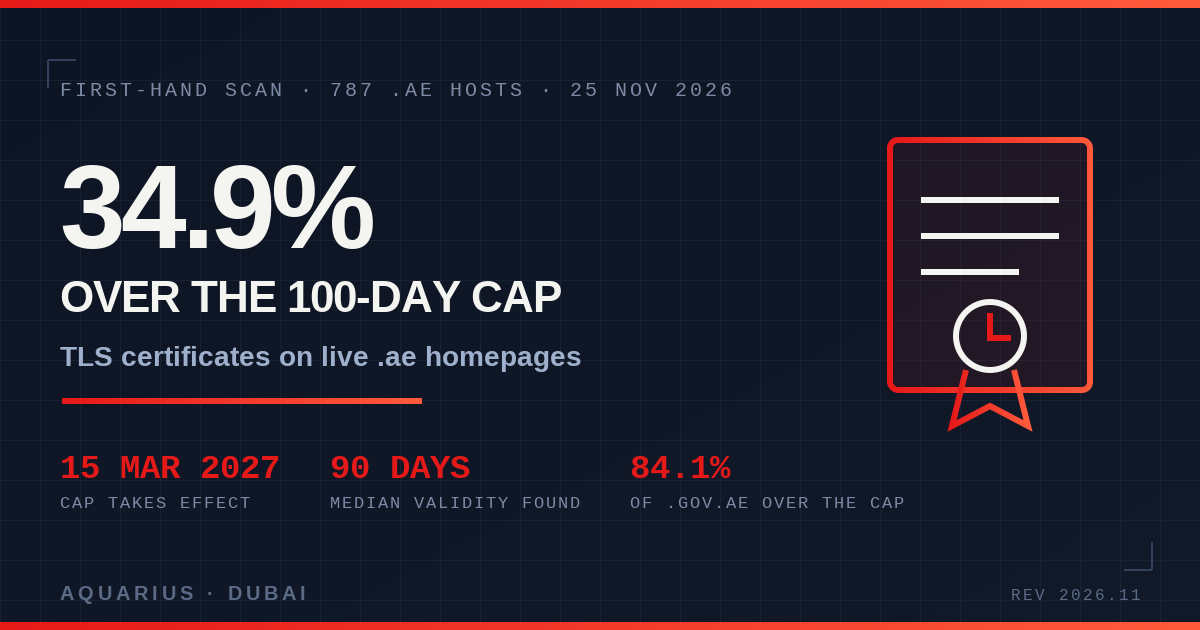
Short answer: on 25 November 2026 we opened a TLS handshake with 787 .ae homepages and read the certificate off every one that answered. 694 completed a handshake, and 242 of them — 34.9% — are still issuing certificates longer than 100 days, which stops being allowed for certificates issued on or after 15 March 2027. Four .ae certificates are expired right now, the worst by 973 days, and 15 sites throw a browser trust warning today.
That is not a vendor forecast. It is a measurement, and you can reproduce it — the method is at the bottom.
What 787 .ae homepages actually look like under the hood
The host list is the .ae slice of the Tranco top-sites ranking, so it is weighted toward sites real people in the UAE open: banks, telcos, retailers, hospitals, universities and federal portals. 694 of 787 completed a TLS handshake on the first attempt; the rest timed out, refused port 443 or resolved nowhere.
- 84.7% negotiate TLS 1.3 (588 of 694). The other 106 top out at TLS 1.2 — still safe, but a lost round trip on every new connection.
- Median certificate validity: 90 days. The
.aemedian is already inside the 2027 limit, because free automated CAs dominate the long tail. - 242 certificates (34.9%) exceed 100 days, and 66 are still over 300 days with a median of 395 — year-long certificates that no CA will be allowed to issue after March 2027.
- 4 certificates are past their expiry date as we scanned, and 38 more expire within 30 days.
- 2 homepages serve a self-signed certificate — one is a cPanel default page that has been expired for 624 days.
Context for why this matters more here than in most markets: the UAE Cyber Security Council recorded roughly 600,000 cyberattacks a day on UAE targets through 2026, with one 24-hour period peaking near 640,000. IBM’s Cost of a Data Breach 2026 puts the Middle East average breach at USD 8 million, about AED 29.4 million — second only to the United States. A certificate is the cheapest control in that stack and the one most often left on a calendar reminder.
The deadline is a CA/Browser Forum ballot, not an upsell
Ballot SC-081v3 passed the CA/Browser Forum and is now in the TLS Baseline Requirements. It steps the maximum certificate lifetime down on fixed dates, and — the part most Dubai teams miss — it steps down how long a CA may reuse the proof that you control the domain.
| Certificate issued on or after | Max certificate lifetime | Max domain-validation reuse |
|---|---|---|
| Today (until 14 Mar 2027) | 200 days | 200 days |
| 15 March 2027 | 100 days | 100 days |
| 15 March 2029 | 47 days | 10 days |
We can see the first step already in the data: the single most common validity value in the .ae set is 198–199 days, which is CAs hugging the 200-day limit that arrived in March 2026. Most Dubai site owners never noticed that one, because their CA absorbed it. The 100-day step is different: at 100 days a human-driven renewal cycle has to run three to four times a year, and that is where processes break. We covered the mechanics and the migration order in the 100-day certificate guide; this post is the measurement of who is actually ready.
Your certificate authority decides whether March 2027 hurts
Here is the issuer breakdown from our own 694 live .ae certificates. The validity column is the median we measured, not a vendor’s marketing number.
| Issuer | .ae certs found | Median validity measured | Over the 100-day cap |
|---|---|---|---|
| Let’s Encrypt | 249 | 90 days | 0% |
| Google Trust Services | 189 | 90 days | 0% |
| DigiCert | 124 | 199 days | 98% |
| GlobalSign | 49 | 199 days | 92% |
| Amazon (ACM) | 27 | 198 days | 100% |
| Sectigo | 24 | 283 days | 100% |
| GoDaddy | 17 | 198 days | 88% |
Read it honestly. A long measured lifetime is not automatically a problem — Amazon’s ACM issues 198-day certificates and renews them for you, so ACM users will wake up on 16 March 2027 with shorter certificates and nothing to do. The risk sits with the certificates a person bought, downloaded and pasted into a server. Those are concentrated in the paid-CA rows, and 100% of the free automated rows are already compliant.
The direction of travel is faster than the ballot, too: Let’s Encrypt made six-day (160-hour) certificates generally available on 15 January 2026 and has said it intends to shorten its default from 90 days toward 45. If a renewal needs a human, that is unsurvivable. If it is ACME, it is a config value.
.gov.ae is the least ready cohort in the whole scan
69 of the 694 live hosts are .gov.ae. They are the slowest-moving group on both axes we measured: median certificate validity 199 days, 84.1% over the 100-day cap, and only 55.1% negotiating TLS 1.3 against 84.7% for the set overall. Federal and emirate portals buy OV certificates from commercial CAs through procurement, and procurement cycles do not naturally produce a renewal every 100 days. Any Dubai agency or supplier in that chain needs ACME or a managed lifecycle in place well before March 2027, not a purchase order.
The wildcard trap that is breaking five well-known .ae sites today
15 of 694 hosts (2.2%) fail browser certificate validation right now. Eleven of those 15 are hostname mismatches, and five of the eleven work perfectly on www. while throwing a full-page warning on the bare apex. The cause is almost always the same assumption: that a wildcard covers the domain it is named after. It does not. *.example.ae matches www.example.ae and shop.example.ae, but it never matches example.ae — the apex needs its own SAN entry. We found one government certificate issued only as *.sharjahcustoms.gov.ae, and the apex duly fails.
The rest of the eleven are redirect and CDN plumbing: a site serving its parent group’s certificate, two UAE brand stores answering the apex with a raw *.demandware.net commerce certificate, and one .ae homepage presenting a German Gitea certificate. Every one of these is a five-minute fix that nobody has noticed, because the people who run them all type www.
Methodology note worth copying into your own process: our first pass, run from a Frankfurt host, flagged 22 failures. Seven of those were “unable to get local issuer certificate”, and re-probing all seven from a second vantage with a current root store showed every one validating cleanly. The fault was a stale ca-certificates package on the scanning box, not the sites. If you are auditing TLS, always confirm a trust failure from a second machine before you email anyone about it.
What else the handshake gave away
Key choices have quietly modernised: 357 of 694 certificates use elliptic-curve keys (mostly P-256) against 337 on RSA, which is a healthier split than the .ae set showed a year ago and means smaller handshakes on mobile networks. Signature hashes are clean — SHA-256 or stronger everywhere, no SHA-1 survivors. 692 of 694 certificates carry embedded Certificate Transparency SCTs, so almost every .ae certificate is publicly logged and your competitors’ issuance history is already readable. And not one certificate in the entire scan sets OCSP must-staple, which is the correct 2026 answer now that the Baseline Requirements have made stapled OCSP optional and short lifetimes carry the revocation load instead. Certificates are only one layer: DNSSEC and MTA-STS adoption on .ae domains is far weaker than TLS adoption.
What fixing this costs in Dubai, and what ignoring it costs
Automation is cheap, certificate outages are not. Indicative Dubai market ranges to get an estate into a state where March 2027 and March 2029 are non-events:
| Work | Typical Dubai cost (AED) | What you get |
|---|---|---|
| TLS audit of a domain estate (up to 50 hosts) | 2,500 – 6,000 one-off | the scan in this article, run on your domains: issuers, lifetimes, apex/www gaps, expiry calendar |
| Apex + www SAN and redirect fix | 800 – 2,000 per domain | certificate reissued with both names, canonical redirect, HSTS kept intact |
| ACME on a single VPS or Nginx host | 1,500 – 3,500 one-off | certbot or acme.sh, DNS-01, reload hooks, zero licence cost |
| Multi-server / load balancer automation | 4,000 – 9,000 one-off | CNAME-delegated DNS-01, central issuance, distribution to edges |
| Managed lifecycle, 10–50 certificates | 6,000 – 15,000 setup, then 900 – 2,500/month | inventory, ARI-driven renewal, failure alerting, on-call |
Against that, the cost of inaction. In DigiCert’s 2026 Global PKI Research, nearly one in four organisations said their most significant certificate incident cost more than USD 250,000 — about AED 918,000 at the pegged 3.6725 rate. An expired certificate in the UAE is not a soft degradation either: Chrome, Safari and Edge together account for roughly 91.7% of UAE browser sessions, and all three show a full-page interstitial that most visitors will not click through. One afternoon of that on a transactional site costs more than every row in the table above.
How we do it at Aquarius: we start with the measurement, because an inventory you did not take is the actual risk — most estates we audit have between one and four certificates nobody on the current team provisioned. Then ACME everywhere it can reach, a terminating proxy in front of the gear that will never speak ACME, and alerting on renewal failure rather than on expiry date, so a broken renewal pages someone 30 days out instead of surprising you at 00:00. Our risk reversal is simple: if the audit finds nothing actionable on your domains, you do not pay for it. Pricing is published, not quoted by negotiation.
Check your own domain in 60 seconds
Run this against the apex and then against www, and compare. If one works and the other does not, you have the wildcard trap:
echo | openssl s_client -servername example.ae -connect example.ae:443 2>/dev/null | openssl x509 -noout -issuer -dates -ext subjectAltName
You want three things in that output: an issuer you recognise, a notBefore-to-notAfter gap of 100 days or less, and both example.ae and www.example.ae in the SAN list. If the gap is 198 days and the renewal is a person, you have roughly 110 days to change the process.
FAQ
What exactly changes on 15 March 2027?
Certificates issued on or after that date may not be valid for more than 100 days, and the domain-control validation behind them may not be reused for more than 100 days. Certificates issued before that date keep their original validity until they expire, so the real deadline for most Dubai teams is their last long-lifetime renewal before mid-March 2027.
Will my existing 198-day certificate stop working in March 2027?
No. It keeps working until its own expiry date. What stops is your ability to buy another one like it. That is why the dangerous pattern is a manual renewal process, not a long certificate.
Is a wildcard certificate enough for my Dubai website?
Only if the apex is also listed. *.yourbrand.ae does not cover yourbrand.ae. Eleven of the 15 validation failures we measured were hostname mismatches, and five of them were exactly this — working on www, broken on the bare domain that people type and that ads link to.
Should a UAE business pay for an OV or EV certificate?
Only if you specifically need the vetted organisation identity in the certificate, for example for a regulator or a banking counterparty. Browsers show no visual difference, and in our scan the free automated CAs were 100% ready for 2027 while the paid rows were 88–100% not ready. You are often paying for a slower process.
Does a shorter certificate lifetime make my site less secure in any way?
Not if renewal is automated. Shorter lifetimes shrink the window in which a stolen key is useful and reduce dependence on revocation, which has never worked reliably. The only thing they punish is manual process.
Method, so you can check us
787 .ae hosts from the Tranco ranking, probed on 25 November 2026 over port 443 with a 12-second timeout, 40 parallel workers. Each host was attempted twice: once with a verifying trust store to record whether a real browser would accept the chain, and once without verification so the certificate could still be parsed when validation failed. We recorded negotiated TLS version and cipher, issuer, subject, SAN count, wildcard status, validity window, key type and size, signature hash, embedded SCTs and must-staple. All trust failures were re-confirmed from a second vantage point. Percentages are over the 694 hosts that completed a handshake, not over all 787.
If you want this run on your own domains before March 2027 rather than after it, send us the list — the scan takes an afternoon and the fixes are usually smaller than the report.