
Car Recovery & Roadside Assistance App Development in Dubai (2026): Real AED Costs, RTA Permits and the Summer Spike Nobody Counts
Roadside calls jump 20-30% June to September across the UAE and the market is worth about AED 1.03 billion. Real AED build costs, call-out rates and RTA permit facts.
- PUBLISHED
- 30 OCT 2026
- READ TIME
- 11 MIN
- AUTHOR
- AQUARIUS · DUBAI
- UNIT
- REV 2026.09
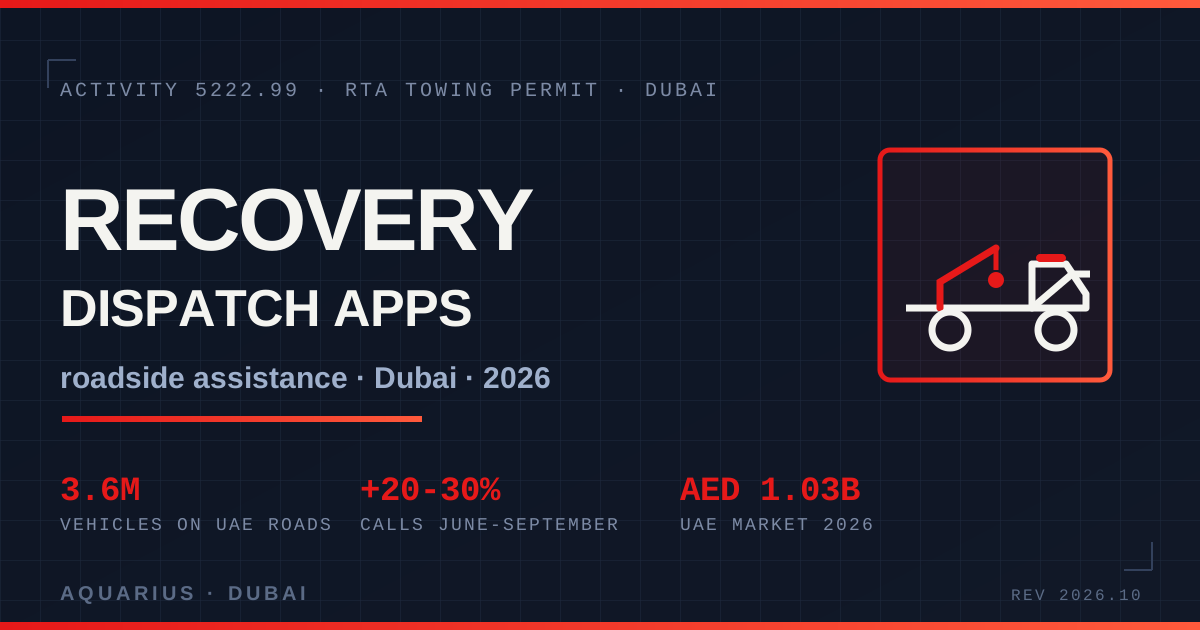
Short answer: a car recovery and roadside assistance app in Dubai is a two-sided dispatch system — a customer app that captures a GPS-accurate breakdown location and an operator app that assigns the nearest truck with live ETA — and in 2026 it costs roughly AED 55,000 to AED 220,000 to build, depending on whether you need a single-fleet dispatcher or an insurer-grade platform. The reason the maths now works is volume: there are over 3.6 million registered vehicles on UAE roads, Dubai alone carries about 3.5 million vehicles during daytime hours, and the UAE vehicle roadside assistance market is estimated at USD 279.7 million in 2026 — about AED 1.03 billion of call-outs a year, still dispatched largely by phone call and WhatsApp voice note.
The number most Dubai recovery firms have never counted
Here is the stat that should end the argument about whether a recovery business needs software. Across the UAE insurance and fleet sector, roadside assistance calls and mechanical claims rise 20% to 30% between June and September, UAE fleet data shows 25–35% more battery-related service requests in summer than in cooler months, and industry estimates put battery failures at 35–40% of all roadside assistance claims at peak summer. The physics behind it is brutal and specific to this market: a car battery that lasts three to five years in a temperate climate typically lasts 18 to 24 months in the UAE, because cabin temperatures past 60°C accelerate electrolyte evaporation and internal corrosion.
So demand is not flat. It spikes by up to a third for four months, and it spikes at the exact hours when a human dispatcher is least able to triage a queue by voice. Most Dubai operators absorb that spike by adding a second phone operator and accepting that some callers hang up and dial the next recovery number on Google. Nobody measures that number, which is precisely why it never gets fixed.
The growth side is just as concrete. Dubai's RTA recorded 196,042 first-time vehicle registrations between January and June 2026 — more than 1,000 a day — and registered vehicles are up 10% over two years. The commercial transport fleet passed 500,000 vehicles, while licensed commercial transport companies grew from 12,100 in 2024 to 16,917 in 2025. Every one of those B2B fleets is a potential contract account rather than a one-off tow, and contract accounts are won on reporting, not on price.
What the app actually has to do
Strip away the feature lists and a recovery platform is four jobs. One: capture the vehicle's position without asking a stranded, stressed driver to describe a slip road in a second language. Two: pick the right truck — a flatbed for a lowered or four-wheel-drive vehicle, a wheel-lift for a basement, a service van for a battery boost that should never become a tow at all. Three: give the customer a live ETA so they stop calling. Four: close the job with a priced, VAT-correct invoice and photographic evidence of vehicle condition at pickup and drop.
Customer app
One-tap SOS with GPS plus a landmark fallback field, service-type selection, an upfront price estimate, live truck tracking, card and Apple Pay / Google Pay payment, vehicle condition photos, and an Arabic/English interface with proper RTL layout. If you are selling to residents rather than only insurers, add a membership tier — the market has trained UAE drivers to expect it, with association plans marketed from around AED 500 up to AED 1,500 a year for tiers that bundle towing, accident recovery, tyre change, lockout, fuel delivery, battery boost and desert or basement pull-out.
Driver and dispatcher apps
Driver app: job offer with an accept/decline timer, turn-by-turn navigation, a status pipeline (assigned, en route, on scene, loaded, delivered), proof-of-service photos, signature capture, and cash-collected reconciliation. Dispatcher console: live map of every truck, auto-assignment by distance and equipment type, manual override, SLA timers, and a queue view that survives a 40-call hour. This is the same operational spine as field service management software and the movers and packers dispatch model, and that logic is reusable — which is why you should never pay for it as if it were novel.
The integrations that decide whether anyone adopts it
Insurer and fleet accounts are the margin in this business, and they are won on integration: an API or portal where the insurer raises a job, tracks it, and receives a closed file with timestamps and photos. Add garage handoff (see garage and workshop management software) so a tow becomes a repair job rather than a dead end, and plan for EV handling. Dubai had 47,944 electric vehicles at the end of 2025, up 27.9% year on year, against 2,223 public charging points by the end of Q1 2026. An EV generally cannot be flat-towed, and a dead-battery EV needs either a flatbed or mobile charging — a service type your dispatch logic must model explicitly, the way an EV charging and CPMS platform models connector types.
Dubai pricing reality: what a call-out sells for
Before you size an app, price the service it dispatches. There is no published consumer tariff for private recovery in Dubai, so the ranges below are operator-advertised rates compiled in 2026 — which is itself the business case for in-app upfront pricing, because opaque pricing is the most common complaint in this category.
| Service | Typical Dubai price (AED) | Dispatch implication |
|---|---|---|
| Battery boost / jump start | 100 – 200 | Service van, not a truck — highest-volume summer job |
| Flat tyre change on site | 100 – 150 | Needs spare-tyre confirmation in the booking flow |
| Fuel delivery | 100 – 150 + fuel | Fuel type and quantity captured, never assumed |
| Short tow, under 20 km | 150 – 250 | Bread-and-butter job; margin lives in truck utilisation |
| Medium tow, 20 – 50 km | 300 – 450 | Route and return-leg planning pays for itself |
| Accident recovery | 250 – 500 | Police report reference and condition photos mandatory |
| Sedan vs 4x4 / luxury call-out | 300 – 500 vs 600 – 1,200 | Equipment matching decides profit or damage claim |
| Dubai to Abu Dhabi transfer | 700 – 1,100 | Inter-emirate pricing rules, driver-hours tracking |
Run the arithmetic on a modest fleet. Six trucks averaging five jobs a day at AED 280 is roughly AED 252,000 a month in gross call-out revenue. A dispatch system that lifts utilisation by one job per truck per day adds about AED 50,000 a month — the entire cost of a mid-range build inside one quarter. That is the number to argue about, not the app's colour scheme.
Licensing and compliance you cannot build around
Software does not exempt you from the permit. Vehicle recovery in Dubai runs under the Vehicles Recovery activity, code 5222.99, covering towing of broken-down and accident-damaged vehicles from public roads, roadside breakdown assistance, and recovery on behalf of insurers or fleet operators. Operating a recovery vehicle on Dubai's road network requires RTA approval and an operational permit for towing on public roads, with the transporting-and-towing permit fee listed at AED 1,000 for a new permit and AED 1,000 on renewal. Trucks must be registered and roadworthy to UAE vehicle standards, drivers must hold the RTA-endorsed licence category for the vehicle they operate, and comprehensive plus third-party liability cover is required on every recovery vehicle.
Two compliance items land squarely in the software. First, continuous location tracking of drivers and customers is personal data under the UAE's federal data protection regime, so you need a lawful basis, a stated retention period, and the ability to serve a data-subject request — our PDPL compliance checklist for websites and apps maps that onto a real backlog. Second, 5% VAT applies to the service, so your invoice needs a correct TRN-bearing tax invoice generated at job close, not reconstructed by an accountant at month end.
The most expensive bug in this category is equipment mismatch. Sending a wheel-lift to a lowered sports car, or flat-towing an EV, turns an AED 250 job into a damage claim worth more than your annual software budget. Model vehicle type, drivetrain and ground clearance as required fields on day one.
What it costs to build in Dubai, in AED
These are Aquarius build ranges for 2026, scoped by capability rather than screen count. They assume Flutter or React Native for the customer and driver apps with a web dispatcher console, which is the correct default here because you are shipping three clients, not one.
| Build | Scope | AED | Timeline |
|---|---|---|---|
| MVP dispatcher | Customer SOS app, driver app, web dispatch map, auto-assign by distance, card payment, basic invoicing | 55,000 – 95,000 | 8 – 12 weeks |
| Full two-sided platform | Adds memberships and subscriptions, service-type and equipment matrix, upfront pricing engine, Arabic RTL, promo codes, ratings, analytics | 120,000 – 220,000 | 14 – 20 weeks |
| Insurer / fleet grade | Adds insurer job API and portal, SLA reporting, multi-branch and franchise roles, garage handoff, audit trail, EV service flows | 250,000+ | 5 – 8 months |
| Annual run cost | Maintenance, OS releases, maps and SMS usage, hosting, support | 15 – 20% of build per year | Ongoing |
Two cost drivers get underestimated every time. Maps and messaging are metered: a live-tracking app makes a geocoding or routing call on every status change, so unit economics belong in the architecture review, not in a surprise invoice in month four. And offline tolerance is not optional — a driver in a basement car park or a desert pull-out loses signal exactly when the job status needs to change, so queue the writes locally and sync.
The subscription layer is where the valuation is
Call-outs are transactional revenue with a seasonal shape. Memberships are recurring. At the market-observed AED 500 to AED 1,500 a year for consumer roadside plans, a thousand retained members is AED 500,000 to AED 1.5 million of annual recurring revenue on a cost base you already operate — and recurring revenue is what turns a truck fleet into an asset an acquirer will pay a multiple for. Getting that billing right from the start is the same recurring-payments plumbing covered in our UAE subscription billing guide.
How Aquarius builds it
We build the dispatch core first and nothing else: SOS capture, assignment, live ETA, job close with photos and a VAT-correct invoice. That ships in weeks, runs a real fleet, and earns the data you need before you spend on memberships or an insurer portal. From there we layer the equipment matrix, Arabic RTL, EV service flows and the insurer API in priority order, set by which accounts you are actually trying to win. Fixed-scope phases, Dubai-based accountability, code and repository ownership transferred to you — see our pricing for how the phases are structured, and what mobile app development costs in Dubai for the wider benchmark.
The market context is not speculative. The UAE roadside assistance market is forecast to grow at roughly 2.8% a year through 2033 from that USD 279.7 million base, Dubai keeps adding more than a thousand newly registered vehicles a day, and EV share keeps climbing against a charging network still catching up. The operators who win the next four years are the ones whose dispatch is a system rather than a phone, because that is the only version that survives a 30% summer spike without losing calls.
FAQ
How much does a car recovery app cost in Dubai in 2026?
An MVP with a customer SOS app, driver app and web dispatcher runs AED 55,000 to AED 95,000. A full two-sided platform with memberships, upfront pricing and Arabic RTL lands at AED 120,000 to AED 220,000, and an insurer-integrated platform starts around AED 250,000. Budget 15–20% of build cost per year for maintenance, maps and messaging usage.
Do I need an RTA permit to run a recovery business in Dubai?
Yes. Recovery and towing fall under the Vehicles Recovery activity, code 5222.99, and operating recovery vehicles on Dubai's road network requires RTA approval plus an operational towing permit — listed at AED 1,000 new and AED 1,000 on renewal. Vehicles must meet UAE roadworthiness standards, drivers need the matching RTA-endorsed licence category, and comprehensive plus third-party liability insurance is mandatory on each truck.
What does car recovery cost in Dubai right now?
Operator-advertised 2026 rates run about AED 150–250 for a short tow under 20 km, AED 300–450 for 20–50 km, and AED 700–1,100 from Dubai to Abu Dhabi. A battery boost is roughly AED 100–200 and a flat-tyre change AED 100–150. There is no published RTA consumer tariff for private recovery, so upfront in-app pricing is a genuine competitive advantage.
Why is roadside assistance demand so seasonal in the UAE?
Heat. Roadside assistance calls and mechanical claims rise 20–30% from June to September, fleet data shows 25–35% more battery service requests in summer, and battery failures make up an estimated 35–40% of peak-summer roadside claims. UAE batteries commonly last 18–24 months instead of the three to five years typical in cooler climates.
Can the same app handle electric vehicles?
Only if you design for it. Dubai had 47,944 EVs at the end of 2025, up 27.9% year on year, with 2,223 public charging points by the end of Q1 2026. EVs generally cannot be flat-towed, so dispatch logic needs a flatbed-or-mobile-charging branch keyed to drivetrain, or you will book a job your truck physically must not perform.
How long does it take to launch?
A working MVP dispatch system takes 8 to 12 weeks, a full platform with memberships and Arabic RTL takes 14 to 20 weeks, and insurer-grade builds run 5 to 8 months. Launching before the June–September surge is worth more than launching with every feature.
Running trucks on phone calls and WhatsApp? Tell us your fleet size and job mix and we will map the smallest dispatch build that measurably lifts utilisation — fixed scope, fixed price, no retainer lock-in.