
Chargebacks and Payment Fraud in Dubai Ecommerce (2026): The 150-Dispute Trap and Real AED Defence Costs
UAE stores enter Visa VAMP scope at just 150 disputes and AED 275,400 - a tenth of the US floor. Real 2026 thresholds, what a dispute costs, and AED prices to fix it.
- PUBLISHED
- 05 OCT 2026
- READ TIME
- 12 MIN
- AUTHOR
- AQUARIUS · DUBAI
- UNIT
- REV 2026.09
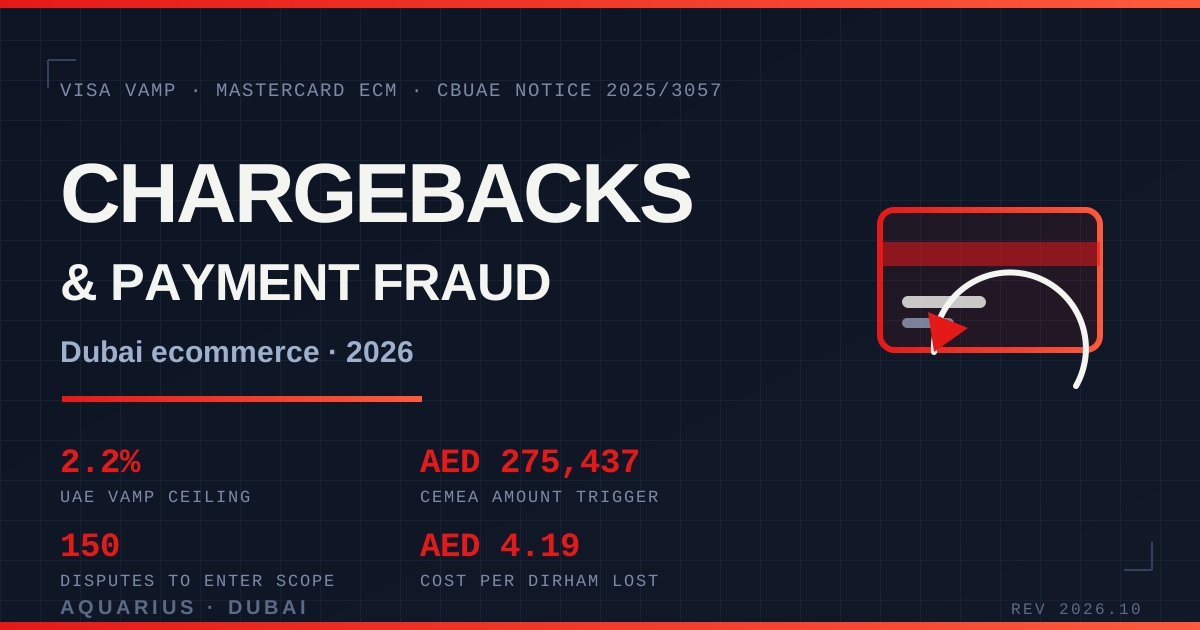
Short answer: a Dubai store crosses into Visa VAMP scope far earlier than most owners think. UAE merchants sit in the CEMEA region, where the review floor is only 150 combined fraud reports and disputes in a month plus USD 75,000 (about AED 275,400) of fraud and dispute value - not the 1,500-dispute floor applied in the US and Europe. Once in scope, the UAE ceiling is a 2.2% VAMP ratio, Mastercard adds its own 1.5% ratio with 100 chargebacks trigger, and breaching either costs roughly USD 8 per disputed transaction on top of fines that run from USD 1,000 to over USD 200,000.
That is the part no payment gateway salesperson explains. Below is what fraud and chargebacks actually cost a Dubai ecommerce business in 2026, the monitoring thresholds you are measured against, the authentication rules that changed in January, and the real AED cost of building a defence that does not strangle your approval rate.
The stakes: what fraud costs a UAE merchant (awareness)
One: every dirham of fraud costs you more than a dirham. The LexisNexis Risk Solutions True Cost of Fraud study puts the total cost at AED 4.19 for every dirham lost to fraud in the UAE - AED 3.62 for retailers and AED 4.99 for financial institutions - because the headline loss is joined by internal labour, external recovery fees, interest and the cost of replacing or redistributing the merchandise. In the same study, 42% of UAE companies reported fraud increasing over the prior twelve months. If your store writes off AED 60,000 of fraud a year, the real hole in the P&L is closer to AED 217,000.
Two: the attack surface is growing as fast as the market. UAE ecommerce reached USD 12.30 billion in 2026 and is forecast to hit USD 21.01 billion by 2031 on an 11.29% CAGR, served by about 11.04 million online shoppers. Retail ecommerce grew 14% in 2025 to AED 40,321 million. Card now carries the majority of that volume while cash on delivery has fallen to roughly 25-30% of transactions, down from about 40% in 2022. Every point of COD that converts to card is a point of volume that can be disputed.
Three: your customers are being attacked weekly. 56% of UAE residents report at least one fraud attempt every month, with credit cards and bank transfers the most targeted instruments; 51% received scam SMS and 56% received scams through messaging apps. Card-not-present fraud is now about 81% of global fraud cases and global CNP losses are tracking toward USD 28.1 billion in 2026, roughly 40% above 2023. Dubai Police has stood up a dedicated AI crimes unit and a deepfake detection capability, and in January 2026 warned of a surge in AI-fabricated official documents used in fraud.
Most Dubai businesses get this wrong: they assume 3D Secure moves all the risk to the bank, so chargebacks are someone else's problem. Two things break that assumption. First, around 80% of chargebacks are classed as fraud-related, and a large share of those are first-party misuse - the cardholder really did buy it and disputes anyway. 3DS does nothing about that. Second, from 6 January 2026 SMS security codes were withdrawn from UAE online banking under CBUAE Notice 2025/3057, with the full phase-out of SMS and email one-time passwords mandated by 31 March 2026. The authentication layer you were relying on no longer works the way your checkout was built for.
The thresholds you are actually measured against (consideration)
Card schemes do not police your fraud rate directly. They police ratios, and the ratios are the thing that gets an account terminated. Here is the 2026 picture for a UAE merchant.
| Programme | Trigger | Scope floor | Consequence |
|---|---|---|---|
| Visa VAMP - UAE / CEMEA | Ratio of 2.2% or above (TC40 fraud + TC15 disputes / settled CNP transactions) | 150 combined fraud reports and disputes per month and USD 75,000 (~AED 275,400) fraud + dispute value | Fees of about USD 8 per disputed or fraudulent transaction, remediation plan, escalation risk |
| Visa VAMP - US / EU / APAC | Tightened from 2.2% to 1.5% effective 1 April 2026 | 1,500 combined disputes and fraud reports per month | Same fee basis - relevant if you sell cross-border through a non-UAE acquirer |
| Visa VAMP - enumeration | 20% or more of transactions flagged as enumerated (card testing) | 300,000 enumerated transactions | Separate breach; card-testing bots on your checkout are your problem, not the bank's |
| Mastercard ECM | 1.5% chargeback ratio and 100+ chargebacks in the same calendar month | Applied after two consecutive breach months | Fines escalating from USD 1,000, plus Issuer Recovery Assessment |
| Mastercard HECM | 3% ratio and 300+ chargebacks | - | Fines to USD 200,000+ and possible MATCH listing |
Read the first two rows together, because that is the trap. The UAE ceiling looks generous at 2.2% against the 1.5% that applies in Europe and North America from 1 April 2026. But the entry floor in CEMEA is ten times lower: 150 disputes and USD 75,000, versus 1,500 disputes elsewhere. A Dubai store doing AED 1.5 million a month at an AED 400 average order value writes roughly 3,750 orders; 150 combined fraud and dispute events is a 4% event rate - uncomfortably reachable for a travel, electronics, luxury or digital-goods seller. Mid-market UAE merchants are in scope. They simply have not been told.
Exiting is slower than entering. Mastercard only releases a merchant after three consecutive months below the ECM threshold, so one bad quarter costs you a full quarter of remediation.
What a dispute really costs
The transaction value is the smallest part of the bill. Industry benchmarks put the average cost of a dispute at about USD 74, while Mastercard estimates the all-in merchant cost at around USD 110 per chargeback once merchandise loss, fulfilment and operational labour are counted; for higher-value baskets the true cost reaches USD 191. At AED equivalents that is roughly AED 270 to AED 700 per dispute before you lose the goods.
Fighting back helps, but not as much as vendors imply. Representment win rates cluster around 41% to 44.6% of disputes fought, with about a 43% win rate on friendly-fraud cases when the evidence package is strong - yet net recovery after costs and second chargebacks falls to 12-18%. Prevention is worth several times representment.
And first-party misuse is getting worse, not better. Visa pegs friendly fraud at about 20% of fraudulent disputes, rising to 30% for high-volume online merchants. The Merchant Risk Council's 2026 payments and fraud research found 64% of merchants reporting rising first-party misuse, with one in four seeing increases of 25% or more.
The other half of the problem: false declines
Over-tightening is the expensive mistake nobody measures. Card-not-present transactions already decline at 15-20% against 2-3% for card-present, and a meaningful share of those are good customers. ClearSale research puts the damage at USD 13 of lost customer lifetime value for every USD 1 of false declines. Properly implemented EMV 3DS2 is the lever that moves both numbers at once: it passes up to 150 data elements for risk scoring, clears roughly 80-85% of transactions frictionlessly, and in mature 3DS markets delivers 10-11% higher authorisation rates than non-3DS traffic, with Worldpay reporting approval rates up more than 3% when exemptions are used intelligently.
A fraud strategy that only reduces chargebacks is half a strategy. The target is lower disputes and higher approvals.
The UAE compliance layer merchants forget
Two UAE-specific rules shape the design.
Authentication (CBUAE Notice 2025/3057). Issued in May 2025, it requires UAE banks and financial institutions to retire SMS and email OTPs and static passwords in favour of phishing-resistant methods - passkeys (FIDO2), in-app approval, biometrics and hardware or software tokens - with the deadline at 31 March 2026 and SMS codes already gone from online banking since 6 January 2026. It also requires real-time transaction analysis that can block or challenge before authorisation, session suspension on compromise signals, and an auditable record of how each authentication and fraud decision was made. Merchants are not the regulated entity, but your checkout sits downstream of it: if your flow assumes an SMS OTP step, expect broken journeys and abandoned carts.
Consumer protection and refunds. Under Federal Decree-Law No. 15 of 2020 and Cabinet Resolution No. 66 of 2023, UAE buyers get a 14-day cooling-off window on distance purchases running from delivery, your returns policy must be disclosed at the point of purchase, and failure to refund or provide the remedy within the prescribed period attracts fines reported at AED 250,000, inside a schedule of 46 violation types ranging from AED 100,000 to AED 1 million. This matters for chargebacks directly: a slow refund is the single most reliable way to convert a returns request into a dispute you then lose. Fast, documented refunds are a fraud control.
If you are also handling customer data for risk scoring and device fingerprinting, that sits under the UAE PDPL - see our PDPL compliance checklist for websites and apps before you ship a third-party fraud SDK.
What it costs to build the defence in Dubai (decision)
There are two spend lines: the platform work and the vendor subscription. Ready-made fraud suites charge on approved volume - Signifyd typically 0.3-0.6% of approved order value depending on category and volume, Riskified on a similar approved-value basis, and Sift on a decision-volume subscription that lands around USD 3,000-15,000 per month for mid-market merchants. At AED 1.5 million monthly GMV, a 0.45% guarantee model is roughly AED 6,750 a month, or AED 81,000 a year - which is only worth it if your current loss plus dispute cost exceeds that.
Our implementation bands for UAE stores, in dirhams:
| Workstream | AED | What you get |
|---|---|---|
| Chargeback & fraud audit | 8,000 - 22,000 | Live VAMP/ECM ratio reconstruction, reason-code breakdown, CEMEA scope test, decline-rate analysis, prioritised fix list |
| 3DS2 & checkout hardening | 18,000 - 45,000 | Full 3DS2 data enrichment, exemption and frictionless tuning, descriptor fixes, velocity and card-testing controls, bot protection |
| Risk engine integration | 30,000 - 90,000 | Signifyd / Riskified / Sift or a rules-plus-scoring build, device fingerprinting, allow and deny lists, manual review queue, PDPL-safe data handling |
| Dispute operations build | 22,000 - 60,000 | Alert integration (Ethoca / RDR style), automated evidence packs, refund-before-dispute automation, SLA dashboards |
| COD & delivery-fraud controls | 12,000 - 35,000 | Address verification, repeat-RTO scoring, OTP-on-delivery, partial prepay rules for high-risk baskets |
| Ongoing risk operations | 3,500 - 14,000 / month | Ratio monitoring, rule tuning, representment handling, monthly loss and approval-rate reporting |
Figures are indicative and scoped per store - current ranges are on our pricing page, and the wider build context sits in services.
The cost-of-inaction maths
Take a Dubai store at AED 1.5 million monthly card volume, AED 400 average order, 3,750 orders a month, running a 1.1% dispute rate - about 41 disputes. At an all-in cost near AED 400 per dispute that is AED 16,400 a month, or AED 197,000 a year, before scheme fees. Apply the LexisNexis AED 3.62 multiplier for retailers to the underlying loss and the total drag is materially higher. Now add the quieter number: if 3% of that volume is falsely declined good traffic, you are turning away AED 45,000 of monthly revenue - AED 540,000 a year - and on ClearSale's lifetime-value multiple the long-run cost is worse. A one-off AED 45,000 hardening project pays for itself inside a quarter in most of the stores we audit.
How Aquarius does it
We start with measurement, not tooling. Week one is a ratio reconstruction: your actual VAMP and ECM numerators by month, reason-code mix, and whether you are inside the CEMEA 150-dispute and USD 75,000 scope floor. Most stores discover two things - a third of their disputes are preventable with descriptor, delivery-evidence and refund-speed fixes that cost nothing, and their decline rate is hiding more lost revenue than their fraud rate.
Then we harden the checkout - 3DS2 with full data population, exemption logic, velocity and enumeration controls - before buying any subscription. A paid risk engine on top of a badly instrumented checkout is an expensive way to score bad data. If you are still building the payment layer itself, start with payment gateway integration costs in Dubai, and if BNPL or COD is in your mix see Tabby and Tamara integration and last-mile and COD integration.
FAQ
What chargeback ratio is safe for a UAE ecommerce store?
Keep the Visa VAMP ratio under 0.65% and the Mastercard chargeback ratio under 0.5% as working internal limits. The scheme ceilings are 2.2% (VAMP in CEMEA, which covers the UAE) and 1.5% with 100+ chargebacks for Mastercard ECM, but you want headroom, because a single bad month on a seasonal spike can push a borderline account into a two-month breach.
Does the UAE really have a different VAMP threshold?
Yes. From 1 April 2026 the merchant excessive threshold fell to 1.5% in the US, EU and APAC, while CEMEA - which includes the UAE - stayed at 2.2%. The catch is the scope floor: CEMEA merchants are assessed from 150 combined fraud reports and disputes plus USD 75,000 in value, versus 1,500 disputes in the tightened regions.
Is 3D Secure enough to stop chargebacks in Dubai?
No. 3DS2 shifts liability on many third-party fraud disputes and lifts authorisation rates by roughly 10-11% in mature markets, but it does not cover first-party misuse, "item not received", "not as described" or subscription disputes - and those are a large and growing share. You still need delivery evidence, clear descriptors, fast refunds and a representment process.
What changed with OTPs in the UAE in 2026?
Under CBUAE Notice 2025/3057, SMS security codes were withdrawn from UAE online banking on 6 January 2026, and SMS and email one-time passwords must be fully replaced by phishing-resistant authentication - passkeys, in-app approval, biometrics or tokens - by 31 March 2026. Any checkout or account-recovery flow that assumes an SMS OTP needs reworking.
Should I buy a fraud platform or build rules?
Below roughly AED 1 million monthly card volume, a tuned rules-and-scoring layer inside your own stack plus proper 3DS2 is usually cheaper and sufficient. Above that - or in high-risk categories such as travel, electronics, luxury and digital goods - a guarantee model at 0.3-0.6% of approved order value starts to beat carrying the loss yourself, especially once dispute labour is costed.
Can I get out of a monitoring programme once I am in it?
Yes, but slowly. Mastercard requires three consecutive months below the ECM threshold before release, and Visa requires a remediation plan with sustained improvement. Budget a full quarter, and expect per-dispute fees of around USD 8 throughout.
The one-line version
UAE merchants enter Visa's monitoring programme at 150 disputes and AED 275,400 of disputed value - a tenth of the floor applied in Europe and North America - while every dirham of fraud costs AED 4.19 all-in and false declines quietly cost more than the fraud does. Measure your ratio before a scheme does it for you.
Want the audit run on your store? Send us your dispute data and we will reconstruct your VAMP and ECM position, name the preventable share, and quote the fix in dirhams. No retainer to find out.