
Closing a Company in Dubai in 2026: The Deregistration Clocks, the Fines and the Data You Must Keep
Cancelling a Dubai trade licence does not close your company. The 2026 deregistration clocks, the AED 20,000 of avoidable fines, and the seven years of records you are not allowed to delete.
- PUBLISHED
- 17 NOV 2026
- READ TIME
- 12 MIN
- AUTHOR
- AQUARIUS · DUBAI
- UNIT
- REV 2026.09
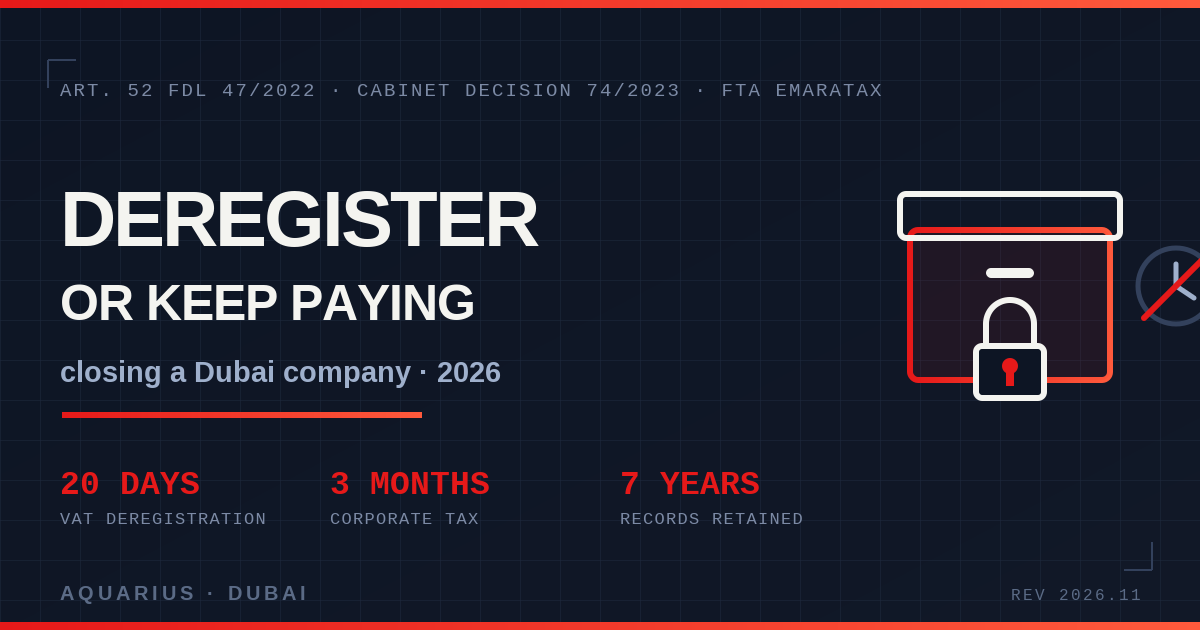
Cancelling a Dubai trade licence does not close your company with the Federal Tax Authority. You have 20 business days to file a VAT deregistration application and three months from the date the entity ceases to exist to file a corporate tax deregistration application under Article 52 of Federal Decree-Law No. 47 of 2022. Miss both and two separate AED 10,000 penalty ceilings stack into AED 20,000 of pure waste. And you still cannot delete anything: Cabinet Decision No. 74 of 2023 holds you to five years of records, and the corporate tax law pushes its own retention to seven.
Every Dubai exit is two projects running at once — a legal wind-up and a data wind-down. Founders budget for the first and discover the second after the servers have already been cancelled.
Dubai’s exit volume is hidden inside its growth numbers
In the first half of 2026 Dubai issued 58,337 business licences across mainland and free zones and renewed 173,652, taking total licensing transactions past 230,000 for the half-year. The number of licences issued between 2023 and 2025 was 84% higher than the 2020–2022 count. The Dubai Unified Licence has cut corporate bank account opening from roughly 90 days to about three.
Formation, in other words, is instrumented, fast and measured in public. Dissolution is none of those things. Nobody publishes a monthly cancellation count, there is no unified exit portal, and the clocks that matter most are not run by the licensing authority at all — they are run by the FTA, and they start at cessation, not at cancellation.
Most Dubai businesses get this backwards. They treat the licence cancellation certificate as the finish line. In 2026 it is the middle of the process: by the time DET or your free zone hands it over, the corporate tax deregistration window may already be two months gone.
The two deregistration clocks
They are different lengths, they are measured from different events, and they are filed separately in EmaraTax.
VAT: 20 business days
A registrant must apply to deregister when it stops making taxable supplies, or when taxable supplies over 12 consecutive months fall below the voluntary registration threshold of AED 187,500. The application is due within 20 business days of that trigger. Late submission draws AED 1,000, then a further AED 1,000 for each month or part-month of delay, capped at AED 10,000.
Corporate tax: three months
Article 52(1) requires a person holding a Tax Registration Number to file a deregistration application “where there is a cessation of its Business or Business Activity, whether by dissolution, liquidation, or otherwise” — within the timeline prescribed by the Authority, which is three months from cessation for a natural person and three months from the date the entity ceases to exist for a juridical person. The penalty ladder is identical: AED 1,000, then AED 1,000 monthly, capped at AED 10,000.
Two clauses do the real damage. Article 52(2) states a taxable person shall not be deregistered unless it has paid all corporate tax and administrative penalties due and filed all returns due, “including its Tax Return for the Tax Period up to and including the date of cessation.” That stub return is the single most commonly missed filing in a UAE wind-up. And Article 52(4) lets the Authority deregister you unilaterally, at its discretion, effective from the later of the last day of the tax period in which the position became apparent or the date you ceased to exist. That is not a reprieve — the penalties have already accrued and the clearance certificate never arrives.
| Obligation | Deadline | Measured from | Late penalty | Ceiling |
|---|---|---|---|---|
| VAT deregistration | 20 business days | Ceasing taxable supplies, or 12 months below AED 187,500 | AED 1,000 + AED 1,000 per month | AED 10,000 |
| Corporate tax deregistration | 3 months | Cessation / date the entity ceases to exist | AED 1,000 + AED 1,000 per month | AED 10,000 |
| Final VAT return | Standard period deadline | End of the final tax period | Standard late-filing and late-payment penalties | — |
| Stub corporate tax return | Within 9 months of period end | End of the shortened final tax period | Standard late-filing penalties, and deregistration is blocked | — |
| Work permit and residency cancellation | 30 days | Employment end date | AED 50 per day overstay after the grace period, plus AED 200 exit permit fee | Per person |
The sequencing trap
These processes are not parallel. Each one gates the next, and the FTA step is slower than most exit plans assume: the Authority may take up to 30 business days to process a deregistration application, and if it requests further information you get 60 calendar days to respond before rejection. Approval produces a tax clearance certificate — the document the licensing authority and, eventually, your bank will ask to see.
A Dubai mainland liquidation adds its own fixed delay. A liquidator is appointed and the dissolution registered, the notice is published in two local Arabic newspapers, and creditors then have 45 days to submit claims. You cannot compress that window, which is why a “quick” mainland closure is still a six-to-nine week project before any tax step completes.
Working order that avoids the dead ends:
- Employees first. Cancel work permits with MOHRE and residency with GDRFA. Online cancellations are typically processed in one working day, with the overall step running one to three working days. Settle end-of-service entitlements before the bank account closes.
- Appoint the liquidator and publish. Mainland: dissolution registration plus two Arabic newspaper notices, then the 45-day creditor window. Free zone: board resolution, liquidator appointment, and the zone’s own winding-up application.
- File the final VAT return, then deregister for VAT. Clear output tax on any assets retained by shareholders — a deemed supply is still a supply.
- File the stub corporate tax return, settle everything, then deregister for CT. Article 52(2) means the order cannot be reversed.
- Collect clearances. Immigration, labour, utilities, telecom, customs code, then the bank account.
- Cancel the licence last and take the cancellation certificate.
If the business is being sold rather than shut, the sequencing is different again — see share deal versus asset deal in Dubai before you dissolve anything, because a dissolved entity cannot transfer a trade licence.
What a clean 2026 exit actually costs in AED
Government fees are small. The liquidator, the audit and the newspaper notices are where the money goes. Free zone figures below are from published schedules of charges; mainland and liquidator figures are adviser benchmarks for a small, solvent, books-in-order company.
| Route | Headline fees | All-in government plus liquidator | Realistic timeline |
|---|---|---|---|
| Dubai mainland LLC (DET) | Dissolution and liquidator registration from about AED 520; two Arabic newspaper notices AED 1,500–3,000; liquidator report AED 4,000–6,000 | AED 8,000–13,000 | 45–60 days minimum |
| DMCC | Company Winding Up AED 4,015 per request; Licence Termination AED 2,000 per request where more than one licence is active; AED 20 Knowledge and Innovation Dirham on every charge | AED 10,000–18,000 including liquidator and liquidation audit at AED 3,500–7,500 | 45–75 days |
| IFZA | Licence cancellation AED 2,000; visa and permit cancellations AED 500–1,500 each | AED 4,000–9,000 for a small company | 30–60 days |
| FTA deregistration (VAT and CT) | No application fee | Cost is the final returns, any unpaid tax, and penalties if late | Up to 30 business days to process |
One correction worth having, because almost every closure guide repeats the error: DMCC’s published AED 2,015 “Company De-registration” line is not the standard wind-up fee. The schedule of charges restricts it to “a company that was only registered and never issued a Licence.” If you ever traded, your line item is Company Winding Up at AED 4,015. Budgeting the cheaper number is how exit quotes get revised upward in week three.
Now the comparison that decides most cases. Keeping a dormant Dubai mainland licence alive costs roughly AED 10,000–15,000 a year once the DET fee, the market fee tied to your office rent and Chamber of Commerce membership are added up. A single year of indecision costs more than the entire closure.
The records you are not allowed to delete
This is the half that no liquidator handles. Article 3(1) of Cabinet Decision No. 74 of 2023 sets the baseline retention periods, “unless the Tax Law states otherwise”:
- 5 years following the tax period to which they relate, for a taxable person;
- 5 years from the end of the calendar year in which the document was created, for persons other than taxable persons;
- 7 years from the end of the calendar year of creation, for real estate records.
The corporate tax law then exercises that override. Article 56 of Federal Decree-Law No. 47 of 2022 requires a taxable person to maintain all records and documents supporting its return, and enabling its taxable income to be readily ascertained, for seven years following the end of the relevant tax period. The same seven years applies to an exempt person maintaining records that prove its exempt status.
Article 3(2) then stretches all of it. Add four more years, or until final settlement if later, where there is a dispute with the Authority; four more years if you are subject to an ongoing tax audit; and four more years if the Authority notified you of an intention to audit before the original period expired.
Run the arithmetic on a company closing now. Records for a 2026 tax period must survive to the end of 2033 under Article 56 — and to 2037 if a dispute or audit opens late in that window. The entity will not exist. The obligation still will, and it attaches to the person who held the records. If an audit does land after closure, the FTA audit and dispute clock runs against an archive, not a finance team.
Two 2026 wrinkles
E-invoicing. Ministerial Decisions No. 243 and No. 244 of 2025 set the scope and the rollout timetable for the UAE e-invoicing system; Ministerial Decision No. 66 of 2026 required businesses with revenue of AED 50 million or more to appoint an Accredited Service Provider by 30 October 2026, with Phase 1 go-live reconfirmed by the Ministry of Finance for 1 January 2027. If your company trades into 2027 before it closes, those structured invoices are part of your retention set. Your ASP contract ends with the company; the seven-year obligation does not.
PDPL. Federal Decree-Law No. 45 of 2021 has been in force since 2 January 2022, but its executive regulations were still not published on the UAE Legislation portal as of November 2026 — so there is no federal fine schedule to point at. What that means practically for an exit: an erasure request does not override a tax retention period. Delete the marketing database, keep the tax set, and document which rule kept which file.
The systems wind-down nobody schedules
A company is not only a licence. It is a registrar account, an identity provider, a payment gateway and six SaaS subscriptions billed to a card that is about to be cancelled. Decommission in the wrong order and the records you are legally required to keep end up behind a paywall you can no longer pay.
| Asset | What goes wrong | Do this before the licence dies |
|---|---|---|
| Domain and DNS | Registrar auto-renew fails on a closed corporate card; the domain drops and is re-registered by someone else | Transfer to a personal or holding-company registrar account and prepay two or more years |
| Business email tenant | Microsoft 365 or Google Workspace tenant suspends; every historical invoice thread goes with it | Export mailboxes to PST or MBOX, then keep the tenant funded for one more billing year |
| Accounting and ERP SaaS | Subscription lapses and your own ledgers sit behind a reactivation fee | Export per-year general ledger, trial balance, VAT returns and invoice PDFs to CSV plus PDF |
| Payment gateway and bank | A settlement or chargeback lands after the account closes and has nowhere to go | Force a final settlement, hold the account open until the gateway cycle clears, then close |
| Website and hosting | VPS is terminated with no static archive; order history is unrecoverable | Take a full static archive plus a database dump before any server is destroyed |
| EmaraTax and UAE Pass delegates | The only authorised user is a departing employee whose visa is already cancelled | Move delegate access to the owner’s identity before cancelling that employee’s residency |
| Backups | Encrypted archive, key held by nobody still employed | Store plain, documented, openly readable formats with a written index |
This is the same discipline a carve-out needs when systems have to keep running for a buyer — the mechanics are covered in IT carve-outs and TSA exits. A closure is a carve-out with nobody on the receiving end, which makes the archive the only deliverable.
What doing nothing costs
Dormancy is the expensive option, and it compounds on several meters at once. The figures below combine published penalty ceilings with adviser benchmarks on DET escalation.
| Doing nothing for… | What accrues | Rough AED cost |
|---|---|---|
| 1 month past licence expiry | DET late renewal penalty from the day after expiry | 250 |
| Trading on an expired licence | Separate fine for operating without a valid licence | 5,000 |
| 6 months | Employee visa renewals blocked across the company | Operationally fatal |
| 12 months of dormancy, licence kept alive | Full renewal: DET fee, market fee on rent, Chamber membership | 10,000–15,000 per year |
| Both deregistrations missed to the cap | VAT AED 10,000 plus corporate tax AED 10,000 | 20,000 |
| Residency not cancelled, per person | Overstay after the grace period plus exit permit fee | 50 per day, plus 200 |
There is a quieter cost too. No tax clearance certificate means an unresolved TRN attached to the shareholders, and unresolved history is exactly what slows down the next licence, the next bank account and the next audit. If carried-forward losses were part of the story, note that they die with the entity — the rules are in UAE tax loss carry-forward and transfers, and a dissolution is the one event no planning fixes retroactively.
How Aquarius handles the data half
Liquidators handle the legal wind-up well and the technical one not at all. We run the other side: a fixed-scope data exit that produces one indexed archive instead of eleven dying subscriptions.
- Full inventory of every system, domain, identity and subscription the company owns, with its renewal date and card on file.
- Export of every record into open, readable formats — CSV, PDF, MBOX, SQL dumps — with a written index mapping each file to the article that requires it to exist.
- Domain, DNS and registrar control transferred out to an account that survives the company.
- A static archive of the website and admin data, delivered on media you hold plus one cloud copy.
- A retention schedule with real dates: what may be deleted in 2031, what must survive to 2033, and what moves to 2037 if an audit opens.
Scope and ranges are on the pricing page. If a closure is already running and the newspaper notice is published, the archive work needs to start now rather than after the servers go — tell us what systems are still live and we will tell you what to pull first.
FAQ
Does cancelling my Dubai trade licence deregister me for corporate tax?
No. They are separate processes with separate authorities. Licence cancellation is handled by DET or your free zone; corporate tax deregistration is a distinct EmaraTax application due within three months of cessation under Article 52 of Federal Decree-Law No. 47 of 2022.
How long do I have to deregister for VAT in the UAE?
20 business days from the trigger — ceasing to make taxable supplies, or 12 consecutive months with taxable supplies below the AED 187,500 voluntary threshold. Late filing costs AED 1,000, then AED 1,000 per month, to a maximum of AED 10,000.
What is the maximum penalty for late tax deregistration?
AED 10,000 per tax. Because VAT and corporate tax deregistration are separate obligations with separate ceilings, a company that misses both can reach AED 20,000 in deregistration penalties alone, before any late-filing or late-payment penalty on the final returns.
Do I still have to file a corporate tax return if the company has closed?
Yes. Article 52(2) blocks deregistration until all corporate tax and administrative penalties are paid and all returns are filed, explicitly including the return for the tax period up to and including the date of cessation. That final stub period return is mandatory even if the result is nil.
How long must I keep records after closing a UAE company?
Seven years following the end of the relevant tax period for corporate tax records under Article 56, against a five-year baseline in Article 3 of Cabinet Decision No. 74 of 2023, and seven years from the end of the calendar year of creation for real estate records. Add four more years if there is a dispute, an ongoing audit, or a notified intention to audit.
How much does it cost to close a company in Dubai in 2026?
Budget AED 8,000–13,000 for a small solvent mainland LLC and AED 10,000–18,000 in DMCC, covering government fees, the liquidator and the liquidation audit, over 45 to 75 days. FTA deregistration itself carries no application fee.
The short version
The licence is the last step, not the first. Cancel visas, appoint the liquidator, publish, file the final VAT return and deregister within 20 business days, file the stub corporate tax return and deregister within three months, collect clearances, then cancel. Export everything to open formats before any subscription lapses, and hold the archive for seven years — because the company will be gone long before the obligation is.