
UAE Tax Losses in 2026: The 75% Cap, the 50% Ownership Test and the Data That Protects Them
UAE tax losses never expire but offset only 75% of taxable income, and a 50% ownership swing can void them. The 2026 rules on carry-forward, Article 38 transfers and tax groups.
- PUBLISHED
- 17 NOV 2026
- READ TIME
- 12 MIN
- AUTHOR
- AQUARIUS · DUBAI
- UNIT
- REV 2026.09
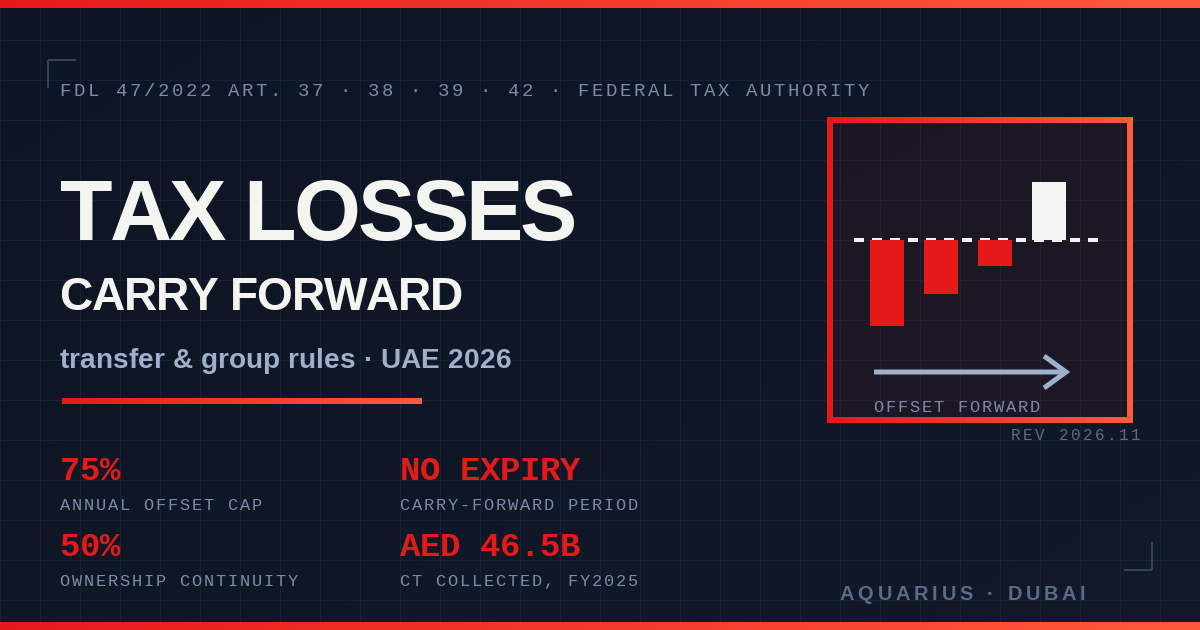
A UAE tax loss carries forward with no expiry date, but it can only reduce the taxable income of any later period by 75% — Article 37(2) of Federal Decree-Law No. 47 of 2022. It survives only while the same person or persons continuously hold at least a 50% ownership interest from the start of the loss period to the end of the period in which it is used, or, after a larger ownership change, while the company keeps conducting the same or a similar business (Article 39). Losses from before your first tax period, and losses from exempt activity, can never be claimed at all.
That is the whole regime in three sentences. The expensive part is proving it four years later.
The FTA has moved from “did you file?” to “what is in the return?”
The Federal Tax Authority collected AED 46.52 billion in corporate tax for financial periods ending in 2025, up 33.9% from AED 34.75 billion the year before, taking cumulative collections since the regime started to AED 81.27 billion. On-time return filing reached 91% in 2026, up from 87% in 2025, with on-time payment at 97%, according to FTA Director General Abdulaziz Al Mulla.
Compliance mechanics are, in other words, close to solved. Separately, the FTA reports that 68,600 taxable persons have already benefited from the late-registration penalty waiver initiative and expects the total to pass 91,000, with around 22,000 still eligible to apply.
When 91% of returns arrive on time, audit attention stops being about the filing and starts being about the numbers inside it. For a Dubai SME, the carried-forward tax loss is usually the largest single discretionary figure in that return — and the one with the thinnest paper trail.
How the 75% cap actually behaves over four years
The cap is applied to taxable income before any loss relief, and the 0% band on the first AED 375,000 sits underneath it. The result is that a loss pool drains more slowly than most founders assume, and a profitable year can still produce cash tax while a large pool is unused. Worked through with a AED 1.2 million first-year loss:
| Tax period | Taxable income before relief | Max loss usable (75%) | Taxable income after relief | CT at 9% above AED 375,000 | Loss pool carried forward |
|---|---|---|---|---|---|
| Year 1 | (1,200,000) loss | — | Nil | Nil | 1,200,000 |
| Year 2 | 400,000 | 300,000 | 100,000 | Nil | 900,000 |
| Year 3 | 1,000,000 | 750,000 | 250,000 | Nil | 150,000 |
| Year 4 | 2,000,000 | 150,000 (pool exhausted) | 1,850,000 | 132,750 | Nil |
Two things fall out of that table. The pool took three profitable periods to clear even though cumulative profit exceeded the loss by Year 3. And in Year 4 the business paid real cash tax on income it had economically already lost money against, because the cap is annual and absolute.
Three losses you can never claim
Article 37(3) rules out losses incurred before the commencement date of corporate tax, losses incurred before a person became a taxable person, and losses from an asset or activity whose income is exempt or otherwise not taken into account. The third limb is the one that bites free zone businesses: a Qualifying Free Zone Person cannot push losses attributable to qualifying income against non-qualifying income.
The set-off order is fixed by law
Article 37(4) requires a loss carried into a period to be set off against that period’s taxable income before any remainder is carried further forward, and before any loss transferred in under Article 38 can be used. Your own pool goes first. A tax schedule that applies a group transfer before exhausting the in-house pool produces the wrong carried-forward balance in every subsequent year.
The 50% ownership test — and the escape hatch most advisers skip
Article 39(1)(a) requires the same person or persons to have continuously owned at least a 50% ownership interest from the beginning of the loss period to the end of the period in which the loss is offset. Miss that and paragraph (b) is the only way back: the taxable person must have continued to conduct the same or a similar business or business activity after the change of more than 50%.
Article 39(2) names the three factors used to judge that:
- the taxable person uses some or all of the same assets as before the ownership change;
- there have been no significant changes to the core identity or operations of the business since the change;
- where changes did occur, they result from developing or exploiting assets, services, processes, products or methods that existed before the change.
One clean exemption exists: Article 39(3) switches off clause 1 entirely for a taxable person whose shares are listed on a Recognised Stock Exchange. Everyone else carries the evidential burden.
This is not an edge case in the UAE. GCC M&A value hit USD 65.1 billion in 2026, up 12.1%, on deal volumes that actually fell 17.9% (192 deals, down from 234) — bigger cheques, fewer of them. The UAE accounted for USD 52.6 billion, or 80.9% of GCC deal value, and 131 of those 192 deals. Every one of those share transfers is an Article 39 event for the target’s loss pool, and partial-stake deals are exactly where the 50% line gets crossed by accident.
Transferring a loss to a sister company (Article 38)
Article 38 lets one taxable person’s loss be offset against another’s taxable income without forming a tax group. All eight conditions must hold — failing any one voids the transfer:
| Article 38(1) condition | What breaks it in practice |
|---|---|
| Both are juridical persons | A sole establishment or natural person in the chain |
| Both are Resident Persons | An offshore or foreign-incorporated sibling |
| 75% direct or indirect ownership, either in the other or a third person in both | Dilution by an ESOP pool or a new investor below the line |
| That common ownership exists from the start of the loss period to the end of the offset period | A mid-year reorganisation that resets the chain |
| Neither is an Exempt Person | A government-related or qualifying investment fund entity in the group |
| Neither is a Qualifying Free Zone Person | The profitable sibling sits in a free zone and holds QFZP status |
| Financial years end on the same date | An acquired company still on a 31 March year end |
| Both use the same accounting standards | One entity on IFRS, one on IFRS for SMEs |
Where the transfer works, Article 38(2) is mechanical: the recipient reduces its taxable income for that period, the total offset still cannot exceed the 75% ceiling in Article 37(2), and the transferor reduces its own available losses by the amount transferred. There is no doubling up.
Tax groups: pre-grouping losses do not pool
Forming a tax group under Article 40 produces one return, not one loss pool. Article 42 keeps the history separate:
- Article 42(3) — a joining subsidiary’s unutilised pre-grouping losses become group losses, but can only offset group taxable income insofar as that income is attributable to that subsidiary.
- Article 42(4) — existing group losses cannot offset income attributable to a newly joined subsidiary. The wall runs both ways.
- Article 42(6) — when a subsidiary leaves, group losses stay with the group, except that subsidiary’s unutilised pre-grouping losses, which leave with it.
- Article 42(7) — on cessation, if the parent remains a taxable person all losses stay with the parent; if the parent ceases to be one, group losses are not available to individual subsidiaries at all, except their own unutilised pre-grouping losses.
- Article 42(5) — all of the above remains subject to Articles 37 and 39, so the 75% cap and the 50% test still apply on top.
Read that list as a data requirement, not a tax rule. A consolidated return that has to attribute taxable income to a named subsidiary for as long as its pre-grouping loss survives needs a per-entity profit trail inside a single filing entity — the same discipline required when a member exits and you need a clean loss-of-control date. Ministerial Decision No. 84 of 2025 already requires every tax group to prepare audited special-purpose financial statements, so the attribution has to stand up to an auditor as well as to the FTA. If you are also carrying related-party pricing adjustments between those entities, the attribution and the transfer pricing data have to reconcile to the same ledger.
The Small Business Relief trap — most Dubai founders get this backwards
Ministerial Decision No. 131 of 2026, issued on 29 July 2026, extended the AED 3,000,000 Small Business Relief revenue threshold to tax periods ending on or before 31 December 2029, three years beyond the original sunset. That was reported as unqualified good news for SMEs. It is not unqualified.
Article 4 of Ministerial Decision No. 73 of 2023 is blunt: tax losses incurred in a period where the relief is elected cannot be carried forward. Article 5 says the same for disallowed net interest expenditure. Earlier amounts survive, but only into later periods where the relief is not elected.
So consider a Dubai studio with AED 2.5 million revenue and a AED 600,000 loss. It elects Small Business Relief because that is what the accountant ticks by default. It owed nothing anyway — a loss produces no taxable income. What it bought for that tick is the permanent destruction of AED 600,000 of future shelter, which at 9% is AED 54,000 of cash tax handed over in some later profitable year. The relief is worth electing in a thin-profit year. In a loss year it is a straight transfer from the company to the FTA.
Two more conditions worth knowing: Article 3 excludes constituent companies of multinational enterprise groups and Qualifying Free Zone Persons regardless of revenue, and Article 6 lets the FTA treat an artificially separated business whose combined revenue exceeds the threshold as an arrangement under Article 50(1) — testing commercial purpose and the financial, economic and organisational links between the entities.
What getting this wrong costs in AED
The direct cost of a forfeited loss is arithmetic: every AED 1 million of pool you cannot defend is AED 90,000 of cash corporate tax. The administrative penalties under Cabinet Decision No. 75 of 2023 stack on top:
| Violation | Penalty |
|---|---|
| Failure to register for corporate tax in time | AED 10,000 (one-off) |
| Late tax return | AED 500 per month for months 1–12, then AED 1,000 per month |
| Incorrect tax return | AED 500, unless corrected before the submission deadline |
| Failure to keep required records | AED 10,000, rising to AED 20,000 for a repeat within 24 months |
| Obstructing a tax audit (person, agent or legal representative) | AED 20,000 |
The record-keeping line is the one that converts a loss claim into a penalty. A loss claimed in Year 5 rests on an ownership register, a financial-year alignment and an attribution schedule from Year 1. If those live in an accountant’s spreadsheet that changed laptops twice, the claim is undefendable long before anyone argues about Article 39. Our walkthrough of FTA audit readiness and the dispute clock covers what the Authority actually asks for and how little time you get to produce it.
How Aquarius builds the loss trail
We are not your tax adviser — your accountants own the numbers. We build the system that can still produce the evidence behind them in 2031. Typical scopes, at our own quote ranges:
| Scope | What you get | Aquarius range (AED) |
|---|---|---|
| Tax loss register add-on | Period-by-period pool, 75% cap waterfall in the legal order, locked history with an audit log | 18,000 – 45,000 |
| Ownership continuity register | Cap table with effective dates, automatic alert when cumulative change approaches 50%, Article 39 evidence pack | 12,000 – 30,000 |
| Group attribution reporting | Per-entity taxable income attribution inside a consolidated return, pre-grouping loss ring-fencing, member join and exit handling | 45,000 – 120,000 |
Fixed-price scope, your finance team keeps control of every figure, and the data model is documented so your auditor and your tax agent can both read it. See pricing for how we scope this, or look at the broader corporate tax accounting stack for Dubai SMEs if you are starting from spreadsheets.
FAQ
Do UAE tax losses expire?
No. Article 37 of Federal Decree-Law No. 47 of 2022 sets no time limit on carrying a tax loss forward. The constraints are the 75% annual offset cap in Article 37(2) and the ownership and business continuity conditions in Article 39, not an expiry date.
Can I offset 100% of my taxable income with carried-forward losses?
No. The loss used in any period cannot exceed 75% of that period’s taxable income calculated before any loss relief. The remainder keeps carrying forward. The Cabinet can set a different percentage or prescribe exceptions, but 75% is the figure in force.
What happens to my tax losses if I sell more than 50% of my company?
They are not automatically lost. Article 39(1)(b) preserves them if the company continued to conduct the same or a similar business or business activity after the change, judged on continued use of the same assets, no significant change to the core identity or operations, and whether any changes came from developing what already existed. Companies listed on a Recognised Stock Exchange are outside the test entirely under Article 39(3).
Can I transfer a loss from one UAE company to a profitable sister company?
Yes, under Article 38, if all eight conditions hold: both are juridical resident persons, 75% direct or indirect common ownership exists across the whole loss-to-offset window, neither is an Exempt Person or a Qualifying Free Zone Person, financial years end on the same date, and both use the same accounting standards. The 75% cap still applies to the combined offset, and the transferor reduces its own pool by the amount transferred.
Does electing Small Business Relief destroy my tax losses?
For losses arising in the periods you elect, yes. Article 4 of Ministerial Decision No. 73 of 2023 blocks carrying forward tax losses incurred in an election period, and Article 5 does the same for disallowed net interest expenditure. Losses from non-election periods survive and can be used in later non-election periods. With Ministerial Decision No. 131 of 2026 extending the AED 3 million threshold to periods ending on or before 31 December 2029, this is now a decision you will face up to four more times — do not elect by reflex in a loss year.
What records prove a tax loss claim to the FTA?
At minimum: the computation that generated the loss, the ownership register showing continuous 50% holding across every period in the chain, financial-year-end and accounting-standard evidence for any Article 38 transfer, and per-subsidiary attribution schedules for any pre-grouping loss inside a tax group. Failure to keep required records carries an AED 10,000 penalty, AED 20,000 on repeat.
The short version
UAE tax losses are generous on duration and strict on evidence. No expiry, 75% a year, 50% ownership continuity or a defensible same-business argument, eight conditions for a sibling transfer, and a hard wall around pre-grouping losses inside a group. None of that is hard to comply with while the facts are fresh, and all of it is close to impossible to reconstruct four years later from email threads.
If your loss pool is big enough to matter and it currently lives in one spreadsheet, that is the problem worth fixing this quarter. Tell us what your group structure looks like and we will map what the system has to remember.
This article explains published UAE legislation and is not tax advice. Figures are from Federal Decree-Law No. 47 of 2022, Cabinet Decision No. 75 of 2023, Ministerial Decisions No. 73 of 2023 and No. 131 of 2026, and FTA statements current to November 2026. Confirm your position with a registered tax agent.