
Cookie Security Scan 2027: Half of .ae Homepage Cookies Are Readable by Any Script
We probed 787 .ae homepages in November 2026: 64.1% set a cookie on arrival, 50.6% of those cookies lack HttpOnly and 35.4% lack Secure. Full census, the Dubai fix list, and AED pricing.
- PUBLISHED
- 29 NOV 2026
- READ TIME
- 10 MIN
- AUTHOR
- AQUARIUS · DUBAI
- UNIT
- REV 2026.09
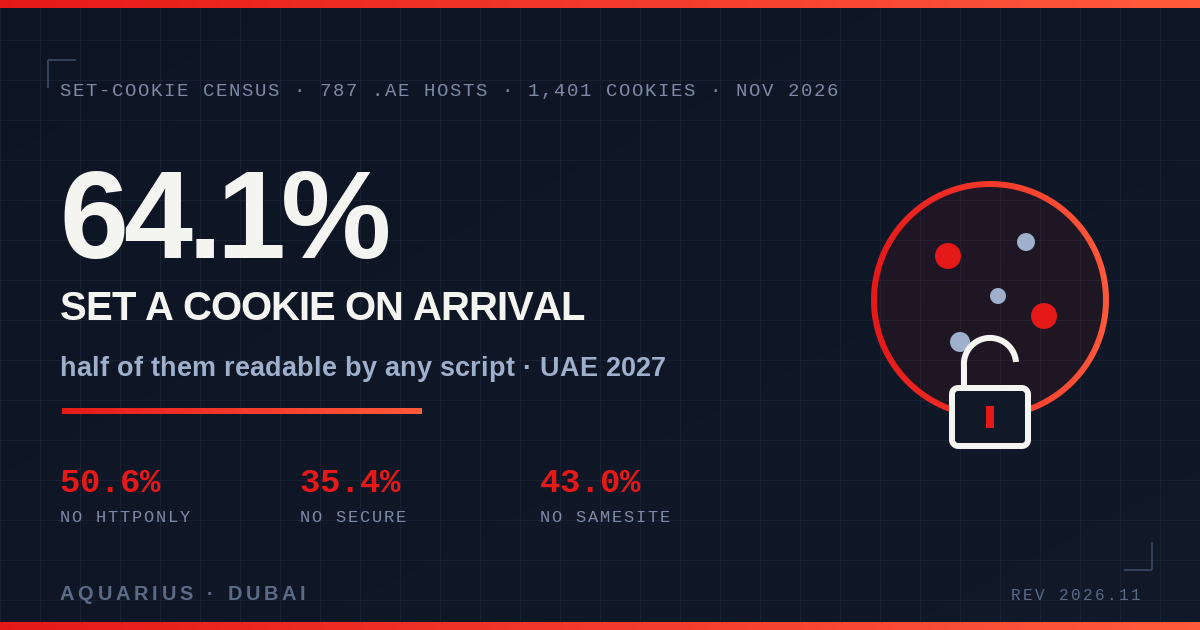
We sent one plain browser request to 787 live .ae homepages in November 2026 and read every Set-Cookie header that came back. 378 of the 590 reachable sites — 64.1% — set at least one cookie before the visitor clicked anything, and of the 1,401 cookies they handed out, 50.6% carry no HttpOnly flag, so any script running on the page can read them. That includes session identifiers on 38 Dubai and UAE sites. This is the full census, the attribute-by-attribute numbers, and the fix list.
The three numbers that should worry any UAE site owner
We pulled the .ae hosts from the Tranco top-sites list, requested both the apex and the www hostname over HTTPS with a normal Chrome user agent, followed redirects, and captured every raw Set-Cookie line across the whole redirect chain. 590 hosts answered with a 2xx. 98 of the rest answered 403 — bot walls, not broken sites.
- 64.1% set a cookie on arrival. 378 of 590 live hosts wrote at least one cookie before any consent interaction. 212 wrote none at all.
- Only 49 hosts are fully modern. Just 49 of the 378 setters — 13% — got Secure, HttpOnly and SameSite right on every single cookie they set. 268 hosts set at least one cookie with no HttpOnly; 218 set at least one with no Secure.
- 43.0% of cookies declare no SameSite at all. 602 of 1,401 cookies omit the attribute entirely, falling back to whatever the browser decides. Strict appears on just 61 cookies — 4.4%.
One honest caveat before anyone quotes these against the global benchmarks: we only see cookies set by HTTP headers. Cookies written in JavaScript via document.cookie are invisible to a header probe, and those are almost always the worst-configured ones. The HTTP Archive Web Almanac's 2025 cookies chapter, which measures both, found only 24% of first-party cookies carry Secure and 12% carry HttpOnly. Our .ae figures of 64.6% and 49.4% look better mostly because header-set cookies are the better half of the population. The real picture on these sites is worse than what we measured, not better.
What each attribute actually does, and how .ae scored
Four attributes carry nearly all of the security weight. Here is what we counted across all 1,401 cookies.
| Attribute | What it stops | Present | Missing |
|---|---|---|---|
Secure | Cookie leaking over plain HTTP, and being overwritten by a man-in-the-middle | 905 (64.6%) | 496 (35.4%) |
HttpOnly | Any injected or third-party script reading the value with document.cookie | 692 (49.4%) | 709 (50.6%) |
SameSite=Lax or stricter | Cross-site request forgery and drive-by cross-site sends | 492 (35.1%) | 909 (64.9%) |
Host-only scope (no Domain) | Cookie tossing from a compromised or rented subdomain | 960 (68.5%) | 441 (31.5%) |
__Host- or __Secure- name prefix | Cookie overwrite attacks that strip the flags | 11 (0.8%) | 1,390 (99.2%) |
Three results stand out. 391 cookies — 27.9% — have neither Secure nor HttpOnly, meaning they travel in clear text on any HTTP downgrade and can be read by any script on the page. 307 cookies declare SameSite=None, which deliberately opts into cross-site sending; two of those also omit Secure, which makes browsers reject them outright, so those sites are shipping cookies that silently never get stored. And cookie name prefixes are effectively unused on .ae: exactly one cookie in the entire census uses __Host-. The Almanac describes the same global pattern — prefixes have had “very low adoption” in the ten years since they were introduced.
The Partitioned attribute (CHIPS) appears on 51 cookies across 43 hosts, which sounds like early adoption until you check the names: 40 of the 51 are Cloudflare's own __cf_bm bot-management cookie. No .ae site in our sample deserves credit for partitioning — their CDN did it for them. The Almanac found the identical thing globally, where over 90% of first-party partitioned cookies belong to Cloudflare.
Session cookies are where this stops being theoretical
We isolated the 189 cookies whose names mark them as session identifiers — PHPSESSID, ASP.NET_SessionId, JSESSIONID, CAKEPHP and friends — across 162 hosts. The results:
- 39 session cookies on 38 hosts have no HttpOnly. One cross-site scripting bug anywhere on the page, one compromised analytics tag, one malicious browser extension with page access, and the session is copied out. That is session hijacking with no password needed.
- 58 session cookies on 52 hosts have no Secure.
- 19 session cookies on 19 hosts have neither flag. We re-verified these individually on both apex and www. Among them:
sabaya.ae,eyeofdubai.ae,jafza.aeanddrivedubai.aeall return a barePHPSESSID=...; path=/with no Secure, no HttpOnly and no SameSite.ccavenue.ae— a payment-gateway domain — returns a bareJSESSIONIDthe same way.
The most instructive failure is subtler, and we found it on four separate sites. sharjahcustoms.gov.ae sets ASP.NET_SessionId correctly, with HttpOnly and SameSite=Lax. Then on the very same response it sets a second cookie, dspcsessionid, containing the identical session value, with no flags at all. The protected cookie is protected and the clone next to it is wide open. itgelectronics.ae, megacomputers.ae and quanticoelectronics.ae do the same trick: PHPSESSID ships with HttpOnly and Lax, and a cookie called ssid ships the exact same value bare, with a 24-hour lifetime. Hardening one cookie means nothing if the value is duplicated into an unhardened one.
Your vendors are better at this than your own code
We split the 1,401 cookies into vendor defaults — Shopify, Cloudflare, Azure, Sitecore, Dynatrace, AWS — and cookies written by the site's own application. 340 are vendor cookies, and almost all of them are correctly flagged out of the box. The remaining 1,061 site-own cookies run 40.3% with no Secure and 55.2% with no HttpOnly.
That split is the actionable finding. Nobody needs to argue with Shopify or Cloudflare about cookie flags. The defects are in PHP session configuration, in hand-rolled language and currency cookies, and in the one-line setcookie() calls a developer added three years ago for a feature that still ships.
Expiry dates nobody honours
729 cookies (52.0%) are persistent and 672 are session-only. 41 cookies ask for a lifetime longer than 400 days, which Chrome has silently refused to grant since version 104 in August 2022 — it clamps the value rather than rejecting the cookie, and Chrome 118 applied the cap retroactively to already-stored cookies. The behaviour is now written into the rfc6265bis draft. Since Chrome holds 76.98% of UAE browser share per StatCounter's October 2026 data, a long expiry on a .ae site is close to meaningless.
The outliers are worth naming because they reveal untested code. fnp.ae sets six cookies with Max-Age=3153600000 — one hundred years, expiring in 2126. torino.ae sets PHPSESSID to expire in 2083. yello.ae sets CAKEPHP to 2051 with Secure but no HttpOnly. 2gis.ae has a preference cookie dated 2047. Every one of those is clamped to 400 days in the browser that 3 in 4 UAE visitors use, so the stated intent and the actual behaviour diverge completely.
What the .gov.ae subset looks like
64 of the hosts we probed were UAE government domains, and 58 of them set cookies — 246 in total. They do better than the commercial average on the flag that matters most: of 39 government session cookies, only one lacks HttpOnly (the sharjahcustoms.gov.ae clone described above). Secure sits at 66.7% and HttpOnly at 63.0%, both above the full-sample rate.
Where government sites fall behind is SameSite: 66.3% of their cookies declare none at all, worse than the commercial average. That is a CSRF exposure on exactly the kind of site where a forged request has real consequences. It is also a pattern we see in enterprise .NET and Java stacks generally — ASP.NET_SessionId (45 occurrences) and JSESSIONID (14) are the second and eighth most common cookie names in the whole census.
The fix list, and what it costs in Dubai
None of this is expensive to repair. It is configuration, not architecture. In priority order:
- Flag every session cookie.
Secure; HttpOnly; SameSite=Laxas the floor. In PHP that is three lines ofsession.cookie_*in php.ini, not a code change. - Hunt the clones. Grep your codebase for every cookie that receives a session ID. If the value appears in two cookies, the weaker one defines your security.
- Drop the
Domainattribute unless a subdomain genuinely needs the cookie. 441 cookies in our census are domain-wide for no reason, and every one of them is reachable by cookie tossing from any subdomain an attacker can get a foothold on. - Set SameSite explicitly. Lax for session cookies, Strict for anything that triggers a state change, None plus Secure only for genuine cross-site embeds.
- Rename your most sensitive cookie with a
__Host-prefix. It forces Secure, host-only scope andPath=/at the browser level, so a cookie-overwrite attack cannot strip the protection. One cookie in 1,401 .ae cookies does this today. - Cap expiry at 400 days and stop pretending otherwise.
- Pair the flags with a real CSP. HttpOnly stops a script reading the cookie; it does not stop the script acting as the user. See our notes on XSS, CSP and Trusted Types for Dubai websites.
Doing this on a typical Dubai business site — audit, remediation, regression check across apex and www — runs AED 3,500 to 6,500 for the audit and fix list, and AED 7,500 to 18,000 for the full remediation sprint on a multi-stack site with a legacy session layer. Our ongoing header and cookie monitoring is AED 1,800 per month. Full detail on our pricing page.
Against that: IBM's Cost of a Data Breach 2026 puts the average Middle East breach at roughly USD 8 million — about AED 29.4 million — versus USD 4.99 million globally, the highest regional figure in the study. A readable session cookie is not the whole attack chain, but it is the cheapest link in it to fix. And under the UAE Personal Data Protection Law, Federal Decree-Law 45 of 2021, an unflagged cookie carrying personal data is a security-measures failure, not just a bug — the Executive Regulations are still unpublished as of late 2026, and Article 29 gives controllers six months to comply once they land. If you have not yet sorted out what you set before consent, start with our guide to cookie consent banners under the UAE PDPL.
How Aquarius runs a cookie audit
We probe apex and www separately, because they frequently disagree — drivedubai.ae returns a 403 bot wall on the apex and 19 cookies on www, and we would have missed its bare PHPSESSID entirely by checking only one. We capture raw multi-value Set-Cookie headers across the full redirect chain rather than a parsed cookie jar, so duplicate and overwritten cookies stay visible. We check logged-in flows as well as the homepage, because the cookies that matter most only appear after authentication. Then we hand over a config diff, not a PDF.
Risk reversal: if our audit does not find at least one session or authentication cookie missing a flag it should have, you pay nothing. On 378 .ae sites that set cookies, we would have lost that bet 268 times out of 378 — and won it 110.
Want the same census run against your own domain and your three closest competitors? Send us the domains and we will send back the header dump and the fix list.
FAQ
Is a missing HttpOnly flag really a serious problem?
On a session cookie, yes. HttpOnly is the only thing standing between a cross-site scripting bug and full account takeover without a password. It converts “an attacker can run a script on your page” into “an attacker can run a script on your page but cannot walk away with the session”. In our .ae census, 39 session cookies on 38 hosts are missing it. Longer term, Device Bound Session Credentials make a stolen cookie useless on another device — we cover that in our piece on session cookie theft and DBSC — but DBSC is rolling out now and HttpOnly is one line of config today.
Does SameSite=Lax break my site?
Rarely, and the breakage is predictable. Lax still sends the cookie on top-level navigations, which covers almost every normal visit, including arriving from a Google result or a WhatsApp link. It blocks the cookie on cross-site POSTs, iframes and background fetches. If something breaks, it is usually a payment-gateway return flow or an embedded widget — both of which should be on an explicit SameSite=None; Secure cookie rather than relying on the default.
Do cookie flags count as a PDPL requirement?
The PDPL does not name cookie attributes. It does require appropriate technical measures to protect personal data, and a session cookie readable by any script on the page is hard to defend as appropriate when the fix is a single configuration line. Treat flags as the baseline evidence that your security measures exist, separate from the consent question of whether you should be setting the cookie at all.
Why do your .ae numbers look better than the global Web Almanac figures?
Because we measure a different population. Our probe reads HTTP response headers only, so it sees server-set cookies and misses everything written in JavaScript. The Almanac's 24% Secure and 12% HttpOnly figures include document.cookie writes, which are overwhelmingly third-party tags and almost never flagged. Compared like with like, .ae sites are roughly average. The honest read is that our 50.6% no-HttpOnly rate is a floor, not a ceiling.
How often should a UAE business re-check this?
After every deployment that touches authentication, any CDN or WAF change, and any new third-party tag. Cookie regressions are invisible — nothing breaks, no error appears, and the flag is simply gone. Quarterly is the minimum for a site that ships regularly; continuous header monitoring costs less than one incident's worth of investigation time.