
We Forged an Origin Header at 787 .ae Homepages: 46 Leak Logged-In Data
We sent a forged Origin header to the 787 top .ae homepages on 28 Nov 2026. 52 reflect any origin back, and 46 do it with credentials:true — the CORS pattern that can leak a logged-in user to any site.
- PUBLISHED
- 28 NOV 2026
- READ TIME
- 11 MIN
- AUTHOR
- AQUARIUS · DUBAI
- UNIT
- REV 2026.09
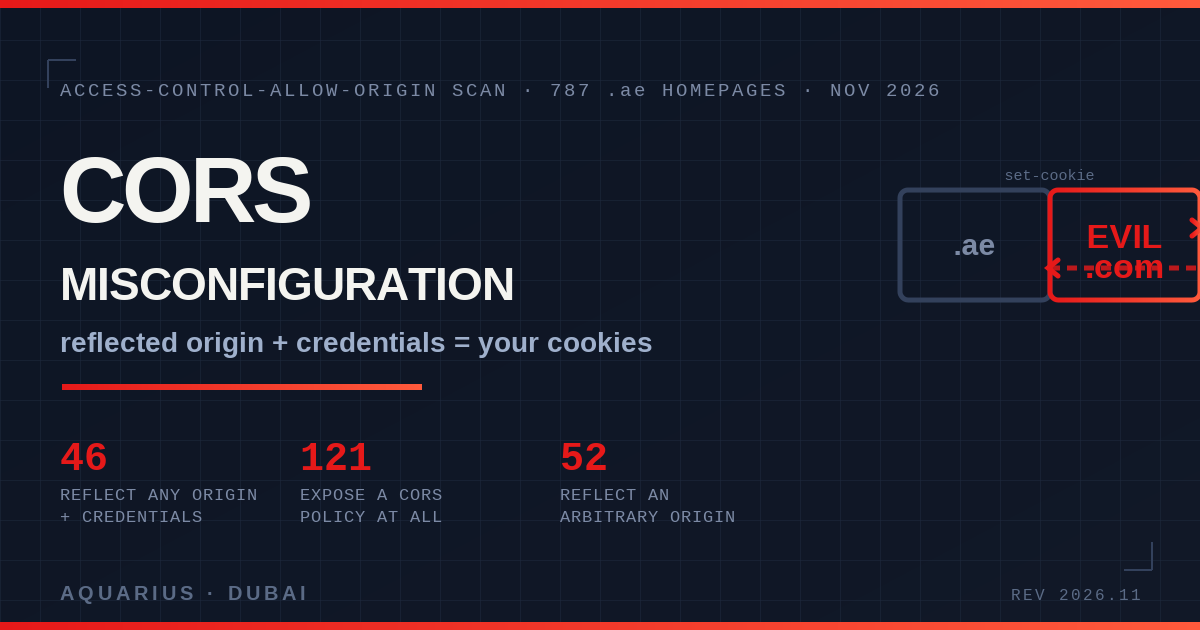
We sent a forged Origin header to the 787 most-visited .ae homepages on 28 November 2026 and read what came back. 121 of them answer with a cross-origin access policy, 52 reflect whatever origin we sent straight back into Access-Control-Allow-Origin, and 46 pair that reflection with Access-Control-Allow-Credentials: true — the precise combination that lets any website on the internet read a logged-in visitor’s private data from the vulnerable site. This is the single most common serious web-security slip we found, and almost nobody in Dubai is checking for it.
Here is the uncomfortable part. A wrong CORS policy is invisible. The site looks fine, loads fast, passes a Lighthouse audit, and ships. The hole only opens when a victim who is logged in visits an attacker’s page in another tab — and by then it is a data-theft bug, not a cosmetic one.
What CORS is, in one paragraph
Browsers block one website from reading another website’s responses by default — the Same-Origin Policy. Cross-Origin Resource Sharing (CORS) is the opt-out: a server adds an Access-Control-Allow-Origin header to say “this other site is allowed to read me.” Used correctly it powers APIs and widgets. Configured lazily — by reflecting back whatever Origin the request carried — it tells every site it is allowed, which is the same as telling none apart. Add Access-Control-Allow-Credentials: true and the victim’s cookies ride along, so the attacker’s script reads authenticated pages as the victim. PortSwigger’s own guidance is blunt: dynamically reflecting the origin plus allowing credentials is the exploitable pattern, and it is why browsers flatly refuse to honour Access-Control-Allow-Origin: * together with credentials.
This is not a theoretical 2015 bug. In 2026 it is still shipping in frameworks: CVE-2026-54290 is the Hono web framework reflecting any origin with credentials when credentials: true was set with no explicit allow-list, and CVE-2026-89058 is Red Hat RESTEasy’s CORS filter doing the same when configured to “allow all.” The default that feels convenient is the default that leaks.
What the scan actually found
We probed 787 hosts from the Tranco-ranked .ae list. 680 answered; 564 returned a real HTML homepage. To each we sent Origin: https://aquarius-cors-probe.example — an origin we control that has no business being trusted by anyone — on both a GET and a non-simple OPTIONS preflight, and recorded every Access-Control-* header. Three numbers set the stakes:
- 121 homepages set an
Access-Control-Allow-Originheader at all. Of those, 58 answer with a wildcard*, 11 name a fixed origin, and 52 reflect our attacker origin back verbatim. - 46 sites reflect our arbitrary origin and send
Access-Control-Allow-Credentials: true. That is the account-takeover pattern, live, on the homepage document itself. - 59 sites send
credentials: truesomewhere in their CORS response — the switch that turns a merely sloppy policy into a dangerous one.
Now the honesty the number demands. 42 of those 46 are one cookie-cutter publishing network — dozens of single-word .ae content sites that share one origin-reflecting backend behind Cloudflare. One operator’s one misconfiguration, copied 42 times. Strip them out and four independent businesses remain, each verified identically on apex and www: atlp.ae (an Abu Dhabi ports logistics platform), allparts.ae and kempstoncontrols.ae (industrial-parts e-commerce with customer accounts), and mediaflow.ae. For a site with a login, a cart, or a customer portal, this header is not cosmetic — it is an open door.
Not every scary header is a bug
Crying wolf helps no one, so here is the triage table we use on a Dubai client’s site, with our own .ae counts. The severity is entirely about two questions: does the policy trust an origin it should not, and does it allow credentials?
| What the server sends back | .ae count | Verdict |
|---|---|---|
| Reflects any origin + credentials: true | 46 | Critical — reads logged-in data cross-site |
| Reflects any origin, no credentials | 6 | Risky — leaks anything readable without a login |
Wildcard * + credentials: true | 5 | Browser rejects the pair — still a config smell |
Wildcard *, no credentials | 53 | Usually fine on a public page; wrong on any API |
| Fixed, correct origin (e.g. its own domain) | 11 | Correct — this is what good looks like |
The “no credentials” row still matters when the responder holds data. Six .ae sites reflect an arbitrary origin without credentials, and the list is not reassuring: adib.ae (Abu Dhabi Islamic Bank), adx.ae (Abu Dhabi Securities Exchange), and four Abu Dhabi government hosts — adpolice.gov.ae, adek.gov.ae, dmt.gov.ae and adcda.gov.ae. None leaks a logged-in session from the homepage, but a header that trusts aquarius-cors-probe.example is trusting the wrong thing on principle, and the same config usually sits in front of the API too.
Two findings are almost comic and both are real. ecmpermits.ae reflects a policy pointing at http://ecmpermitstest.ae/ — a test origin, over plain HTTP, baked into production. And ajman.ae literally returns Access-Control-Allow-Origin: origin — the word “origin,” a templating variable that was never substituted. These are not attackers being clever; they are copy-paste defaults shipped without a second look.
The government cut, and why wildcards are not automatically safe
Of 65 reachable .gov.ae homepages, 16 set a CORS policy: 11 wildcard, four reflect-any-origin (the Abu Dhabi hosts above), and exactly one — dubaicustoms.gov.ae — does it right, naming only its own origin. A wildcard on a public information page that needs no login is genuinely harmless; PortSwigger notes the real wildcard danger is on internal or intranet systems an attacker otherwise cannot reach. The problem is that the same wildcard, copied onto an endpoint that does return personal data, hands that data to any page on the web. The header does not know whether the JSON behind it is a press release or a citizen’s file — your deployment does, and that context has to drive the config.
One caveat we will not paper over: we measured the homepage document response, not authenticated JSON APIs. A reflecting homepage is the canary, not the whole mine. But in our experience the header is set once, globally, at the reverse proxy — so a homepage that reflects your attacker origin is strong evidence the /api and /login endpoints on the same origin do too. The four independent reflect-plus-credentials sites all run exactly the kind of backend (accounts, carts, portals) where that assumption gets expensive.
What it costs to get wrong, and how we fix it
The UAE’s Personal Data Protection Law (Federal Decree-Law No. 45 of 2021) makes a cross-site data leak a reportable personal-data breach to the UAE Data Office, with a stated penalty range running into the millions of dirhams once the Executive Regulations finish the fine schedule — still unpublished as of late 2026, which is exactly why you do not want to be the test case. The commercial number is worse than the regulatory one: IBM’s 2026 Cost of a Data Breach puts the Middle East average at roughly USD 8 million, well above the global figure. Against that, the fix is a few lines of config.
Here is how we close it, and what we charge in the real Dubai market. A focused CORS-and-security-header audit of one site — homepage plus the login and API endpoints, every origin reflected back, the null-origin and credentials traps checked, and a tested patch for your stack — runs AED 2,500–6,000 as a one-off. Rolling it into a broader penetration test or a retainer brings the per-site cost down. The remediation itself is almost always the same shape: replace reflect-the-origin logic with an explicit allow-list of the exact origins that need access, never combine credentials with a wildcard, and reject null. For 76.98% of your UAE visitors — Chrome’s October 2026 StatCounter share — that single change is the difference between a private portal and a public one.
If your .ae site has a login, a checkout, or a customer dashboard, this is a ten-minute thing to check and a cheap thing to fix — and a genuinely bad thing to learn about from an incident report. We will run the reflected-origin test against your real endpoints and show you the raw headers. See how our security & web team works, compare transparent AED pricing, or just send us your domain and we will test it.
This scan is part of an ongoing first-hand audit of the UAE web. See also our companion measurements of insecure http:// links across .ae homepages, third-party script integrity and CSP, and where .ae sites are really hosted.
FAQ
Is a wildcard Access-Control-Allow-Origin: * a security hole?
Not by itself. On a public page that returns no private data and no credentials, * is fine — 53 of our .ae sites use it harmlessly. It becomes a hole the moment the same header sits on an endpoint that returns personal data, or when someone adds credentials. Browsers refuse to honour * together with Access-Control-Allow-Credentials: true, which is why five .ae sites that ship both are protected only by the browser, not by their own config.
Why is reflecting the origin worse than a wildcard?
Because reflection is how servers sneak credentials past the browser’s wildcard ban. A wildcard plus credentials is blocked; reflecting the caller’s exact origin plus credentials is allowed — and it trusts literally every origin, including the attacker’s. That is why 46 reflect-plus-credentials sites are the real finding, not the 58 wildcards.
Can you really steal data just from a bad header?
If the site reflects the attacker’s origin, allows credentials, and serves authenticated data on that origin, then yes: a page the victim visits elsewhere can silently fetch() the victim’s authenticated responses and read them. The victim does nothing but be logged in and open a tab. That is the entire attack.
How do I check my own Dubai site?
Send a request with an Origin header you control (curl -H "Origin: https://evil.example" -I https://yoursite.ae/) and look at what comes back. If Access-Control-Allow-Origin echoes evil.example — especially alongside Access-Control-Allow-Credentials: true — you have the bug. Test your login and API endpoints too, not just the homepage. Or grab the free checklist above and send us the domain.
Method note: a single local probe of 787 Tranco-ranked .ae hosts on 28 November 2026, one GET and one OPTIONS preflight each with a forged Origin, reading only response headers on the homepage document. Headline hosts were re-verified on apex and www. We did not test authenticated API endpoints; treat homepage reflection as a strong indicator, not a full audit.