
Script Supply Chain on UAE Websites: We Scanned 635 .ae Homepages and 84.9% Pin Nothing (2027)
First-hand scan of 635 .ae homepages: 477 load cross-origin script and 84.9% pin none of it, 69.6% of apparent SRI is an injected Cloudflare beacon, and only 1.1% send a CSP that stops injected script.
- PUBLISHED
- 24 NOV 2026
- READ TIME
- 12 MIN
- AUTHOR
- AQUARIUS · DUBAI
- UNIT
- REV 2026.09
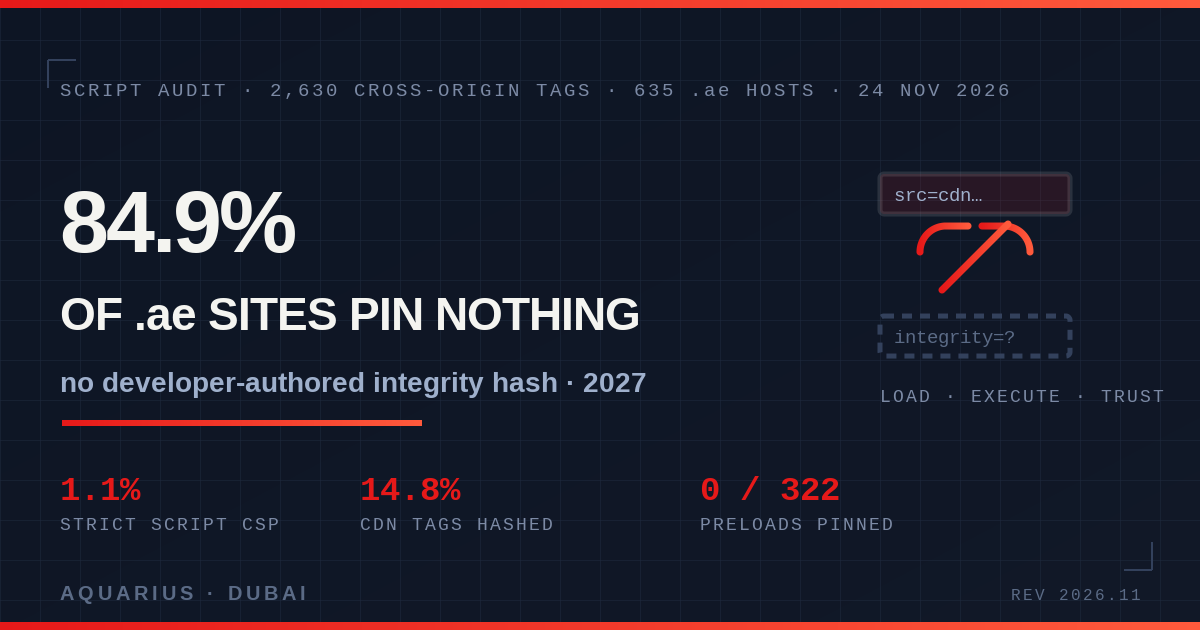
Short answer: on 24 November 2026 we parsed the homepages of 635 of the UAE’s most-visited .ae domains and read every <script>, stylesheet and preload tag on them. 477 of those sites load at least one script from a domain they do not control — and 84.9% of them pin none of it with an integrity hash. Only 7 sites out of 635 (1.1%) send a Content-Security-Policy strong enough to stop an injected script from executing.
That is the finding in one line: three quarters of the UAE’s busiest web runs code it cannot verify, and the defence that has shipped in every browser for a decade — one HTML attribute, no dependency, no vendor — is used by roughly one site in seven. Below is every number, how we got it, the fix order, what it costs in AED, and the one .ae homepage still calling the script that was backdoored in 2024.
Why unverified third-party script is a UAE problem, not a theory
Three numbers set the stakes before we get to the scan.
- The UAE Cyber Security Council reports blocking roughly 600,000 cyberattacks a day — about 416 every second — and confirmed 128 cyber incidents against UAE entities in 2026, with state-sponsored groups behind 71.4% of them.
- IBM’s 2026 Cost of a Data Breach puts the Middle East average at USD 8 million, about AED 29.4 million — and breaks out supply chain compromise as 16% of breaches at an average USD 8.45 million (roughly AED 31 million), above the regional mean. Lost business alone averages USD 3.57 million.
- UAE e-commerce is worth roughly AED 45.1 billion in 2026 and is forecast to reach AED 67.2 billion by 2030. Every dirham of that moves through a checkout page assembled from other people’s JavaScript.
The regulatory clock already ran out. Since 31 March 2025, PCI DSS v4.0.1 requirements 6.4.3 and 11.6.1 have been mandatory rather than best practice. 6.4.3 requires that every script loaded and executed in the customer’s browser on a payment page is authorised, has its integrity assured, and appears in a maintained inventory with written justification. 11.6.1 requires a change-and-tamper-detection mechanism on the payment page and its HTTP headers, running at least every seven days. If you take card details on your own pages in Dubai, “we trust the CDN” is now a documented audit finding. Our PCI DSS compliance cost guide for Dubai covers where that sits in an assessment.
And the threat is not slowing. The Shai-Hulud npm worm spent 2026 publishing malicious versions of packages with a combined 2 billion monthly downloads — more than 1,300 package versions across waves in May and August 2026, the largest of which hit the keyv caching family and spread to over 400 packages within hours. Some of those poisoned builds carried valid provenance attestations, because they were published through the real release pipeline.
How we ran the scan
We took every .ae host in the Tranco top-1M list (781), fetched the homepages on 24 November 2026, and parsed the 635 that returned usable HTML. For each page we extracted all <script> tags (23,788 of them, plus 13,139 inline blocks), every <link rel="stylesheet"> and every script preload, then classified each one as first-party or cross-origin by comparing registrable domains — handling multi-label UAE suffixes such as co.ae, gov.ae and ac.ae. Separately we read the response headers of all 781 hosts for Content-Security-Policy and its report-only twin, and parsed every policy we found.
Limits worth stating plainly: homepage only, not whole sites, so payment pages specifically are out of scope. We parse static HTML, which means scripts injected later by a tag manager are invisible to us — and tag managers are everywhere, so our tag counts are floors. We verified that integrity attributes are present and well-formed; we did not verify that each hash matches the file currently served. Every number below understates the exposure rather than overstating it.
Finding 1: 2,630 cross-origin script tags, 325 with a hash
Of 635 live .ae homepages, 477 (75.1%) load at least one script from a third-party origin and 158 (24.9%) load none at all. Across those 477 sites we counted 2,630 cross-origin script tags, of which 325 (12.36%) carry an integrity attribute and 539 carry crossorigin. The median site pulls 3 external scripts, the mean is 5.5, the 90th percentile is 11 — and one site, a padel-court booking platform, loads 96.
| Posture on cross-origin script | Hosts | Share of the 477 |
|---|---|---|
Every external script pinned with integrity | 49 | 10.3% |
| Some integrity present, some scripts unpinned | 188 | 39.4% |
| No integrity anywhere | 240 | 50.3% |
| No integrity and no nonce/hash CSP — neither defence | 231 | 48.4% |
| No integrity and no CSP header at all | 130 | 27.3% |
Where hashes do exist they are at least competent: 188 sha512, 73 sha384, 63 sha256, zero malformed, and only one tag in the entire dataset carries integrity without the crossorigin attribute it needs to work. UAE developers who reach for SRI get it right. Almost none of them reach for it.
The Cloudflare mirage: most .ae “SRI adoption” is not yours
This is the number that changed our own read of the data. Count hosts with any integrity attribute at all and you get 237 of 477 — 49.7%, which would make the UAE a world leader in subresource integrity. It is an artefact.
165 of those 237 sites (69.6%) show integrity only on script their platform injected for them — overwhelmingly Cloudflare’s own static.cloudflareinsights.com/beacon.min.js, which arrives pre-hashed whether you asked for it or not, plus Webflow’s hosted bundles. Strip the platform-injected tags and developer-authored SRI on UAE homepages is 72 of 477 sites: 15.1%. The other 84.9% pin nothing they chose themselves.
If your security report says “SRI: present”, check which tag it found. A hash on your analytics beacon protects your analytics beacon. It does nothing for the jQuery plugin running on your enquiry form.
For context, 334 of 635 hosts (52.6%) sit behind Cloudflare, and cloudflareinsights.com is the single most common external origin on the UAE web at 170 hosts (26.8%) — just ahead of Google Tag Manager at 168 (26.5%).
Finding 2: library CDNs — SRI’s home turf — sit at 18.2%
Subresource Integrity was invented for exactly one pattern: pulling a versioned library file off a public CDN. So we isolated that subset. 181 .ae homepages load 406 script tags from public library CDNs. 60 tags (14.8%) are hashed, and only 33 of the 181 hosts (18.2%) pin anything at all. 148 hosts pin nothing.
| CDN origin | .ae hosts reached | Script tags | Note |
|---|---|---|---|
| cdn.jsdelivr.net | 132 (20.8%) | 179 | 160 tags unpinned |
| cdnjs.cloudflare.com | 80 (12.6%) | 113 | 88 tags unpinned |
| code.jquery.com | 31 (4.9%) | 37 | official docs ship hashes; most sites drop them |
| unpkg.com | 25 (3.9%) | 26 | serves whatever the latest publish contains |
| ajax.googleapis.com | 16 (2.5%) | 17 | Google Hosted Libraries |
| maxcdn / stackpath (BootstrapCDN) | 14 (2.2%) | 24 | origins long since retired |
| cdn.tailwindcss.com | 2 (0.3%) | 2 | play CDN, not for production |
| cdn.polyfill.io | 1 (0.2%) | 1 | see below |
The largest single pool of unpinned script is not a library CDN at all: cdn.shopify.com accounts for 319 unpinned tags across 35 UAE stores, followed by Google Tag Manager at 207 and jsDelivr at 160. Platform script is the hardest category to pin, which is precisely why a CSP has to carry the weight there.
Finding 3: 45.2% send a CSP, 1.1% send one that stops injected script
287 of 635 hosts (45.2%) send a Content-Security-Policy header, 31 (4.9%) send report-only, 32 (5.0%) declare one in a <meta> tag, and 292 (46.0%) have one somewhere. On paper the UAE is well ahead of the global baseline. Then you read the policies.
| What the 287 CSP headers actually contain | Hosts | Share of CSPs |
|---|---|---|
Restricts script at all (script-src or default-src) | 137 | 47.7% |
Does nothing but upgrade-insecure-requests | 72 | 25.1% |
Allows 'unsafe-inline' | 136 | 47.4% |
Allows 'unsafe-eval' | 114 | 39.7% |
| Uses a nonce | 33 | 11.5% |
| Uses a script hash | 7 | 2.4% |
Uses 'strict-dynamic' | 5 | 1.7% |
| Enforces Trusted Types | 2 | 0.7% |
Sends violations anywhere (report-uri/report-to) | 24 | 8.4% |
A quarter of UAE CSPs are a single directive that forces HTTPS and nothing more. Nearly half of the rest hand the 'unsafe-inline' keyword straight back, which switches off the protection the header exists to provide. Apply one honest test — does the policy restrict script and use a nonce or hash without 'unsafe-inline' — and 7 of 635 UAE homepages pass. That is 1.1%, and two of the seven are Google-owned. Median policy length is 177 characters; the longest is 23,081. The short ones are decoration.
Only 24 sites in the country are collecting violation reports, which means almost nobody would find out if an injection started today. The mechanics of fixing that — report-only rollout, nonces, strict-dynamic, Trusted Types — are in our CSP Level 3 and Trusted Types guide for Dubai sites.
Finding 4: the forgotten half — stylesheets and preloads
Script gets the attention; the other two load paths get none.
- External stylesheets: 304 hosts (47.9%) load 1,033 cross-origin CSS files. 38 tags across 26 hosts are hashed. A swapped stylesheet cannot run JavaScript, but it can reposition a fake payment field over a real one.
- Script preloads: 41 hosts issue 322 cross-origin
<link rel="preload">ormodulepreloadhints for script. Zero carry an integrity attribute. That is not 1%, it is 0 of 322 — and an unhashed preload lands in the cache before the pinned<script>tag that references it ever runs.
Government sites are not ahead of the market. Across 54 .gov.ae hosts, 47 load cross-origin script, 12 show any integrity attribute and 31 send a CSP header — broadly the national average, on the domains carrying Emirates ID and visa journeys.
Finding 5: one .ae homepage is still calling polyfill.io
Here is the shareable one. In June 2024, polyfill.io — a convenience script embedded in more than 100,000 websites — began serving malware. The domain and its GitHub account had been sold to a Chinese operator, Funnull, in February 2024; Sansec published the backdoor on 25 June 2024, Namecheap suspended the domain two days later, and Cloudflare and Fastly stood up clean mirrors. On 29 May 2025 the US Treasury’s OFAC sanctioned Funnull Technology and its administrator for infrastructure tied to over USD 200 million in romance-baiting scam losses.
Two and a half years later, our scan found a live UAE homepage still shipping <script src="https://cdn.polyfill.io/v2/polyfill.min.js">. It is a home-services marketplace, not a bank, and the domain no longer resolves to the attacker — but nobody at that company decided any of that. The tag is still there because nobody looked. That is the real finding of this scan: not malice, not even negligence, just an inventory that nobody owns.
The fix order, cheapest first
- List what executes. Open your checkout and your highest-traffic page, and write down every script origin. Most Dubai teams find two to five tags nobody can name. Anything unexplained gets deleted, not hashed — the median site in our scan could drop a third of its external script with no user-visible change.
- Self-host the libraries. A jQuery or Bootstrap file served from your own origin removes an entire third party from your trust boundary and usually loads faster than a cold CDN connection. This is the single highest-value change and it is a build-config edit.
- Pin whatever stays. Add
integrityandcrossorigin="anonymous"to every versioned third-party file. ADIB does this correctly today: a jsDelivr Swiper bundle with a sha384 hash and the matchingcrossorigin. One attribute, universal browser support, no runtime cost. Pin preloads too — 0 of 322 in the UAE are pinned. - Ship a report-only CSP.
Content-Security-Policy-Report-Onlywith a nonce policy and a reporting endpoint breaks nothing and starts telling you what loads. Only 24 UAE sites currently collect these reports; being the 25th takes an afternoon. - Enforce, then watch. Promote the policy to enforcing, drop
'unsafe-inline', add'strict-dynamic'for tag managers, and set a weekly automated diff of your payment page and its headers — the literal text of PCI DSS 11.6.1.
What this costs in Dubai, in AED
These are our quoting bands for UAE work, not industry averages. They assume one production site, an existing CI pipeline, and no rewrite.
| Scope | What you get | Timeline | AED range |
|---|---|---|---|
| Script inventory and integrity audit | Every script origin on key templates, business justification per tag, hash coverage map, delete list, PCI 6.4.3 evidence pack | 3–5 days | AED 4,000 – 9,000 |
| SRI rollout and self-hosting | Libraries moved to your origin, integrity plus crossorigin on everything remaining, preload hashes, build step so hashes regenerate on release | 1–2 weeks | AED 3,000 – 8,000 |
| Nonce CSP migration | Report-only rollout, inline handler refactor, strict-dynamic for GTM, enforcing policy with no 'unsafe-inline', violation endpoint | 2–4 weeks | AED 8,000 – 22,000 |
| Tamper detection and monitoring | Weekly automated diff of payment page and HTTP headers, alerting, change log and the 11.6.1 evidence trail | 1 week setup | AED 6,000 – 15,000 |
| Full client-side hardening sprint | All four above, plus HSTS, X-Frame-Options, Referrer-Policy and Permissions-Policy cleanup and a handover runbook | 4–6 weeks | AED 18,000 – 45,000 |
Now the arithmetic that matters. The whole programme tops out near AED 45,000. IBM puts a supply chain compromise in this region at an average USD 8.45 million — roughly AED 31 million, of which USD 3.57 million is lost business, the cost that lands after the incident is closed. The audit at the top of that table is 0.01% of the downside. Even ignoring breach cost entirely, a failed PCI assessment can suspend your ability to take cards — and in a market doing AED 45.1 billion of e-commerce, a checkout you cannot turn on is the expensive outcome.
FAQ
Does Subresource Integrity break when the CDN updates the file?
Yes, by design — that is the point. Pin a versioned URL such as swiper@10/swiper-bundle.min.js, never a @latest or rolling path, and regenerate the hash in your build when you bump the version. If a vendor rotates file contents behind a stable URL, you cannot pin it; move that script behind a CSP nonce and a weekly tamper check instead.
If I already have a CSP, do I still need SRI?
They stop different attacks. A CSP controls where script may come from; SRI controls what that script contains. An allowlisted CDN that gets compromised passes your CSP perfectly — that is exactly how polyfill.io worked. In our scan, 231 of 477 UAE sites have neither, and only 7 have a CSP strong enough to matter on its own.
Is this mandatory in the UAE, or just good practice?
Mandatory if you take card payments on your own pages: PCI DSS v4.0.1 requirements 6.4.3 and 11.6.1 have been in force since 31 March 2025, covering script authorisation, integrity and tamper detection. Separately, UAE Federal Decree-Law No. 45 of 2021 (PDPL) requires appropriate technical measures to protect personal data, and a form that leaks to injected script is a disclosure of exactly that. Our Dubai software supply chain guide maps the wider inventory obligations.
Google Tag Manager cannot be hashed. What then?
Correct — GTM rewrites its own payload, and it was the second-most-common external origin in our scan at 168 UAE hosts and 207 unpinned tags. Handle it with a nonce plus 'strict-dynamic' so GTM can load its own children while arbitrary injected tags still cannot, lock container publishing to named users with two-factor, and keep marketing tags off the payment page entirely. PCI DSS treats a tag manager on a checkout as script you are responsible for.
How do I check my own site in five minutes?
View source on your busiest page, search for src="https://, and count how many of those tags have an integrity attribute. Then run curl -sI https://yourdomain.ae | grep -i content-security-policy. If the count is zero and the header is missing or only says upgrade-insecure-requests, you are in the 27.3% of UAE sites with no client-side defence at all.
Check your own script inventory this week
Three quarters of the UAE’s most-visited websites execute code they cannot verify, and the attribute that fixes most of it has been free and universally supported since 2015. This is the rare security problem with no licence fee, no vendor, no migration and no performance cost — just a list nobody has written down yet.
We run this scan on UAE sites for a living: your tags, your origins, your hash coverage, your CSP, and a ranked fix list with AED numbers against each line. Send us a domain and we will tell you what we find before you commit to anything. Get your script audit, see where a hardening sprint sits on pricing, or read the companion cache-header audit from the same corpus of UAE homepages.