
The .ae Mixed-Content Audit: 22.3% of UAE Homepages Still Link to http://
We parsed 530 live .ae homepages on 27 November 2026. Only 2.6% still break on blocked mixed content, but 22.3% ship http:// links, and 86% of those are one find-and-replace from clean.
- PUBLISHED
- 27 NOV 2026
- READ TIME
- 12 MIN
- AUTHOR
- AQUARIUS · DUBAI
- UNIT
- REV 2026.09
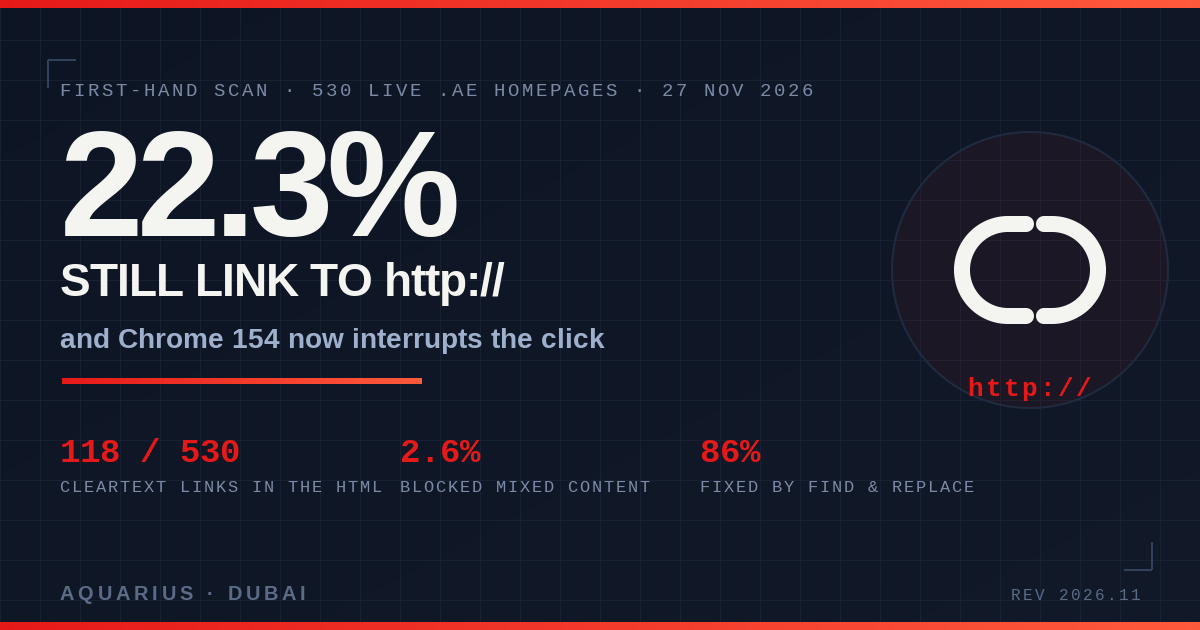
We fetched the homepage of every domain on the Tranco-ranked .ae list on 27 November 2026 and parsed every URL in the HTML. Across 530 live, real UAE homepages, classic mixed content is almost extinct: only 14 sites (2.6%) load a script or stylesheet over cleartext, and not one homepage served its final page over plain HTTP. The live problem is different — 118 of 530 (22.3%) still hand visitors http:// links, and since Chrome 154 shipped “Always Use Secure Connections” as the default in October 2026, Chrome decides what happens to those clicks, not you.
Here is the part most Dubai teams get wrong. They assume an http:// link is harmless because the browser “just fixes it.” It usually does — and that is exactly why nobody notices the ones it cannot fix.
What the numbers actually say (awareness)
We probed 787 hosts. 530 answered with a real, human-facing HTML homepage over HTTPS after filtering out WAF challenges, parked domains and thin shells. Three findings set the stakes:
- Zero of 530 homepages finished on cleartext HTTP. Transport encryption is finished business in the UAE. The HTTP Archive’s 2025 Web Almanac puts 98.8% of all mobile requests on HTTPS globally, and our
.aesample is consistent with that. - 14 sites (2.6%) still ship blockable mixed content — a
<script src="http://…">, anhttp://stylesheet, or a CSSurl(). Chrome has blocked these outright since Chrome 80 in early 2020, so those assets have simply not loaded for six years. - 118 sites (22.3%) ship at least one
http://link — 255 external link occurrences, 88 pointing back at the site’s own domain, and 8 inside<link rel>canonical or alternate tags.
That last number is the one that changed meaning this year. Chrome 147 turned on “Always Use Secure Connections” by default for Enhanced Safe Browsing users in April 2026; Chrome 154 made it the default for everyone in October 2026. Chrome holds 76.98% of UAE browser share (StatCounter, October 2026), so this is not an edge-case browser setting — it is how three out of four UAE visitors now experience your links.
What Chrome does with each kind of insecure reference (consideration)
“Mixed content” is four different problems with four different outcomes. This is the table we use when we triage a Dubai client’s site, with our own .ae counts in the last column.
| What the HTML references over http:// | What Chrome does in 2026 | What the visitor experiences | In our 530-site scan |
|---|---|---|---|
script src, link rel=stylesheet, CSS url() | Blocked outright — no upgrade attempt | Broken layout or dead JavaScript. Silent: the error is console-only | 14 sites (2.6%) |
img, video, audio, srcset, poster | Auto-upgraded to HTTPS; blocked if the upgrade fails | Nothing, or a missing image where the asset has no HTTPS twin | 11 sites (2.1%) |
form action | Submitted in cleartext; Chrome warns on submit | “The information you are about to submit is not secure” | 1 site (0.2%) |
a href — a navigation | Upgraded by HTTPS-First; full-page warning if the upgrade fails | Nothing at all, or a red interstitial they must click through | 118 sites (22.3%) |
Most of it is a find-and-replace. A minority is a real wall.
We did not stop at counting links — we probed all 137 distinct hostnames those http:// links point at. 114 of 137 (83%) already answer over HTTPS today, and 84 of them already redirect http to https themselves. For 102 of the 118 offending sites (86%), every single insecure target is HTTPS-capable: Chrome silently upgrades the click and the only cost is an extra round trip.
Then there is the residue. 15 of the 137 targets answered on neither scheme — dead hosts, not insecure ones — which means 13 sites carry links that have rotted entirely. Four more targets serve HTTPS with an invalid certificate. Those are the clicks where a UAE visitor gets a full-page security warning or a dead end with your brand at the top of the tab.
The CSP directive almost everyone misreads
88 of 530 sites (16.6%) send the Content-Security-Policy directive upgrade-insecure-requests. It is a genuinely useful one line, and it is the most common CSP directive on the web. But it upgrades subresources — it does not touch top-level navigations. 12 of those 88 sites still ship http:// links and believe the header has them covered.
A further 44 sites (8.3%) are still sending block-all-mixed-content, a directive that has been deprecated and is now a no-op in modern browsers — a header that costs bytes and buys nothing. If you want this layer done properly, pair it with HSTS: our scan of Strict-Transport-Security on .ae homepages found 55.7% of live sites sending no HSTS header at all.
Half the blocked assets are one dead script from 2011
This was the finding we did not expect. Of the 14 sites with blockable mixed content, 7 are loading html5shiv or html5shim from googlecode.com over HTTP — an Internet Explorer 8 polyfill, hosted on a Google service that shut down in 2016. Five of those seven are .gov.ae domains, including Abu Dhabi’s culture, health and mobility authorities. The tag has been dead code served over a dead protocol from a dead host for a decade, and because Chrome blocks it silently, nobody saw a thing.
The other named examples from our dataset, each re-verified on both the apex and the www hostname:
- sedd.ae — sends
upgrade-insecure-requests, and still hard-codes 6 cleartext own-domain CSS and JS files plus 55http://links. The header rescues the assets; nothing rescues the links. - fujairah.ae — four homepage links point at
http://10.5.10.141:8222, a private RFC 1918 address published in the public HTML. No visitor on earth can open it, and Chrome will never upgrade an IP literal. - etihadwe.ae — a CSS background pulls an arrow icon from
ewewebtst.fewa.ae:3435, a test server leaked into production markup. - eyeofdubai.ae — the newsletter form posts to an
http://endpoint, the only cleartext form action in 530 homepages. - cineroyal.ae and ecmpermits.ae — IE9-era polyfills and Font Awesome 4.2.0 requested over
http://from public CDNs that have served HTTPS for a decade.
Infrastructure explains a lot of the variance. Of the 248 sites behind Cloudflare, exactly zero had blockable mixed content; of the 18 on Microsoft-IIS, 16.7% did. Managed edges rewrite this class of mistake for you. Legacy on-premise stacks hand it straight to the browser.
What it costs to clear, and what it costs not to (decision)
UAE e-commerce was worth AED 42.2 billion in 2025 — 15.7% of total UAE retail — and is heading to AED 67.2 billion by 2030 (EZDubai with Euromonitor International). Spread evenly, that is roughly AED 4.8 million of UAE online retail transacting every hour. Against that, a Deloitte and Google study found a 0.1-second improvement in mobile load time lifted retail conversion by 8.4%. Every http:// link is an extra upgrade round trip before the next page even starts, and every blocked stylesheet is a layout that renders wrong on first paint.
The downside tail is worse than the latency. A cleartext form post on a UAE site is personal data in transit without protection, which is squarely in scope of Federal Decree-Law No. 45 of 2021 (the UAE PDPL). IBM’s 2026 Cost of a Data Breach report puts the Middle East average at roughly AED 29.4 million per breach — the highest region in the study.
| Work | What you get | Aquarius price (AED) |
|---|---|---|
| HTTPS hygiene audit | Every insecure reference classified by the four classes above, with the target-host HTTPS check that tells you which are cosmetic and which break | 1,200 – 3,500 |
| Remediation sprint | Scheme-relative or HTTPS rewrite across templates and database content, CSP upgrade-insecure-requests, HSTS, dead-asset removal, redeploy | 4,000 – 9,000 |
| Monitored build | New site shipped clean, with CSP reporting so an http:// string can never reach production unnoticed | From 500 / month hosting + build |
How we do it
We do not hand over a PDF of warnings. We run the scan, split the findings into “Chrome already hides this” and “a visitor sees this today,” fix the second list first, then add a CSP report-only policy so the next http:// paste shows up in a report instead of in a customer’s browser. If our audit finds nothing a visitor can experience, we say so and bill the audit only — we would rather tell you your site is clean than invent a sprint. See our pricing for how audits roll into build retainers, and the companion scans on script integrity and CSP and TLS certificates for the rest of the picture.
The 30-minute version, if you want to do it yourself
- Grep your templates, theme and CSS for the literal string
http://. Most of what you find is a link, not an asset. - Grep your database content too — CMS body fields are where old
http://links survive redeploys. - For each distinct target host, test whether
https://answers. If it does, rewrite the link. If it does not, the link is dead or the host is abandoned — remove it. - Delete, do not upgrade, assets from services that no longer exist. Nothing on
googlecode.comis coming back. - Add
upgrade-insecure-requeststo your CSP for the subresources, and remember it does nothing for links. - Drop
block-all-mixed-content. It is deprecated and ignored.
FAQ
Is mixed content still a real problem for UAE websites in 2026?
Barely, as a loading problem: only 2.6% of the 530 live .ae homepages we scanned have blockable mixed content, and browsers have been silently blocking it since 2020. The successor problem is cleartext http:// links, which 22.3% still ship, because Chrome’s HTTPS-First default now intervenes on navigations too.
What exactly changed in Chrome 154?
“Always Use Secure Connections” became the default for all users in October 2026 (it was on by default for Enhanced Safe Browsing users from Chrome 147 in April 2026). Chrome attempts every public HTTP navigation over HTTPS first. If HTTPS works, the visitor sees nothing. If it fails, they get a full-page warning before the page loads.
Does upgrade-insecure-requests fix my http:// links?
No. It upgrades subresources — images, scripts, stylesheets, fetches. Top-level navigations are explicitly out of scope. In our scan, 12 of the 88 sites sending the directive still shipped http:// links they assumed it covered.
Do http:// links hurt SEO?
Internal http:// links are the bigger risk: they feed crawlers a URL that is one redirect away from your canonical, which dilutes internal link signals and wastes crawl budget. 27 of our 530 sites link to their own domain over http://. Eight sites go further and declare an http:// URL inside <link rel="canonical"> or rel="alternate", which is a direct contradiction of the HTTPS page it sits on.
How do I find every insecure reference without a crawler?
Open DevTools, reload with the Console filtered to warnings, and look for “Mixed Content” entries — that catches assets. Links will not appear there, because they are not an error until someone clicks. For those you need to grep the markup, which is exactly what this scan did across 787 hosts.
The short version
HTTPS is solved in the UAE. Mixed content is nearly solved. What is left is a decade of copy-pasted http:// strings sitting in markup, and a browser that as of October 2026 no longer quietly tolerates them. For 86% of the affected sites this is one find-and-replace and a redeploy. For the rest, it is a visitor staring at a security warning with your logo above it.
If you want to know which group your Dubai site is in, send us the URL — we will run the same scan on it and tell you plainly.