
Debt Collection and Receivables Software in Dubai (2026): Real AED Costs, Payment Orders and the 15-Day Cheque Route
Two in five UAE B2B invoices are paid late. Real AED costs for receivables and collections software, the 3-day payment order, the 15-day cheque route and the 6-month VAT bad-debt clock.
- PUBLISHED
- 03 OCT 2026
- READ TIME
- 12 MIN
- AUTHOR
- AQUARIUS · DUBAI
- UNIT
- REV 2026.09
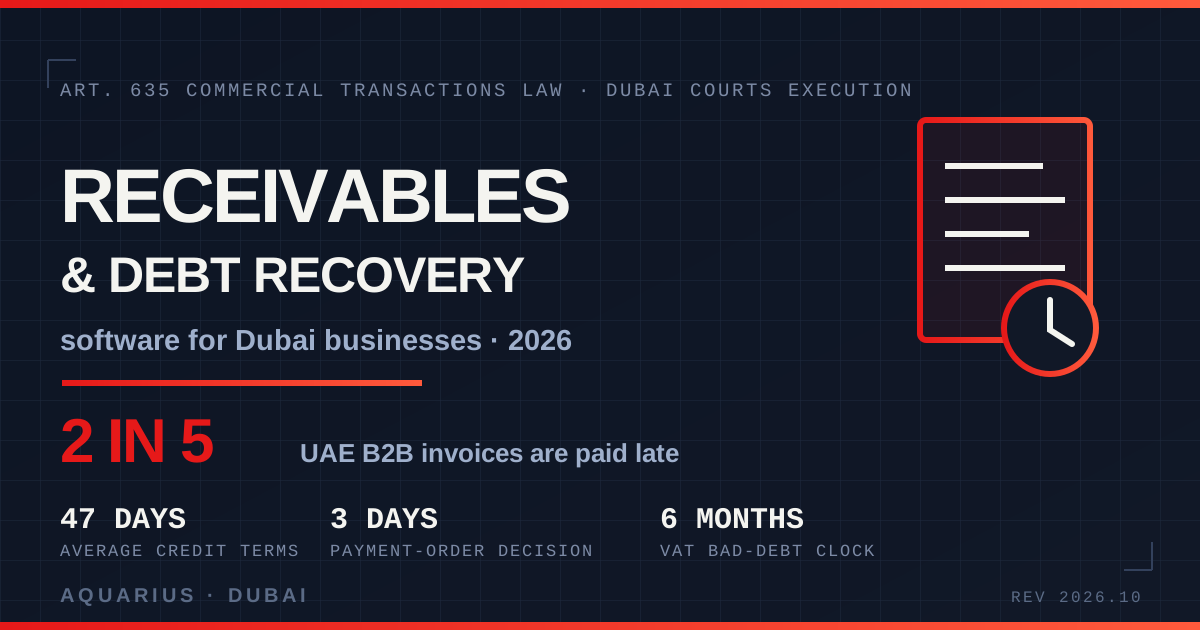
Short answer: a custom receivables and collections system in Dubai costs roughly AED 60,000-280,000 to build and AED 1,800-7,000 a month to run. The reason it pays for itself is the arithmetic on the other side: around two in five UAE B2B invoices are paid late, average credit terms sit near 47 days, a collection agency takes 10-25% of whatever it recovers, and a Dubai payment-order filing costs 6% of the claim value. Software that escalates on a clock is cheaper than every route that starts after the debt has already aged.
Dubai businesses rarely lose money because they cannot collect. They lose it because nobody escalated on day 31, the VAT relief clock ran out quietly, and by the time the file reached a lawyer the only cheque on record had gone stale.
What late payment actually costs a UAE business (awareness)
The Atradius Payment Practices Barometer for the UAE, surveyed in the second half of Q2 2026, is the cleanest picture of the problem. Around two in five B2B invoices are paid late. Credit sales now make up an average of 47% of B2B transactions, with nearly half of the businesses surveyed extending more credit than before. The 2025 edition put it harder still: 58% of credit-based sales were paid late, and average payment terms ran to 47 days before a single day of delay was added on top.
The damage shows up as a financing problem, not an accounting one. 47% of UAE respondents report higher financing needs because of payment delays, 46% report reduced liquidity headroom, and 38% say cash flow planning has become harder. Looking forward, 46% expect default risk to rise further and 39% expect it to stay elevated. The single most cited cause of delay is the customer’s own cash flow constraints, at 49% - which means the fastest creditor in the queue gets paid and the patient one funds the shortfall.
Industrial and construction businesses are the worst affected, because their payment cycles are longest and their claims run through variations, retentions and certified valuations. In Dubai that is a very large share of the B2B economy.
Most Dubai businesses get this wrong: they treat collections as a monthly finance task instead of an event-driven workflow. An aged debtors report tells you what already went wrong 30 days ago. A receivables system that fires a bilingual reminder on day -3, a statement on day 7, a hold on new orders on day 30 and a formal legal notice on day 45 changes the outcome, because in a market where 49% of delays are the customer’s own cash squeeze, payment order is decided by whoever asked first and loudest.
What a Dubai receivables system has to do (consideration)
Strip the vendor demos out and a working order-to-cash stack is six pieces. Most Dubai SMEs have one or two of them and improvise the rest in WhatsApp.
- Credit control at the front door. Credit limit and terms per customer, approval workflow, and a hard block on new orders past a threshold. Credit scoring gets stronger if you pull bureau data - see our guide to AECB credit bureau API integration in Dubai.
- Invoice as a structured object. Not a PDF. TRN, 5% VAT, bilingual EN/AR layout, PO and delivery-note references, and a payload that can be emitted as XML when e-invoicing goes live.
- Dunning ladder on a clock. Scheduled, logged, multi-channel reminders (email, SMS, WhatsApp Business API) in English and Arabic, each one timestamped so it becomes evidence later.
- Promise-to-pay and dispute tracking. Every call logged against the invoice, every dispute parked with a reason code so genuine queries stop polluting the overdue list.
- Cash application and reconciliation. Bank feed matching, part payments, post-dated cheque register with presentation dates, and automatic allocation so the ledger is true at 9am not month-end.
- Escalation and legal pack. One click that assembles the contract, the signed delivery notes, the invoice, the statement of account and the full reminder history into the bundle a lawyer or the court actually needs.
That last item is the one nobody budgets for and the one that decides whether a claim is cheap or expensive. Build cost splits roughly like this for a production system in Dubai.
| Scope | What you get | Build cost (AED) | Timeline |
|---|---|---|---|
| Receivables MVP | Customer ledger, VAT invoicing, ageing, automated bilingual dunning ladder | 60,000 - 110,000 | 6 - 9 weeks |
| Full collections workflow | MVP plus credit limits and order holds, promise-to-pay, disputes, collector queues and targets | 110,000 - 180,000 | 9 - 14 weeks |
| Order-to-cash platform | Above plus bank-feed cash application, PDC register, customer payment portal, legal-pack generator, DSO dashboards | 180,000 - 280,000 | 14 - 22 weeks |
| Integrations (each) | Accounting or ERP, payment gateway, WhatsApp Business API, e-invoicing ASP, credit bureau | 14,000 - 45,000 | 2 - 4 weeks |
| Run and support | Hosting, monitoring, backups, small changes, support SLA | 1,800 - 7,000 / month | ongoing |
Is it worth building rather than buying? The benchmark data says the mechanism works regardless of who builds it. Organisations running AI-assisted receivables automation cut Days Sales Outstanding by 20-30% within 12 months; 99% of companies using AI in AR reduced average DSO, and 75% cut it by six days or more. Best-in-class teams reach a 39-day DSO, a 92% touchless payment rate and average days delinquent of 6. On the cost side, the average organisation spends USD 9.40 to process an invoice, manual teams up to USD 19.83, and best-in-class teams USD 2.78. Prioritising collections by risk rather than by invoice age cuts bad-debt write-offs by about 26% and collector time spent on low-risk accounts by 40%. Mature order-to-cash automation reports 30-40% lower cost per transaction and about 3.1x ROI over three years.
The honest rule: if you issue fewer than about 150 invoices a month on standard terms, bolt automated dunning onto whatever accounting tool you already run. Once you have post-dated cheques, retentions, Arabic statements, multi-entity ledgers or a collections team with targets, generic AR modules stop fitting and the custom build wins - the same build-versus-buy line we draw in the Dubai CRM software comparison.
The four recovery routes, ranked by what they cost you
Once an invoice is genuinely overdue, Dubai gives you four routes. They are not alternatives - they are a ladder, and software decides how fast you climb it.
| Route | What it needs | Typical cost | Typical speed |
|---|---|---|---|
| Automated dunning and statements | Invoice, delivery proof, logged reminder history | Near zero marginal cost | Day 1 - 45 |
| Agency or amicable collection | Debt file and evidence pack | 10 - 25% of amounts recovered, usually no recovery no fee | Weeks |
| Legal notice then payment order | Clear written admission of debt plus proof the demand was served | Court fee 6% of claim value, capped at AED 40,020 | Order decided within 3 days of filing |
| Direct execution on a dishonoured cheque | Original cheque plus bank rejection certificate | Execution fees around 2% of the amount under execution, capped | 15-day demand notice from the Execution Judge |
Two of those deserve detail, because they are where Dubai differs from almost everywhere else.
The payment order: three days, if your paperwork is clean
Under Article 63 of the Civil Procedure Regulations, a creditor holding a debt that is confirmed in writing can skip a full trial on the merits. The court is to decide the application within three days of filing. The debtor gets a minimum of five days from receiving the demand to pay, has 15 days from issuance to lodge a grievance (which is itself to be determined within about a week), and the order becomes void if it is not served within three months. The Dubai court fee is 6% of the claim value, capped at AED 40,020.
The catch is evidentiary. Courts want a clear and unequivocal admission of debt - certain, assertive, and free of ambiguity - plus evidence the payment demand was actually served. A signed delivery note, a countersigned statement of account, an email confirming the balance: that is what turns a 12-month lawsuit into a three-day order. A receivables system that captures and stores those artefacts against each invoice is, in practice, a litigation accelerator. Without them you are back to an ordinary civil claim, where Dubai fees run 6% of claim value capped at AED 20,000 for claims up to AED 500,000, AED 30,000 between AED 500,001 and AED 1 million, and AED 40,000 above that - and where courts award only a token contribution to your legal fees, commonly AED 1,000-2,000 per stage no matter what you actually spent.
The cheque route: not a crime any more, but faster to enforce
This is the most widely misunderstood change in UAE commercial practice. Since Federal Decree-Law No. 14 of 2020 came into force on 2 January 2022, a cheque dishonoured for insufficient funds is no longer a criminal matter - Articles 401, 402 and 403 of the old Penal Code provisions were abrogated for that scenario (forgery and stop-payment instructions remain criminal). Plenty of Dubai suppliers read that as “cheques are worthless now” and stopped collecting them.
The opposite happened. Under Article 635 of the Commercial Transactions Law, a cheque dishonoured for insufficient funds is an executive instrument. You take the original cheque plus the bank’s rejection certificate straight to the Execution Judge at Dubai Courts, filed electronically, with no civil trial on the underlying debt. The judge issues a 15-day demand notice, after which enforcement measures - bank account freezes, attachment of property, travel bans - are available directly. Banks are also now obliged, where possible, to make partial payment of whatever funds are in the account and issue a partial payment certificate recording what was paid and what remains.
Practical consequence for software: your system needs a proper post-dated cheque register with presentation dates, custody, and scanned images front and back. A PDC that is not presented on time is not an executive instrument you can use - it is a piece of paper.
Two clocks nobody puts in the CRM (decision)
Chasing late payers is the visible cost. The invisible one is tax relief you forfeit by missing a deadline.
VAT bad debt relief. Under Article 64 of the VAT Decree-Law you can reclaim output VAT on a bad debt only when four conditions are all met: the supply was made and output VAT was charged, accounted for and paid to the authority; the consideration has been written off in full or in part in your accounts; more than six months have passed from the date of supply; and you have notified the recipient of the amount written off. The notification needs the invoice date, invoice number and the amount written off, can go by letter, email or post, and does not need a reply - but you must keep proof you sent it. On a stuck AED 500,000 invoice that is AED 23,809 of VAT you either reclaim or donate. A receivables system should generate that notice and file the evidence automatically; most do not, because nobody told the developer the rule exists.
Corporate tax write-offs. Under Article 28 of Federal Decree-Law No. 47 of 2022, only a specific bad debt formally written off in the accounts is deductible. General IFRS 9 provisions for doubtful debts are not. Three things have to be true: the debt was included in taxable income, reasonable steps to collect were taken, and the debt was formally written off - with proof of debt, proof of recovery attempts and write-off approval kept for seven years. “Reasonable collection steps” is exactly the audit trail an automated dunning ladder produces as a by-product. Spreadsheet chasing produces nothing you can show an auditor. The wider setup is covered in our corporate tax accounting software guide for Dubai SMEs.
And the deadline that forces the rebuild anyway. UAE e-invoicing opened for voluntary adoption on 1 July 2026. Businesses with annual revenue of AED 50 million or more must appoint an Accredited Service Provider by 30 October 2026 (extended from 31 July 2026) and go live on 1 January 2027. Everyone else appoints an ASP by 31 March 2027 and goes live 1 July 2027; government entities follow on 1 October 2027. Invoices move as structured XML through the ASP, not as emailed PDFs. If you are touching your invoicing stack in 2026, do receivables and e-invoicing in one project rather than two - the detail is in our UAE e-invoicing and ERP integration guide.
The AED case, run on real numbers
Take a Dubai trading company with AED 40 million of annual credit sales and a 72-day DSO. A conservative 20% DSO reduction - the low end of the benchmark - releases about 14 days of sales, roughly AED 1.56 million of cash permanently freed from the ledger. Financed at 7%, that is AED 109,000 a year in avoided interest alone. Cut bad-debt write-offs by the benchmark 26% on a 1.5% write-off rate and that is another AED 156,000. Against an AED 180,000 build and AED 45,000 of annual running cost, payback lands inside the first year - before counting the agency commissions you no longer pay at 10-25% of recovered amounts, or the VAT you stop forfeiting at the six-month line.
Aquarius builds these as one system rather than four tools taped together: a React and Node stack, UAE hosting where data residency is required, Arabic and English statements and invoices built in from the start, a dunning engine you can change without a developer, a PDC register that matches how Dubai actually trades, and a legal-pack generator so escalation takes minutes. We scope in two-week discovery, ship the ledger and dunning ladder first so finance feels it inside two months, then add cash application, the customer portal and the e-invoicing path. Fixed-price phases, source code and data are yours, no per-collector licence to leave behind. See pricing or the full services list.
FAQ
How much does debt collection and receivables software cost in Dubai?
A custom build runs AED 60,000-280,000 depending on whether you stop at automated dunning or go through to cash application and a legal-pack generator, plus AED 1,800-7,000 a month to run. Integrations with accounting, payment gateways, WhatsApp or an e-invoicing ASP add AED 14,000-45,000 each.
Is a bounced cheque still a criminal offence in the UAE?
Not for insufficient funds. Since 2 January 2022, under Federal Decree-Law No. 14 of 2020, dishonour for insufficient funds is no longer criminal, though forgery and stop-payment instructions still are. Commercially you are better off: under Article 635 of the Commercial Transactions Law the cheque is an executive instrument you enforce directly through the Execution Judge, who issues a 15-day demand notice before account freezes, asset attachment or travel bans become available.
How fast is a payment order in Dubai Courts?
The court is to decide a payment-order application within three days of filing, and the debtor gets at least five days from the demand to pay. The debtor has 15 days to lodge a grievance, and the order lapses if it is not served within three months. It only works if you hold a clear written admission of the debt and can show the demand was served - which is a documentation problem your software should solve before the dispute exists.
What does it cost to file a debt claim in Dubai?
A payment-order application attracts a court fee of 6% of the claim value, capped at AED 40,020. Ordinary civil claims are also 6%, capped at AED 20,000 up to AED 500,000, AED 30,000 from AED 500,001 to AED 1 million, and AED 40,000 above that. Execution is charged separately at around 2% of the amount under execution, subject to caps. Recoverable legal costs are token, commonly AED 1,000-2,000 per stage.
When can I reclaim the VAT on an unpaid invoice?
When all four Article 64 conditions are met: output VAT was charged, accounted for and paid; the consideration is written off in your accounts; more than six months have passed since the date of supply; and you have notified the customer of the written-off amount, quoting the invoice date, invoice number and the amount. Keep proof of that notification - the customer does not have to reply.
Should I use a collection agency or build better internal processes?
Both, in that order. Agencies charge 10-25% of amounts recovered on a no-recovery-no-fee basis, which is good value on genuinely stuck debt and terrible value on debt that was only ever 20 days late and unattended. Automate the first 45 days internally, then hand over what survives it with a complete evidence pack.
If two in five of your invoices land late, the problem is a missing clock, not a missing collector. Send us your invoice volume, terms and current DSO and we will come back with a scoped phase plan, a number, and the escalation ladder we would wire in first.