
Digital Signage Software in Dubai (2026): The Screen Is the Cheapest Part
Dubai screens are cheap to buy and expensive to keep legal: the electronic screen advertising permit runs AED 1,000 per square metre every year. Real 2026 numbers.
- PUBLISHED
- 16 SEPT 2026
- READ TIME
- 10 MIN
- AUTHOR
- AQUARIUS · DUBAI
- UNIT
- REV 2026.09
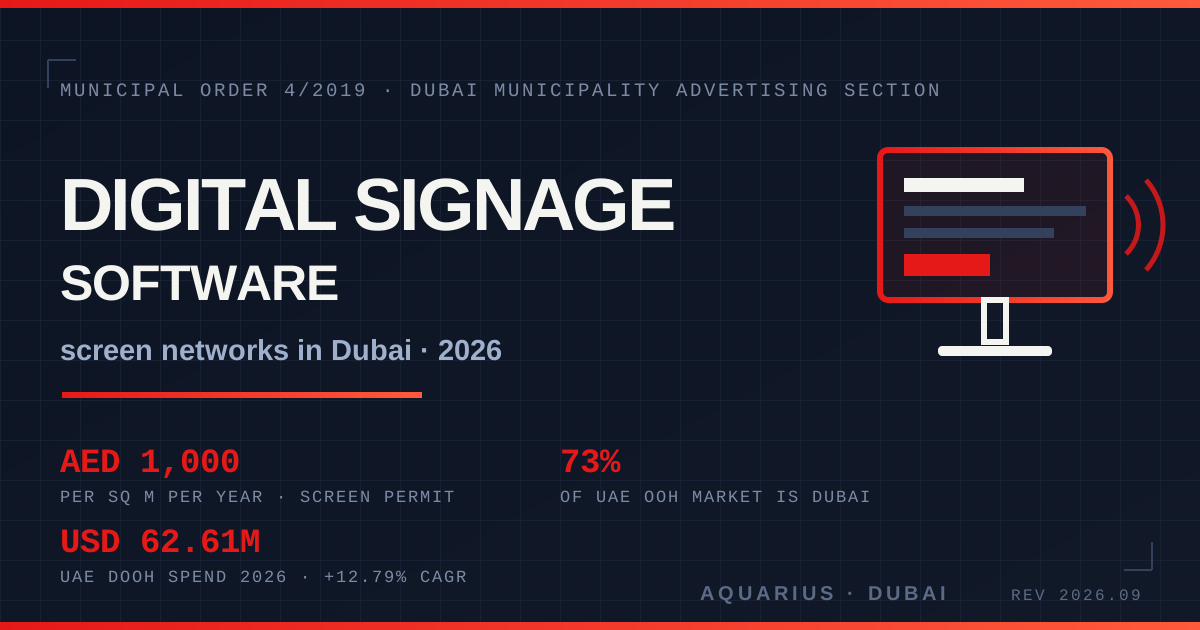
Short answer: A digital signage rollout in Dubai has three cost lines, and the panel on the wall is the smallest of them. A 55-inch commercial display runs AED 3,500–6,500 once; the content management software runs USD 8–30 per screen per month forever; and if that screen carries advertising visible from outside your unit, Dubai Municipality charges an electronic screen advertising permit of AED 1,000 per square metre per year, also forever. Budget the recurring lines first, design the software around Arabic-first content and offline playback, and the hardware question answers itself.
Key takeaways
- The permit recurs, the screen does not. Electronic screen advertising permits in Dubai are priced at AED 1,000 per square metre per year. A 6 m² outdoor display is an AED 6,000 annual line item before a single pixel of content is produced.
- Arabic is a technical requirement, not a nicety. Dubai’s Decree No. (6) of 2020 Regulating Advertisements makes Arabic the main language of advertising content, and Federal Law No. 15 of 2020 on Consumer Protection requires consumer-facing information in Arabic. Artwork submitted without Arabic gets rejected at technical review — so your CMS needs real RTL layout, not a translated PNG.
- Dubai is where the UAE screen money is. Dubai accounts for roughly 73% of the country’s out-of-home market, and UAE DOOH ad spend is estimated to move from USD 53.91 million in 2025 to USD 62.61 million in 2026, reaching USD 114.3 million by 2031 at a 12.79% CAGR.
- The infrastructure bet is already placed. Hills Advertising committed AED 971.3 million (USD 265 million) to Dubai DOOH expansion on contracts signed in Q1 2026, converting 20 of its 94 bridge banner locations to digital.
- Off-the-shelf CMS is the right default. Yodeck starts at USD 8 per screen per month and ScreenCloud at USD 20; Xibo is open source if you self-host. Custom software earns its keep only when the screens plug into your POS, your booking system or your ad inventory.
The market you are actually buying into
Two different numbers get quoted in Dubai signage meetings and they measure different things. The digital signage market — screens, players, software, installation — is estimated at USD 280.5 million in the UAE in 2026, growing to USD 455.7 million by 2031 at an 8.4% CAGR. The DOOH advertising market — money paid to put a message on somebody else’s screen — is the smaller but faster line: USD 62.61 million in 2026 at 12.79% CAGR, with programmatic formats the fastest-growing slice at a 16.03% CAGR through 2031.
The distinction matters because it decides which side of the transaction you are on. If you own a retail chain, a clinic group or a restaurant estate, you are buying the first market to avoid paying into the second. If you own the wall, the lobby or the car park, the screens are a media asset and the software has to prove delivery to an advertiser.
The footfall backing all of this is not speculative. The Dubai Mall recorded more than 111 million visitors in 2024, and Emaar reported average mall occupancy of 98% in Q3 2025. Dubai’s screen inventory is being built against the densest retail traffic on earth — which is exactly why the regulator watches what goes on those screens.
The permit line most Dubai businesses discover late
Outdoor advertising in Dubai is governed by Municipal Order No. 4/2019, the Regulations for Outdoor Advertising, which set technical specifications for dimensions, illumination, structural engineering and content standards. Three permit types get confused with each other:
| Permit | What it covers | Indicative cost | Timeline |
|---|---|---|---|
| Signboard permit | Your shop fascia sign, matching the DET trade name exactly | AED 500–2,500, typically renewed with the trade licence | DED 2–5 working days; Dubai Municipality 5–10 |
| Electronic screen advertising permit | Digital and LED displays installed on land at approved locations | AED 1,000 per square metre per year | Content approval required from the DM Advertising Section |
| Outdoor structure / billboard permit | Billboards and hoardings, priced by location and size | AED 5,000–12,000+, premium on Sheikh Zayed Road and the Burj Khalifa area; DM advertising permits span AED 500–50,000 | Permits typically valid 1–3 years |
Two practical consequences for the build. First, every advertisement needs content approval from the Advertising Section — so your CMS needs an approval state before a playlist can go live, and an audit trail of what actually played. Second, the artwork requirement is bilingual with Arabic present and at least equal in prominence. A signage stack that treats Arabic as an afterthought produces rejected submissions and re-shoots. If you have not solved RTL properly elsewhere, our guide to Arabic localisation and RTL in Dubai covers the same failure modes on the web side.
What a Dubai screen network costs in 2026
Here is the honest build-up for a ten-screen indoor network in a Dubai retail or clinic environment, using current UAE supplier pricing.
| Line item | 2026 range | Recurring? |
|---|---|---|
| 55-inch commercial display (non-touch) | AED 3,500–6,500 each | One-off, 3–5 year replacement |
| Small commercial screens / mid-size displays | AED 2,500–8,000 / AED 8,000–25,000 | One-off |
| Indoor LED video wall | From about AED 2,900 per m² (P2.5–P3.9 SMD) up to AED 40,000+ per m² for fine-pitch MicroLED or COB | One-off |
| Media players, mounts, cabling, installation | AED 800–2,500 per screen | One-off |
| CMS software, budget tier (Yodeck) | USD 8–16 per screen per month | Monthly |
| CMS software, mid tier (ScreenCloud, OptiSigns, Xibo Cloud) | USD 15–30 per screen per month | Monthly |
| Permits (if the screen advertises outward) | AED 1,000 per m² per year | Annual |
| Content production and scheduling | AED 1,500–8,000 per month depending on refresh rate | Monthly |
Run the software line at scale and the shape of the decision appears: at 50 screens, monthly CMS cost is roughly USD 400–800 on Yodeck and USD 1,000–1,500 on ScreenCloud — USD 12,000–18,000 a year on the mid tier. That is the number that makes a custom or self-hosted stack worth pricing, and the number below which it almost never is.
Buy the CMS or build it? The honest test
Off-the-shelf wins on day one and keeps winning until one of four things is true:
- Your screens must read live business data. Menu boards that follow POS stock and price changes, queue and now-serving displays tied to a clinic’s booking system, warehouse or fleet status boards, hotel lobby boards driven by the PMS. A generic CMS shows a playlist; it does not know your inventory. The same integration logic sits behind QR menu and table ordering systems.
- You sell the screen time. The moment a third party pays for a slot, you need proof-of-play logs, per-site and per-loop reporting, and eventually an SSP connection if you want programmatic demand — the fastest-growing DOOH segment in the UAE at a 16.03% CAGR.
- Per-screen licensing has outgrown a build. At 200+ screens, USD 20 per screen per month is USD 48,000 a year. A self-hosted Xibo deployment plus a thin custom scheduling and reporting layer is often cheaper by year two — and it keeps content on infrastructure you control, which matters when the content includes customer data.
- Your content rules are local and complex. Daypart scheduling around Dubai’s trading patterns, prayer-time and Ramadan-hours playlists, Arabic and English loops that must stay in sync, and per-emirate content approval states. These are cheap to code and painful to fake with tags.
Four software requirements Dubai punishes you for skipping
- Offline-first playback. Mall and site Wi-Fi drops. Players must cache the full loop locally and keep playing; a screen showing a connection error in a Dubai Mall corridor is a brand liability with 111 million annual witnesses.
- Real bilingual rendering. Native RTL text, correct Arabic shaping and a font stack that handles both scripts — not screenshots of Arabic pasted into an English template.
- Remote device health. Temperature, brightness, last-heartbeat and screenshot-back for every player. Outdoor screens in a Dubai summer fail differently than screens in Manchester, and you want the alert before the client calls.
- Proof-of-play and approval history. What played, where, when, and which approved artwork version it was. This is your defence at a municipality inspection and your invoice backup if you sell slots.
Pricing, payback and where Aquarius fits
Our typical Dubai engagements land in three tiers. A managed rollout on an off-the-shelf CMS — screen and player selection, installation coordination, permit paperwork, bilingual template system and content calendar — runs AED 18,000–45,000 plus hardware and the monthly licence. A custom signage layer integrating screens with your POS, booking system or ERP runs AED 60,000–150,000. A full self-hosted network platform with proof-of-play, multi-tenant site management and ad-slot reporting runs AED 180,000–400,000+, and only makes sense above roughly 150–200 screens or when you are selling the inventory. Engagement models are on our pricing page, and the wider build scope on services.
The payback arithmetic is unusually clean on the media side. Dubai holds about 73% of a UAE out-of-home market where digital already accounts for close to a third of outdoor spend, and DOOH spend is growing at 12.79% a year while the underlying hardware market grows at 8.4%. In plain terms: the value is migrating from owning screens to controlling what they play and proving it played. That control is software.
Three mistakes we keep seeing
- Buying hardware before checking the permit. A display sized at 6 m² instead of 4 m² costs AED 2,000 more every year for its entire life. Size the screen against the permit tariff, not against the wall.
- Treating Arabic as a translation task. Arabic must be the main language in advertising content under Dubai’s Decree No. (6) of 2020, and at least equal in prominence on signage. Build the bilingual template system first; retrofitting RTL into a finished template set is the expensive version.
- No content owner. The single most common failure is not technical: screens go live with a launch loop and still show it four months later. Budget the monthly content line from day one or the network quietly becomes wallpaper.
FAQ
How much does a digital screen advertising permit cost in Dubai?
Electronic screen advertising permits are priced at AED 1,000 per square metre per year for digital and LED displays on land at approved Dubai locations. Shop signboard permits are separate and typically AED 500–2,500, renewed alongside the trade licence, while larger outdoor structures range from AED 5,000 to AED 12,000+ and DM advertising permits overall span AED 500–50,000 depending on size and location.
Do I need a permit for a screen inside my own shop?
The permit regime targets advertising visible to the public and content displayed at approved advertising locations, and all advertisement content requires approval from the Dubai Municipality Advertising Section. Internal operational displays — queue systems, staff boards, menu boards inside the unit — are treated differently from outward-facing advertising, but the moment a screen is readable from outside your premises or carries third-party advertising, treat it as a permitted display and confirm with the Municipality before installation. The cost of asking is a phone call; the cost of assuming is a removal order.
Which digital signage software is best for a Dubai business?
For fewer than about 50 screens with straightforward content, a hosted CMS is the right default: Yodeck at USD 8–16 per screen per month for budget deployments, ScreenCloud or OptiSigns at USD 15–30 for richer app integrations. Xibo is open source and free if you self-host. Build custom only when screens must read live data from your POS, booking or ERP systems, or when you sell the screen time and need proof-of-play.
Does the content have to be in Arabic?
Yes, in substance. Dubai’s Decree No. (6) of 2020 Regulating Advertisements makes Arabic the main language of advertising content, and Federal Law No. 15 of 2020 on Consumer Protection requires consumer information to be in Arabic, with other languages permitted alongside. Practically, signage artwork is submitted bilingually with Arabic at least equal in prominence, and submissions without Arabic are rejected at technical review.
How long does a signage rollout take in Dubai?
Approvals are the pacing item, not the build: DED signage approval typically takes 2–5 working days and Dubai Municipality 5–10 working days, before fabrication and installation. A ten-screen indoor network on a hosted CMS is realistically 4–6 weeks end to end. A custom integration with POS or booking data is 8–14 weeks, and a self-hosted multi-site platform with proof-of-play reporting is 14–24 weeks.
Where to start
Before you quote hardware, answer two questions: how many square metres of outward-facing screen you are committing to annually, and what live data those screens must show. Those answers set the permit bill and decide buy-versus-build in one pass. Talk to Aquarius — we size the network, handle the Municipality paperwork, build the bilingual template system and wire the screens to the systems that already run your business, against a fixed price.