
DNS Resilience in the UAE: We Scanned 787 .ae Domains and 26.8% Have Every Nameserver in One /24
First-hand NS and SOA census of 787 UAE .ae domains: 50.7% run only two nameservers, 85.9% use a single DNS provider, and 26.8% have every nameserver IP inside one /24. What that costs Dubai businesses.
- PUBLISHED
- 27 NOV 2026
- READ TIME
- 10 MIN
- AUTHOR
- AQUARIUS · DUBAI
- UNIT
- REV 2026.09
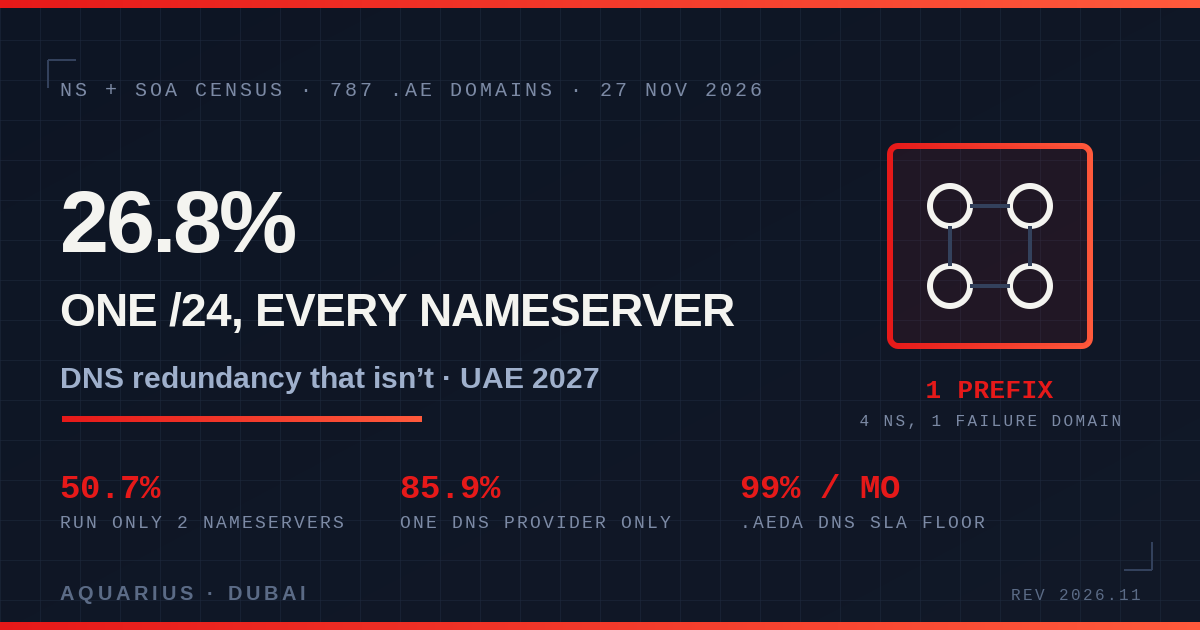
Most Dubai businesses think four nameservers means redundancy. It usually doesn't. We ran a first-hand NS and SOA census of 787 UAE .ae domains on 27 November 2026: 50.7% publish only two nameservers, 85.9% use a single DNS provider, and 26.8% have every single nameserver IP address sitting inside one /24 network block. If that block goes dark, the domain stops resolving — website, email, apps, API, all of it — no matter how many nameserver names are listed.
What we measured (and what it says about UAE DNS)
We took the 787 most-visited .ae hosts and queried each one over DNS-over-HTTPS for its NS record set, SOA fields, apex A records and MX records, then resolved every nameserver name to IPv4 and IPv6 and looked up the originating autonomous system and announced BGP prefix for each address. 781 domains returned a working NS record set. Headline numbers from that run:
- 396 of 781 domains (50.7%) run two nameservers or fewer. One runs a single nameserver.
- 671 domains (85.9%) have every nameserver under one provider — no secondary DNS anywhere.
- 709 domains (90.9%) have all their nameservers inside a single autonomous system.
- 209 domains (26.8%) have every nameserver IP inside one /24, and none of those 209 sit on an anycast platform.
- Two providers carry 62.4% of the list: Cloudflare (297 domains) and Etisalat/e& domains (190).
- 544 domains (69.7%) have no nameserver physically in the UAE at all; 502 domains' nameservers geolocate to the US.
The 90.9% single-ASN figure looks alarming and mostly isn't. If your nameservers are all inside Cloudflare, AWS Route 53 or Akamai, that single ASN is an anycast network with hundreds of points of presence — the ASN is not a failure domain. Strip those out and the honest number is the one that matters: 268 domains (34.4%) sit on a single non-anycast autonomous system, and 213 of those publish from a single announced BGP prefix. That is a real single point of failure, and it includes a large share of UAE government and enterprise names.
The pattern that gives it away
190 domains on the list — 24.3% — delegate to exactly four names: ns1 through ns4.etisalatdomains.ae. Resolve them and you get 5.195.168.51, .53, .54 and .55. Four nameservers, four IPs, one /24, one announced prefix (5.195.128.0/18), one ASN (AS5384), one country — and zero AAAA records, so nothing on that delegation is reachable over IPv6 (see our IPv6 readiness scan of .ae domains). 177 of the 190 add no second provider at all. On the .gov.ae cut of our data — 91 live domains — 86 are single-provider and 86 are single-ASN, with 64 on that same e& delegation.
Four nameserver names is what a registrar control panel shows you. One failure domain is what the routing table shows you. Those are not the same audit.
Why two nameservers in one rack is not redundancy
The rule here is 28 years old and still the standard. RFC 2182 (BCP 16) is explicit: "Secondary servers must be placed at both topologically and geographically dispersed locations on the Internet, to minimise the likelihood of a single failure disabling all of them." It goes further: "Servers for a zone should certainly not all be placed on the same LAN segment in the same room of the same building - or any of those. They should also be connected to the net via quite diverse paths." And on count: "It is recommended that three servers be provided for most organisation level zones, with at least one which must be well removed from the others."
Nothing in the .ae registry forces this. We read the full text of the .ae Domain Name Policy AEDA-POL-007 v1.1 — it contains no nameserver or DNS diversity requirement whatsoever. The one hard number in the registry paperwork is a service level, from the TDRA/.aeDA Registry-Registrar Agreement AEDA-AGR-001: "Name Service Availability: At least 99% per calendar month" and "Name Server Availability: At least 98.9% per calendar month". 99% of a month is 7.2 hours of permitted downtime, every month, contractually fine. Compare that to the 99.9% floor the same agreement sets for other registry services. If you are relying on your registrar's default DNS, 7.2 hours a month is the contract you are on.
Two 2025 incidents show what the failure actually looks like. AWS's own post-event summary for the 20 October 2025 outage names the cause plainly: "a latent race condition in the DynamoDB DNS management system that resulted in an incorrect empty DNS record for the service's regional endpoint" — "all IP addresses for the regional endpoint were immediately removed," and the knock-on recovery ran roughly 15 hours. A month later, Cloudflare's 18 November 2025 outage ran from 11:20 to 17:06 UTC and took CDN, Workers KV, Turnstile, Access and the dashboard with it; Cloudflare called it "Cloudflare's worst outage since 2019". Both providers are excellent. Both had a bad day. 85.9% of the .ae list has no plan for either one's bad day.
The quiet second defect: stale TTLs and broken SOA
Redundancy is half the picture; recovery speed is the other half. In our data the median SOA minimum — the negative-cache TTL, i.e. how long resolvers remember that your name failed — is 1,800 seconds, but 179 domains set it at 3,600 or higher. That means a 5-minute misconfiguration can keep returning NXDOMAIN to customers for an hour after you fix it. Separately, 175 domains (22.4%) have an SOA mname that isn't in their own NS set, which breaks dynamic-update and notify paths and is usually a leftover from a migration nobody finished. Apex A record TTLs are healthier: median 300 seconds, with 218 records at 60 seconds or below.
What good looks like, and what it costs in AED
There is a working example on the list. adnoc.ae runs ten nameservers across three independent sets — e& domains, ecompany.ae (separate Abu Dhabi and Dubai clusters) and its own ns1/ns2.adnocnet.ae. Different providers, different networks, different operational teams. That is what RFC 2182 describes, and it is achievable for a Dubai SME at a cost most owners will find smaller than they expect.
| Setup | Real failure domains | Typical monthly cost | Suits |
|---|---|---|---|
| Registrar default DNS (4 names, one /24) | 1 | AED 0 (bundled) | Nothing that earns revenue |
| Single anycast provider (Cloudflare / Route 53) | 1 provider, many PoPs | AED 0–75 | Brochure sites, early-stage |
| Primary anycast + free secondary on a second provider | 2 | AED 0–200 | Most Dubai SMEs and e-commerce |
| Two paid anycast providers, zone synced by IaC | 2 independent | AED 200–900 | Payments, booking, SaaS, logistics |
| Two providers + in-UAE node for latency and sovereignty | 3 | AED 900–3,000 | Government, banking, healthcare |
For reference on the raw infrastructure side: AWS Route 53 lists "$0.50 per hosted zone per month for the first 25 hosted zones" and "$0.40 per million queries" for standard queries — about AED 1.84 per zone per month at the 3.6725 peg, plus roughly AED 1.47 per million queries. The DNS itself is close to free. What costs money is doing the migration without breaking resolution, which is a one-off engineering job, not a subscription.
How to fix your own delegation this week
- Count real failure domains, not nameserver names. Resolve every NS name to an IP, then check whether those IPs share a /24 and an ASN. If the answer is yes and your provider is not anycast, you have one nameserver with four labels.
- Add a secondary DNS provider. Several anycast providers offer free or near-free secondary zones. Primary plus secondary on separate networks takes you from one failure domain to two for roughly the price of a coffee.
- Drop the SOA minimum to 300–900 seconds so a mistake expires in minutes, not an hour.
- Fix the SOA mname so it points at a server actually in your NS set.
- Publish IPv6 glue if your provider has it — 37.8% of the list still has no AAAA on any nameserver.
- Turn on DNSSEC once the delegation is stable, and keep the signing keys with the provider that holds the zone. Our DNSSEC and MTA-STS scan of .ae domains has the UAE adoption numbers.
- Monitor from outside your own network — resolution failures are invisible from inside the office.
What an hour of no-resolution costs a Dubai business
UAE e-commerce turned over AED 42.2 billion in 2025 — 15.7% of total UAE retail, according to EZDubai's Euromonitor-backed report, heading for AED 67.2 billion by 2030. Spread evenly, that is roughly AED 4.8 million of UAE online retail per hour (our derivation: 42.2bn / 8,760 hours). Your share of that hour is the number to weigh against a DNS fix that costs less than a mobile plan. And unlike a server outage, a DNS outage takes your email with it, so the customers you cannot serve also cannot reach you to complain.
At Aquarius we treat the delegation as part of the build, not an afterthought: we audit the current NS set and prefix spread, stand up a second anycast provider, sync the zone from version-controlled records so both providers can never drift, tighten the SOA timers, and leave external monitoring in place with an alert that reaches a human. A typical retrofit for a Dubai SME runs AED 3,000–8,000 one-off, and larger multi-brand or government-grade setups with in-UAE nodes land in the AED 15,000–25,000 range. We do the cutover with the old provider still live and rollable, so if anything looks wrong the previous delegation is one record change away — no window where your domain depends on new, unproven infrastructure.
If you want to know which of the five rows in that table you are actually on, send us your domain and we will run the same 12 checks we ran across all 787 hosts and tell you what we find, including when the answer is "you are fine, change nothing". See what we build, or send us the domain.
FAQ
How many nameservers should a UAE business have?
Three or more names, across at least two independent providers on different networks. RFC 2182 recommends three for most organisation-level zones with at least one well removed from the others. Four names from one provider in one /24, which 26.8% of the domains we scanned have, counts as one.
Does the .ae registry require redundant DNS?
No. The .ae Domain Name Policy AEDA-POL-007 contains no nameserver diversity requirement. The Registry-Registrar Agreement sets name service availability at "At least 99% per calendar month" — about 7.2 hours of permitted downtime monthly. Resilience is on you, not the registry.
Is secondary DNS expensive in Dubai?
Rarely. Several anycast providers offer free or low-cost secondary zones, and AWS Route 53 charges about AED 1.84 per zone per month. Expect AED 0–200 per month for a two-provider setup; the cost is the migration engineering, not the hosting.
Will adding a second DNS provider slow my site down?
No. Resolvers pick whichever nameserver answers fastest and cache the result — the median apex TTL on the domains we scanned is 300 seconds. Adding a second anycast provider usually makes first-resolution faster for visitors far from your primary.
How do I check my own domain's prefix diversity?
Query your NS set, resolve each name to an IP, then look up the originating ASN and announced prefix for each IP (Team Cymru's origin lookup service does this over DNS). If every IP maps to one prefix, you have one failure domain. Our free checklist has the exact commands.
Method note: 787 hosts from the Tranco .ae list, queried over DNS-over-HTTPS on 27 November 2026; every headline figure re-verified on a second independent resolver. Numbers are a point-in-time snapshot and will drift.