
We Read the Mail DNS of 787 .ae Domains: Only 47.6% of the Ones Receiving Email Enforce DMARC
We read the live mail DNS of 787 UAE .ae domains on 27 Nov 2026. Of the 634 that actually receive email, only 47.6% enforce DMARC, 187 sit at p=none and 31 publish neither SPF nor DMARC.
- PUBLISHED
- 27 NOV 2026
- READ TIME
- 13 MIN
- AUTHOR
- AQUARIUS · DUBAI
- UNIT
- REV 2026.09
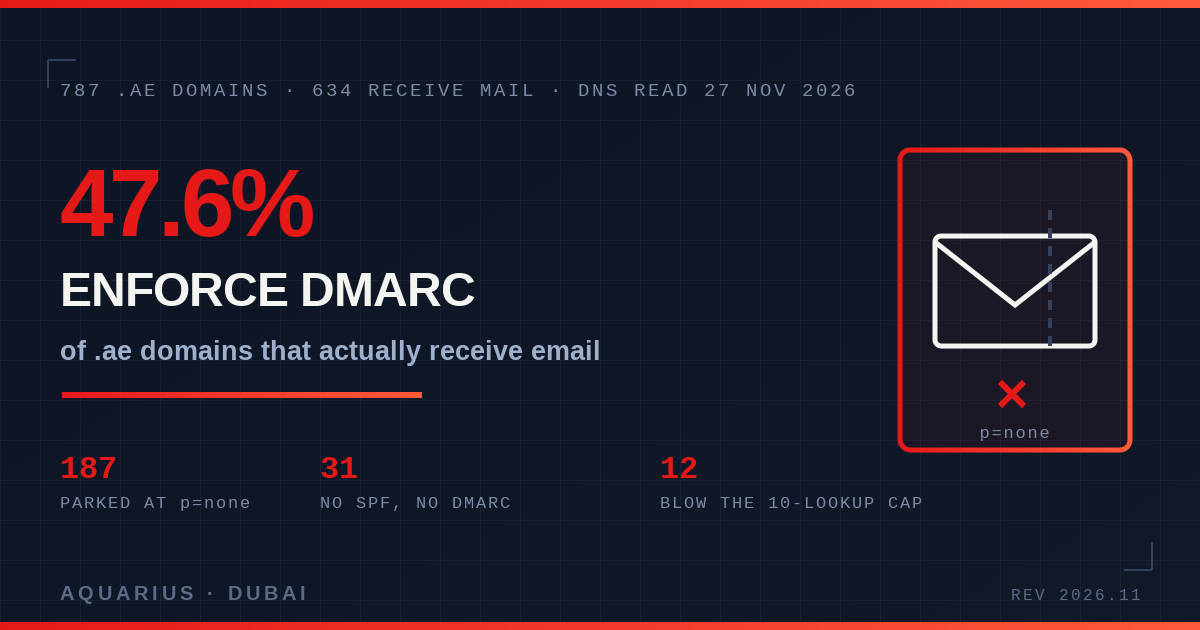
Short answer: on 27 November 2026 we read the live mail DNS of all 787 hosts on the Tranco .ae list. 634 of them actually receive email — and only 302 of those 634 (47.6%) publish a DMARC policy that does anything. 187 sit at p=none, which logs forgeries and delivers them anyway, and 31 publish neither SPF nor DMARC, so anyone on the internet can send mail as them today.
That matters more in the UAE than almost anywhere. The UAE Cyber Security Council puts more than 75% of cyber breaches as starting with a phishing email or fraudulent message, against a backdrop of over 3.4 billion phishing messages sent globally every day. And IBM’s Cost of a Data Breach 2026 puts the Middle East average breach at USD 8 million, with phishing the single most common initial attack vector — 18% of incidents, at an average USD 10.41 million each, roughly AED 38 million.
The headline myth this scan kills: “we set up SPF and DKIM, so our domain is protected.” It is not. SPF and DKIM authenticate a message. Only DMARC with p=quarantine or p=reject tells the receiving mail server what to do when authentication fails — and on the .ae domains that receive mail, 93.8% publish SPF but only 47.6% enforce. That 46-point gap is the whole finding.
What 787 .ae domains publish today
786 of the 787 hosts resolved in DNS. We split the numbers two ways, because they tell different stories: every resolving domain, and then only the 634 with an MX record — the ones that genuinely run email and therefore have no excuse.
| Record | All resolving (n=786) | Receive mail (n=634) | Only .gov.ae (n=94) |
|---|---|---|---|
| SPF published | 629 (80.0%) | 595 (93.8%) | 89 (94.7%) |
| DMARC record present | 519 (66.0%) | 489 (77.1%) | 79 (84.0%) |
p=none — monitor only | 196 | 187 | 22 |
p=quarantine | 143 | 140 | 26 |
p=reject | 180 | 162 | 31 |
| Actually enforcing | 323 (41.1%) | 302 (47.6%) | 57 (60.6%) |
| Neither SPF nor DMARC | 140 | 31 | 4 |
| MTA‑STS / TLS‑RPT | 21 / 22 | — | 5 / 3 |
BIMI (default._bimi) | 16 (2.0%) | — | 1 |
Two comparisons put those numbers in context. Globally, Valimail’s 2026 State of DMARC report found 78% of domains carry a DMARC record and 42% enforce — so the top .ae sites are marginally ahead of the world on enforcement (41.1% across all resolving domains, 47.6% among mail receivers) but no better than average. Meanwhile ORYXLABS and the UAE Cyber Security Council’s State of the GCC 2025, presented at GITEX GLOBAL in Dubai, scanned the regional long tail and found DMARC on just 12% of domains, with only 29% publishing a reporting address and two-thirds still letting unverified mail through. In our top-787 sample, 410 of 519 DMARC records (79%) do publish a rua= address. The visible brands are far ahead of the regional average — and still half-finished.
The p=none trap
p=none is a legitimate starting point. It is meant to last a few weeks while you read reports and find the senders you forgot about — the CRM, the invoicing tool, the recruitment portal, the office printer. It is not a destination. A domain at p=none gets reports and zero protection: a forged invoice from your domain still lands in your client’s inbox.
187 mail-receiving .ae domains are parked there, including some that will surprise you. e&’s eand.ae publishes SPF with a hard -all fail and no DMARC record at all. szgmc.ae publishes v=DMARC1; p=none; pct=100 with no reporting address, so it is not even collecting the data p=none exists to collect. 101 of the 489 DMARC records we found have no rua= — monitoring that nobody monitors.
Three SPF failures you cannot see from the inside
SPF is the record most Dubai businesses believe they have finished. Three failure modes in this scan say otherwise, and all three are invisible unless you check the DNS directly.
| Failure | Domains | What actually happens |
|---|---|---|
| Two SPF records on one domain | 10 | Instant PermError under RFC 7208 — SPF is treated as broken, not as pass or fail |
| Over the 10 DNS-lookup limit | 12 | Same PermError. Worst offender resolves 15 lookups |
| Sitting at exactly 10 lookups | 16 | Still valid — until one vendor adds one include and it breaks silently |
+all — pass anything | 1 | Authorises the entire internet to send as that domain |
?all — neutral | 6 | Equivalent to publishing no policy at all |
The duplicate-SPF list includes dubailand.gov.ae, eand.ae and szgmc.ae — each with two separate v=spf1 records, typically because a second vendor was onboarded by appending a new TXT record instead of editing the existing one. The +all domain is ubuy.ae, publishing v=spf1 include:_spf.google.com include:amazonses.com +all. The lookup-limit casualties include adu.ac.ae at 15, plus dctabudhabi.ae, deyaar.ae and dubaicareers.ae at 14 — all big multi-vendor stacks where each new SaaS tool added one more include. Every one of these is verified on two independent resolvers.
Of the 629 SPF records we parsed, the full distribution is reassuring at the bottom and alarming at the top: 253 domains resolve one include, 110 resolve two, and then a long tail where 28 domains sit at 10 or above. Encouragingly, zero .gov.ae domains exceed the limit.
Your mail provider predicts your policy
We grouped all 634 mail-receiving domains by MX provider. The split is the most actionable thing in the dataset.
| MX provider | .ae domains | Enforcing DMARC |
|---|---|---|
| Microsoft 365 | 205 | 59.5% |
| Other / self-hosted | 224 | 39.3% |
| Zoho | 15 | 33.3% |
| Google Workspace | 90 | 31.1% |
| Proofpoint / Mimecast gateways | 43 / 28 | — mostly enterprise, mixed |
A Dubai business on Google Workspace is roughly half as likely to enforce DMARC as one on Microsoft 365. That is not a product flaw; it is a setup-path artefact. Google’s own admin guidance has required SPF, DKIM and DMARC for bulk senders — anyone sending 5,000 or more messages a day to Gmail addresses — since 1 February 2024, alongside a spam-complaint rate kept below 0.30% and one-click unsubscribe headers. But the guidance explicitly allows the DMARC policy to be p=none, and that is exactly where most tenants stop. They are compliant and unprotected at the same time.
DKIM is the hardest thing to measure from outside, because selectors are arbitrary. Probing 16 common selectors, we found DKIM keys on 391 domains — selector1 (188 hits) and s1 (120) dominating, which is itself a Microsoft 365 and marketing-platform fingerprint. Treat 391 as a floor, not a census.
Where .ae is quietly ahead — and badly behind
Federal and emirate-level government is the strongest sector in the scan: 60.6% of .gov.ae domains enforce, a third of them at full p=reject. moi.gov.ae is the model answer — a single managed SPF include, p=reject; pct=100; sp=reject so subdomains inherit the policy, and MTA‑STS published on top. Four .gov.ae domains, including tahseel.gov.ae, still publish neither SPF nor DMARC.
Where the whole country is behind is the layer above DMARC. Only 21 of 786 domains publish MTA‑STS, which forces TLS on inbound SMTP and blocks downgrade interception, and only 22 publish TLS‑RPT to find out when delivery is being tampered with. Just 16 publish BIMI, the record that puts a verified logo next to your name in Gmail — emiratespost.ae, adx.ae, rakbank.ae, amazon.ae, deliveroo.ae and eleven others. At 2.0% that is actually below Valimail’s global 4%, and BIMI requires p=quarantine or p=reject first, so 338 .ae domains are not even eligible. For a market this brand-conscious, a verified logo in the inbox is cheap differentiation nobody has taken.
What it costs to fix in Dubai
This is not a big project. It is DNS, a reporting feed and the discipline to read it for a few weeks. Typical Dubai market ranges:
| Scope | What you get | Timeline | Typical Dubai range (AED) |
|---|---|---|---|
| Audit + emergency fixes | Duplicate SPF records merged, lookup count brought under 10, +all or ?all replaced with ~all, DKIM verified on every sender | 1–2 days | AED 1,200 – 3,500 |
Full DMARC rollout to p=reject | Reporting feed, every legitimate sender identified and aligned, staged none → quarantine → reject with sp= and pct= ramp | 6–10 weeks | AED 6,000 – 18,000 |
| Inbound hardening | MTA‑STS policy file served over HTTPS, TLS‑RPT, CAA records | 2–4 days | AED 2,000 – 5,000 |
| BIMI with verified logo | SVG Tiny‑PS mark, VMC certificate procurement, DNS publication | 3–6 weeks | AED 9,000 – 25,000 (certificate dominates) |
| Ongoing DMARC monitoring | Aggregate reports parsed weekly, alerts when a new sender appears or alignment breaks | ongoing | AED 800 – 2,500 / month |
Set that against the cost of inaction: a phishing-initiated breach in the Middle East averaged USD 10.41 million in IBM’s 2026 study, with USD 3.57 million of the regional average breach cost being lost business rather than remediation. A staged DMARC rollout is three orders of magnitude cheaper than the event it prevents.
How we do it at Aquarius: we start by reading your DNS exactly the way we read these 787 domains, then turn on reporting before changing a single policy — because the only way to reach p=reject without losing legitimate mail is to know every system that sends as you first. We ramp with pct= rather than flipping, and we set sp=reject so a forgotten subdomain cannot be used against you. Our published pricing starts at AED 500 for a Starter Site and AED 2,500 for an 8-page bilingual Business Site with SEO and AEO built in; correct SPF, DKIM and DMARC are configured as part of any site we launch, not billed as an extra. If you want the hands-on version of this, our SPF, DKIM and DMARC setup guide for UAE businesses walks the records line by line.
Risk reversal: send us your domain and we will run all 11 checks from this scan against it and tell you in one reply whether you are enforcing, monitoring or wide open — free, no audit fee, no obligation. If your DNS is already correct, we will say so in one line and leave you alone.
How we ran the scan
On 27 November 2026 we queried DNS-over-HTTPS for all 787 hosts on the Tranco .ae list: apex TXT for SPF, _dmarc. for DMARC, _mta-sts., _smtp._tls., default._bimi., MX and CAA, plus 16 common DKIM selectors on every domain with an MX record. SPF lookup depth was computed by recursively resolving every include, redirect, a, mx and exists term exactly as a receiving server would, with a shared cache. Every domain named in this article was then re-checked on a second independent resolver before publication; all claims held.
Two honest caveats. First, DKIM cannot be enumerated — a domain using a selector outside our list of 16 will read as “no DKIM found” here even though it signs correctly, so the 391 figure understates reality. Second, a published policy is not the same as a correctly operated one: a domain at p=reject whose SPF misses a legitimate sender is losing real mail, and that failure is invisible from outside. Both caveats cut the same way, though — neither affects the central finding, which is that the records are simply absent or inert on half of the .ae domains that run email. For the matching picture on web transport, see our TLS certificate scan of .ae homepages.
FAQ
Is DMARC mandatory in the UAE?
There is no single federal rule that obliges every UAE business to publish DMARC. What exists is pressure from three directions: Google and Yahoo require SPF, DKIM and DMARC from bulk senders to their users (5,000+ messages a day to Gmail since 1 February 2024), sector regulators and large enterprise procurement increasingly ask for it, and the UAE Cyber Security Council treats phishing as the dominant breach vector. Treat it as a market requirement rather than a legal one — the practical effect is the same.
Will moving to p=reject stop my own emails from arriving?
Only if you skip the reporting stage. The whole purpose of p=none with a rua= address is to surface every system sending as your domain — and in a typical Dubai SME that list is longer than anyone expects: accounting software, a booking engine, two marketing tools, a recruitment portal, the e-commerce platform. Align each one, ramp with pct=, then enforce. 101 domains in our scan published DMARC with no reporting address, which is the way to get this wrong.
Why would a domain have two SPF records?
Because adding a TXT record feels like the obvious way to onboard a new email vendor. It is not: RFC 7208 allows exactly one v=spf1 record per domain, and a second one makes the result a PermError — worse than having none, because receivers can no longer evaluate you at all. Ten .ae domains in this scan are in that state right now. The fix is to merge the include terms into a single record and delete the other.
What is the 10-lookup limit and how do I check mine?
An SPF evaluation may trigger at most 10 DNS lookups; past that, receivers must return PermError. Each include, redirect, a, mx and exists term counts, and nested includes count too — one vendor include can quietly cost you four. Count recursively, not by eyeballing your record: 16 .ae domains are sitting at exactly 10, one vendor away from breaking, and they look perfectly healthy today.
Is BIMI worth it for a Dubai business?
Only after enforcement. BIMI needs p=quarantine or p=reject plus a Verified Mark Certificate, and the certificate is the bulk of the cost. If you are a consumer-facing UAE brand sending transactional mail at volume, a verified logo in Gmail is a real trust signal that 770 of 786 .ae domains do not have. If you are B2B and send 200 emails a month, fix DMARC and spend the certificate money elsewhere.
The takeaway
93.8% of the .ae domains that receive mail publish SPF. 47.6% enforce DMARC. The gap between those two numbers is the attack surface, and it exists because SPF feels like the finish line and DMARC feels like a project. It is not a project — it is three DNS records, a reporting feed and six weeks of attention. If you want to know which side of that gap your domain is on, send us the domain and we will tell you today.