
Employee Intranet and Staff Portal Development in Dubai (2026): SharePoint vs Custom, Real AED Costs
Most Dubai companies run internal comms on WhatsApp groups and a shared drive. What a real staff portal costs in AED in 2026, when SharePoint is enough, and when a custom build pays for itself.
- PUBLISHED
- 12 OCT 2026
- READ TIME
- 12 MIN
- AUTHOR
- AQUARIUS · DUBAI
- UNIT
- REV 2026.09
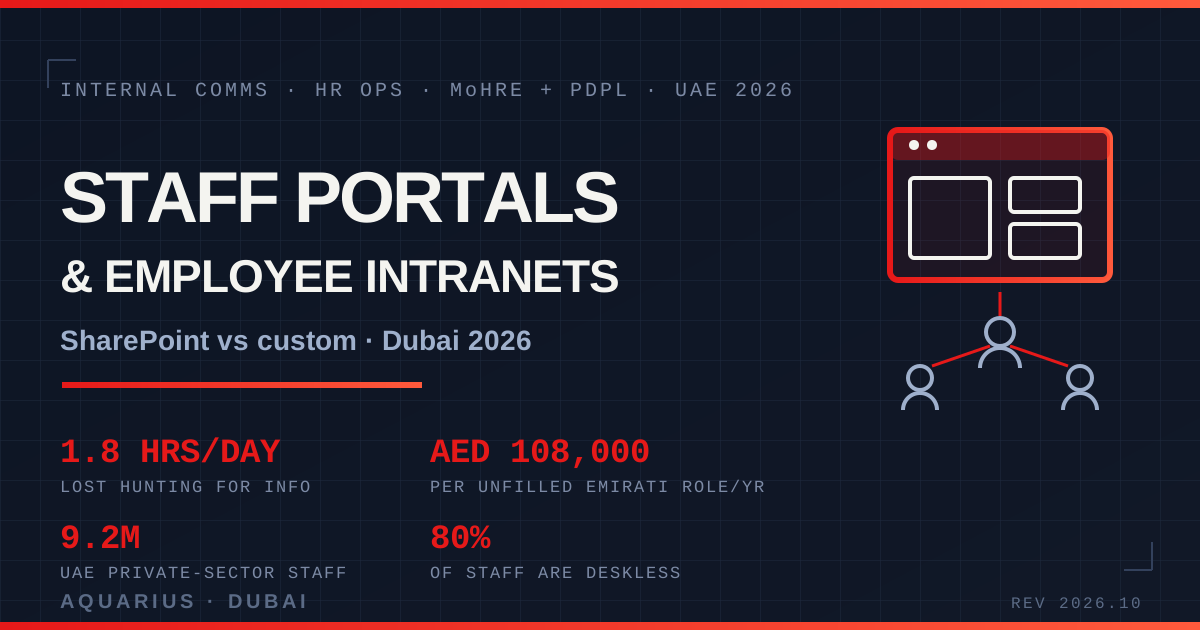
Short answer: if your company already pays for Microsoft 365, build the intranet on SharePoint and Viva Connections first — both are included in every M365 plan at no extra licence cost, and a configured, branded SharePoint intranet lands at roughly AED 25,000–75,000 in Dubai. Go custom (AED 90,000–350,000+) only when the portal has to do real work that SharePoint cannot: Arabic-first and multi-language content for a 95%-expatriate workforce, mobile-first access for deskless staff, live Emiratisation and WPS data, document approvals with an audit trail, and PDPL-compliant storage of employee data.
Here is the part most Dubai businesses get wrong: they treat the intranet as an IT housekeeping project and so it never gets funded. It is not. It is a productivity line item. McKinsey’s long-cited research puts the time an employee spends simply searching for information at 1.8 hours a day — 9.3 hours a week, close to a quarter of the working week. On a 200-person Dubai company with an average all-in cost of AED 15,000 a month per head, clawing back even a third of that is worth over AED 2 million a year. A WhatsApp group does not do that. A searchable portal does.
Key takeaways
- The UAE private-sector workforce grew 2.5% in Q1 2026 (MoHRE) on a base of roughly 9.2 million workers, about 95% expatriate — so a Dubai intranet is a multi-language, multi-nationality problem from day one.
- Viva Connections and Viva Engage are included free in all Microsoft 365 plans. If you are paying for M365 you already own an intranet platform you are probably not using.
- Microsoft 365 E3 rises from US$36 to US$39 per user per month on 1 July 2026 (+8%), so licence-efficiency now beats adding another SaaS tool.
- Emiratisation non-compliance costs roughly AED 9,000 per month per unfilled Emirati role — about AED 108,000 a year. A portal that surfaces the live quota number is a compliance control, not a nice-to-have.
- 80% of the world’s workforce is deskless (around 2.7 billion people) yet has historically received about 1% of enterprise software spend — the single biggest gap in Dubai construction, hospitality, retail and logistics.
- UAE workers lead the world on AI adoption at 70.1% of the working-age population, and 40% go to an AI tool first with a work question (vs 31% globally). If your portal has no AI search, your policies lose to a chatbot guess.
Why 2026 is the year Dubai staff portals stopped being optional
Three numbers set the stakes.
First, scale and churn. MoHRE data shows the UAE private-sector workforce expanded 2.5% in the first quarter of 2026, with skilled roles up 1.5%, on a base of about 9.2 million private-sector workers of whom roughly 95% are expatriates. More than 190,000 Emiratis are now employed in the private sector across 32,000 companies, and 123,388 Emirati women were in private-sector roles by the end of H1 2026 — up more than 128% on 2023. Dubai teams are growing, nationalising and reshuffling at the same time. Every new joiner is an onboarding cost, and onboarding is exactly what an intranet industrialises.
Second, the technology gap on the front line. Deskless workers are roughly 80% of the global workforce, about 2.7 billion people, and have historically absorbed only about 1% of enterprise software spend. In Dubai that 80% is your site crew in Jebel Ali, your housekeeping team in Deira, your drivers, your retail floor in Dubai Mall. They do not have a desktop, a corporate email habit, or a quiet moment to read a PDF. If the portal is not mobile-first and readable on a AED 400 Android handset, it does not exist for most of your company.
Third, the market is already moving. The UAE employee-experience management market was US$52.1 million in 2023 and is forecast to reach US$83.0 million by 2028 (MarketsandMarkets), a 9.8% CAGR. Around 50% of UAE companies are expected to be running hybrid models in 2026, with digital HR system adoption near 65%. Your competitors are buying this.
And the behaviour change nobody planned for: the UAE now ranks first globally for AI adoption, at 70.1% of the working-age population in Q1 2026. 78% of UAE respondents use AI tools daily or weekly (vs 59% globally), 57% use autonomous agents (vs 43%), and 40% reach for AI first when they need an answer at work, against a 31% global benchmark. Read that as a warning: if your leave policy, expense limits and HSE procedure are not in a searchable internal system, your staff are not reading the correct policy. They are asking a public chatbot to guess at it.
What a Dubai staff portal actually needs to contain
Strip the vendor brochures away and a UAE intranet earns its budget on seven things.
1. Employee self-service (the volume killer)
Payslips, leave balances and requests, salary certificates, NOC letters, visa and Emirates ID expiry alerts, end-of-service gratuity estimates. In most Dubai SMEs an HR coordinator answers these by WhatsApp one at a time. Self-service removes 60–80% of that queue and gives you a timestamped record of every request — which matters when a labour claim lands at MoHRE.
2. One searchable source of policy
HR handbook, HSE procedures, IT acceptable-use, delegation of authority, travel and expense limits — versioned, dated, searchable in English and Arabic, with read-receipts for the policies that need acknowledgement.
3. Arabic and multi-language content
A workforce that is ~95% expatriate across dozens of nationalities is not served by English-only text. Proper RTL layout for Arabic plus translated versions of safety-critical content (commonly Hindi, Urdu, Malayalam, Tagalog, Bengali on UAE sites) is the difference between a policy published and a policy understood. If you are building bilingual, read our notes on Arabic website localisation and RTL done properly.
4. Mobile-first and deskless-friendly
Phone-number login rather than corporate email, a PWA or light app, offline reading for site crews with bad coverage, push for urgent notices, large tap targets. This is the single most skipped requirement in Dubai intranet projects and the main reason adoption dies at 20%.
5. Compliance surfaces
Emiratisation quota status, WPS payroll run confirmation, document-expiry dashboards, training and certification records. Firms with 50 or more skilled workers must raise Emirati representation in skilled roles by 2 percentage points a year, reaching 10% by the end of 2026, and 95% of mandated companies met their targets in H1 2026 — so being in the non-compliant minority is now conspicuous as well as expensive. For the mechanics, see our guide to Emiratisation and NAFIS compliance software.
6. Approvals with an audit trail
Leave, expenses, purchase requests, document sign-off. If it currently runs on email threads, you have no audit trail. This overlaps heavily with document management and approval workflow systems — build them as one project, not two.
7. AI search over your own content
Given the 40%-ask-AI-first behaviour above, the answer is not to ban the chatbot. It is to give staff a better one: retrieval-augmented search over your actual policy set, citing the document and version it answered from, with employee data kept inside your tenancy.
SharePoint vs off-the-shelf vs custom: the real comparison
Almost every Dubai company lands in one of three places. The deciding factor is rarely features — it is whether your portal must hold live operational data.
| Option | Typical Dubai build cost (AED) | Ongoing licence | Best fit | Where it breaks |
|---|---|---|---|---|
| SharePoint + Viva Connections (configured, branded) | 25,000 – 75,000 | Included in your existing M365 plan | Office-based teams of 50–1,000 already on Microsoft 365 | Deskless access, Arabic-first design, live HR/ERP data, complex approvals |
| Off-the-shelf intranet SaaS (employee-app products) | 15,000 – 60,000 setup | Roughly AED 15–45 per user per month | Fast launch, heavy internal-comms and engagement focus | Per-user cost at 500+ staff, data residency, deep integrations |
| Custom portal (web + PWA, your cloud) | 90,000 – 350,000+ | Hosting + support only, typically AED 2,500–9,000 per month | 1,000+ staff, deskless majority, multi-entity groups, HR/ERP integration, PDPL-sensitive data | Needs real ownership: a product owner and a maintenance budget |
Two licence facts should shape that decision in 2026. Viva Connections and Viva Engage are included in all Microsoft 365 plans at no additional cost — most Dubai companies are already paying for an intranet platform they have never switched on. If you want more, Viva Employee Communications and Communities is about US$2 per user per month, and the full Viva Suite around US$12. Meanwhile Microsoft 365 E3 goes from US$36 to US$39 per user per month on 1 July 2026 (an 8% rise, with Defender for Office 365 P1 folded in). In the UAE, entry M365 plans start around AED 23 per user per month and full desktop-app plans run AED 46–82. At 300 staff, a AED 30 per user per month SaaS intranet is AED 108,000 a year, every year — which buys a custom build outright in year two. Run that arithmetic before you sign an annual subscription. Our broader Google Workspace vs Microsoft 365 comparison for Dubai has the licence maths in full.
The PDPL question: where does employee data live?
An intranet holds some of the most sensitive data in the business: passport and visa scans, salaries, medical and insurance records, disciplinary files, next-of-kin details. Under the UAE Personal Data Protection Law (Federal Decree-Law No. 45 of 2021) that is all personal data, and employees are data subjects with rights.
The practical constraint is cross-border transfer. The PDPL restricts moving personal data outside the UAE unless the destination offers an adequate level of protection or you have put proper safeguards in place such as standard contractual clauses, and 2026 guidance has made clear that a documented transfer risk assessment is expected before the transfer happens, not after. For a staff portal that means three concrete decisions:
- Know your hosting region. UAE regions from the major clouds exist for exactly this reason; pick one deliberately rather than inheriting a vendor default in Ireland or Virginia.
- Map your sub-processors. Every SaaS add-on, every AI API, every analytics script in the portal is a potential transfer. Document the chain.
- Minimise. The portal does not need to store a passport scan to show a visa-expiry date. Store the date, not the document, wherever you can.
The off-the-shelf route is where this quietly goes wrong: a cheap per-user intranet that stores HR files in an unnamed region is a documented PDPL exposure in exchange for a saving of a few thousand dirhams. Our UAE PDPL compliance checklist covers the controls in detail, and private LLM and data-residency options cover the AI-search half.
Build sequence: how to get adoption instead of a dead homepage
Most failed intranets fail identically — a beautiful launch, a news carousel nobody reads, 15% monthly actives by month three. The fix is sequencing: lead with transactions, not content.
- Weeks 1–2: pick the three transactions. Usually payslip access, leave request, and salary/NOC letter request. Measure the current volume so you can prove the saving later.
- Weeks 3–6: ship those three, mobile-first. Phone login, Arabic and English, works on a mid-range Android. Nothing else.
- Weeks 7–10: add search and policy. Load the real handbook, version it, add acknowledgement tracking for safety-critical documents.
- Weeks 11–14: integrate. HR or payroll system, document expiry, Emiratisation and WPS status. This is where the portal becomes the system of record rather than a brochure.
- Then add news, recognition, surveys and AI search — once people already open the app weekly for a reason that benefits them.
Target metric, not vanity: weekly active users above 60% of headcount by month three, and a measurable drop in HR ticket volume. If you are integrating payroll, our guide to HR and payroll software development with WPS in Dubai covers the file formats and bank handshakes.
What this costs with Aquarius, and the number that decides it
Our 2026 Dubai ranges: a branded SharePoint and Viva Connections intranet with the three core transactions, AED 25,000–75,000, typically live in 4–6 weeks. A custom mobile-first staff portal with self-service, bilingual policy library, approvals, HR integration and UAE-region hosting, AED 90,000–350,000 depending on integration count, with support from AED 2,500 per month. AI policy search over your own documents adds roughly AED 20,000–60,000. All AED-first, VAT handled, full source and cloud-account handover. See our pricing for how the engagement models compare.
The cost-of-inaction number is the one to take to your finance director. Hold the McKinsey figure of 9.3 hours a week per employee lost to information hunting against your own payroll: at 200 staff and AED 15,000 a month all-in, a one-third reduction is worth north of AED 2 million a year. Add the compliance exposure — roughly AED 108,000 a year per unfilled Emirati role — and a portal that keeps the quota visible pays for itself by preventing one bad quarter. Against that, a AED 75,000 SharePoint build is not an IT expense. It is the cheapest productivity purchase on the 2026 budget.
FAQ
How much does an employee intranet cost in Dubai in 2026?
A configured, branded SharePoint and Viva Connections intranet runs AED 25,000–75,000 with no extra licence cost if you already have Microsoft 365. Off-the-shelf intranet SaaS is typically AED 15,000–60,000 to set up plus about AED 15–45 per user per month. A custom mobile-first portal is AED 90,000–350,000+ with hosting and support from around AED 2,500 a month.
Is SharePoint enough, or do we need a custom portal?
SharePoint is enough for an office-based team that mainly needs news, documents and policy search — and you already own it. Go custom when the portal must serve a deskless majority on mobile, be Arabic-first, hold live HR, payroll or Emiratisation data, run multi-step approvals with an audit trail, or keep employee data in a specific UAE region for PDPL reasons.
Do we already have an intranet with Microsoft 365?
Almost certainly. Viva Connections and Viva Engage are included in all Microsoft 365 plans at no additional cost, and SharePoint Online comes with the business and enterprise tiers. Most Dubai companies are paying for the platform and using it as a file dump. Note that M365 E3 rises from US$36 to US$39 per user per month on 1 July 2026, which makes using what you own the cheaper move.
Where should employee data be hosted for UAE PDPL compliance?
Prefer a UAE cloud region. The PDPL restricts transfers of personal data outside the UAE unless the destination provides an adequate level of protection or you have safeguards such as standard contractual clauses, and 2026 guidance expects a documented transfer risk assessment before any cross-border transfer. Map every sub-processor the portal touches, including AI APIs, and minimise what you store.
How long does a staff portal take to build?
A SharePoint-based intranet with core self-service is typically 4–6 weeks. A custom mobile-first portal with HR integration is 10–16 weeks, shipped in the sequence above so the first useful version lands around week six rather than at the end.
How do we stop adoption dying after launch?
Launch transactions, not content. If the first thing the portal does is deliver a payslip and approve a leave request on a phone, people return weekly without being chased. News, recognition and surveys work only on top of that habit. Track weekly actives as a percentage of headcount — aim above 60% by month three — and watch HR ticket volume fall.
Running your internal comms on WhatsApp groups and a shared drive? Send us your headcount, your Microsoft 365 plan and your three worst HR bottlenecks. We will tell you honestly whether SharePoint covers it or whether a custom portal is justified — and give you the AED number either way. Talk to Aquarius.