
EMR Software for Dubai Clinics 2026: NABIDH Integration & Cost
Every DHA clinic must connect to NABIDH. EMR and integration costs AED 15,000–60,000 upfront in 2026 — plus eClaimLink, 25-year UAE data rules and options.
- PUBLISHED
- 17 SEPT 2026
- READ TIME
- 10 MIN
- AUTHOR
- AQUARIUS · DUBAI
- UNIT
- REV 2026.09
Short answer: Every DHA-licensed clinic in Dubai must connect its EMR to NABIDH, the emirate’s health information exchange, as a condition of its facility licence — and keep all patient data inside the UAE for at least 25 years. A NABIDH-certified off-the-shelf EMR plus integration typically costs AED 15,000–60,000 upfront and AED 500–3,000 a month; a custom EMR takes around 3–4 months to integrate. The real decision is not “which EMR” but whether your system also handles eClaimLink claims, e-prescriptions and patient booking without double entry.
Most Dubai clinic owners get one thing wrong: they buy an EMR for the doctors and discover at go-live that NABIDH, insurance claims and the patient-facing website are three separate projects. This guide shows how the pieces fit, what each option costs in AED, and how to pick without paying twice.
Why EMR software is now a licensing issue in Dubai
Three numbers explain why clinic software stopped being an IT preference and became a regulatory one:
- 5,800 licensed facilities. Dubai had approximately 5,800 licensed healthcare facilities in 2025, up from 5,340 in 2024 — growth of more than 8% — with the private healthcare workforce passing 69,400 professionals (Dubai Media Office, February 2026). More facilities means more competition for the same insured patients.
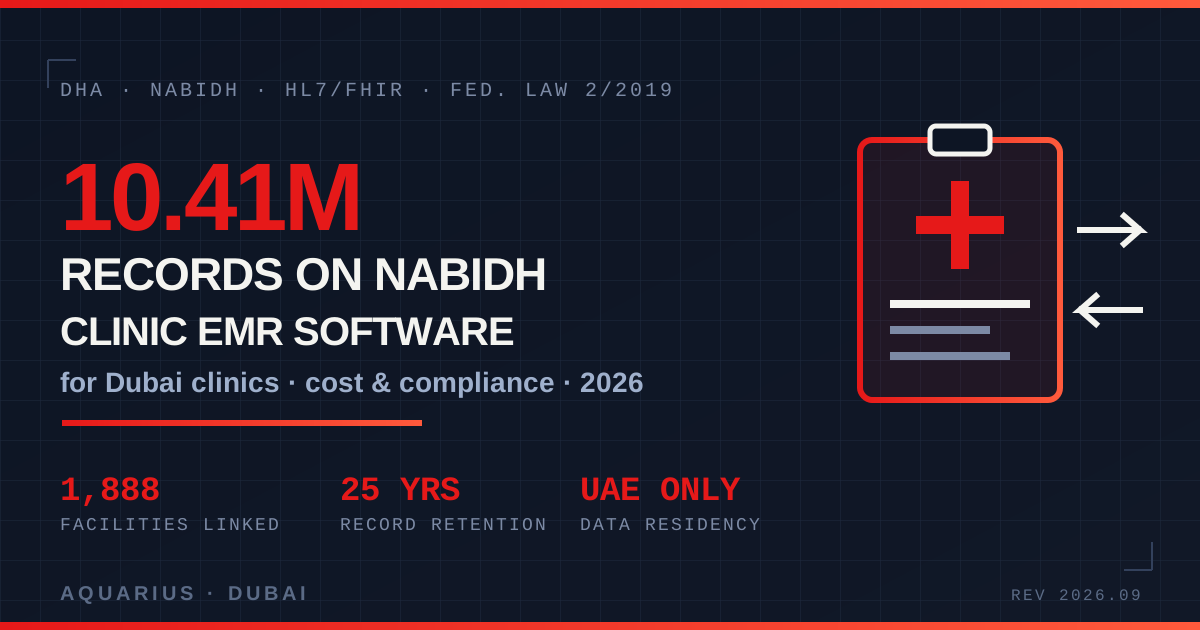
- 10.41 million records on NABIDH. By the end of June 2025, NABIDH held more than 10.41 million patient records from 1,888 connected facilities, 91 EMR systems and 53,659 healthcare professionals. Six months earlier the count was about 9.47 million records across 1,300+ facilities. If your EMR is not on that list, your clinic is the gap.
- 25 years of retention, inside the UAE. Federal Law No. 2 of 2019 on ICT in health fields requires health data to be kept for at least 25 years from the last procedure, and bars storing, processing or transferring UAE health data outside the country without health-authority approval. That rules out many overseas-hosted SaaS tools by default.
Put together: an EMR in Dubai is not just a charting tool. It is the pipe your clinic uses to meet DHA licence conditions, get paid by insurers and prove data residency.
Myth-bust: “Our EMR is cloud-based, so NABIDH is handled”
Cloud does not mean compliant. Three things have to be true at once:
- The EMR is NABIDH-certified (or your custom system passes DHA’s conformance testing). Integration uses HL7 and FHIR messaging, with diagnoses coded in ICD-10-CM and procedures in CPT.
- Your facility is onboarded. The clinic goes through user acceptance testing against DHA scenarios — registration, encounter, prescription, lab — and DHA signs off before go-live.
- Every copy of the data stays in the UAE. Not just the live database: backups, logs and failover servers too.
A popular international EMR hosted in Frankfurt or Virginia can fail the third test even if its features are excellent.
The three UAE health exchanges your software may touch
Which exchange you integrate with depends on where your facility is licensed. Multi-emirate groups often need more than one.
| Exchange | Regulator | Covers | Scale (latest public figure) |
|---|---|---|---|
| NABIDH | Dubai Health Authority (DHA) | DHA-licensed facilities in Dubai | 10.41M+ records, 1,888 facilities, 91 EMRs (June 2025) |
| Malaffi | Department of Health – Abu Dhabi | Abu Dhabi facilities | 3,000+ facilities on 90+ EMR systems |
| Riayati | Ministry of Health and Prevention (MOHAP) | Federal facilities in the Northern Emirates | Linked with NABIDH and Malaffi since January 2023 |
Sources: DHA / MedEdge MEA (H1 2025 NABIDH figures); DoH Abu Dhabi and SNOMED International (Malaffi); MOHAP announcement on Riayati–Malaffi–NABIDH integration.
What a Dubai clinic system actually has to do
NABIDH is the compliance floor. A system that pays for itself covers the whole patient journey:
1. Clinical charting with correct coding
SOAP notes, vitals, allergies and problem lists — with ICD-10-CM and CPT pick-lists built in, so the codes that go to NABIDH and to the insurer are the same codes the doctor chose.
2. NABIDH message feed
Registrations, encounters, diagnoses, prescriptions and lab results sent as HL7/FHIR messages in near real time, with a queue that retries failures and a dashboard that shows what did not send.
3. eClaimLink and the DHPO eRx Hub
Dubai insurance claims flow through DHA’s eClaimLink standard via the DHPO platform, and e-prescriptions go through the same hub so the insurer returns coverage feedback before the patient leaves. Claims should leave the EMR directly — not be re-typed into a separate billing portal.
4. Online booking and reminders
Doctor calendars, online appointment booking, WhatsApp reminders and Emirates ID capture at registration. Our clinic website and booking system guide covers the patient-facing side in detail.
5. UAE hosting, access control and audit logs
Role-based access, encryption, full audit trails and UAE-region hosting for primary data, backups and logs — designed around the 25-year retention rule, not bolted on later.
Off-the-shelf, customised or custom: the real trade-offs
| Approach | Typical 2026 cost | Time to NABIDH go-live | Best for | Watch out for |
|---|---|---|---|---|
| NABIDH-certified clinic EMR (SaaS) | AED 15,000–60,000 upfront + AED 500–3,000/month | 4–12 weeks | Single clinics, dental and GP practices | Per-user fees, rigid workflows, weak booking and website tools |
| Certified EMR + custom integrations | EMR cost + a scoped integration build | 6–14 weeks | Growing clinics that need booking, WhatsApp, CRM or BI on top | Depends on the EMR vendor exposing an API |
| Custom EMR / HMS | Project-quoted; the largest upfront spend | ~3–4 months for integration alone | Multi-branch groups, specialty centres, telehealth-first providers | You own DHA conformance testing and long-term maintenance |
Cost and timeline ranges: published 2026 Dubai NABIDH integration pricing (Spectronix Consultancy) — EMR licence AED 12,000–40,000, connector AED 8,000–25,000, UAE cloud hosting AED 500–3,000/month, training AED 2,000–6,000.
For most Dubai clinics, the middle row wins: let a certified EMR carry the compliance burden, and build only what makes the clinic different — the booking funnel, the patient app, the referral CRM, the owner dashboard.
The hidden cost: claims that bounce
The software line item is visible. Revenue lost to billing errors is not. Dubai billing firms report that clinics with poorly managed systems see 8–20% of claims denied, and that many UAE clinics lose 5–20% of potential revenue to unresolved denials — with fewer than a third of denied claims ever recovered (Medimate, Escrow Healthcare, 2026). Mismatched diagnosis and procedure codes are among the most common triggers.
Run the arithmetic for a clinic billing AED 150,000 a month to insurers: even a 5% leak is AED 7,500 a month, or AED 90,000 a year — more than the upfront cost of most certified EMR setups. Coding inside the EMR, validated before the claim leaves, is where that money comes back.
What Aquarius builds for Dubai clinics
We are a software studio, not an EMR vendor — so we do not push you onto a licence. Typical project scopes:
| Scope | What you get | Timeline |
|---|---|---|
| Clinic website + online booking | Bilingual site, doctor profiles, live booking synced to your EMR calendar, WhatsApp reminders | 3–6 weeks |
| Integration layer | API bridges between your certified EMR and booking, CRM, payments, WhatsApp and BI dashboards; UAE-hosted | 4–8 weeks |
| Custom patient portal or telehealth app | Patient app, records view, teleconsults, FHIR-based data exchange with your EMR | 10–16 weeks |
Every project is fixed-quoted after discovery — see our pricing and services. Planning virtual consults? Read our telemedicine app development guide first.
- Compliance first: UAE-region hosting for data, backups and logs from day one.
- No double entry: one patient record flows from booking to chart to claim.
- Honest boundaries: DHA licensing and NABIDH sign-off stay with your facility and your certified EMR vendor; we build around them and tell you when a certified off-the-shelf EMR is the smarter first step.
Frequently asked questions
Is NABIDH integration mandatory for clinics in Dubai?
Yes. DHA-licensed healthcare facilities must connect to NABIDH as a condition of obtaining and maintaining their facility licence, regardless of size or specialty.
How much does NABIDH integration cost in Dubai?
Published 2026 ranges put a certified EMR licence at AED 12,000–40,000 and the NABIDH connector at AED 8,000–25,000, for a typical total of AED 15,000–60,000 upfront plus AED 500–3,000 a month for UAE hosting and support.
Can a Dubai clinic use an EMR hosted outside the UAE?
Generally no. Federal Law No. 2 of 2019 prohibits storing, processing or transferring health data related to services provided in the UAE outside the country unless the health authority grants an exception — and that applies to backups and logs too.
How long must medical records be kept in the UAE?
At least 25 years from the date of the patient’s last health procedure, under Article 20 of Federal Law No. 2 of 2019.
Should my clinic build a custom EMR?
Usually not at first. A NABIDH-certified EMR plus custom integrations for booking, WhatsApp and reporting is faster and cheaper. Custom EMRs make sense for multi-branch groups or specialty and telehealth models that off-the-shelf tools cannot support.
Opening or scaling a clinic in Dubai? Talk to Aquarius about connecting your EMR, booking, WhatsApp and insurance workflow into one system — so the next DHA audit and the next month-end claims run are both non-events.