
ERPNext Implementation Cost in Dubai (2026): Why AED 0 Software Is Not a Free ERP
ERPNext charges no per-user licence, so Dubai firms assume it is cheap. Real 2026 AED implementation tiers, hosting maths, UAE tax and e-invoicing gaps, and when it beats Odoo.
- PUBLISHED
- 16 OCT 2026
- READ TIME
- 11 MIN
- AUTHOR
- AQUARIUS · DUBAI
- UNIT
- REV 2026.09
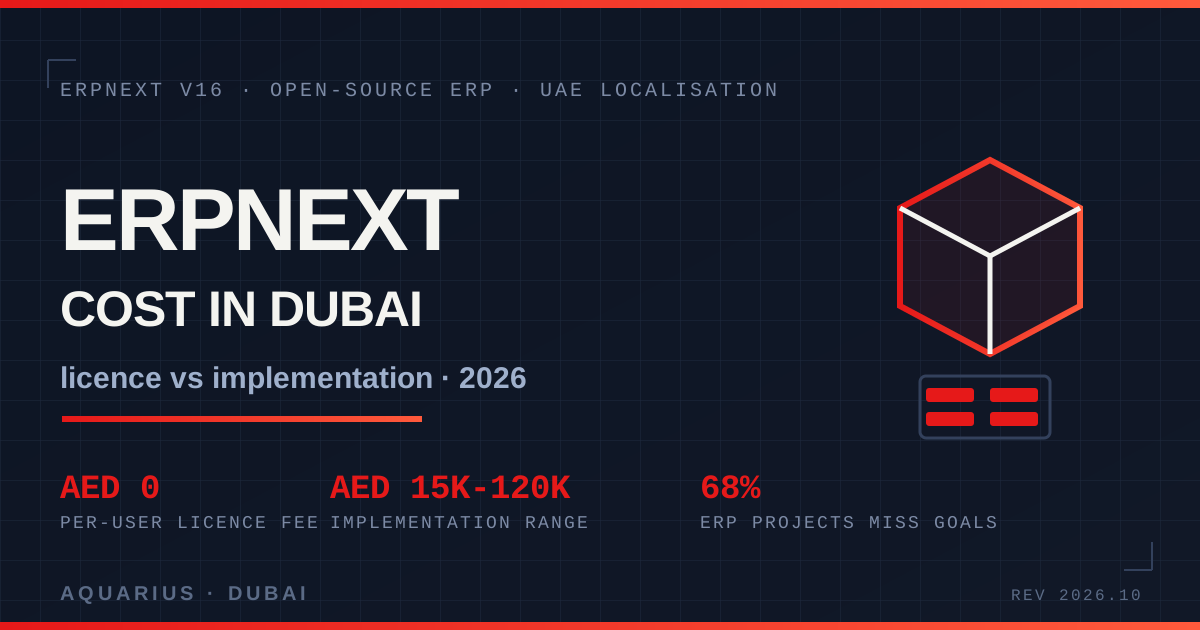
Short answer: ERPNext itself costs AED 0 — it is fully open-source with no per-user licence fee — but a real Dubai implementation runs AED 15,000–40,000 for a 1–10 user SME, AED 40,000–120,000 for a 10–50 user mid-market rollout, and AED 120,000+ for 50 users and above. Hosting on Frappe Cloud starts around USD 5 per month for a shared site and USD 40 per month for a dedicated server, and support or AMC typically adds AED 800–2,500 a month.
Here is the thing most Dubai businesses get wrong about ERPNext: they compare a zero-dirham licence against Odoo’s per-user fee, declare victory, and then discover that the licence was never the expensive part. The expensive part is the UAE tax localisation, the data migration out of fifteen years of spreadsheets, and the e-invoicing plumbing the Federal Tax Authority has now put a deadline on. ERPNext saves you a recurring licence. It does not save you an implementation.
Key takeaways
- No licence, no user limit. ERPNext is 100% open-source. Frappe Cloud bills by compute — CPU, RAM, storage — not per seat, so adding your twentieth warehouse user costs nothing extra.
- v16 landed 12 January 2026, after a November 2025 beta, with a performance overhaul the project claims delivers up to 2x faster page loads and reports.
- Implementation is the real bill: AED 15,000–40,000 (small), AED 40,000–120,000 (mid), AED 120,000+ (enterprise).
- VAT is covered; e-invoicing is not. ERPNext has a UAE VAT 201 report out of the box, but it is only “Corner 1” of the Peppol chain — you still must appoint an FTA-Accredited Service Provider.
- 68% of ERP projects miss their original objectives (Panorama Consulting, 2025–2026 data). Free software does not move that number. Scope discipline does.
Why Dubai SMEs are pricing ERPs right now
Three numbers explain the 2026 rush, and none of them are about software fashion.
First, volume. 71,830 new companies joined Dubai Chamber of Commerce during 2025, taking active membership to 292,486 by year-end, and 2,709 more joined in March 2026 alone. That is a very large cohort of firms that started on Excel and QuickBooks and has now outgrown both.
Second, the money is already committed. The UAE ERP software market generated roughly USD 631.8 million in 2025 and is forecast to reach USD 1.50 billion by 2033 at an 11.6% compound rate. Cloud took 60.98% of that 2025 spend — for SMEs here the on-premise era is finished.
Third, the deadline. Ministerial Decisions No. 243 and 244 of 2025, issued 28 September 2025, set the UAE e-invoicing rollout. A voluntary pilot opens 1 July 2026. Businesses with revenue of AED 50 million or more must appoint an Accredited Service Provider by 30 October 2026 and go live 1 January 2027. Everyone else appoints an ASP by 31 March 2027 and goes live 1 July 2027, with business-to-government following on 1 October 2027. Invoices must be structured XML in the PINT AE format over a Peppol-based 5-corner model.
Any ERP decision you make in Dubai this year is really an e-invoicing decision wearing an ERP budget. Ask the ASP question in the first meeting, not the last.
What ERPNext actually is — and what the AED 0 covers
ERPNext is a full-stack ERP built on the Frappe Framework: accounting, stock, manufacturing, CRM, projects, HR and payroll, all in one codebase, all under an open-source licence. Version 16 reached general release on 12 January 2026 following a beta in November 2025, backed by a contributor community in the high hundreds, and shipped a caching and performance overhaul the project benchmarks at up to 2x faster page loads and report generation.
What AED 0 buys you: every module, unlimited users, the source code, and the right to self-host anywhere — including on a UAE-region server, which matters if your data-residency policy or your bank’s due-diligence questionnaire cares where the database lives.
What AED 0 does not buy you: a chart of accounts that matches your business, your item master cleaned and imported, approval workflows, Arabic print formats, your bank feed, your WPS payroll file, or anybody answering the phone at 9pm when the stock entry will not submit. Those are services, and services in Dubai are priced in dirhams.
ERPNext implementation cost in Dubai: 2026 AED tiers
Certified UAE partner pricing clusters tightly. The figures below are the ranges quoted across Dubai-based ERPNext partners in 2026 for one-time implementation, excluding hosting and ongoing support.
| Company size | One-time implementation (AED) | Typical scope | Realistic timeline |
|---|---|---|---|
| 1–10 users | 15,000–40,000 | Accounting, VAT, sales, purchase, basic stock | 4–8 weeks |
| 10–50 users | 40,000–120,000 | Add manufacturing or projects, HR and payroll, 2–4 integrations | 3–6 months |
| 50+ users | 120,000+ | Multi-company, multi-currency, custom apps, phased rollout | 6–12 months |
| Entry “starter” packages | 1,999–9,999 | Standard setup, 1–5 employees, minimal customisation | 1–3 weeks |
Those AED 1,999 starter packages are real and they are honest about what they are: a configured instance, not a transformation. If your business genuinely runs on invoices, receipts and a stock list, that is the right tier and anyone selling you AED 80,000 of discovery is selling you a slide deck. If you have three legal entities, inter-company transfers and a bonded warehouse, the starter tier will fail in month two.
The running costs nobody quotes upfront
Frappe Cloud, the first-party managed option, publishes Sites from USD 5 per month on shared infrastructure and Servers from USD 40 per month for a dedicated virtual machine — billed on compute, never per user. Realistic production sites for a Dubai SME land at USD 50–200 per month (roughly AED 185–735) once you want dedicated workers, proper RAM and backups. Self-hosting on AWS Middle East (UAE) or a local provider is the other route, and Dubai partners quote AED 1,000–5,000 per year for light setups rising to AED 1,500–4,000 per month for serious infrastructure with managed ops on top.
Add an AMC or support retainer of AED 800–2,500 per month and your year-two run rate for a 25-user ERPNext deployment sits around AED 15,000–40,000 — with the software line still reading zero.
ERPNext vs Odoo vs NetSuite: the five-year AED maths
This is where the open-source argument either wins or collapses. Below is a like-for-like five-year total cost of ownership for a 25-user Dubai company, using published 2026 vendor pricing and mid-range UAE partner implementation quotes. Licence conversions use USD 1 = AED 3.6725.
| Line item | ERPNext | Odoo (Standard, yearly) | NetSuite / tier-1 cloud |
|---|---|---|---|
| Licence, 25 users, 5 years | AED 0 | ~AED 74,300 (USD 13.50/user/mo) | Six figures, quote-only |
| Implementation (one-time) | AED 40,000–120,000 | AED 94,000–205,000 | AED 250,000+ |
| Hosting, 5 years | AED 11,000–44,000 | Included on Odoo Online | Included |
| Support / AMC, 5 years | AED 48,000–150,000 | AED 48,000–150,000 | Bundled, non-negotiable |
| Five-year indicative total | AED 99,000–314,000 | AED 216,000–429,000 | AED 500,000+ |
Read that honestly. ERPNext does not make an ERP cheap — it removes one line and leaves the other three intact. The saving is real, roughly AED 75,000–115,000 over five years at 25 users versus Odoo Standard, and it widens every time you add a user because your licence line never moves. On Odoo’s Custom plan at USD 20.40 per user per month, the same 25 seats cost about AED 112,000 over five years. That is the entire implementation budget of a small rollout, spent on permission to log in.
Where ERPNext loses: niche vertical functionality, the depth of the partner bench in Dubai, and the comfort of a single vendor to blame. If you are weighing the licensed alternatives in detail, our Odoo implementation cost breakdown for Dubai runs the same maths on the other side, and the ERP implementation guide for Dubai SMEs covers the decision framework before you shortlist anything.
The UAE compliance gap you must budget for
ERPNext handles UAE tax better than its reputation suggests, and worse than the marketing implies.
VAT at 5% is genuinely covered. There is a UAE-specific VAT 201 report, configurable tax templates and reverse-charge handling, and it produces compliant tax invoices once the templates are set correctly. Corporate tax at 9% above AED 375,000 of taxable income is calculable with correct account grouping and a properly structured chart of accounts — but the provision logic and the audit-ready disclosure schedules are configuration work, not a checkbox.
E-invoicing is the real gap. ERPNext can emit PINT AE XML through its REST APIs, and partner apps now map PINT AE fields to ERPNext doctypes. But under the UAE framework your ERP is only Corner 1 of a 5-corner model — the legal transmission has to go through an FTA-Accredited Service Provider, and to be accredited a provider must already be a Peppol-certified Service Provider. Budget the ASP subscription and the integration work as separate lines. Our UAE e-invoicing ERP integration guide walks the full chain.
Two more UAE specifics that catch projects late: WPS payroll needs the bank’s SIF file format produced exactly, down to the employee and employer identifiers; and Arabic invoices need RTL-aware print formats, not a translated field label. Both are solvable in ERPNext. Neither is free.
How Aquarius implements ERPNext in Dubai
We do the unglamorous part first, because 68% of ERP implementations fail to meet their original objectives — Panorama Consulting’s 2026 report, built on 170 organisations surveyed between January 2025 and January 2026, also found 30% of projects exceeded budget. Those projects did not fail on software selection. They failed on scope, data quality and nobody owning the migration.
So: a two-week discovery that ends in a signed process map and a data-cleanliness verdict. A phased go-live — finance and VAT first, then stock, then the modules that need the other two to already work. Your instance, your cloud account, your database credentials, full source handover, because open-source without the keys is just somebody else’s SaaS. And an e-invoicing path specified on day one against your actual FTA deadline, not retrofitted in late 2026 when every ASP in the country has a queue.
Fixed scope, fixed price, published rate card — see our pricing. If what you need sits outside standard ERPNext, we build the custom Frappe app rather than bending your business to fit a form, and you keep that code too.
FAQ
Is ERPNext really free in the UAE?
The software is, permanently and with no user cap. What costs money is implementation (AED 15,000–120,000+ depending on size), hosting (from USD 5 per month on Frappe Cloud shared sites), and support (AED 800–2,500 per month). Expect a five-year total of AED 99,000–314,000 at 25 users — still well below the licensed alternatives, but not free.
Is ERPNext compliant with UAE VAT and e-invoicing?
VAT yes — there is a built-in UAE VAT 201 report and 5% tax templates. E-invoicing is partial: ERPNext can generate PINT AE structured XML, but legal transmission requires an FTA-Accredited Service Provider, since your ERP is only Corner 1 of the Peppol 5-corner model. Budget the ASP separately.
ERPNext or Odoo for a Dubai SME?
If you have many light users, in-house or partner technical capability, and want zero recurring licence, ERPNext wins on five-year cost — roughly AED 75,000–115,000 saved at 25 users. If you need deep vertical modules, a large local partner bench, or a single vendor contractually on the hook, Odoo’s per-user fee buys you something real.
How long does an ERPNext implementation take in Dubai?
Four to eight weeks for a 1–10 user finance-and-stock rollout. Three to six months for 10–50 users with manufacturing or payroll. Six to twelve months for multi-company enterprise programmes. Panorama’s surveyed median project timeline across all ERPs was nine months — treat anyone promising a 50-user go-live in three weeks as a risk, not a bargain.
Can we self-host ERPNext in the UAE for data residency?
Yes. Because you hold the source and the database, you can run it on AWS Middle East (UAE), a UAE datacentre, or your own hardware. Frappe Cloud is also multi-cloud with region selection. Expect AED 1,500–4,000 per month for properly managed self-hosted infrastructure once backups, monitoring and patching are included.
What happens if our ERPNext partner disappears?
This is the strongest practical argument for open source in Dubai. The code is public, the data is in your MariaDB, and any Frappe-capable developer can pick it up. Insist on source handover, documented customisations and your own cloud credentials in the contract — the lock-in risk in ERPNext is the partner relationship, not the software.
Pricing an ERP this year and unsure whether the AED 0 licence is a saving or a trap for your business? Send us your process list and headcount and we will tell you plainly which tier you belong in — including when the answer is a licensed product instead.