
Odoo Implementation Cost in Dubai (2026): Real AED Numbers
What Odoo really costs a Dubai business in 2026: AED implementation tiers, the licence maths, hosting, support, and the FTA e-invoicing deadline that sets your timeline.
- PUBLISHED
- 19 SEPT 2026
- READ TIME
- 10 MIN
- AUTHOR
- AQUARIUS · DUBAI
- UNIT
- REV 2026.09
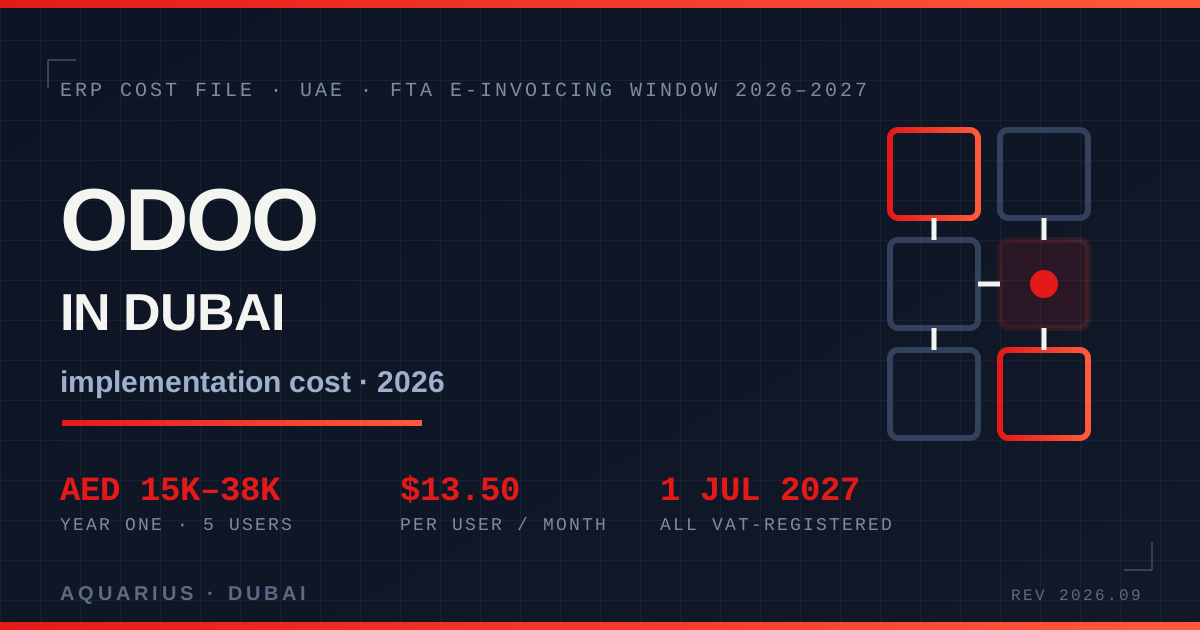
Short answer: In Dubai in 2026, an Odoo implementation runs roughly AED 12,500 for a single-department rollout to AED 150,000+ for a multi-company programme, and the Odoo Enterprise licence itself is only USD 13.50 per user per month on the Standard plan billed yearly. A realistic year-one budget for a 5-user UAE SME is AED 15,000–38,000 all-in; a 25-user mid-size company lands at AED 94,000–205,000.
Most Dubai businesses price Odoo as a licence. The licence is the smallest line on the bill. What you are actually buying is the configuration, the UAE tax localisation, the data migration and the e-invoicing readiness — and the Federal Tax Authority has now put a hard date on that last one.
Why every Dubai SME is suddenly pricing an ERP
Three numbers explain the 2026 rush.
First, the sheer volume of new companies. 71,830 new companies joined Dubai Chamber of Commerce during 2025, taking active membership to 292,486 by year-end. Across the UAE, roughly 250,000 new companies were registered in 2025, pushing the national total past 1.4 million. That is a very large cohort of firms that started on spreadsheets and has now outgrown them.
Second, the money is already moving. The UAE ERP software market generated about USD 631.8 million in revenue in 2025, and cloud deployments took 60.98% of that spend — the on-premise era is effectively over for SMEs here.
Third, and this is the one with a deadline attached: the UAE e-invoicing mandate. Ministerial Decisions No. 243 and 244 of 2025, issued 28 September 2025, set a phased rollout. A pilot and voluntary phase opens 1 July 2026. It becomes mandatory on 1 January 2027 for businesses with revenue above AED 50 million, extends to all VAT-registered entities on 1 July 2027, and covers business-to-government transactions from 1 October 2027. Every in-scope business must appoint an Accredited Service Provider (ASP) — and to be accredited, a provider must already be a Peppol-certified Service Provider, because the UAE framework is built on the Peppol PINT standard and a 5-corner DCTCE model.
If your accounting system cannot emit a structured, Peppol-conformant invoice through an ASP by mid-2027, it is not an accounting system any more. It is a liability with a spreadsheet export.
What Odoo actually costs in Dubai in 2026
Odoo's own pricing is public and global, quoted in USD and billed per user per month across all apps:
| Plan | Annual billing | Monthly billing | What you get |
|---|---|---|---|
| One App Free | Free | Free | One app, unlimited users, Odoo Online hosting only |
| Standard | USD 13.50 / user / mo | USD 16.90 / user / mo | All apps, Odoo Online hosting |
| Custom | USD 20.40 / user / mo | USD 25.50 / user / mo | All apps plus Odoo Studio, multi-company, external API, Odoo.sh or on-premise |
Note the discount rule: the promotional annual rate is valid for 12 months, for the initial users ordered. Year two is the list rate. Budget for it now — a 25-seat Standard deployment is roughly AED 15,000 per year in licences at the promo rate, and meaningfully more once it lapses.
The implementation is where the real money sits. UAE Odoo partners publish tiers in this shape:
| Scope | One-time fee (AED) | Typical fit | Timeline |
|---|---|---|---|
| Mini / single module | from 4,500–12,500 | Accounting or CRM only, clean data, no customisation | 4–6 weeks |
| Starter | from 30,000 | Accounting + inventory + sales, VAT localisation, basic migration | 6–10 weeks |
| Business | from 70,000 | Multi-module, payroll/WPS, custom reports, integrations | ~90-day go-live |
| Scale-up / enterprise | 150,000–500,000+ | Multi-company, multi-currency, manufacturing, custom modules | 6–12 months |
Then the two lines nobody quotes until invoice three:
- Hosting. Odoo Online is bundled with Standard. Odoo.sh runs AED 250–700 per month. A private cloud or UAE-resident VPS deployment is AED 800–2,500 per month — relevant if you have data-residency requirements, which we cover in our Dubai hosting and data residency guide.
- Annual support. Budget 10–15% of the implementation fee per year. In practice that is AED 2,500–5,000 for a small company, AED 10,000–22,000 mid-size, and AED 30,000–75,000 at enterprise scale.
Put together, the honest year-one totals for a Dubai business look like this:
| Company size | Year-one total (AED) | What that covers |
|---|---|---|
| 5 users | 15,000–38,000 | Licences, focused implementation, hosting, first-year support |
| 25 users | 94,000–205,000 | Multi-module rollout, migration, payroll, integrations |
| 100 users | 284,000–695,000 | Multi-company, custom modules, phased go-live |
The UAE localisation work you are really paying for
A generic Odoo install is not a UAE Odoo install. The UAE fiscal localisation ships a chart of accounts aligned to IFRS and FTA requirements, with separate VAT payable and VAT receivable accounts, preconfigured 5% standard VAT, tax groups, TRN fields on partners, and reverse-charge handling for imports. Configured properly, the same ledger structure carries your 9% corporate tax reporting.
Beyond tax, the UAE-specific configuration that eats implementation hours:
- WPS payroll files. Odoo Payroll can generate Wage Protection System files and calculate end-of-service gratuity against UAE labour law — but the salary structures, allowances and gratuity rules have to be built to match your contracts. See our WPS payroll software guide for what that involves.
- Arabic and RTL. Bilingual invoices, Arabic product names, right-to-left layouts in printed documents. Free-zone and government-facing businesses usually need this from day one.
- E-invoicing readiness. Odoo 19 supports FTA-aligned e-invoicing with QR codes, digital signatures and automated invoice validation. That is necessary but not sufficient — you still need a contracted, Ministry-of-Finance-accredited ASP to actually exchange the invoice. Confirm which ASP your partner integrates with, in writing, before you sign.
- Version currency. Odoo 19 landed in October 2025; Odoo 19.3 followed in May 2026 with a rebuilt accounting engine, AI agents in everyday workflows, and localisations expanded across 25+ countries. An implementation quoted on Odoo 17 in 2026 is quoting you a migration you will pay for twice.
Where Odoo is the wrong answer
Odoo now serves over 170,000 customers and more than 16 million users across 120+ countries, holding roughly 5.77% of the global ERP market and a far larger share of the SME segment. It is genuinely good software. It is still the wrong purchase in three situations we see regularly in Dubai:
- Your differentiator is the process itself. If your operational workflow is the business — a marketplace, a logistics network, a regulated fintech — bending Odoo to fit costs more than building the thing. Compare against our custom software cost breakdown before committing.
- You only need one department fixed. If the pain is purely CRM or purely inventory, a focused tool at AED 4,500 beats a 90-day ERP programme. Odoo's One App Free tier is a legitimate way to test this for zero licence cost.
- Nobody internally owns the data. ERP projects do not fail on software. They fail because the opening balances, the item master and the customer list were never cleaned, and go-live reveals it. If you cannot name the person who owns data quality, fix that before you buy anything.
If Odoo passes those three tests, the broader comparison logic sits in our Dubai ERP implementation cost guide.
How Aquarius scopes an Odoo build in Dubai
We do not sell licences, which means we have no incentive to inflate your seat count. We scope the implementation, build the UAE-specific pieces, and hand you a system your own team can run.
Our published pricing tiers apply the same way here: a focused Odoo configuration with VAT localisation and one integration sits in the Custom App band at AED 10,000; a multi-module rollout with payroll, custom reports and e-invoicing plumbing sits at AED 24,000; ongoing ERP support and roadmap work runs as a AED 9,500 per month squad. Licences are paid direct to Odoo at their published rate — we never mark them up.
The cost of waiting is the part to weigh. Businesses above AED 50 million in revenue have a mandatory e-invoicing date of 1 January 2027, and everyone VAT-registered follows on 1 July 2027. A typical mid-market Odoo rollout is a 90-day go-live, and enterprise multi-company programmes run 6–12 months. Counting backwards from July 2027 with a 2026 start gives you room to run a pilot in the voluntary window opening 1 July 2026. Counting backwards from a 2027 start does not.
FAQ
How much does Odoo cost per month in the UAE?
The Odoo Enterprise licence is USD 13.50 per user per month on the Standard plan billed annually, or USD 20.40 on the Custom plan, which adds Odoo Studio, multi-company and API access. Monthly billing is higher at USD 16.90 and USD 25.50 respectively. Implementation, hosting and support are separate and quoted in AED by your partner.
Is Odoo compliant with UAE VAT and the FTA e-invoicing mandate?
Odoo's UAE fiscal localisation covers 5% VAT, TRN fields, reverse charge and FTA-aligned reporting, and Odoo 19 supports e-invoice generation with QR codes and digital signatures. Compliance with the mandate itself also requires an Accredited Service Provider approved by the Ministry of Finance and the FTA — the ERP alone does not satisfy it.
How long does an Odoo implementation take in Dubai?
Four to six weeks for a single-module scope with clean data, around 90 days for a typical SME or mid-market multi-module rollout, and six to twelve months for multi-company or manufacturing programmes. Data migration quality is the single biggest variable.
Can I start with the free version of Odoo?
Yes. The One App Free plan gives you one application with unlimited users on Odoo Online, including any apps it depends on. It is a sensible way to validate fit before committing to an implementation, though it does not include multi-company, Studio or the API access most UAE integrations need.
What is the biggest hidden cost in an Odoo project?
Two. The promotional licence discount is valid for 12 months on the initially ordered users, so year two costs more than year one. And annual support — typically 10–15% of the implementation fee — is rarely included in the headline quote.
Before you sign anything
Ask any Dubai Odoo partner for three things in writing: the Odoo version they will deploy, the named ASP they integrate with for e-invoicing, and the year-two cost including the lapsed licence discount and support retainer. A partner who can answer all three in a page has done this before.
If you would rather have the scoping done for you, send us your current process — how you invoice, what you track, where the spreadsheets are — and we will come back with a module list, an AED range and a go-live date before the July 2027 deadline. No licence commission, no discovery fee.