
ESG and Carbon Reporting Software in Dubai (2026): Your Spreadsheet Is Now a Legal Liability
The UAE Climate Law deadline passed on 30 May 2026 with no exemption by size or sector, and fines reach AED 2,000,000 per violation. What a carbon reporting system really costs in AED.
- PUBLISHED
- 20 SEPT 2026
- READ TIME
- 11 MIN
- AUTHOR
- AQUARIUS · DUBAI
- UNIT
- REV 2026.09
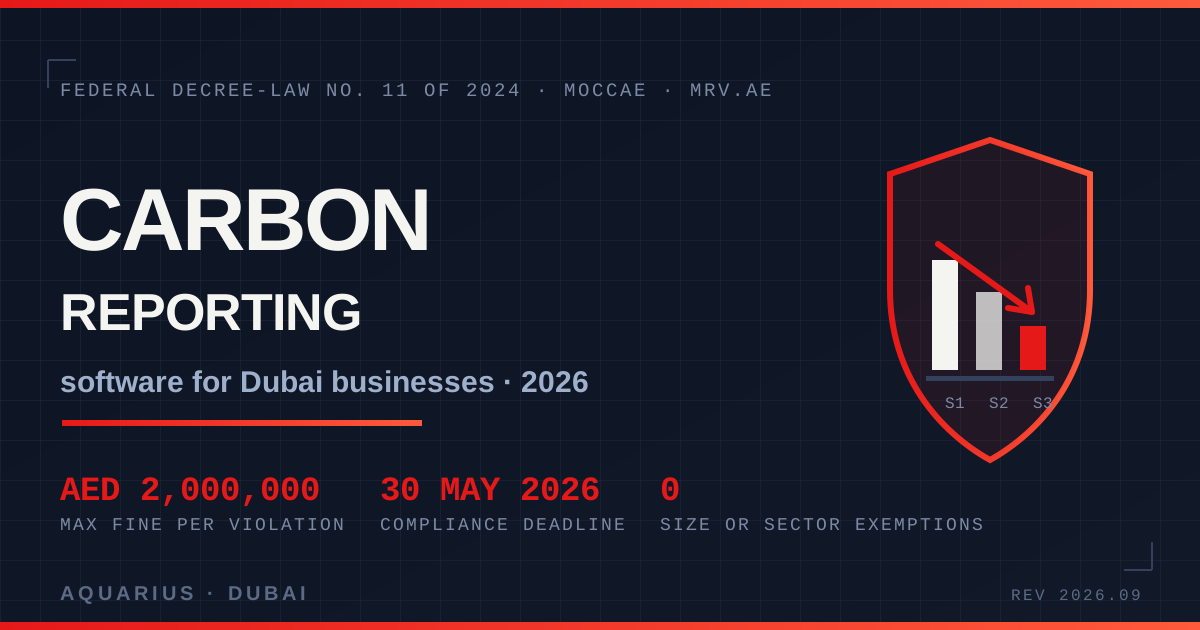
Short answer: Under Federal Decree-Law No. 11 of 2024, every UAE entity that generates greenhouse-gas emissions — mainland or free zone, large or small — must measure, report and reduce those emissions, and the headline compliance deadline of 30 May 2026 is already behind us. Fines run AED 50,000 to AED 2,000,000 per violation and double for a repeat inside two years. A carbon and ESG reporting system that actually survives verification costs roughly AED 60,000–140,000 for a single-entity build, AED 160,000–380,000 for a multi-site group with an audit trail, and AED 400,000+ once Scope 3 and supplier data come in. Updated September 2026.
Here is what most Dubai businesses got wrong. They treated ESG as a design job — a glossy PDF, a page of pledges, a photo of a beach clean-up. Then the law landed and the deliverable changed shape completely. What the regulator wants is not a report. It is traceable data: metered numbers, a defined organisational boundary, IPCC-aligned calculation factors, and an independent verifier who can follow every tonne back to an invoice. A designer cannot produce that. A spreadsheet cannot defend it. It is a software problem, and it has been one since 30 May 2025.
Key takeaways
- The law has no small-business escape hatch. Federal Decree-Law No. 11 of 2024 entered force on 30 May 2025 and carves out no exemption by size, turnover or sector — free-zone entities included. Dubai alone has over 215,000 active business licences.
- Penalties are real money. AED 50,000–2,000,000 per violation, doubled for repeat violations within two years.
- There is a government portal now. MOCCAE launched the Integrated Emissions Quantification Tool (IEQT) at mrv.ae on 15 October 2025 at GITEX — the National MRV Transparency System is where filings land.
- Big emitters have a separate, harder regime. Cabinet Resolution 67/2024 covers entities above 0.5 million tonnes CO₂e per year (Scope 1 + 2): National Carbon Credit Registry registration, an ISO 14064 inventory and third-party verification by a MOCCAE-approved verifier. Their registration deadline was 28 June 2025.
- Listed companies had this first. DFM and ADX PJSCs file annual sustainability reports within 90 days of financial year-end or before the AGM, whichever is earlier, against roughly 32 ESG metrics. ADX alone carries 170+ listed firms.
Why 2026 is the year ESG stopped being marketing
Three dates explain the shift.
30 May 2025. Federal Decree-Law No. 11 of 2024 on the Reduction of Climate Change Effects entered into force, making the UAE the first MENA jurisdiction to put corporate climate accountability into binding federal legislation. In-scope entities must measure emissions, report them, and maintain a reduction plan. The statute does not filter by revenue or headcount, and it explicitly reaches into free zones — which matters in an emirate where a large share of licences sit inside DMCC, JAFZA, DIFC, Dubai South and the rest.
15 October 2025. MOCCAE launched the IEQT platform at mrv.ae during GITEX Global, operationalising the National MRV Transparency System and aligning it with Article 13 of the Paris Agreement. Before that date, “how do I actually file?” was a fair question. After it, it stopped being one.
30 May 2026. The general compliance deadline. If you are reading this in late 2026 without a defensible emissions inventory, you are not early and you are not preparing — you are exposed, on an annual cycle that repeats every year from here.
Set against Dubai's own targets, none of this is symbolic. The Dubai Supreme Council of Energy approved the Dubai Carbon Abatement Strategy 2030, committing the emirate to a 30% emissions reduction by the end of 2030, inside a national path to net zero by 2050. Strategies of that size are enforced through data returns from thousands of licensees, not through press releases.
Who exactly has to report — and what changes per tier
The obligation is not uniform. Three overlapping regimes stack on top of each other, and confusing them is the most common reason a Dubai company either over-builds or under-files.
| Tier | Trigger | What it demands | Where it files |
|---|---|---|---|
| General entity | Any UAE entity generating GHG emissions (incl. free zones) | Measure Scope 1 and Scope 2, report annually, maintain a reduction plan | IEQT / mrv.ae |
| Huge-emission entity | ≥ 0.5 million tCO₂e/yr, Scope 1 + 2 combined (Cabinet Resolution 67/2024) | ISO 14064 inventory, National Carbon Credit Registry registration, mandatory third-party verification | IEQT + Registry |
| Listed PJSC | DFM or ADX listing (SCA rules) | Annual sustainability report, ~32 ESG metrics, sector-tailored KPIs | Exchange disclosure, within 90 days of FY-end or pre-AGM |
| Dubai hotel | DET / Dubai Sustainable Tourism | Monthly consumption across 9 carbon sources; the mandatory measures framework expanded from 19 to 27 | Carbon Calculator, Tourism Dirham Platform |
That last row is worth dwelling on, because it is the closest thing Dubai has to a live rehearsal of federal reporting. Since January 2017, Dubai's hospitality sector has submitted monthly consumption data across nine emission sources — electricity, water, district cooling, LPG, landfill waste, recycled waste, petrol, diesel and refrigerants — through the Carbon Calculator on the Tourism Dirham Platform. Around 528 hotels were trained on the original 19 sustainability requirements from 2019, and the framework has since widened to 27 mandatory measures. Every hotel finance team in Dubai can tell you the same thing: the reporting is not hard, the data collection is, and it breaks whenever it depends on someone remembering to email a meter reading.
What the software actually has to do
The IEQT reporting cycle has four stages, and each one is a different engineering requirement.
1. Data collection that does not depend on goodwill
Activity data across fuel, purchased electricity, district cooling, waste, refrigerant top-ups and fleet consumption. In Dubai that usually means DEWA bills, an Empower or Tabreed district-cooling invoice, fuel-card statements, chiller service reports and waste-contractor manifests — sitting in five systems and three inboxes. The system's job is to ingest them on a schedule, not to offer a blank upload form once a year.
2. Calculation with versioned factors
The platform applies IPCC-aligned factors and outputs Scope 1 and Scope 2 separately, in tonnes CO₂e, with the full gas basket broken out rather than a single headline figure. Your own system has to match that: emission factors stored as dated, versioned records, so that a 2026 recalculation of a 2025 figure is explainable rather than embarrassing.
3. Verification you can survive
Independent assurance by a MOCCAE-authorised verifier is a prerequisite, not an optional upgrade, for entities in the Cabinet Resolution 67 tier. Verifiers do not audit dashboards. They audit evidence. Every number needs a source document attached, a timestamp, an approver and an immutable change log.
4. Submission with a consistent boundary
This is where most projects quietly fail. Your consolidation basis — operational control, financial control or equity share — must be identical across the climate filing, the exchange disclosure and the registry entry. A mismatch between a group's statutory accounts and its emissions boundary is the fastest route to a failed verification. Registration on mrv.ae itself follows a strict path: personal details, organisation selection, role assignment (data provider, validator, administrator), internal administrator authorisation, then approval by an emirate-level focal point. Designate one administrator before anyone else registers, or you end up with three uncoordinated accounts for the same licence.
Buy a platform or build one? The AED crossover
The global ESG reporting software market is projected to grow from USD 1.31 billion in 2026 to USD 2.93 billion by 2031, a 17.4% CAGR, and the Middle East carbon accounting software segment — currently around USD 18 million — sits inside an MEA market forecast to reach USD 2.1 billion by 2033 at 20.2% CAGR. Translation: plenty of vendors will sell you something. The question is what it costs once it is actually running on your data.
Enterprise ESG platforms in the Middle East commonly start near USD 50,000 a year for a mid-sized business — roughly AED 184,000 annually, before implementation. And the licence fee is rarely the full picture: implementation, data cleansing, supplier onboarding and assurance preparation are routinely quoted separately or left out of the first proposal entirely.
| Option | Indicative cost | Best fit |
|---|---|---|
| Spreadsheet + consultant, annual | AED 25,000–70,000 per filing cycle | One site, simple Scope 1/2, low change |
| Off-the-shelf ESG SaaS | From ~USD 50,000/yr (~AED 184,000) + implementation | Listed entities needing multi-framework output today |
| Custom build — single entity | AED 60,000–140,000 | Scope 1/2 capture, utility ingest, IEQT-ready export, evidence vault |
| Custom build — group, multi-site | AED 160,000–380,000 | Consolidation by boundary, verifier workpapers, DFM/ADX report builder, approvals |
| Custom build — Scope 3 and supply chain | AED 400,000+ | Supplier portal, ISO 14064 evidence chain, GRI/ISSB multi-framework output |
| Annual run cost (custom) | 15–20% of build, per year | Hosting, factor updates, regulatory changes |
The crossover maths is unusually clean here. A mid-sized Dubai group paying AED 184,000 a year in licence fees alone spends AED 552,000 over three years and owns nothing. A AED 260,000 custom platform with a 17.5% annual run cost lands near AED 351,000 over the same three years, and the data model belongs to you. Below one site and one reporting framework, buy. Above two entities, multiple utility feeds and an exchange disclosure, build — the same conclusion we reach on BI and reporting dashboards.
The Dubai-specific plumbing nobody budgets for
Generic carbon platforms are built for European invoice formats and grid factors. In Dubai the friction is local and specific:
- District cooling. Empower and Tabreed consumption is a major Scope 2 line for any Dubai tower or hotel, and it arrives on a billing format no imported platform parses natively.
- Refrigerants. One of the nine sources in Dubai's own hospitality framework, and one nobody has a digital record of — it lives in HVAC contractor service sheets.
- Bilingual output. Arabic and English reporting, with RTL handled properly, is table stakes for anything going to a government portal or a local board.
- Data residency and personal data. Employee commute and fleet-telematics data used for Scope 3 is personal data under the UAE PDPL — the same discipline set out in our PDPL compliance checklist applies here.
- Finance-system overlap. Fuel, electricity and waste costs already exist in your accounting stack. The emissions system should read them rather than re-key them — the same integration argument as corporate tax and accounting software.
What this costs you to get wrong, and how we build it
Run the downside honestly. A single violation carries AED 50,000–2,000,000, doubled on repeat inside two years. One AED 500,000 penalty plus a failed verification plus a rushed consultant re-baseline costs more than the entire platform in this article — and that is before a lender, a landlord or a government tender asks for your verified inventory and you do not have one. Reporting is also increasingly a commercial gate: Scope 3 disclosure expectations are tightening for large enterprises into 2027, which means your emissions data becomes your customers' emissions data, and your inability to supply it becomes their procurement problem.
We build these the way the compliance calendar actually runs, not the way a feature list reads. Phase 1 ships in 6–10 weeks: source register, utility and fuel ingest, versioned emission factors, Scope 1 and 2 calculation, evidence vault with immutable change log, and an IEQT-shaped export. Phase 2 adds group consolidation by declared boundary, approval workflow and verifier workpapers. Phase 3 adds the Scope 3 supplier portal and multi-framework output for GRI, ISSB or an exchange disclosure.
Fixed-scope phases, fixed prices, source code handed over, UAE data-residency hosting, bilingual by default. See transparent pricing or book a 30-minute scoping call and we will map your sites, utility accounts and reporting tiers into a build plan with AED numbers attached.
FAQ
Does the UAE Climate Law really apply to small companies and free-zone entities?
Yes. Federal Decree-Law No. 11 of 2024 does not exempt entities on the basis of company size, turnover or sector, and it applies to entities licensed in free zones. What scales with size is the depth of the obligation — only entities above 0.5 million tCO₂e per year fall into the Cabinet Resolution 67/2024 regime with mandatory ISO 14064 verification and carbon registry registration.
What are the penalties for not reporting emissions in the UAE?
Fines range from AED 50,000 to AED 2,000,000 per violation, and are doubled for repeat violations committed within two years of the previous one.
Where do UAE companies actually submit emissions data?
Through the National MRV Transparency System — the Integrated Emissions Quantification Tool (IEQT) at mrv.ae, launched by MOCCAE on 15 October 2025. Registration requires organisation selection, role assignment and approval by an emirate-level focal point before any submission is possible.
How long does it take to build a carbon reporting system?
A working Phase 1 — source register, utility ingest, Scope 1/2 calculation, evidence vault and export — takes 6–10 weeks. Group consolidation and verifier workpapers add 5–8 weeks. Scope 3 supplier collection is the long pole, because it depends on how many of your suppliers can answer at all.
Can one system serve both the federal filing and a DFM sustainability report?
It should. The underlying inventory is identical; only the output framework changes. Build the data layer once with a single declared organisational boundary, then render the federal submission, the exchange disclosure and any GRI or ISSB report from the same verified numbers. Two parallel spreadsheets is how boundary mismatches — and failed verifications — get created.
We are a Dubai hotel already using the Carbon Calculator. Is that enough?
It is a strong head start, because you already collect monthly data across nine emission sources and have the habit. It is not automatically a federal filing: the boundary, the factor set and the verification expectations differ. Most hotels find their existing collection process maps across with modest rework.
The uncomfortable summary: the ESG deadline everyone was preparing for passed on 30 May 2026. The companies that treated it as a design brief now have a beautiful PDF and no defensible inventory. The ones that treated it as a data pipeline have a system that files itself every year, survives a verifier, and answers a client procurement questionnaire the same afternoon it arrives. Only one of those is worth AED 2 million.