
Expand Your Dubai Online Store to Qatar, Kuwait, Oman and Bahrain (2026)
Four GCC markets worth AED 42.5bn online in 2026 and Dubai brands skip them. KNET, OmanNet, 0-10% VAT and Qatar new e-commerce licence decide if you win.
- PUBLISHED
- 04 NOV 2026
- READ TIME
- 12 MIN
- AUTHOR
- AQUARIUS · DUBAI
- UNIT
- REV 2026.09
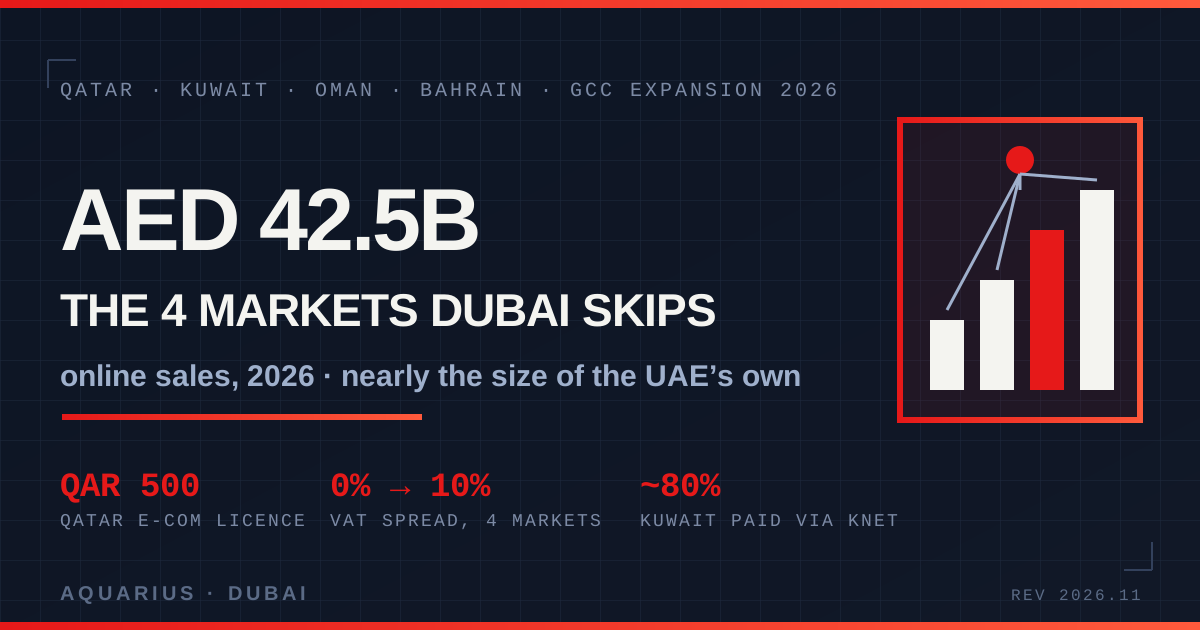
Short answer: Qatar, Kuwait, Oman and Bahrain will do roughly USD 11.6bn (about AED 42.5bn) in online sales in 2026 — almost as much as the UAE's own USD 12.30bn market, and almost nobody in Dubai is selling into them properly. The blockers are not logistics. They are four different payment rails, four different tax positions (0% to 10% VAT), three separate data-protection laws, and Qatar's brand-new e-commerce licence that demands a .qa domain and an Arabic version of your site.
The four markets most Dubai stores skip (and what they're worth)
Everyone in Dubai expands to Saudi Arabia first. That's correct — it's the biggest prize, and we've written the full Dubai-to-KSA playbook separately. But the obsession with Riyadh means the rest of the GCC gets treated as a rounding error. It isn't.
Mordor Intelligence sizes the four smaller GCC e-commerce markets in 2026 at Qatar USD 4.96bn (growing 9.34% a year to USD 7.75bn by 2031), Oman USD 3.26bn (7.22% CAGR), Kuwait USD 1.95bn (5.02% CAGR) and Bahrain USD 1.41bn — the fastest grower of the set at a 14.22% CAGR, more than doubling to USD 2.73bn by 2031. Add them up and you get USD 11.58bn, roughly AED 42.5bn, against a UAE online market Mordor puts at USD 12.30bn in 2026 with 11.04 million online shoppers.
In other words: the markets Dubai treats as optional are collectively the same size as the market Dubai treats as home. Qatar alone expects online sales to hit QR 18bn in 2026. And the GCC as a whole is on a 15.15% annual growth track from USD 584.8bn in 2025 to USD 2.08 trillion by 2034, according to IMARC — this window does not stay open quietly.
Most Dubai brands get this backwards. They assume the hard part is shipping. The hard part is checkout: a Kuwaiti shopper who can't pay with KNET simply closes the tab.
Three routes into Qatar, Kuwait, Oman and Bahrain
1. Cross-border from your existing Dubai store
Cheapest to start. You keep one store, one warehouse in Dubai, and bolt on multi-currency pricing, local payment methods and a courier with GCC lanes. Expect 3–7 working days to deliver, duty and VAT collected at the border, and a conversion rate well below your UAE baseline until you localise. Best for AOV above AED 400, where shipping economics survive.
2. Marketplaces first, own store second
List on the regional marketplaces to prove demand before you spend on localisation. You lose margin and the customer relationship, but you buy data: which SKUs move in Doha versus Muscat, what price elasticity looks like, whether returns kill you. Treat it as paid research, not a strategy.
3. Local entity and local fulfilment
Required if you want same-day delivery, cash on delivery at scale, or — in Qatar's case — a compliant standalone e-commerce licence. Highest cost, highest conversion. Only worth it once a market clears roughly AED 150k–200k a month in orders.
What actually breaks: a market-by-market reality check
This is the table nobody gives you. Every row below is a real build decision, not a nice-to-have.
| Market | VAT | Domestic card rail you must accept | E-invoicing status (2026) | Data-protection law |
|---|---|---|---|---|
| Qatar | None (no VAT as of late 2026) | NAPS — 3m+ local cards, plus the new Himyan prepaid debit card | Draft law Cabinet-approved May 2026; platform in testing, no deadline | PDPPL (Law 13/2016); fines to QAR 5m |
| Kuwait | None | KNET — on every Kuwaiti debit card, ~80% of online transactions | No mandate announced | No comprehensive PDPL; sectoral rules only |
| Oman | 5% | OmanNet — ~90% of all payment cards in Oman | Fawtara: pilot Aug 2026, Phase 1 Apr 2027, Phase 2 Oct 2027 | PDPL (RD 6/2022); fully enforceable since 5 Feb 2026 |
| Bahrain | 10% | BENEFIT and BenefitPay, the most-used wallet in Bahrain | No live mandate, no published dates | PDPL (Law 30/2018); fines to BHD 1m |
Payments: your card-network-only checkout is not enough
This is where Dubai stores quietly lose the sale. In Kuwait, KNET has been the national debit switch since 1992 and carries around 80% of all online transactions — a Visa/Mastercard-only checkout is invisible to most of the market. In Oman, OmanNet covers roughly 90% of payment cards. Qatar's NAPS network has more than 3 million local cards in circulation, with QPay handling e-commerce, and Bahrain runs on BENEFIT plus BenefitPay.
Wallets are the growth story: in Kuwait, cards were 50.23% of 2025 payment value while digital wallets are the fastest-growing method at a 9.03% CAGR, and cash on delivery has fallen to roughly 20% and keeps sliding. Build for local debit first, wallets second, COD as a fallback you can switch off region by region.
Tax: a 0% to 10% spread across four neighbours
Qatar and Kuwait have no VAT. Oman charges 5% — the same rate your UAE store already handles. Bahrain charges 10%, doubled from 5% on 1 January 2022. If your checkout hard-codes 5% VAT because that's what the UAE does, you under-collect in Bahrain and over-charge in Doha. Separately, Kuwait's Decree-Law No. 157 of 2024 introduced a 15% domestic minimum top-up tax on in-scope multinationals (consolidated revenue above EUR 750m) for tax periods starting on or after 1 January 2025 — relevant if you're part of a large group, irrelevant to an SME.
Qatar's new e-commerce licence is the biggest 2026 change
Ministerial Decision No. 25 of 2026, issued on 29 March 2026 by Qatar's Ministry of Commerce and Industry, regulates selling online without a physical storefront — and it carries hard technical requirements:
- A separate e-commerce licence for each website you operate.
- QAR 500 issuance fee, covering 194 approved commercial activities, applied for through the Single Window platform.
- The site must run on a
.qaor.com.qadomain, registered through one of eight CRA-approved providers. - An Arabic version of the website must be available.
- Your commercial registration number and e-commerce licence number must be displayed on the site, along with contact details, exchange and return policy, and consumer-complaint procedures.
- You must offer electronic payment options to consumers.
Practically, that means a Qatar launch is a build item, not a marketing item: a new domain, hreflang, an Arabic locale and a compliance footer. Personal transactions are excluded — but only where they are not conducted in commercial volumes.
Oman's Fawtara deadlines are closer than they look
Oman's Tax Authority confirmed the e-invoicing rollout in Decision No. 189/2026 on 9 August 2026: a pilot from August 2026 with 100 large taxpayers, Phase 1 in April 2027 for businesses above OMR 5m in annual supplies, and Phase 2 in October 2027 covering all VAT-registered businesses. It uses a decentralised Peppol-style five-corner model through accredited service providers — so if you will be VAT-registered in Oman, your invoicing stack needs a 2027 plan now. Qatar has a draft law in testing with no published deadline, and Bahrain has no announced dates at all, despite the NBR designing a national platform.
Data: three different laws, three different ceilings
Qatar's PDPPL (Law 13/2016) allows fines up to QAR 5m. Bahrain's PDPL (Law 30/2018) allows administrative fines up to BHD 1m and has a standing Personal Data Protection Authority. Oman's PDPL (Royal Decree 6/2022, with executive regulations in Ministerial Decision 34/2024) finished its transition period on 5 February 2026 and is now fully enforceable — with penalties reaching OMR 100,000–500,000 where an unlawful cross-border transfer causes damage. Kuwait has no comprehensive statute yet. One consent banner and one privacy policy will not cover four jurisdictions.
Customs and delivery: check the threshold, not the vibe
GCC courier de minimis sits around 1,000 units of local currency on CIF value, and it generally applies to personal parcels — the UAE's own AED 1,000 exemption does not cover commercial e-commerce shipments, which pay duty from the first dirham. Assume duty is payable, quote landed cost at checkout, and never let a customer discover the bill at the door. Last-mile cost outside the capitals — beyond Doha, beyond Muscat — is the single most common margin killer in GCC cross-border.
What it costs in AED (and how Aquarius does it)
For context on your home market first: our Dubai e-commerce licence cost guide covers the UAE side. Here is what the GCC expansion layer typically costs when we build it.
| Scope | What you get | Typical AED |
|---|---|---|
| One extra market, light | Currency and local payment rail, VAT rule, localised shipping and landed-cost display, legal pages | 14,000 – 28,000 |
| Arabic locale | RTL layout, Arabic content pass, hreflang, Arabic checkout and emails | 18,000 – 40,000 |
| Qatar compliant build | .qa domain setup, Arabic version, CR and licence disclosures, consumer-complaint flow | 22,000 – 45,000 |
| All four markets | Multi-market storefront, four payment rails, tax matrix, four-jurisdiction privacy stack | 65,000 – 140,000 |
| Oman e-invoicing readiness | Fawtara-ready invoice data model and ASP integration path | 12,000 – 30,000 |
How we sequence it: we start with the market where your existing traffic already shows demand — not the biggest one. One market, one payment rail, one tax rule, live in 3–5 weeks. We instrument checkout so you can see exactly where non-UAE shoppers drop, then add the next market only once the first is profitable. Compliance items — Qatar's licence requirements, Oman's e-invoicing model, the four privacy positions — get built in from day one, because retrofitting them later means touching checkout twice.
Risk reversal: fixed-price scope per market, so you never pay for discovery twice. If the first market does not clear its acquisition cost in 90 days, we tell you to stop rather than sell you the next one. See our pricing for how the fixed-scope model works.
The cost of waiting is measurable. Bahrain's 14.22% CAGR means a market worth USD 1.41bn today is USD 2.73bn by 2031 — and the brands that own the search results and the KNET/BENEFIT checkout habit by then will be the ones that moved in 2026, not 2029.
FAQ: selling from Dubai into Qatar, Kuwait, Oman and Bahrain
Do I need a local company in each GCC country to sell online?
Not to ship cross-border from Dubai. You do need a Qatari commercial registration and an e-commerce licence per website to operate as a licensed e-commerce business in Qatar under Decision No. 25 of 2026. For Kuwait, Oman and Bahrain, cross-border selling from a UAE entity is the normal starting point; a local entity becomes worthwhile when you want local fulfilment, COD at scale or VAT registration.
Which payment method matters most in each market?
KNET in Kuwait (around 80% of online transactions), OmanNet in Oman (about 90% of cards), NAPS and QPay plus the Himyan card in Qatar, and BENEFIT with BenefitPay in Bahrain. Add international cards and a wallet, but the domestic debit rail is the one that decides whether you convert.
What VAT do I charge a customer in Bahrain or Oman?
Bahrain is 10% and Oman is 5%. Qatar and Kuwait currently have no VAT. Whether you charge and remit depends on your registration position and the shipping terms — but your storefront needs a per-market tax rule either way, not a single hard-coded 5%.
Does my website legally need Arabic?
In Qatar, yes — Ministerial Decision No. 25 of 2026 requires an Arabic version of the site for licensed e-commerce activity, on a .qa or .com.qa domain. Elsewhere in the GCC it is a conversion requirement rather than a statutory one, which in practice is almost as binding.
Which market should a Dubai store enter first?
Qatar usually, on size: USD 4.96bn in 2026 and QR 18bn in projected online sales, with high purchasing power. But check your own analytics first — if your existing traffic already skews Bahraini or Omani, start where the demand is already proven and the localisation cost is lowest.
Ready to take your Dubai store across the GCC?
Planning a 2026 GCC expansion? Talk to Aquarius. We will map your regulatory route market by market, tell you which one to open first based on your own traffic, and give you a fixed AED quote within a week. Or see what else we build on our services page.