
Expand Your Dubai Online Store to Saudi Arabia (2026): Rules, Costs & Setup in AED
Selling from Dubai into KSA? mada, 15% VAT, Arabic legal pages and ZATCA e-invoicing decide if Saudis buy. 3 routes in, compliance traps and real AED costs.
- PUBLISHED
- 17 SEPT 2026
- READ TIME
- 11 MIN
- AUTHOR
- AQUARIUS · DUBAI
- UNIT
- REV 2026.09
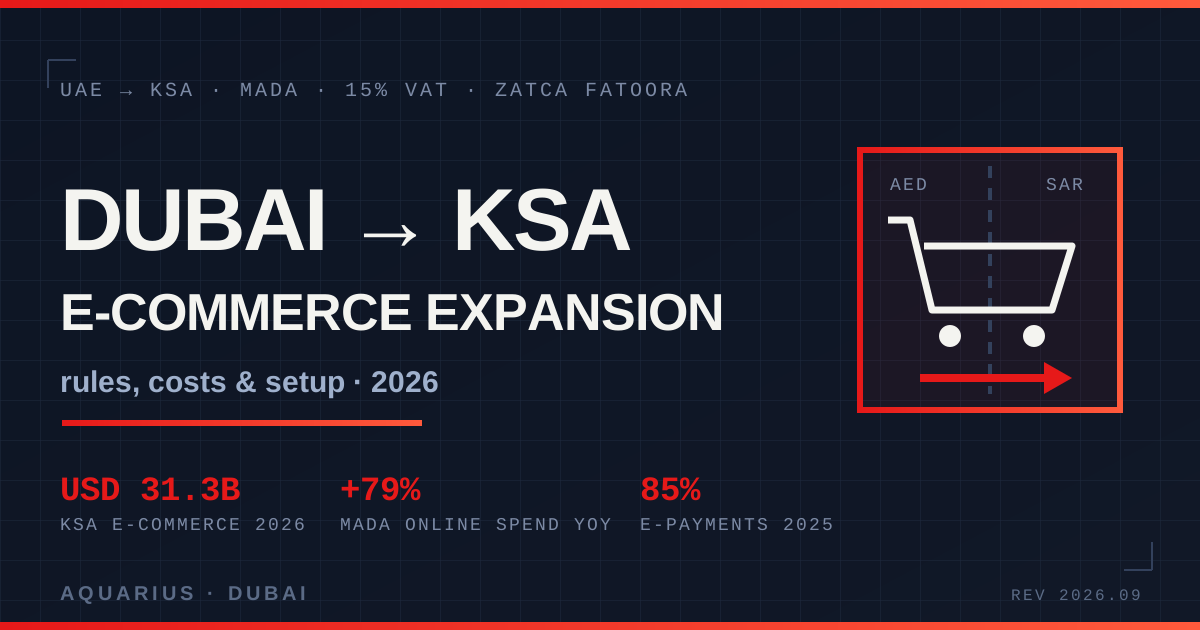
Short answer: A Dubai online store can start selling to Saudi Arabia in 2026 without opening a Saudi company — by shipping cross-border from the UAE or listing on a KSA marketplace — but to scale you will need a Saudi-ready store: Arabic legal pages, mada and BNPL at checkout, SAR pricing with 15% VAT, and ZATCA-compliant invoicing once you register. For most UAE SMEs, making an existing store KSA-ready costs AED 25,000–70,000; a full Saudi storefront with local fulfilment and Fatoora integration runs AED 70,000–180,000.
Most Dubai brands get one thing wrong: they treat Saudi Arabia as “the UAE, but bigger” and simply turn on GCC shipping. Then checkout conversion collapses because the cards, the tax rate, the language rules and the return rights are all different. This guide walks through the numbers, the three ways in, what each costs in AED, and the compliance traps that stop UAE stores cold.
Why Saudi Arabia is the obvious next market (the stakes)
If you sell online from Dubai, the largest e-commerce opportunity in the Gulf is one border away — and it is growing fast:
- Market size: Saudi e-commerce is estimated at USD 31.29 billion in 2026, up from USD 27.96 billion in 2025, and forecast to reach USD 54.87 billion by 2031 — an 11.92% CAGR (Mordor Intelligence).
- Cash is disappearing: the Saudi Central Bank (SAMA) reports electronic payments made up 85% of individual retail transactions in 2025, up from 79% in 2024 and 70% in 2023.
- Online card spend is exploding: e-commerce spending on mada cards hit SAR 29.86 billion in July 2025 alone, up 79.45% year on year, across 149.74 million online transactions (SAMA data via Arab News).
Add near-universal connectivity — around 99% internet penetration and 78% 5G coverage — and you have a market where shoppers are ready. The question is not whether to sell into KSA. It is whether your store is built for how Saudis actually buy.
A Saudi shopper who does not see mada, Arabic return terms and a SAR price with VAT included is not a “lost lead”. They were never a lead — they bounced at checkout.
Three ways to sell from Dubai into Saudi Arabia
There is no single “right” route. It depends on your order volume, margins and how much control you want over the customer.
1. Cross-border shipping from your UAE store
You keep your Dubai entity and warehouse and ship parcels into KSA. It is the fastest way to test demand. Saudi customs applies a SAR 1,000 duty de minimis (goods plus shipping and insurance), and since 6 October 2024 customs fees on low-value individual e-store shipments up to SAR 1,000 have been capped at SAR 15. The catch: 15% import VAT can still apply below that line, and delivery takes days, not hours. If you sell DDP (duties paid) and act as importer, expect to need a Saudi VAT number — ZATCA sets no registration threshold for non-resident suppliers.
2. Saudi marketplaces first
List on noon or Amazon.sa and let the platform handle payments, Arabic content rules and much of the logistics. Great for validating which SKUs sell — but you pay commission, you do not own the customer data, and you compete on price next to your own listings. We compared the economics in noon vs Amazon vs your own store.
3. Saudi entity + local fulfilment
Register in KSA, stock inventory in a Riyadh or Jeddah 3PL, and run a Saudi storefront. Foreigners can fully own an e-commerce business, but you will need a MISA investment licence and a Commercial Registration, with e-stores registered on the Saudi Business Center’s business.sa platform (which replaced Maroof). Reported timelines for foreign investors are 6–10 weeks. This is the route to next-day delivery and the best conversion rates.
| Route | Time to first sale | Delivery to KSA customer | Tax & compliance load | Best for |
|---|---|---|---|---|
| Cross-border from UAE | 2–6 weeks | Several days, customs clearance | Medium — KSA VAT if you import | Testing demand, higher-AOV products |
| Saudi marketplaces | 1–4 weeks | Platform-dependent | Low — platform handles most | SKU validation, low-margin volume |
| Saudi entity + 3PL | 2–4 months | Next-day in major cities | High — CR, VAT, ZATCA Phase 2, PDPL | Brands committed to KSA growth |
What a Saudi-ready store actually needs
This is where most UAE stores fall short. A GCC shipping toggle is not a Saudi store. Here is the checklist we build against.
Payments: mada first, BNPL second, COD as a fallback
mada is Saudi Arabia’s national debit scheme and the default card for most shoppers. If your gateway only processes Visa and Mastercard, a large share of Saudi buyers simply cannot pay. Use a gateway that acquires mada for online payments (for example Tap, HyperPay, Moyasar or Checkout.com), and show the mada logo at checkout.
Instalments matter just as much: 42% of Saudi consumers had used BNPL as of March 2025, with Tabby reporting 15 million+ users and Tamara 10 million+. Cash on delivery is still expected in many categories — most major carriers support it at roughly 3% per parcel — but price it in or cap it by order value. See our Tabby and Tamara integration guide.
Tax: 15% VAT, not 5%
UAE VAT is 5%; Saudi VAT is 15%. Prices shown to Saudi shoppers should be in SAR and VAT-inclusive, and your store needs a separate tax zone — not a currency converter on top of UAE prices. Once you hold a Saudi VAT number, invoices must follow ZATCA rules (more on that below).
Arabic is a legal requirement, not a nice-to-have
Saudi e-commerce rules require essential store information — terms and conditions, refund and return policy, and contact details — to be available in Arabic. Consumers also have a 7-day right to return unused goods. A proper right-to-left build (not a translation plugin) is covered in our Arabic localisation guide.
Data: Saudi PDPL has teeth
Saudi Arabia’s Personal Data Protection Law is actively enforced by SDAIA: in early 2026 it reported 48 enforcement decisions over the prior year, with fines of up to SAR 5 million, doubled for repeat violations. Marketing messages without consent and weak safeguards are common violations. Cross-border transfers out of KSA need a legal basis and, for sensitive or large-scale transfers, a documented risk assessment — so think before piping Saudi customer data into every UAE marketing tool.
Delivery: set expectations honestly
Domestic Saudi express delivery typically starts around SAR 15–35 per parcel, with SMSA and Naqel leading locally and Aramex strongest on the UAE–KSA cross-border lane. Show realistic delivery dates per city at checkout; a missed promise in Riyadh costs you a repeat customer.
ZATCA e-invoicing: the deadline most UAE brands miss
If you register for VAT in Saudi Arabia, you enter ZATCA’s e-invoicing (Fatoora) regime. Phase 2 “integration” means invoices are generated as structured XML with QR codes, cryptographic stamps and UUIDs, and transmitted to ZATCA via API. Wave 24 pulled in every taxpayer whose VAT-able revenue exceeded SAR 375,000 in 2022, 2023 or 2024, with integration due by 30 June 2026 — the lowest threshold yet, and the first wave to sweep in large numbers of SMEs. Reported penalties for non-compliance range from SAR 5,000 to SAR 50,000 per violation.
For an online store, that means your platform, ERP or invoicing app must speak Fatoora. Shopify apps, WooCommerce plugins and custom builds can all do it — but it needs to be designed in, not bolted on after the first ZATCA notice. The UAE is on a similar path; see our UAE e-invoicing guide.
What it costs in AED (and how Aquarius does it)
These are the ranges we quote Dubai brands in 2026. They cover the store build and integrations — not Saudi company formation, 3PL contracts or government fees.
| Scope | What’s included | Typical AED cost | Timeline |
|---|---|---|---|
| KSA-ready upgrade | SAR tax zone at 15% VAT, mada gateway, Tabby/Tamara, Arabic legal pages, KSA shipping rules | AED 25,000–45,000 | 4–6 weeks |
| Full bilingual KSA storefront | Everything above plus full Arabic RTL store, city-level delivery promises, COD rules, PDPL consent flows | AED 45,000–70,000 | 6–10 weeks |
| Saudi operation build | Separate KSA store, 3PL/WMS integration, ZATCA Phase 2 invoicing, ERP sync, analytics per market | AED 70,000–180,000 | 10–16 weeks |
Is it worth it? Consider the cost of inaction: with mada online spend growing nearly 80% a year and 85% of Saudi retail transactions already electronic, every month your checkout rejects mada or shows AED prices is a month a Saudi competitor — or a marketplace — keeps your customer.
Our approach is deliberately staged, so you do not bet the business on day one:
- Validate: list top SKUs on a marketplace or ship cross-border to measure real Saudi demand.
- Localise: upgrade your store with mada, BNPL, SAR/VAT pricing and Arabic legal pages.
- Localise operations: once volume justifies it, add the Saudi entity, 3PL and ZATCA-integrated invoicing.
Every build includes fixed-price milestones and full code and data ownership — no lock-in. See our pricing or the full list of e-commerce and web services.
FAQ: selling from Dubai to Saudi Arabia
Do I need a Saudi company to sell to Saudi customers online?
No, not to start. You can ship cross-border from the UAE or sell through Saudi marketplaces. For local fulfilment, next-day delivery and the strongest conversion rates, you will eventually need a MISA licence and a Commercial Registration.
Do I have to charge Saudi VAT as a UAE business?
If you make taxable supplies in Saudi Arabia as a non-resident — for example importing goods DDP or selling digital services to Saudi consumers — ZATCA applies no registration threshold, and the rate is 15%. Confirm your specific structure with a KSA tax adviser.
Can my UAE payment gateway accept mada?
Only if it supports mada acquiring for online payments. Several regional gateways (such as Tap, HyperPay, Moyasar and Checkout.com) do; many UAE-only setups do not. Check before you launch Saudi marketing spend.
Does my store really need to be in Arabic?
Yes, at minimum your terms, return policy and contact details. A fully Arabic RTL store converts far better with Saudi shoppers than an English store with a translated policy page.
How long does it take to launch in KSA?
A KSA-ready upgrade of an existing store takes 4–6 weeks. A full Saudi operation with an entity, local 3PL and ZATCA integration is typically 3–4 months end to end.
Ready to take your Dubai store into Saudi Arabia?
Saudi Arabia rewards the brands that show up properly — mada at checkout, SAR prices with VAT, Arabic terms and delivery dates they can trust. Aquarius builds and upgrades e-commerce stores for UAE brands expanding across the Gulf. Tell us about your store and we’ll send a staged KSA launch plan with fixed AED pricing.