
E-Commerce Licence in Dubai (2026): eTrader from AED 1,070, Mainland vs Free Zone, and the 28 November Rule
A Dubai eTrader licence costs AED 1,070 a year; a full mainland e-commerce licence AED 12,000-25,000 in year one. Real 2026 costs, the eligibility trap and the AED 100,000 penalty regime.
- PUBLISHED
- 28 SEPT 2026
- READ TIME
- 12 MIN
- AUTHOR
- AQUARIUS · DUBAI
- UNIT
- REV 2026.09
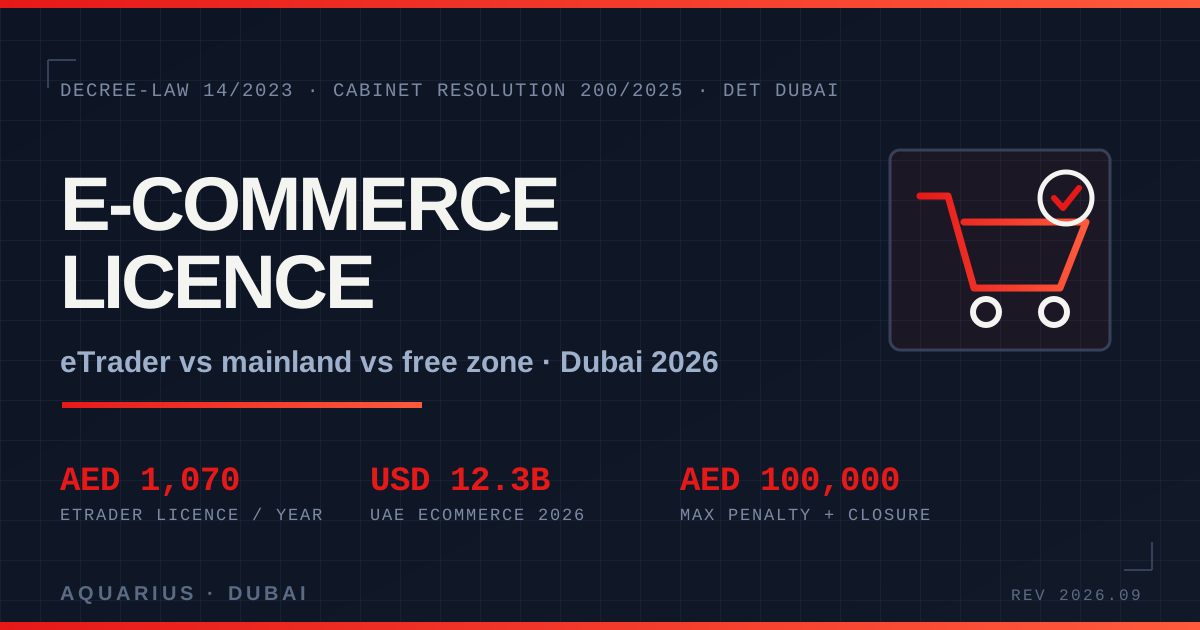
Short answer: there are three legal ways to sell online from Dubai in 2026. The DET eTrader licence costs AED 1,070 a year plus AED 300 Dubai Chamber membership and is issued electronically in 24-48 hours. A full mainland e-commerce licence runs AED 12,000-25,000 in year one including trade licence, an Ejari-backed address, establishment card and one visa. A free zone package advertises from AED 12,500-12,900 but lands at AED 25,000-31,500 once cards, visas and insurance are added. The cheapest option is not automatically the one you qualify for - and since 28 November 2025 selling without the right licence is a graded offence topping out at AED 100,000 and permanent closure.
Key takeaways
- eTrader is the cheapest legal route at AED 1,070 + AED 300 a year - no office, no minimum capital, no establishment card. It also grants no visa and no shop.
- The eligibility trap nobody mentions: selling or importing physical commercial products under eTrader is restricted to UAE and GCC nationals. Expat residents are generally limited to professional and service activities.
- Cabinet Resolution No. 200 of 2025 came into force on 28 November 2025, giving Federal Decree-Law No. 14 of 2023 real teeth: a tiered regime from warning to fines up to AED 100,000 and permanent closure for repeat offenders.
- Your licence decides whether you can take money. Telr, PayTabs, Network International, Tap, Checkout.com and Stripe UAE all require an active UAE trade licence at merchant onboarding.
- Tax is smaller than the rumours. VAT registration is mandatory only above AED 375,000 turnover, and Small Business Relief keeps corporate tax at zero for revenue under AED 3 million - now extended to tax periods ending on or before 31 December 2029.
Why the licence question got serious in 2026
The UAE e-commerce market reached USD 12.3 billion in 2026 and is forecast to hit USD 21 billion by 2031 at roughly an 11.29% CAGR. That market is served by more than 45,000 active e-commerce stores and 11 million-plus online shoppers. Dubai sits at the centre of it: the emirate's wholesale and retail trade sector produced AED 50.9 billion in real gross value added in Q1 2026 alone, about 22% of Dubai's GDP.
The behaviour behind those numbers is aggressively mobile and aggressively digital. 78.67% of orders now come from mobile. Around 80% of payments are digital and cash-on-delivery volumes have fallen 37%. More than 40% of UAE consumers use BNPL - Tabby or Tamara - and quick commerce now delivers across Dubai in 12-15 minutes.
Here is the part most founders miss. A market this large and this formalised attracts regulation, and the regulation arrived. Federal Decree-Law No. 14 of 2023 on Trading by Modern Technological Means took effect in September 2023, replacing the 2006 e-commerce law, and it explicitly covers trade through websites, e-platforms, social media and mobile apps. An Instagram storefront is not a grey area under that law. It is a regulated digital shop.
Then came enforcement. Cabinet Resolution No. 200 of 2025 entered into force on 28 November 2025 and codified the violations-and-penalties schedule behind the decree-law: a graded escalation running from warning through fines up to AED 100,000, with permanent closure available against repeat offenders. Before that date, "I will get licensed once sales pick up" was a cash-flow decision. After it, it is a bet against a published penalty table.
The three routes, compared in AED
Every legal online seller in Dubai sits in one of three buckets. The differences that actually matter are eligibility, visas, and whether marketplaces and payment gateways will accept you.
| Route | Year-one cost (AED) | Who it suits | Hard limits |
|---|---|---|---|
| DET eTrader | 1,070 licence + 300 Dubai Chamber = 1,370 | Solo founders, home-based sellers, service providers testing demand | No visa, no shop, no establishment card. Physical-goods trading restricted to UAE/GCC nationals. Trade name must match the individual's own name |
| Mainland (DET) e-commerce | 12,000-25,000 all-in year one | Sellers holding local stock, delivering UAE-wide, working with local couriers and marketplaces | Needs an Ejari-registered address; renewal is blocked without active Ejari. Multi-activity commercial licences reach 38,000+ |
| Free zone e-commerce | Headline from 12,500-12,900; realistic 25,000-31,500 | Cross-border sellers, dropshippers, 100% foreign-owned structures wanting a visa quota | Selling into the UAE mainland usually needs a distributor or dual-licence arrangement. Licence-only fees start near 5,750 before office, cards and insurance |
Mainland cost is not one number, it is a stack: licence fee AED 5,500-12,000, registration AED 1,000-3,000, address or flexi-desk AED 2,000-15,000, one visa AED 3,000-7,000, bank account setup AED 1,500-5,000. A single-activity professional licence starts around AED 12,500; a four-activity commercial licence passes AED 38,000. On the free zone side, Meydan from about AED 12,500 and IFZA from about AED 12,900 are the usual entry quotes - but a typical AED 12,900 IFZA setup lands at AED 25,000-31,500 in true first-year cost once office, establishment card, visas and insurance are counted. Ask any consultant for the all-in figure, in writing, before you pay a deposit.
The eTrader eligibility trap
This is the most common expensive mistake in Dubai e-commerce. eTrader requires you to be 21 or older, resident in Dubai, holding a valid Emirates ID. Emiratis and GCC nationals can take both commercial and professional activities under it, which means they can sell physical products. Expat residents are in most cases limited to professional and service activities: consulting, photography, design, coaching, makeup artistry. Selling and importing physical commercial products under this category is restricted to UAE and GCC nationals, so an expat who wants to ship goods needs a full e-commerce company instead.
Founders discover this in one of two ways. The cheap way is reading it now. The expensive way is paying AED 1,370, building a store, then getting rejected at marketplace or gateway onboarding because the activity on the licence does not match what the shop actually sells.
What the law now requires on the storefront itself
The digital commerce law is not only about holding a licence. It sets standards for the shop, and Resolution 200 made those standards enforceable. Build these into the site, not into a policy PDF nobody reads:
- Accurate, truthful product information - descriptions that match what ships.
- Transparent pricing, including payment terms and all associated fees. Surprise charges at checkout are now a compliance issue, not only a conversion one.
- Clear terms and conditions of purchase, available before the customer commits.
- Delivery fees and timelines stated in the digital contract - not "3-5 days" in a chat reply.
- Secure identity verification, accurate invoicing and a working complaint-handling mechanism.
Invoicing deserves a flag. Once you cross the VAT threshold you must issue compliant tax invoices showing your TRN - and the UAE's phased e-invoicing mandate lands in 2027, which makes it an architecture decision for your store today rather than a bookkeeping task later. We covered the detail in VAT-compliant e-commerce invoicing in the UAE.
Your licence is also your payment-gateway application
A licence you cannot bank is a hobby. Every major UAE gateway requires an active UAE trade licence at merchant onboarding - Telr, PayTabs, Network International, Tap Payments, Checkout.com and Stripe UAE included. Stripe additionally asks for the memorandum of association and proof of an active bank account. Rejections most often trace to a mismatch between the licensed activity and what the website sells, or to a store missing required refund and terms pages.
| Gateway | Monthly fee (AED) | UAE cards | International cards |
|---|---|---|---|
| Telr | 99-349 | 2.49% + AED 0.50 | 3.49% + AED 0.50 |
| Network International | Negotiated minimum | 2.4-2.9% + AED 1 | 3.4-3.9% + AED 1 |
| Checkout.com | None (standard) | 2.9% + fixed | 2.9% + fixed |
| Stripe UAE | None | 2.9% + AED 1 | 3.9% + AED 1 |
| PayTabs | 0-183 | 2.85% + AED 0.27 | 3.5% + AED 1 |
| Mamo | 0 or 399 | 2.9% + AED 1 | 3.2% + AED 0.80 |
| Tap Payments | None | 2.75% | 3.25% + FX |
Marketplaces apply their own gate. On Amazon.ae, individual sellers moving fewer than about 40 units a month can start without a trade licence, but a Professional Seller account requires a valid UAE trade licence or commercial registration - and the cheapest qualifying route for a UAE resident is the eTrader licence at AED 1,070. If marketplaces are your main channel, read selling on noon and Amazon versus your own store first, because the commission maths changes the licence maths.
Tax: smaller than the rumours
Most first-time Dubai sellers overestimate this badly. VAT registration is mandatory only once taxable turnover passes AED 375,000 in a rolling twelve months, with voluntary registration available from AED 187,500. Corporate tax is 0% on the first AED 375,000 of taxable profit and 9% above it - profit, not revenue. A store turning over AED 2 million on AED 200,000 of profit owes nothing, because the profit never reaches the threshold.
Better still, Small Business Relief lets a business with total revenue at or under AED 3 million in the tax period elect to be treated as having no taxable income - it still files, but pays nothing. Ministerial Decision No. 131 extended that window to tax periods ending on or before 31 December 2029, up from the previous cut-off of 31 December 2026. One caution: it works as a one-strike rule. Exceed AED 3 million in any period and eligibility is lost permanently, even if revenue later falls back.
So the compliance cost of going legal early is a licence, a filing and a bookkeeping habit. The compliance cost of going legal late is a penalty schedule.
The real year-one budget: licence plus the store
A licence does not sell anything. Budget the whole launch:
| Line item | Realistic 2026 Dubai range (AED) |
|---|---|
| eTrader licence + Dubai Chamber | 1,370 per year |
| Mainland e-commerce licence, all-in year one | 12,000-25,000 |
| Free zone e-commerce, true year one | 25,000-31,500 |
| Domain + hosting | 500-3,000 per year |
| Store build | From 500 for a starter site; 2,500+ for a business store |
| Payment gateway | 0-399 monthly plus 2.4-2.9% MDR on UAE cards |
| Bank account setup | 1,500-5,000 |
Read that against the downside. A repeat violation under the post-28-November regime reaches AED 100,000 and permanent closure - roughly 73 times the annual cost of an eTrader licence, and it arrives after you have already spent months building traffic, reviews and a customer list you would lose along with the shop.
The cost of inaction, in one line: in a market worth USD 12.3 billion and compounding at 11.29% a year, the expensive mistake is never the licence fee - it is being shut out of the market you just finished building for.
How Aquarius does it
We do not sell licences. We build the store that has to survive on the other side of one, and we tell you which route your activity actually qualifies for before you pay a consultant. In practice: we map your products to the licence activity your gateway will accept, build the storefront with the Resolution 200 disclosures in place (pricing transparency, terms, delivery timelines, refund policy, complaint route), wire the gateway and BNPL options UAE shoppers expect, and structure invoicing so the 2027 e-invoicing mandate becomes a configuration change rather than a rebuild.
Our Starter Site begins at AED 500 and the Business Site at AED 2,500 before VAT, with full handover of domain, hosting and code in your own name. See our pricing and what each service includes. Already licensed but stuck at gateway approval? That is usually a two-day fix, and we quote it as a fixed fee.
Related reading: e-commerce website development in Dubai and the payment-gateway stack, what payment gateway integration really costs, and free zone versus mainland for a software company licence.
FAQ
How much does an e-commerce licence cost in Dubai in 2026?
The DET eTrader licence is AED 1,070 a year plus AED 300 Dubai Chamber membership, issued electronically in 24-48 hours. A full mainland e-commerce licence costs AED 12,000-25,000 in year one including the trade licence, an Ejari-backed address, establishment card and one visa. Free zone packages advertise from AED 12,500-12,900 but realistically total AED 25,000-31,500 in the first year.
Can an expat sell physical products on a Dubai eTrader licence?
Generally no. Selling and importing physical commercial products under the eTrader category is restricted to UAE and GCC nationals. Expat residents are in most cases limited to professional and service activities, and need a full mainland or free zone e-commerce company to trade goods.
Do I need a licence to sell on Instagram or WhatsApp in Dubai?
Yes. Federal Decree-Law No. 14 of 2023 covers trade conducted through websites, e-platforms, social media and mobile applications. Since Cabinet Resolution No. 200 of 2025 came into force on 28 November 2025, unlicensed digital trading sits inside a graded penalty regime reaching AED 100,000 and permanent closure for repeat offenders.
Does an eTrader licence come with a residence visa?
No. eTrader grants no visa, no establishment card and no right to open a shop or physical premises. If you need to sponsor yourself or staff, you need a mainland or free zone licence with a visa quota.
Will a payment gateway approve me on an eTrader licence?
Often yes for service-based activities, but approval turns on the licensed activity matching what the site sells. Telr, PayTabs, Network International, Tap, Checkout.com and Stripe UAE all require an active UAE trade licence at onboarding; Stripe also asks for the MOA and an active bank account. Mismatched activities and missing refund or terms pages are the two most common rejection reasons.
Do I have to register for VAT as a new Dubai online store?
Only once taxable turnover passes AED 375,000 in a rolling twelve months - voluntary registration is possible from AED 187,500. On corporate tax, Small Business Relief keeps the bill at zero for revenue at or under AED 3 million, now available for tax periods ending on or before 31 December 2029, though you still file a return.
Mainland or free zone for a Dubai online store?
Mainland if you hold local stock, deliver across the UAE and want frictionless work with local couriers and marketplaces. Free zone if you sell mainly cross-border or dropship, want 100% foreign ownership and the leanest structure - accepting that selling into the mainland typically needs a distributor or a dual-licence arrangement.
Bottom line: pick the licence your activity qualifies for, not the one with the smallest number. eTrader at AED 1,370 a year is the cheapest legal door in Dubai, and for an expat shipping physical goods it is also the wrong one. Get the route right the first time and the entire compliance layer costs less than one month of ad spend. Talk to Aquarius for a free activity-to-gateway check on your product list, or a fixed AED quote to build the store that passes.