
The .ae Favicon Audit: 1 in 3 UAE Homepages Ships a Site Icon Google Can Barely Render
We read the favicon bytes of 512 live .ae homepages. 33.1% ship an icon under 48px, 10.9% are not square, and 16 give Google nothing at all. What the 2027 rules actually say.
- PUBLISHED
- 27 NOV 2026
- READ TIME
- 10 MIN
- AUTHOR
- AQUARIUS · DUBAI
- UNIT
- REV 2026.09
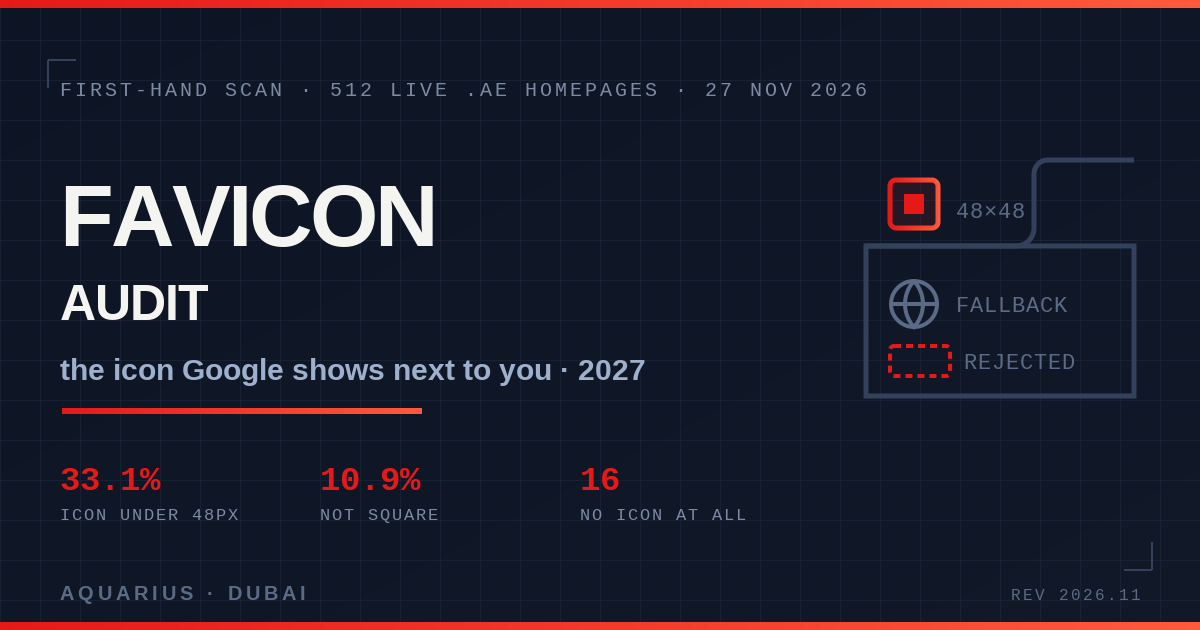
We fetched every live homepage on the Tranco top-ranked .ae list and parsed the favicon each one hands to Google. Of 512 clean, real UAE sites, 33.1% ship a site icon smaller than the 48px Google recommends, 10.9% ship one that is not square at all — which Google treats as a hard failure — and 16 sites have no fetchable icon anywhere, so Google draws a grey globe next to them instead.
That grey globe sits beside your brand on every mobile search result, inside every AI Overview citation row, and in every browser tab. It is the cheapest brand asset on the internet to fix, and the UAE market is quietly failing it.
Why a 48-pixel square matters more in 2027 than it did in 2023
Three numbers set the stakes. Google handles 95.42% of all UAE search traffic (StatCounter, October 2026) — there is no second search engine worth optimising for here. 67.8% of UAE search sessions happen on mobile, and mobile is exactly where Google renders your favicon at the head of every single organic result. And the UAE now runs at 99.0% internet penetration with 11.5 million users (DataReportal, Digital 2027: UAE, published 4 November 2026), so effectively your entire addressable market meets your brand through a search result before it meets your website.
The favicon used to be a browser-tab nicety. It is now the only piece of your visual identity that survives into an AI answer. When Google's AI Mode shows a citation row under a generated response, there is no blue link, no meta description and often no visible URL — just a row of favicons. Google began testing that citation-count-plus-favicon row in June 2026. Hover cards over AI Overview links show the site name and the favicon. If yours is a globe, your brand is anonymous in the surface that is eating click-through.
What Google actually requires — and the rule most Dubai agencies still quote wrongly
This is where almost every UAE agency checklist is out of date. Google's documentation used to say: “Your favicon must be a multiple of 48px square, for example: 48x48px, 96x96px, 144x144px and so on.” Google deleted that sentence around 25 October 2024. The live requirement today reads:
“Your favicon must be a square (1:1 aspect ratio) that's at least 8x8px. While the minimum size requirement is 8x8px, we recommend using a favicon that's larger than 48x48px so that it looks good on various surfaces.” — Google Search Central, Define a favicon to show in search results
So the hard, disqualifying rule is square. The 48px figure is a quality recommendation, not a gate — and “multiple of 48” is now purely historical. The other live constraints matter just as much:
- Supported formats: BMP, GIF, ICO, PNG, JPEG, PPM and TIFF. SVG and WebP are not on that list.
- Supported
relvalues:icon,apple-touch-icon,apple-touch-icon-precomposed,shortcut icon. Nothing else counts. - Crawlability: Googlebot must be able to crawl your home page and follow any redirect to wherever the favicon is declared, and Googlebot-Image must be able to crawl the icon file itself. Neither may be blocked by robots.txt “or by other means” — which includes a WAF returning 403.
- URL stability: “The favicon URL must be stable (don't change the URL frequently).”
- Turnaround: a fix takes “anywhere from several days to several weeks” to appear. John Mueller confirmed in January 2026 that broad core updates are not the reason a favicon disappears — it is always a technical cause.
The scan: 512 live .ae homepages, measured not guessed
We probed 787 hosts on 27 November 2026, requesting each homepage with a real desktop Chrome user-agent over HTTPS, parsing every <link> element with an icon-bearing rel, resolving each declared URL, fetching it, and reading the actual pixel dimensions out of the file bytes — PNG IHDR chunks, ICO directory entries, JPEG SOF markers, GIF logical screen descriptors, WebP VP8 headers and SVG viewBox values. We also probed the root /favicon.ico fallback on every host.
573 homepages answered HTTP 200 with HTML. We then removed 61 of them: WAF challenge pages served as 200, parked domains, JavaScript redirect stubs, thin shells, and three hosts that bounce to a bot-management wall. That leaves a clean set of 512 genuinely live UAE homepages. Every host named below was re-verified on both the apex and www hostname before we printed it.
| Favicon signal | Sites | Share of 512 | Google verdict |
|---|---|---|---|
Declares at least one rel="icon" | 480 | 93.8% | Baseline |
Declares apple-touch-icon | 222 | 43.4% | Supported, optional |
Declares zero icon <link> at all | 30 | 5.9% | Relies on root fallback |
| Icon resolves and is a readable image | 495 | 96.7% | Pass |
| No usable icon anywhere | 16 | 3.1% | Grey globe |
| Not square (1:1) | 54 | 10.9% | Fails the hard rule |
| Largest edge under 48px | 164 | 33.1% | Below recommendation |
| Exactly 32×32px | 111 | 22.4% | Below recommendation |
| Exactly 16×16px | 41 | 8.3% | Legacy only |
| 192px or larger | 197 | 39.8% | Comfortable pass |
/favicon.ico returns 200 but is not an image | 41 | 8.0% | Silent failure |
| At least one declared icon URL returns non-200 | 22 | 4.3% | Broken declaration |
| Ships a dark-mode icon variant | 1 | 0.2% | Nice-to-have |
Format split across the 495 resolvable icons: PNG 326, ICO 173, SVG 41, JPEG 24, WebP 10, GIF 1. Note the 41 SVG and 10 WebP icons — 51 UAE sites are shipping a primary site icon in a format Google's own supported-formats list does not include. Most of them get away with it because a legacy /favicon.ico happens to exist underneath. The ones that do not get away with it have no idea.
The four ways .ae homepages actually break their favicon
1. The 200-OK file that is not an image (41 sites, 8.0%). This is the most insidious category, because every monitoring tool you own reports it green. 18 of these serve a zero-byte file with a 200 status and an image/x-icon content type — a1properties.ae and laperlaspa.ae among them. Another 22 serve the entire HTML homepage in response to /favicon.ico: request adnoc.ae/favicon.ico and you receive 77,628 bytes beginning <!DOCTYPE; sephora.ae returns 152,423 bytes of homepage; atlp.ae returns 361,594. These are catch-all rewrite rules in a single-page-app router, and they turn a missing file into an invisible one.
2. The declaration that points nowhere (22 sites, 4.3%). alwaslsc.ae declares <link rel="shortcut icon" type="image/x-icon" href="media/favicon.png"> — a relative path, mistyped MIME type, and a 404 on fetch. alhilalbank.ae declares four icons, and all four return 403 to a standard desktop Chrome user-agent: the bank's edge security blocks its own brand mark. Google's documentation is explicit that the icon must not be blocked “by other means”, and a WAF 403 is exactly that.
3. The deliberate blank. Two government examples are instructive. dmt.gov.ae — Abu Dhabi's Department of Municipalities and Transport — ships <link href="" rel="shortcut icon" />, an empty href, and its /favicon.ico returns a 246-byte HTML error page with a 200 status. moi.gov.ae declares href="data:;base64,iVBORw0KGgo=": that payload is just the eight-byte PNG signature with no image data, a known trick for suppressing the browser's favicon request. Google cannot fetch a data: URI. The Ministry of Interior is saved only because a real 1,150-byte ICO still sits at the root — a fallback nobody appears to be relying on deliberately.
4. The wrong shape and the wrong size. 54 sites fail the one rule that is actually a gate. The dimensions are specific and, once you read them out of the file bytes, slightly comic: bookends.ae at 32×13, fujairahport.ae at 14×20, emiratesislamic.ae at 16×15, dubaipolice.gov.ae at 17×16, ajmanpolice.gov.ae at 29×32, unioncoop.ae at 32×31, visitabudhabi.ae at 32×33, bigticket.ae at 71×68, clean.ae at 559×142, albayan.ae at 504×215. Several are off by a single pixel — a cropping accident that nobody ever measured. And rta.ae/favicon.ico returns 568 bytes whose magic number is 42 4D: the ASCII letters BM. It is a 16×16 Windows bitmap being served as image/x-icon. Google supports BMP, so it technically passes — at 16 pixels.
The public sector is the worst offender
Isolate the 47 .gov.ae hosts in the clean set and the picture gets worse, not better. Four declare no icon <link> at all. Of the 45 with readable dimensions, 24 — 53.3% — ship an icon under 48px, against 33.1% for the sample as a whole. Dubai and Abu Dhabi government portals are, on average, half the resolution of the commercial .ae web.
And the opposite failure: icons measured in hundreds of kilobytes
62 of the 495 icons exceed 50KB and 31 exceed 100KB. shoptheworld.ae ships a 492,422-byte favicon. dubaidolphinarium.ae ships 445,828 bytes. eand.ae, etisalat.ae and michaelpage.ae each ship the identical 370,070-byte file. A favicon renders at 16 to 48 CSS pixels; half a megabyte of it is a render-blocking request in the critical path for nothing. Worse, 245 of 838 icon responses (29.2%) carry no caching headers or explicitly disable caching, so that payload is re-fetched rather than reused.
How to fix it properly — and what it costs in Dubai
A correct 2027 favicon implementation is one master square file and five lines of HTML. There is no reason for any of the failures above to exist.
- Start from one square master, 512×512 or 1024×1024, with your mark centred and visually padded so it survives being scaled to 16px.
- Ship a PNG at 192×192 or larger as the primary
rel="icon". PNG is on Google's supported list and 192px clears the recommendation with room to spare. If you also want an SVG for crisp browser tabs, declare it in addition, never instead. - Keep a real multi-size
/favicon.icoat the domain root as the fallback — and verify it is actually an ICO, not a zero-byte file and not your homepage. - Add
apple-touch-iconat 180×180 with an absolute path. 43.4% of the sample already does this; relative paths on a redirecting homepage are the usual cause of failure. - Verify crawlability for Googlebot-Image specifically. Fetch the icon URL with a bare client and no cookies. If your WAF or bot manager returns 403 or a challenge, Google sees the same thing you do.
- Set a long
Cache-Control, keep the URL stable forever, and version by filename only when the mark genuinely changes. - Measure the bytes, not the
sizesattribute. Thesizes="32x32"in your HTML is a claim. We found sites whose declared size and real pixel dimensions disagreed. Read the file header.
In Dubai, a complete icon system — master mark, every required raster size, root ICO, Apple and Android variants, dark-mode variant, and the crawlability verification — runs AED 1,500–4,000 as a standalone piece of work. Bundled into a brand or site build it is effectively a line item, typically AED 3,000–8,000 when it includes the full audit of what is currently being served and a fix to the server rules causing the soft failures. Set that against the cost of the alternative: 3.1% of live UAE homepages are currently represented in Google by a generic globe, on the device where 67.8% of UAE searches happen, in a market where Google is 95.42% of search. For a UAE e-commerce sector worth AED 42.2 billion in 2025 and 15.7% of all UAE retail, heading for AED 67.2 billion by 2030, an anonymous search result is not a cosmetic problem.
How Aquarius handles this
Every site we build ships the full icon set from a single square master, with the root /favicon.ico fallback written as a genuine multi-size ICO and the SPA catch-all route explicitly excluded so it can never answer with HTML. We fetch each icon URL post-deploy with a bare client, read the pixel dimensions back out of the file bytes, and assert square. It is in the deploy check, not a launch-day memory. If we build it and Google still shows a globe, we fix it at no charge — because if it is broken, it is our server rule that broke it.
If you already have a site, the fastest useful thing you can do is open your own /favicon.ico in a private window and look at the response size. Zero bytes or a page of HTML means you have been shipping a grey globe for years. Our technical SEO and web engineering services start with exactly that class of silent defect, and transparent AED pricing is published up front. Tell us your domain and we will run the byte-level check on it.
Related scans from this series
This is part of our ongoing first-hand measurement of the UAE web. See also our Open Graph and WhatsApp preview scan of .ae homepages — the other brand asset that fails silently — and the web app manifest and installability scan, which covers the Android icon path most of these sites also get wrong.
FAQ
Does Google still require favicons to be a multiple of 48px?
No. Google removed that wording from its documentation around 25 October 2024. The current requirement is a square 1:1 aspect ratio at a minimum of 8×8px, with anything larger than 48×48px recommended. Square is the hard rule; 48px is guidance. In our scan 10.9% of .ae homepages fail the hard rule and 33.1% fall below the guidance.
Can I use an SVG favicon for Google Search?
Not as your only icon. Google's supported formats are BMP, GIF, ICO, PNG, JPEG, PPM and TIFF — SVG is not on that list, and neither is WebP. 41 sites in our sample ship an SVG as the primary icon and 10 ship WebP. Declare an SVG alongside a PNG or ICO if you want crisp browser tabs, never instead of one.
Why does Google show a grey globe next to my site?
In order of likelihood: the icon file 404s, your /favicon.ico returns a 200 that is not actually an image, the icon is not square, a WAF or bot manager returns 403 to Googlebot-Image, the declaration uses an unsupported rel value or a data: URI, or the homepage redirects and the icon is only declared on the pre-redirect URL. John Mueller confirmed in January 2026 that core algorithm updates are never the cause.
How long does a favicon fix take to appear in Google?
Google states it can take “anywhere from several days to several weeks” after the home page is recrawled. Keep the URL stable while you wait — changing the icon URL repeatedly resets the clock.
Do favicons matter for AI search and AI Overviews?
More than they did for classic blue links. Google began testing a citation row under AI Mode answers in June 2026 that shows a source count alongside each cited site's favicon, and AI Overview hover cards show the site name and favicon. In an AI answer there is no meta description and often no visible URL, so the icon is frequently the only brand signal travelling with your citation.
How did you measure this?
Scan run 27 November 2026 against the Tranco top-ranked .ae host list (787 hosts). Each homepage was requested over HTTPS with a desktop Chrome user-agent; every <link> carrying an icon-bearing rel was parsed, resolved and fetched, and pixel dimensions were read directly from the file bytes (PNG IHDR, ICO directory, JPEG SOF, GIF screen descriptor, WebP VP8, SVG viewBox). The root /favicon.ico was probed separately on every host. 573 homepages returned HTTP 200 with HTML; 61 were excluded as WAF challenge pages served with a 200 status, parked domains, JavaScript redirect stubs, thin shells or dead hosts, leaving a clean denominator of 512. Every named host was re-verified on both apex and www before publication.