
We Checked the Web App Manifest on 787 .ae Homepages: Only 24 Are Actually Installable
We probed 787 .ae homepages on 25 November 2026: 86 of 567 link a web app manifest, but only 24 pass Chrome install criteria once every icon is fetched and measured. Zero ship screenshots.
- PUBLISHED
- 25 NOV 2026
- READ TIME
- 12 MIN
- AUTHOR
- AQUARIUS · DUBAI
- UNIT
- REV 2026.09
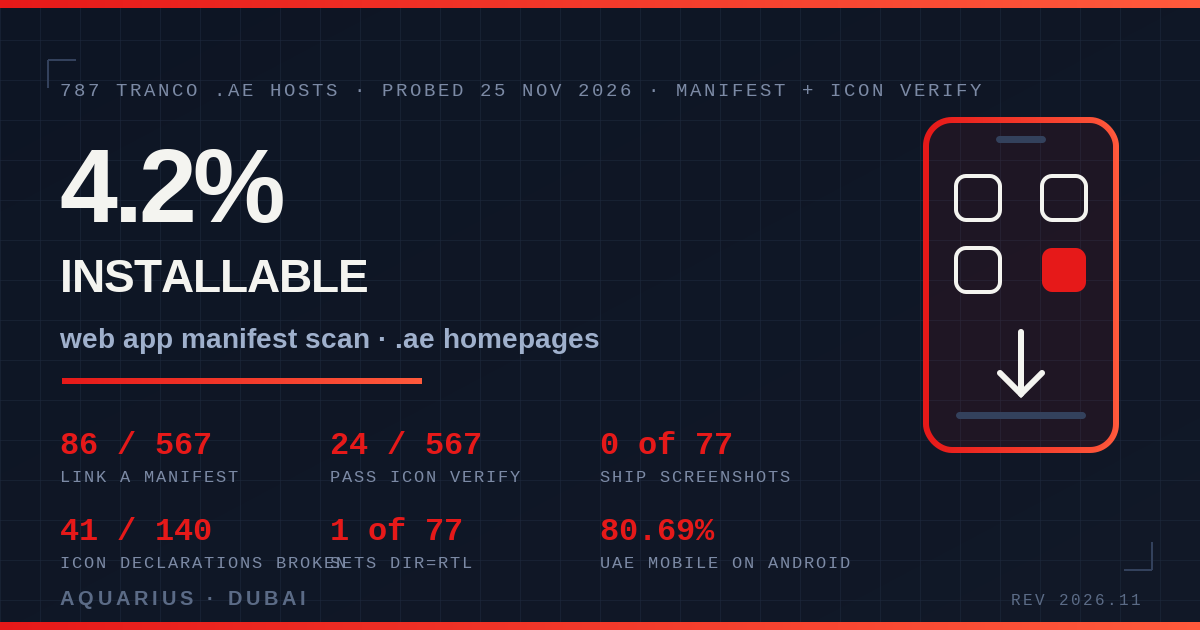
Short answer: we read the HTML of 787 of the most-visited .ae domains on 25 November 2026, pulled every <link rel="manifest"> we found, parsed the JSON, and then fetched every icon it declared. 86 of the 567 reachable homepages link a web app manifest — roughly 1.7× the global rate — but once the icons are verified to actually exist at the size they claim, only 24 sites (4.2%) meet the bar Chrome documents for an install prompt. Shipping a manifest and being installable are two different things, and most of the UAE web is in the gap between them.
The stakes: 67.8% of UAE traffic is mobile, and 80.69% of it is Android
StatCounter puts the UAE at 67.8% mobile, 31.37% desktop and 0.84% tablet for October 2026. Within that mobile slice, Android holds 80.69% against iOS at 19.29%. That split matters more than it looks, because Android/Chrome is the platform that actually offers to add your site to the home screen — and Chrome’s share of all UAE browsing is 76.98%. Four out of five UAE phones can show your customer an install prompt, if you give Chrome something valid to work with.
The commercial frame is just as blunt. UAE e-commerce was worth AED 42.2 billion in 2025 and is projected to reach AED 67.2 billion by 2030, served to roughly 11.3 million internet users at near-99% penetration. An installed web app is a permanent icon on a device that already does most of the country’s shopping — a re-entry point that costs you nothing per acquisition and no app-store cut.
Globally, the Web Almanac 2025 PWA chapter measures a manifest on about 9% of sites. The UAE beats it. What the UAE does not beat is correctness.
What we measured, and how
We took 787 .ae hostnames from the Tranco popularity list, requested each homepage once over HTTPS with a mobile Chrome user agent on 25 November 2026, and followed redirects. 679 hosts answered. 567 returned usable 2xx HTML — that is the denominator for every percentage below. Of the 112 that answered with a 4xx or 5xx, 102 were HTTP 403 bot blocks; none of those 112 exposed a manifest link, so treat the figures here as a floor, not a ceiling. The remaining non-answers were transport failures: 46 connection errors, 40 connect timeouts, 12 read timeouts, 10 TLS errors.
For every homepage we extracted the <link rel="manifest"> href, resolved it against the final URL, fetched it, recorded the HTTP status and content type, parsed the JSON, and read the fields Chrome’s install criteria actually depend on. Then — and this is the step almost nobody runs — we fetched every declared icon of 192px or larger and read its real pixel dimensions out of the PNG, JPEG or WebP header to confirm it exists and matches the declaration.
The findings
| Finding (787 .ae hosts, 25 Nov 2026) | Count | Share |
|---|---|---|
| Answered the request | 679 | 86.3% of 787 |
| Served usable 2xx HTML | 567 | 72.0% of 787 |
| Link a web app manifest | 86 | 15.2% of 567 |
| Manifest URL broken (404, 503 or HTML served instead) | 9 | 10.5% of 86 |
| Manifest parsed as valid JSON | 77 | 89.5% of 86 |
| Declares a 192×192 icon | 71 | 92.2% of 77 |
| Declares a 512×512 icon | 49 | 63.6% of 77 |
Declares start_url | 48 | 62.3% of 77 |
Has a usable name or short_name | 66 | 85.7% of 77 |
Ships a maskable icon | 15 | 19.5% of 77 |
Declares scope | 11 | 14.3% of 77 |
Sets lang | 11 | 14.3% of 77 |
Sets dir | 6 | 7.8% of 77 |
Ships screenshots (richer install UI) | 0 | 0% of 77 |
Ships shortcuts | 0 | 0% of 77 |
Ships display_override | 0 | 0% of 77 |
| Meet Chrome’s documented bar on paper | 30 | 5.3% of 567 |
| Still pass after every icon is fetched and measured | 24 | 4.2% of 567 |
Chrome’s criteria are not a matter of opinion — web.dev lists them: a manifest with a name or short_name, icons including both a 192px and a 512px entry, a start_url, a display value of fullscreen, standalone, minimal-ui or window-controls-overlay, prefer_related_applications absent or false, and HTTPS. Thirty of the 77 parsed manifests clear that list as written. Six of those thirty then fail when you check the files.
Four ways .ae manifests break
1. The missing start_url (29 manifests). The single most common disqualifier. It is one line of JSON — "start_url": "/" — and its absence alone kills the prompt on sites including supermeal.ae, propsearch.ae, yalah.ae and mamasandpapas.ae.
2. No 512px icon (27 manifests). Chrome needs the big one for the splash screen and the install dialog. Globally the Almanac finds 512×512 on about 75% of manifests; on .ae it is 63.6%. ounass.ae, hsbc.ae, 24.ae and ncm.gov.ae each fail on this requirement and nothing else.
3. The empty-string name (10 manifests). This is the most avoidable failure we found. Ten manifests declare the name key and ship "" — wam.ae, nike.ae, underarmour.ae, bloomingdales.ae, rdc.gov.ae, dubaifuture.ae, everhomes.ae, homebook.ae, igold.ae and apkcafe.ae. A build pipeline interpolated a variable that was never set, the JSON stayed syntactically valid, and the install prompt silently died. Only one site, vara.ae, omits the key altogether.
4. Icons that lie (24 of 77 hosts, 31%). We fetched 140 icon declarations of 192px or larger. 41 of them — across 24 hosts — are broken. Sixteen hosts declare large icons whose URLs return 404. Eight declare a size the file does not have: parkin.ae claims 512×512 and serves the 192×192 asset, riah.ae declares 192, 384 and 512 and serves a 134×134 image for all three, apkcafe.ae declares 192 and serves 32×32, dubailand.gov.ae declares 512 and serves 270×270, decathlon.ae declares both 192 and 512 and serves one 500×500 file for each. Lighthouse’s installability audit reads the declaration. Chrome reads the file. That is the whole 5.3%-to-4.2% drop.
Not one .ae site qualifies for Chrome’s richer install dialog
Chrome has a second, better install experience: an app-store-style dialog with a description and screenshots instead of a one-line banner. Its requirements are documented and modest — a description of up to 300 characters, and at least one entry in screenshots (up to 8 on desktop, 5 on Android; PNG or JPEG only; 320–3840px per side; identical aspect ratio within a form_factor, and since Chrome 109 only form_factor: "wide" shows on desktop).
Zero of 77 .ae manifests ship a single screenshot. Zero ship shortcuts. Zero ship display_override. Every UAE site that does install, installs behind the plainest prompt Chrome offers. For a retailer competing with a native app listing that has five screenshots and a star rating, that is a conversion gap sitting in a JSON file.
The rest of the field confirms the pattern. Only 17 of 77 manifests are served with the correct application/manifest+json content type (41 send application/json, 11 application/octet-stream, 5 text/plain, 3 send nothing). Only 9 of 567 homepages (1.6%) call serviceWorker.register in their homepage HTML — the Almanac puts service workers at roughly 20% of sites globally. apple-touch-icon appears on 239 homepages (42.2%), which tells you the real UAE habit: teams ship the iOS bookmark icon and skip the manifest that would make the site installable for the 80.69% of UAE phones running Android.
The Arabic gap, again
Of 77 manifests, two set lang to Arabic and exactly one sets dir: "rtl" — akhbrna.ae. An installed app inherits its manifest’s direction for the app title and splash screen, so an Arabic-language UAE business that omits dir ships a left-to-right shell around right-to-left content. It is the same omission we measured at the page level in our Arabic RTL readiness scan of .ae homepages: bilingual intent, monolingual plumbing.
Government sites are the weakest segment
We isolated the 59 reachable .gov.ae homepages. Seven link a manifest (11.9%). Three of those seven URLs are broken — dha.gov.ae and shjmun.gov.ae among them. Four parse. One, dubailand.gov.ae, clears Chrome’s criteria on paper. Zero survive icon verification, because dubailand.gov.ae’s declared 512×512 icon is a 270×270 file. Not one UAE government homepage in our sample is installable as of 25 November 2026.
What it costs to fix in Dubai, in AED
This is the cheapest technical win on the UAE web, and the pricing reflects that. Below is what the work actually involves at Dubai market rates.
| Scope | What you get | Typical Dubai range (AED) |
|---|---|---|
| Manifest audit + fix | Valid manifest, verified 192/512 icons, start_url, scope, correct content type, dir for Arabic | 1,800 – 4,500 |
| Richer install UI pass | description, 3–5 wide + narrow screenshots, maskable icon, shortcuts | 3,500 – 8,000 |
| Offline shell + service worker | Registered worker, cached app shell, offline fallback page | 7,000 – 18,000 |
| Full installable PWA build | All of the above plus install-prompt UX, analytics on install events, QA on Android + iOS | 18,000 – 45,000 |
Compare that to the cost of being slow or uninstallable. Deloitte and Google’s Milliseconds Make Millions study found a 0.1-second mobile speed improvement lifted retail conversion 8.4% and average order value 9.2%. An installed web app skips the browser cold start, serves from a warm cache, and puts you one tap from the home screen — on devices where the UAE already spends 67.8% of its browsing time.
How Aquarius fixes this
We run the same probe we ran for this article against your domain: fetch the manifest, parse it, fetch every icon, measure the real pixels, and hand you a pass/fail against Chrome’s documented criteria rather than a Lighthouse score that trusts your JSON. Then we fix what fails — usually in a single sprint, because the median failure in our dataset is one missing line and one wrong image. We ship the screenshots array nobody in the UAE has bothered with, set dir correctly for Arabic builds, and verify the install prompt on a real Android device, not an emulator.
If the install prompt does not appear on a clean Android Chrome profile after we are done, we keep working at no extra cost. That is the whole risk reversal: the criteria are objective and binary, so either the browser offers to install your site or it does not.
Already weighing whether to build an app at all? Read our breakdown of native app vs PWA for UAE businesses first, and our Core Web Vitals guide for Dubai websites for the speed half of the same problem. Then see our pricing for fixed-scope engagements.
FAQ
Does a web app manifest help SEO in the UAE?
Not directly — a manifest is not a ranking factor. It helps indirectly: installable sites get repeat visits from the home screen, lower bounce from cached loads, and the speed gains that Core Web Vitals do reward. Treat it as a retention and conversion lever, not a ranking one.
Why does Lighthouse say my site is installable when Chrome never offers to install it?
Because Lighthouse reads what your manifest declares and Chrome reads what your server actually returns. In our scan, 41 icon declarations across 24 hosts were either 404s or the wrong pixel dimensions. Always fetch your own icon URLs and check their real size before trusting an audit score.
What is the minimum manifest that makes a UAE site installable?
A name (non-empty), a start_url, display: "standalone", and two icons that genuinely exist at 192×192 and 512×512, served over HTTPS with prefer_related_applications absent or false. That is it — and it is why only 4.2% failing is so striking.
Do I need a service worker for the install prompt?
Chrome no longer requires one for the prompt itself, but without it your installed app has no offline behaviour and no cache strategy — it is a shortcut, not an app. Only 1.6% of the .ae homepages we scanned register one at all.
Should an Arabic-language Dubai site set dir in the manifest?
Yes. dir: "rtl" plus lang: "ar" makes the app title and splash screen render correctly right-to-left. Exactly one site in our sample of 77 does it.
The one-line version
Most Dubai businesses think “we have a manifest” means “our site installs.” We checked 787
.aehomepages: 86 have a manifest, 24 install. The difference is one missing line of JSON and one icon that is not the size it claims to be.
If you want to know which side of that 4.2% your site is on, send us the domain and we will run the probe and send back the pass/fail.
Method: 787 Tranco-ranked .ae hostnames, single HTTPS GET per homepage with a mobile Chrome user agent, redirects followed, probed 25 November 2026. Manifests resolved against the final URL and parsed as JSON; every declared icon of 192px or larger fetched and measured from its image header. 102 hosts returned HTTP 403 bot blocks and are excluded from the 567 denominator, so real adoption may be marginally higher. Global baselines from the Web Almanac 2025 PWA chapter; install criteria and richer-install-UI requirements from web.dev; UAE device and browser shares from StatCounter, October 2026.